Showing posts with label Spirituality. Show all posts

Tuesday, October 3, 2023

The Daily Offices: A Rich Resource of Anglican Spirituality


The Apostle Paul urges us to “pray without ceasing, give thanks in all circumstances; for this is the will of God in Christ Jesus for you” (1 Th 5:16-18).


This is a tall order when we have to feed ourselves and others, work, sleep, provide care, and do the myriad other things that occupy our time.  


The early church compromised; St. Benedict set fixed times of the day and night for prayer for monastic communities, which became known as the canonical hours: small services called matins and lauds (usually counted as a single hour), in the middle of the night; prime, at sunrise; terce, 9 a.m.; sext, noon; none, 3 p.m.; vespers, sunset; and compline, bedtime. 


These fixed hour services became known as the Daily Offices, from the Latin word officium meaning duty, following the idea that Christians had a duty to pray regularly.


During the English Reformation, Thomas Cranmer simplified the daily offices and boiled them down to four services:  Morning Prayer (also called Mattins), Noon Prayer, Evening Prayer, and Compline.  All four of these services can be found in the 1962 Prayer Book.    Thus our tradition of daily prayer is essentially Benedictine.


Cranmer’s idea was that these short and simple services could give clergy and laity alike a structure for regular prayer and scripture reading that would deepen their spiritual lives while allowing them to live and work in their daily lives.


Old time Anglicans will remember Morning and Evening Prayer on Sundays and some who have lived in institutional settings may know the offices as well.  Compline got Fr. Michael through a difficult year at a church boy’s school and he loves it to this day.  


Sadly, most Anglicans today don’t get much chance to say and hear this ancient and rich prayers, which can ground us in our faith and orient our day on God and God’s purpose for us.


However, lately at All Saints we have been to revive this tradition with some success, in that a few people are showing up to join our clergy in the mornings and evenings.


The schedule we are aiming for is as follows;


Morning Prayer:  Tuesday, Thursday, and Friday at 8am

Evening Prayer:   Tuesday, Thursday and Friday at 5pm


However, this schedule may vary slightly from week to week, depending on the availability of our clergy to lead, so please check our parish Facebook page or the bulletin.    


Services will be be adapted from the Book of Common Prayer and are easy to follow.  There will be no Eucharist, hymns, or sermons and each service takes about 20 minutes.   The Elgin Street double doors will be unlocked 5-10 minutes ahead of time.  When clergy are unavailable to lead, lay people are perfectly welcome to say the offices, and Sharon and Michael can provide instruction on that (it’s easy).


If you can’t attend but would like to  try the Daily Offices at home, there is a simple version which you can download from https://anglicancompass/dailyofficebooklet and there is also an app that you can download from the Prayer Book Society at https://prayerbook.ca/common-prayer-app/


We would be delighted to train some of our parishioners to lead these services, so they can be offered with regularity.   There is absolutely no reason why a layperson can not lead morning or evening prayer, it’s easy to do and the clergy can show you how in ten minutes.


Of course, the daily offices are purely optional, so take this merely as an invitation to deepen your prayer life if any of these days, times or methods are convenient.     As is true of most things Anglican, the old rule applies:  all may, some should, none must.  

Monday, September 18, 2023

Ben Crosby on the Benefits of Praying the Daily Offices

Ben Crosby is a young Anglican priest and theologian based in Montreal.   In this short Substack essay, he describes how the part of the Anglican tradition known as The Daily Offices (Morning and Evening Prayer, plus Compline before retiring) benefited his prayer and faith life.     You can find that essay here.

Here’s an excerpt from Ben’s piece:

"Being steeped in Scripture, especially the psalter, organizing my days around time with God, taking time every day for confession, for praise, to hear God’s word, and to petition him for my own needs and those of others – all these have been so vital to me. They have been so important for keeping me anchored through health crises, international moves, struggles in faith, the ordination process, disappointments in ministry, all the changes and chances of this fleeting world. The words of the psalter have sunk into my bones, becoming the words I use to express my deepest aspirations and profoundest distress. In the moments where my heart is full to bursting with gratitude for all that God has given me, the office is there. In the moments I am in despair, with no words to come before God, the office is still there."

Saturday, May 27, 2023

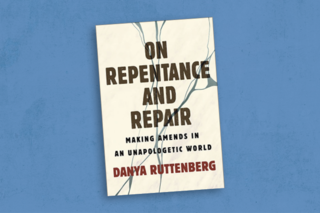
Book Review: Repentance and Repair by Rabbi Danya Ruttenberg


A group of us at All Saints, Collingwood, recently completed a study of this book and I compiled a summary of it for our parish newsletter, passed on in hopes that this post stirs some interest in the book.  Michael+


“In a moral universe, there is work to do whenever harm is inflicted”.  Rabbi Danya Ruttenberg


Through Lent and into the season of Easter, a number of us read a book called On Repentance and Repair: Making Amends In An Unapologetic World.   The author, Danya Ruttenberg, is a young American rabbi and scholar who has thought long and hard about why we as a society have such a hard time truly saying that we are sorry.  For example:


  • Individuals hide behind anonymity to be horrible on social media;
  • Celebrities are caught being abusive and sexist and then complain that they have been cancelled; 
  • Corporations make mealy mouthed statements about their misdeeds, vetted by lawyers and PR departments:

   and

  • Governments struggle to right old wrongs.  


As Ruttenberg carefully and passionately explains it, anyone who has committed harm has work to do to fix it.  She defines harm as “hurt, injury, or damage of some sort, whether mental, emotional, or physical, which may be sustained for a brief amount of time or across generations”.  

The only remedy for harm, she writes, is the hard work of repentance.    Repentance involves the offender recognizing, naming, and owning the harm they’ve done, doing the hard soul work necessary to change their character and behaviour, and making a sincere apology that includes, if necessary, offers of compensation for loss and injury. 


 A true apology, she writes, “is about trying to see the human being in front of you, to connect with them … to make it clear - abundantly, absolutely, profoundly clear - that … their feeling better matters to you”.


As Christians, we found some of the book challenging, as Ruttenberg reports that the Jewish tradition does not place the same emphasis on forgiveness as Jesus did.   Forgiveness, she writes, should never be required of the victim if the offender is not truly penitent, or if the offence is unforgivable.     While nursing a grudge can be harmful, and sometimes forgiveness may be someone saying “I’m going to forget an offence you caused me even if you’ll always be a horrible person”, the decision to forgive is always the victim’s.


Forgiveness is also not required if there is a power imbalance and where forgiveness might simply continue patterns of injustice.  For example, she notes the habit of reporters asking African American families if they forgive the police for unjustified shootings of their loved ones.  Do expectations that families will apologize merely perpetuate cycles of violence and police brutality?


Finally, Canadians may find the book challenging because, even if successive governments have apologized to indigenous communities for longstanding injustices, Ruttenberg challenges the validity of these apologies if these communities still don’t have good drinking water and still languish in poverty.  As she writes, “The [Canadian] government is still committing harm, environmental injustice, colonialist land theft, and more”.   Apologies only matter if there’s change:  “Without transformation, there’s no repentance”.


While most of us found this a hard and challenging read, I think we all felt better for it.   Repentance is part of our vocabulary as Christians, and we can always use a bracing and  honest account what hard work it can be, and how necessary it is.  Thank you, Rabbi Danya, for calling us to the work of being better people.

Tuesday, October 4, 2022

Rabbi Danya Ruttenberg on Repentance


Today on Yom Kipur, I’m grateful that Religion News Service chose this fitting day of atonement to post a short interview with American Rabbi, Danya Ruttenberg.    Rabbi Danya has just published a new book, On Repentance and Repair: Making Amends in a Non-Apologetic World, which I’m very keen to read.    Several comments from this short interview struck me.

First, her answer to a question about slavery reparations to African Americans offers some insight into what an ongoing process of reconciliation and dialogue with indigenous Canadians might look like.

Truth-telling is so vital. A robust process of national truth-telling to echo Archbishop Tutu’s (Truth and Reconciliation Commission) where everybody understands what’s been done to Black Americans, not just enslavement, but everything since. We don’t stop until people find changes of the sort this country has never seen.

Also, her comment about repentance as a kind of self-care, as in healing of the soul/self, is helpful in terms of better understanding how repentance and atonement help us better inhabit the image of God, the self that God wants us to be.

If you’re causing harm, something’s off with you. You’re not aligned with your integrity, your values, your highest self. This is a chance to say, “Hey self, you’re not acting like the person I know you to be. You’re not listening to the voices inside talking about who you can really be. Are you so stressed out you’re not paying attention to other people? How do you get back to wholeness? The work of teshuva (the Hebrew word for “return” or “repentance”) is an opportunity to grow into the person you could be. That’s an amazing opportunity.

I’ve got the book on order, more here soon.

MP+

Thursday, November 26, 2020

Theology Drop: Michael Di Fuccia on Owen Barfield, the Value of Humility, and Attending to Transcendence

Hi!  Here’s a brief post to say that I've recently discovered a theologian, Michael Di Fuccia, who has some interesting things to say on spirituality, the contemplative life, and spiritual development.   Here he is in a Sept 2020 conversation with Michael (sorry, don’t know his last name) from a YouTube channel called The Meaning Code.  It’s a dense and far-ranging conversation.  If you only can give a few minutes, pick it up at 103:10 until about 1:09.  Michael Di Fuccia talks about how, if we want to attend to transcendence and be instructed to it, then that posture will entail a fair degree of humility.    That’s a stance that I think we could all take more consistently on our social media platforms.


Michael Di Fuccia was a student of the Anglican theologian John Millbank (co-founder of the Radical Orthodox movement), and has recently published a book on Owen Barfield, who travelled in the same Oxford circles as J.R.R. Tolkien and C.S. Lewis.      Barfield is not someone who was on my radar screen - he is briefly mentioned in Humphrey Carpenter’s book The Inklings (1978) as a student of Coleridge and of a German early 20th century spiritual and philosophical movement called Anthroposophy.  You can find some of Barfield’s writings here.

Di Fuccia is also associated with The Martin Institute, an organization inspired by the Christian writer Dallas Willard and dedicated to spiritual formation; it hosts an interesting site called Conversatio Divina: A Centre for Spiritual Renewal.  

On that site you can find a resource called 12 Spiritual Practices For A Pandemic, which looks fascinating - I’ve bookmarked for further study.

I pray that this is helpful and that God goes with you today.

Cheers and blessings,

Michael

Technorati Tags: ,

Tuesday, April 9, 2013

Notable Quotable: Laurie Skow-Anderson On Asking God For Help

Depending on our traditions, some Christians are more comfortable than others at asking God for help, it seems to me. Some feel that God is able and willing to intervene in our daily lives, while others see God as working at a more distant, macro level. In a meditiation on Psalm 30, Lutheran pastor Laurie Skow-Anderson (Trinity Lutheran Church, Pelican Rapids, Minnesota) wonders why some Christians seem more comfortable with the latter view.


How do you need God's help today? During prayer time with our Wednesday after-school children's program, sitting in a circle on the floor, I asked the children how they need God's help. They had no trouble answering that question. They needed God's help getting along with their brothers or sisters, with their homework, and for Grandma when she is sick. I did an experiment with the church council, during prayer time before one of our meetings. I asked the council how they needed God's help in their lives this week. It was quiet for a few moments, before the first brave soul said, that it was hard to think about how she needed God's help. I found that it was much harder for the adults to ask God for help than it was for the children. What does that say about us if we don't seem to need God's help? Do you need God's help today?


This meditation from Laurie comes from a series of devotions, offered daily by email by Luther Seminary. You can check them out and, if you wish, sign up for them here.


Tuesday, August 7, 2012

Notable Quotable: Richard Polt On The Lifeworld

This Sunday's NYT had a great essay by Richard Polt, professor of philosophy at Xavier University in Cincinatti, challenging determinist and behavioural claims by scientist's such as Edmund O. Wilson that our huamnity is much less unique and exalted than has been traditionally supposed.

Polt's basic claim is that our actions are not simply driven by genetics or behaviour, but occur within the "lifeworld", the realm of meaning.

"So why have we been tempted for millenniums to explain humanity away? The culprit, I suggest, is our tendency to forget what Edmund Husserl called the “lifeworld” — the pre-scientific world of normal human experience, where science has its roots. In the lifeworld we are surrounded by valuable opportunities, good and bad choices, meaningful goals, and possibilities that we care about. Here, concepts such as virtue and vice make sense. Among our opportunities are the scientific study of ants or the construction of calculating machines. Once we’ve embraced such a possibility, it’s easy to get so absorbed in it that we try to interpret everything in terms of it — even if that approach leaves no room for value and meaning. Then we have forgotten the real-life roots of the very activity we’re pursuing. We try to explain the whole in terms of a part."

As Polt writes, the idea of the lifeworld is not necessarily a justification for religion. One can have a meaningful life without religion. But the lifeworld is the realm where ethics, choice, morality, identity, and spirituality manifest themselves, and it is a realm, he notes, that cannot be simply explained by a reductionist science.

Tuesday, April 3, 2012

Remembering Richard of Chichester


I was reminded today in my morning devotions that today is the feast of Richard of Chichester (1197-1253), and since I have a fondness for medieval saints, here is a post for St. Richard.

Richard of Wyche was a scholar and student of canon law. He was elected to be Bishop of the Diocese of Chicester in 1244 but the election did not have the approval of King Henry III and so Richard had to live on the charity of his priests and people for over a year. For All The Saints, a publication of the Anglican Church of Canada, relates that during that time "[Richard] learned how ordinary folk loived and what their problems were, and he walked with beggard and outlaws. When he finally gained legal jurisdiction over his diocese he initiated a wide range or reforms, all designed to bring the ministry of the Church closer to the people" (p. 136).

Richard is best known for writing a famous prayer, which became "Day by Day" from the musical Godspell:

"Thanks be to thee, my Lord Jesus Christ, for all the benefits thou hast given me, for all the pains and insults thou hast borne for me. O most merciful redeemer, friend and brother, may I know thee more clearly, love thee more dearly and follow thee more nearly, day by day."

If you only pray once this holy week, this would be a pretty good choice, methinks.

Tuesday, August 9, 2011

Peter Short on the Spiritual Life of the Chaplain

The following meditation was given by the Rev. Dr. Peter Short to the annual gathering of Canadian Forces Chaplains in June of this year, and is published here with his kind permission. Rev. Short is a former Moderator of the United Church of Canada and is a member of the Interfaith Committee on Canadian Military Chaplaincy. The meditation below is useful not only for chaplains but for any person of faith who still has time to rest and enjoy what remains of summer. I hope you find it a blessing, as I did when I heard it. Enjoy. MP+

The Spiritual Life of the Chaplain

Peter Short
The Interfaith Committee on Canadian Military Chaplaincy
June 9, 2011
(Notes for an eight minute address to Canadian Forces Chaplains at Cornwall, ON.)


I offer three brief thoughts, each followed by a text. I hope that in receiving this - wheat and chaff together - you will keep what is worth keeping and with the breath of kindness blow the chaff away.

First, a thought. The spiritual life of the chaplain is a human life. I know - deep - but it’s the best place to start. Like all God’s creatures you are born, you flourish for a season, and die.

Do you know why mothers and fathers weep at weddings? It’s not because they are overcome by the beauty of liturgy or the splendour of costume. They weep because life is short

Here is a text by Michael Crummey, novelist and poet from Newfoundland and Labrador.

Her Mark

I, Ellen Rose of Western Bay in the Dominion of Newfoundland. Married woman, mother, stranger to my grandchildren. In consideration of natural love and affection, hereby give and make over unto my daughter Minnie Jane Crummey of Western Bay, a meadow garden situated at Riverhead, bounded to the north and east by Lovey’s Estate, to the south by John Lynch’s land, to the west by the local road leading countrywards. Bounded above by the sky, by the blue song of angels and God’s stars. Below by the bones of those who made me.
I leave nothing else. Every word I have spoken the wind has taken, as it will take me. As it will take my grandchildren’s children, their heads full of fragments and my face not among those. The day will come when we are not remembered, I have wasted no part of my life in trying to make it otherwise.
In witness thereof I have set my hand and seal this thirteenth day of December, One thousand nine hundred and Thirty-Three.

Her
Ellen X Rose
Mark
(Michael Crummey, Hard Light, 1998)

This text is a simple and eloquent commentary on the wisdom of Qoheleth, the preacher whose work we call Ecclesiastes. Our life in all its dimensions, including its spiritual dimension, is the life of the creature.


A second thought. The spiritual life of the chaplain creature is vulnerable. That which is human is also frail. It can be easily damaged. Spiritual life can be used up and cast aside empty. We are neither immortal nor invulnerable. Forgetting or disdaining the source of the soul’s vitality, the chaplain soon becomes prey to her or his own ambition.

Here is a text by the Quaker educator and writer Parker Palmer. This is a brief section of an essay in which he is writing about what he calls, “the shadow side” of leaders.

I call [it] functional atheism. This is the belief that ultimate responsibility for everything rests with me. It is a belief held among people whose theology affirms a higher power than the human self, people who do not understand themselves as atheists but whose behavior belies their belief.
Functional atheism is an unconscious belief that leads to workaholic behavior, to burn-out, to stressed and strained and broken relationships, to unhealthy priorities. Functional atheism is the unexamined conviction that if anything decent is going to happen here, I am the one who needs to make it happen. Functional atheism is the reason why the average group (according to studies) can tolerate only 15 seconds of silence; people believe that if they are not making noise, nothing is happening. Functional atheism is an inner shadow of leaders that leads to dysfunctional behavior on every level of our lives.
(Leading From Within, Parker Palmer, public address, 1990)
The spiritual life can become distorted and ultimately destructive, especially when the desperate chaplain goes beyond feeling responsible to God and gets to feeling responsible for God.


Therefore, a third thought. Like the life of any creature, the spiritual life must be connected to its lifesource. It must be nourished and defended against danger so that, like the flourishing tree, it might bring forth its fruit in its season. Here is a poem by Unitarian Universalist minister, editor and poet Lynn Ungar.

Camas Lilies

Consider the lilies of the field,
the blue banks of camas opening
into acres of sky along the road.
Would the longing to lie down
and be washed by that beauty
abate if you knew their usefulness,
how the natives ground their bulbs
for flour, how the settlers’ hogs
uprooted them, grunting in gleeful
oblivion as the flowers fell?

And you - what of your rushed and
useful life? Imagine setting it all down -
papers, plans, appointments, everything

leaving only a note: “Gone to the fields
to be lovely. Be back when I’m through
with blooming.”

Even now, unneeded and uneaten, the
camas lilies gaze out above the grass
from their tender blue eyes.
Even in sleep your life will shine.
Make no mistake.
Of course
your work will always matter.
Yet Solomon in all his glory
was not arrayed like one of these.
(Lynn Ungar, Blessing the Bread: Meditations)

The healthy spiritual life returns again and again to the fields of its blooming. Perhaps the fields of your blooming are in the sacred texts in which you were seeded and sprouted. Or perhaps in the nurture and relationships of a community in which you were formed. Maybe there are practices of spiritual vitality through which your strength and your delight are restored in equal measure.

Wherever they are, return to the fields of your blooming. Not once but always. No chaplain wants to give people plastic flowers. Every chaplain wants to give the bloom of life.

So if you are setting out on holiday this summer and if on the last day of work you want to leave a message on your answering service, don’t forget to provide the numbers people can call in case of emergency. Then at the last, you can say, “Gone to the fields to be lovely, be back when I’m through with blooming.”

Monday, May 16, 2011

"The Only Therapy Is Prayer": A Whole Country With PTSD


Journalist Anna Badkhen has written an unnerving piece (Trauma Center; How do you bring peace to a country where everyone has PTSD and the only therapy is prayer?) about Afghanistan posted 13 May 2011 on Foreign Policy.com. She describes something we can scarcely imagine - a country so ravaged by war and violence that the mental effects of war are widespread and where mental health resources as we in the West understand them are virtually non-existent. The lens through which she tells the story is Abdul Hamid, a hospital attendant whose loss of vision after exposure to ghastly sights is a sign of conversion disorder, the brain protecting itself from further horrors by shutting down the eyes. For Badkhen, Hamid comes to stand for the 1 in 3 Afghans who suffer from some kind of war-induced mental injury, and his reponse, making a pilgrimage to a Muslim shrine, is the only recourse available to those who dwell in a country where "the only therapy is prayer".

Her account of Badkhen's visit to the shrine is as memorable as it is horrific:

"Last Wednesday, Abdul Hamid's sisters led the gardener into the shrine's putrid crepuscule and anchored him, teetering, on the floor near the northwest corner of the tomb. Next to him, a young man clasped the railing and shook. A few paces away, another man, recently paralyzed on his left side after a stroke, moaned a lament he alone could comprehend.

A woman ran fierce laps around the tomb, as she has done for 20 years, marking each footfall with a sharp, piercing shriek, as though her voice could scare away the destitution, horror, and war all around her. Then she collapsed on the floor in defeat.

Disoriented and frightened, Abdul Hamid wept.

The ammoniac reek of urine wafting from the floor of a place supposed to be holy, the cacophony of sounds -- the rattle of the metal railing, the woman's screams, the incoherent keening, the slapping of palms against adobe walls -- made no sense to him. His sudden blindness made no sense. "I am afraid," he whimpered, again and again, "I am so afraid."

He curled up against the corner of the tomb railing and tied, with his sisters' help, a plain white string to a metal post with long fingers he could not feel. His sightless eyes teared. He lay on the floor awhile. Unseen by him, swallows tumbled down elegantly out of their nests in the ceiling and dove through the shrine's open green door to somersault above the golden plains."


Badhken's elegant and poetic prose is deployed to make the point that in a country where there are only 200 beds for mental health patients, this shrine to a dead holy man is an inaqequate substitute. Her style -- "putrid crepuscule", "amoniac reek of urine", the whimpering and tearful sufferer -- underscore the title's implied scorn for "prayer" as "the only therapy" available to these poor people. The counterpoint of the unseen swallows enjoying their freedom "above the golden plains" underscores the bondage of those poor wretches as the birds tumble freely above them in a presumably uncaring heaven.

As you can imagine, I take issue with Badkhen here. I was just in a mental health ward here in Canada yesterday and I wish with all my heart that such comfortable facilities, with such well trained staff, were available to the people of Afghanistan. But go into any western hospital or nursing home and you'll smell the "amoniac reek of urine" and see and hear the whimpering and screaming of the deranged and the mentally ill. It's not pretty, but it goes with the territory of mental illness.

That a pilgrim shrine should stand for the pitiful inadequacy of Afghanistan's mental health resources is unfair. Badkhen's choice of focus has undertones of patronising scornfulness, saying, in effect, "this is the best these poor benighted people can do and it doesn't make the slightest difference", and I wonder if this is permissable because it's an account of a Muslim country. Would Badkhen have used such a tone and such images to describe those who visit a Christian shrine, such as Lourdes? Would Foreign Policy have published it? Perhaps. Post Dawkins and Hitchens, scorn for religion and spirituality is permissable for our educated and dispassionate observers of the human condition. That such scorn should be entrenched in an otherwise moving acount of the widespread mental damage caused by war is disappointing.

Tuesday, April 26, 2011

Notable Quotable: Thomas Carlyle on the Lost Tidings of Our Souls

The following quote is from the Victorian writer Thomas Carlyle's Past and Present, which I confess I haven't read, but now want to. I gleaned this quote from a novel I just finished, The Guernsey Literary and Potato Peel Pie Society, by Marry Ann Shaffer and Annie Barrows. My wife Kay urged me to read this book, and I'm glad I did. It is one of those rare books that makes you want to read other books that would otherwise seem too daunting or fusty to seek out. I won't say more about the novel, except that it's a moving and artful meditation on how reading creates communities that sustain people in believable and profound ways.

Here's Carlyle:

Does it ever give thee pause, that men used to have a soul - not by hearsay alone, or as a figure of speech; but as a truth that they knew, and acted upon! Verily it was another world then ... but yet it is a pity we have lost the tidings of our souls ... we shall have to go in search of them again, or worse in all ways shall befall us.

Wednesday, April 13, 2011

Faith in the Wasteland


The caption for this picture reads: "Jikou Yoshida, a Buddhist nun, prays in a tsunami-devastated area of Minamisanriku, on April 12." It's from a photo-essay on the aftermath of the tsunami entitled Japan's Chernobyl. Looking at this image, I was reminded of the verse from last Sunday's First Lesson for Lent 5A, "He said to me, 'Mortal, can these bones live?' I answered, 'O Lord God, you know.'" (Ezekiel 37:3). MP+

Wednesday, January 12, 2011

"Either We Live Together Or We Die Together": In Egypt, Hope for Religious Harmony

I saw this story last week and have been delayed in posting it, but I think it makes a hopeful counterbalance to the news from Pakistan about the assasination of Salman Taseer by an Islamist radical. News from Egypt suggests that religious tolerance and courage exists in the Arab world, a fact we may sometimes lose sight of in talk of Moslem extremism.

Several media outlets reported that after the New Years Day bomb attack on a Coptic Christian church in Alexandria, Egypt, numerous Muslims turned out on the Coptic Christmas celebrations of 6 January to act as human shields for their Christian neighbours. As one Egyptian woman was quoted as saying, "I know it might not be safe, yet it's either we live together, or we die together, we are all Egyptians."


Muslims protect and greet Orthodox Christians leaving the church where Saturday's bomb blast took place in Alexandria, January 6, 2011, after the Coptic Christmas mass. Egypt tightened security around churches on Thursday, the eve of Coptic Christmas, after a New Year's Day bombing killed up to 23 and sparked angry protests by Christians demanding more protection from Muslim militants. REUTERS/Asmaa Waguih

Several prominent Egyptians, including journalists, actors, and two sons of President Hosni Mubarak leant their support to the Coptic community. Read more coverage in the Washington Post here.

Sunday, January 2, 2011

What I'm Reading: The Grace to Race, Sister Madonna Buder

The Grace to Race: The Wisdom and Inspiration of the 80-Year-Old World Champion Triathlete Known as the Iron Nun Sister Madonna Buder with Karin Evans. New York: Simon & Schuster 2010


I first heard about Sister Madonna Buder when she was profiled as one of Running World Magazine's 2007 Heroes of Running. However, if I was part of the triathlon community, I'm sure I would have known about this legendary figure long before.

Marie Dorothy Buder first took her vows as a Roman Catholic nun when she was 23 years old in 1953. The first part of her memoir offers a profound description of her struggling with her call to a life that would cut her off from the world and from many of the life options open to a beautiful and accomplished young woman from a prosperous family. After her vows she worked as an educator and social worker in the rigidly structured world of her order, but in mid life two things changed.

First, she took advantage of reforms in Catholic religious communities and in the 1980s joined a less structured order, the Sisters for Christian Community, which gave her greater freedom of travel and time. Second, at the age of 48, while attending a workshop on spirituality, she followed the advice of a priest who advocated running as a means to physical, mental and spiritual health. Within a few years she had qualified for the Boston Marathon and from there she became involved in the then-burgeoning sport of triathlon.

Buder's account of how she became a record-setting triathlete is full of humour, wisdom, and awareness that this was a continuation of God's calling in her life. She writes, "I found peace in the realization that if God gives you a talent, He expects you to ue it. You don't need to apologize for His gifts, only for neglecting to use them. You are honouring your Creator by making use of them. Not to do so would insult His generosity. This realization gave me the courage to keep going. My drive has always been to answer the call and let God do the rest" (p. 106).

When you read this sometimes funny, often harrowing account of injuries, accidents, and frequent trips to the brink of physical collapse, you realize that this book really is an account of stepping out in faith. Buder frequently attributes her success to God's help, often in the form of "angels", bystanders, fellow athletes and race officials who gave her a helping hand or encouragement when she couldn't rely on herself to finish. Often, too, it is Buder who is the one exhorting and encouraging those around her. Passages such as this one, from the Simon and Schuster website, show her belief in God sending these "angels" as an explanation for her success. Often too Buder describes her work, though not in so many words, as an evangelist to the running community, one whose faith, prayerfulness and determination are an inspiration to those around her.

For athletes, even those who are not believers, Buder has a lot of wisdom to offer. For example, as a struggling and aspiring runner, I'm obsessed with numbers, such as time, pace, distance, and total kms run. For people like me, she writes "I feel that being focsed on making up a certain number of miles can turn me into a robot". Instead, she counsels "Don't waste time training for training's sake; incorporate the workout into your daily life; make it joyful" (111-112). Examples of her practice include making up haikus based on sights and thoughts encountered during the run and turning them into mantras to accompany the rhythmn and pace of the run, or using the time to pray intensely and repeatedly, either in intercession or using a fixed prayer such as the rosary. More important than any one technique is her joyous and firm conviction that despite injury and setback, there is purpose, opportunity, and satisfaction in the journeys of life and faith.

I would recommend Buder for those who, like myself, reached middle age before they really decided to challenge themselves. For athletes much more accomplished than myself, she also has wise words about balance, so that one is not "enslaved by the very process you feel gives you freedom" (240). The final pages of her book list Buder's maxims for sport and for life that I will copy and keep close to hand for years to come.

Saturday, November 21, 2009

Teddy Roosevelt's Ten Reasons to Go to Church

As noted on Ethics Daily.com, some good arguments from one of America's favourite presidents. Makes me wonder if a similar document came from a Canadian prime minister. Anyone know? MP+

Teddy Roosevelt's 10 Reasons for Going to Church
Barry Howard
Posted: Wednesday, November 18, 2009 5:20 am

Some people go to church regularly, some go occasionally, and others seldom go at all. How important is church participation? Are there good reasons that I should go to church?

Actually, the Bible calls on believers to be the church, and not just go to church. But to effectively be the church, believers need to faithfully gather with the other members of the body of Christ for equipping and encouragement.

Theodore Roosevelt, the 26th president of the United States, believed in attending and participating in church. In 1917, in an interview with Ladies Home Journal, President Roosevelt offered at least 10 reasons for going to church:


Read them here.

Saturday, October 31, 2009

Pagans Have it Rough Too

I like to tell people who say they don't have time for "organized religion" that in fact it's pretty disorganized. Boring rituals? Trouble getting a congregation together? Difference over dogma and ritual? This piece from slate.com by Lee Ann Kinkaide suggests that our pagan friends suffer from the same problems. MP+

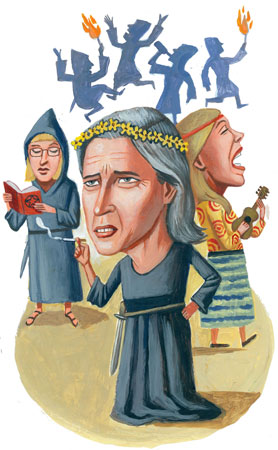
In a grove near you, pagans are gathering to celebrate Samhain, the night when the veil between the living and the dead, between this world and others, is thin. We will wear cloaks and have ritual daggers, called athemes, at our waists. The prerequisite silver jewelry will gleam in the firelight. Natural fabrics flow as freely as the mead. There will be an unfortunate excess of tie-dyed material. In other words, we will look most like your picture of witches.


This picture leaves out an important detail, and I don't mean the whole human-sacrifice-and-stealing-Christian-babies thing. Planning a ritual, whether it's for Halloween or any other holiday, is a conflict-filled battle. It's like trying to herd jack rabbits on horseback. Those who practice witchcraft tend to be strident nonconformists, and the very nature of paganism, which has no unifying body or text, means that we have no obligation to believe the same thing or listen to anything beyond the dictates of our own consciences to unite in perfect accord. Often we flow together, achieving unity in which we are transported beyond ourselves, connected with the earth we love and the energy we feel from it.

And just as often, we don't.

Read the whole article here.

Tuesday, September 29, 2009

Is Worship Boring?

This piece from the Washington Post by Erica Brown, a Scholar-in-Residence for The Jewish Federation of Greater Washington, came to my attention via an Anglican clergy discussion list. Providentially, I read it the same day I had lunch with a chaplain colleague who had returned from a six month tour at the military hospital in Landstuhl, Germany, working with very seriously wounded soldiers and their families. My friend, a Roman Catholic, told me that what sustained him spiritually during this gruelling time was attending Mass as often as he could, and daily if possible. When a nurse friend asked him how he could do such a repetitious thing, he replied, "you breathe and eat, don't you?". MP+

Bored in Worship? No Wonder

The poet Dylan Thomas once wrote, "Something is boring me. I think it's me." This humbling confession gets to the heart of an issue long kept under wraps within faith communities. People are bored. People are terribly bored in churches and synagogues and mosques world-over. The liturgy can feel stale or archaic. The leadership of faith institutions can be out of touch with issues of contemporary relevance. In the fast-paced, ever-changing modern world of technology, religion can seem quaint but uninteresting to a young generation of hipsters who can't seem to understand the appeal of tradition.

But boredom can actually help faith if we allow ourselves to wallow in it just long enough for it to spark creativity. Think of a child who begs his mother for something to do only to be told that he is on his own. He must find his own entertainment. After sitting with self-pity for a while, he rummages in the toy box and two hours later has created a whole imaginary city. He sat with boredom long enough to get bored of his boredom and then found his own creative way out.

Read the complete text here.

Friday, February 27, 2009

A model of biblical proportions

This story combines the Mad Padre's love of a) things religious with b) things historical with c) crazy modeling pursuits. As a friend of mine commented, when the English farmer who built this massive model of King Herod's temple dies, his long-suffering wife should open it to tourists and charge admission. Has to be seen to be believed.

Thursday, January 8, 2009

Rest in Peace, Father Richard John Neuhaus

I was saddened to learn today, via Titus One Nine, of the passing of Fr. Richard John Neuhaus yesterday, January 8, at the age of 72. Father Neuhaus was for years the genius behind First Things magazine, an intelligent and lively journal of conservative Catholic thought. His book Death on a Friday Afternoon remains one of my favourite Good Friday devotions.


Neuhaus, while a stern and uncompromising critic of liberal trends in the Anglican Communion, was a great friend of Anglicanism and was always worth reading. I will miss his acerbic roundup of religious news every month in FT. I join Titus One Nine in excerpting this piece from Neuhaus' meditiation on his cancer and his nearness to death, written in 2002:

“Everything is ready now.” I would be thinking about that incessantly during the months of convalescence. My theological mind would immediately go to work on it. They were angels, of course. Angelos simply means “messenger.” There were no white robes or wings or anything of that sort. As I said, I did not see them in any ordinary sense. But there was a message; therefore there were messengers. Clearly, the message was that I could go somewhere with them. Not that I must go or should go, but simply that they were ready if I was. Go where? To God, or so it seemed. I understood that they were ready to get me ready to see God. It was obvious enough to me that I was not prepared, in my present physical and spiritual condition, for the beatific vision, for seeing God face to face. They were ready to get me ready. This comports with the doctrine of purgatory, that there is a process of purging and preparation to get us ready to meet God. I should say that their presence was entirely friendly. There was nothing sweet or cloying, and there was no urgency about it. It was as though they just wanted to let me know. The decision was mine as to when or whether I would take them up on the offer."
Read the whole piece.

Requiescat in pacem, Father.

Wednesday, November 26, 2008

Pastor Advises Flock to Have Seven Days of Sex

I think Christians always get a bad rap for being anti-sex, so it always does my soul good to hear a pastor who is willing to defend sex as part of God's good plan for creation. This article from the New York Times caught my attention the other day and is worth repeating. I'm not sure if the "let them eat cake" advice for singles will give much comfort, however ...


November 24, 2008
Pastor’s Advice for Better Marriage: More Sex
By GRETEL C. KOVACH

GRAPEVINE, Tex. — And on the seventh day, there was no rest for married couples. A week after the Rev. Ed Young challenged husbands and wives among his flock of 20,000 to strengthen their unions through Seven Days of Sex, his advice was — keep it going.

Mr. Young, an author, a television host and the pastor of the evangelical Fellowship Church, issued his call for a week of “congregational copulation” among married couples on Nov. 16, while pacing in front of a large bed. Sometimes he reclined on the paisley coverlet while flipping through a Bible, emphasizing his point that it is time for the church to put God back in the bed.

“Today we’re beginning this sexperiment, seven days of sex,” he said, with his characteristic mix of humor, showmanship and Scripture. “How to move from whining about the economy to whoopee!”

On Sunday parishioners at the Grapevine branch watched a prerecorded sermon from Mr. Young and his wife, Lisa, on jumbo screens over a candlelit stage. “I know there’s been a lot of love going around this week, among the married couples,” one of the church musicians said, strumming on a guitar before a crowd of about 3,000.

Mrs. Young, dressed in knee-high black boots and jeans, said that after a week of having sex every day, or close to it, “some of us are smiling.” For others grappling with infidelities, addictions to pornography or other bitter hurts, “there’s been some pain; hopefully there’s been some forgiveness, too.”

Mr. Young advised the couples to “keep on doing what you’ve been doing this week. We should try to double up the amount of intimacy we have in marriage. And when I say intimacy, I don’t mean holding hands in the park or a back rub.”

Mr. Young, known simply as Ed to his parishioners, and his wife, both 47, have been married for 26 years and have four children, including twins. They have firsthand experience with some of the barriers to an intimate sex life in marriage, including careers, exhaustion, outside commitments, and “kids,” a word that Mr. Young told church members stands for “keeping intimacy at a distance successfully.”

But if you make the time to have sex, it will bring you closer to your spouse and to God, he has said. You will perform better at work, leave a loving legacy for your children to follow and may even prevent an extramarital affair.

“If you’ve said, ‘I do,’ do it,” he said. As for single people, “I don’t know, try eating chocolate cake,” he said.

Read the whole article

Mad Padre

Mad Padre
Opinions expressed within are in no way the responsibility of anyone's employers or facilitating agencies and should by rights be taken as nothing more than one person's notional musings, attempted witticisms, and prayerful posturings.

Followers

Blog Archive

Labels