Showing posts with label Church History. Show all posts

Friday, May 17, 2024

Whitsunday or Pentecost?


This Sunday, May 19, is the Day of Pentecost, which is often called “the birthday of the church”.  On this day we remember the first appearance of the Holy Spirit which empowered the disciples and allowed them to go out and become the church in the world.

Pentecost always falls on the fiftieth day after Easter, and the old Book of Common Prayer says that this day is “commonly called WHITSUNDAY”.    This name is confusing, because “Whitsunday” literally means “white Sunday”, though the liturgical colour is red for the flames of the Holy Spirit that descend on the apostles (see Acts 2:3).  So why the name Whitsunday?


A brief dive into early church history tells us that while new believers being instructed in the faith (called catechumens) were usually baptized on the Vigil of Easter (the Saturday before Easter Sunday).   However, those who weren’t ready by the Vigil were baptized on Pentecost, when they received new white robes to symbolize their new identity as Christians.


In the Anglo-Catholic tradition, Whitsunday is the preferred name and it is seen as a day when we remember the gifts of the Holy Spirit which include the traditional seven sacraments (though the Thirty Nine Articles only recognizes two, Baptism and Communion, as “ordained by Christ” (BCP p. 708).  


In the old Prayer Book calendar, “Whitsuntide” runs from Pentecost/Whitsunday to Trinity Sunday, and includes three “Ember Days” (Wednesday, Friday, and Saturday) when we pray for those who “are called to any office or administration in the church”.   


While many congregations often are asked to wear red for Pentecost Sunday, it is also appropriate to wear white in memory of the older name of Whitsunday.   So come to church wearing red, or white, or both, and you’ll be fine!

Wednesday, November 22, 2023

Video of our Anglicanism 101 Series: Fr. Michael on Church History

 Here is the complete video of Fr. Michael's talk on church history from our Anglicanism 101 series.    

When time next permits I'll post Rev. Sharon's talk from the same series on How We Worship.

Tuesday, November 7, 2023

A Quick Tour of Anglican Church History for Our Parish Anglicanism 101 Series


The notes and illustrations on this page are meant to be prompts to me for Anglicanism 101 series in our Regional Ministry.  If you find this page, I hope it’s helpful to you and I’ll try and build this page out a bit and flew out the references as time permits.  MP+

Why Church History?
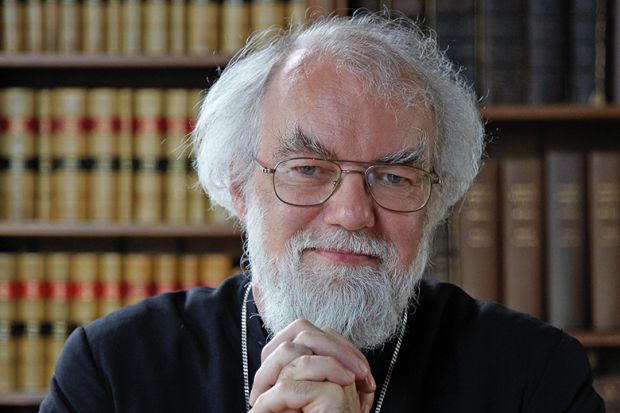
Rowan Williams, Why Study The Past?

“To engage with the Church’s past is to see something of the Church’s future.”


Church and Continuity

How far back should we go in studying the Anglican Church?

“We have always been here” (Stephen Neill, Anglicanism).  When you go into an old Anglican church in Britain or Ireland, you realize that our worship and church come out of a long continuity, that we have been gathering in these places worshipping together before we were Anglicans.    In other words, our the church didn’t start with the Reformation, as some Protestants believe.


St Mary’s, Limerick, Ireland
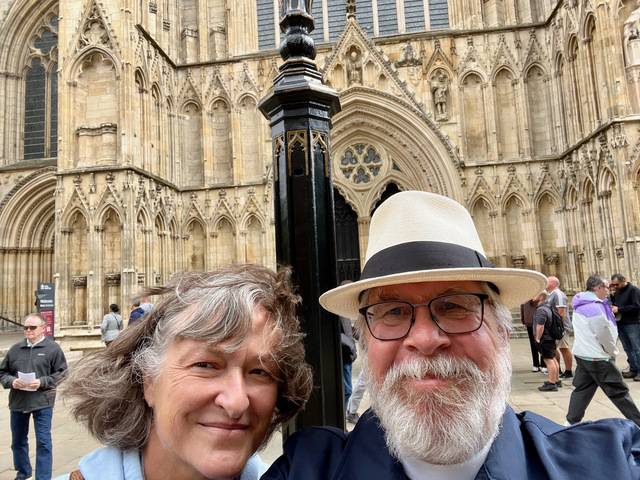
York Cathedral, York, England

But what of Canada?   What of the churches built here, like Prince of Peace (50ish years old) or St Margaret’s Barrie (30ish)

Do we see these churches as new, in that they are newer churches in a newer country, or as old churches, in that they come out of a centuries old tradition?   And where is tradition anyway in our life as a church and is it important?  And are there some unique aspects of our life together as Canadian Anglicans?  We’ll come back to that.

So Let’s Talk About The Reformation, Where Some Say it all Started

Was it just about Henry VIII and his wives?

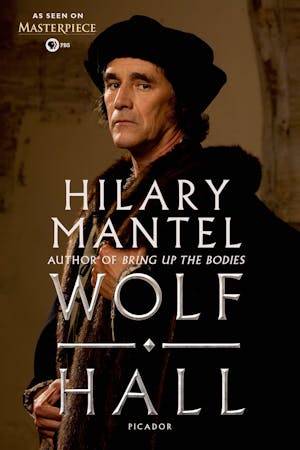
To Be Sure it was about politics - that’s covered in the late Hilary Mantel’s trilogy about Thomas Cromwell, beginning with Wolf Hall
 

The Reformation was a real fight about superpower politics, about English independence from Europe (specifically the Catholic church - it was the first Brexit) and it was about land and money.

John Houghton, Dominican (d 1535), one of the the First (Catholic Martyrs of the Reformation), the most famous of which was Sir Thomas More, the Man for All Seasons.  There were martyrs on both sides.

But the Reformation was also a fight over theology.  It was about who could read and translate the Bible (eg, John Tyndale (d 1536), and it was about how Salvation worked (grace vs works) and the perceived monetization of grace by the Roman Catholic church.   It was driven by the writings of rebellious theologians from Europe, specifically Martin Luther


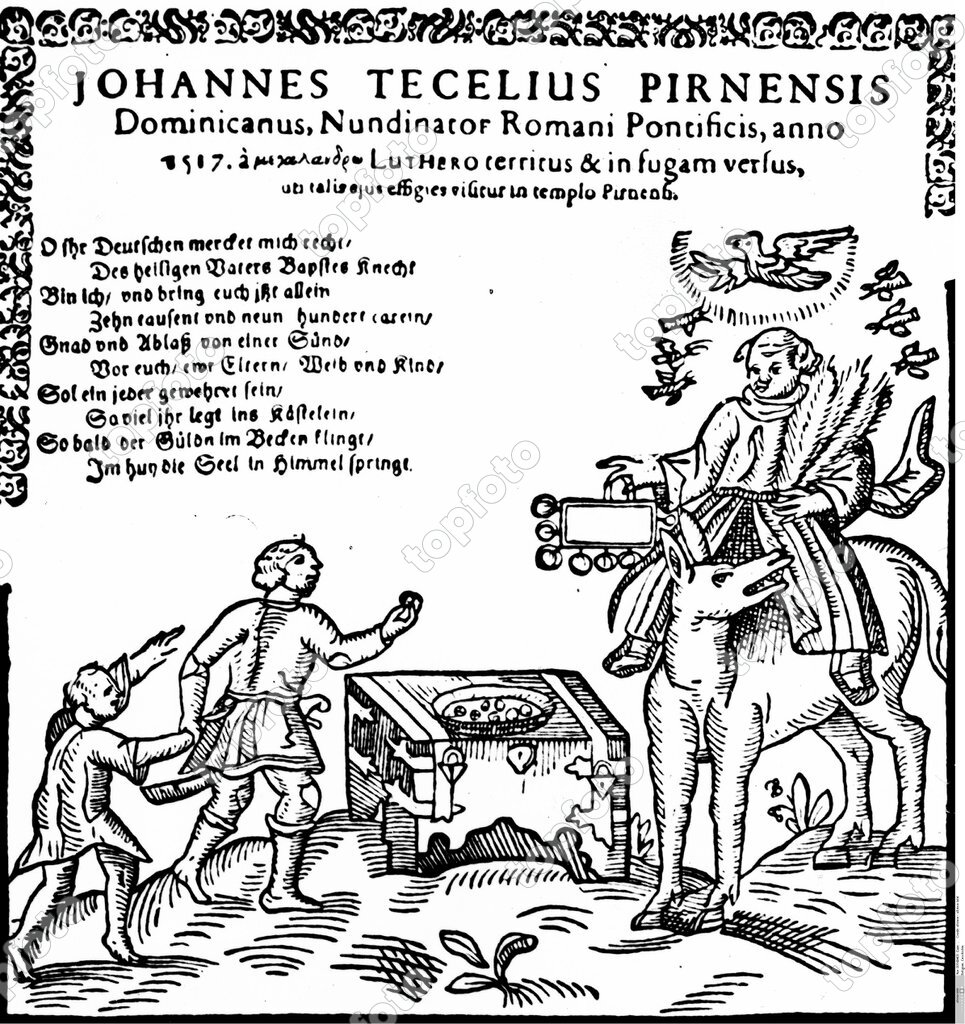
German Dominican Friar Johann Tetzel selling indulgences (pardons from Purgatory).

When Henry VIII asserts the independence of the English church, his key church supporter is Thomas Cranmer, the Archbishop of Canterbury (which explains why Canterbury is the centre of the Church of England and was, until recently, the spiritual centre of the Anglican Communion)
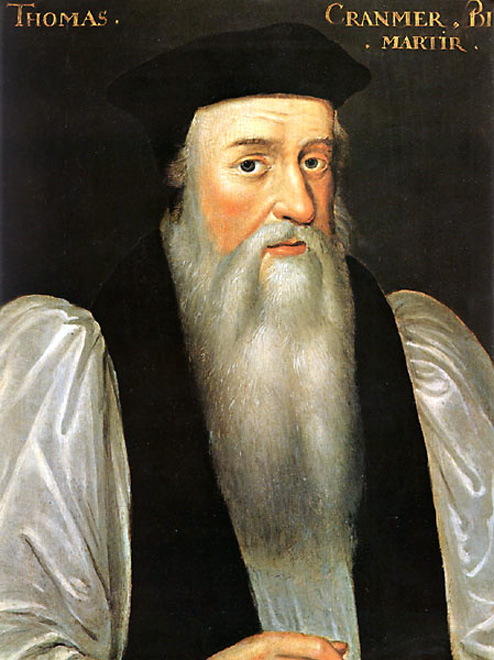
Key Beliefs of the English Reformers

An English language book of common prayer that all the laity could use and pray with (hence the word common), which was rooted in the Roman tradition of worship but adapted both in the times of prayer (morning and evening prayer, Communion, compline)

An emphasis on theology of grace, hence the Prayer of Humble Access from the BCP:

WE do not presume to come to this thy Table, O merciful Lord, Trusting in our own righteousness, But in thy manifold and great mercies. We are not worthy So much as to gather up the crumbs under thy Table. But thou art the same Lord, Whose property is always to have mercy: Grant us therefore, gracious Lord, So to eat the Flesh of thy dear Son Jesus Christ, And to drink his Blood, That our sinful bodies may be made clean by his Body, And our souls washed through his most precious Blood, And that we may evermore dwell in him, And he in us. Amen.

An emphasis on doctrine (the sermons provided for English clergy, the Thirty Nine Articles of Faith)

A suspicion of the Roman doctrine of Transubstantiation and Real Presence, a tendency towards the idea that the Communion was a memorial rather than a sacrament.  Leftover bread was to be eaten by the priest for lunch, it wasn’t to be revered and paraded around.

Reformation, Counter Reformation, Compromise

However, after the death of Henry VIII, the reign of Catholic Queen Mary (a bad time for Cranmer and his associates) and the reign of the Protestant(ish) Queen Elizabeth, a sort of compromise evolved.As Elizabeth said, the Crown did not want to “make windows into men’s souls”, a certain amount of belief, eg, about what happened at Communion) was private.  

Thus there is a sort of compromise in the Words of Administration in our Prayer Books. 

THE Body of our Lord Jesus Christ, which was given for thee, preserve thy body and soul unto everlasting life: Take and eat this in remembrance that Christ died for thee, and feed on him in thy heart by faith with thanksgiving.

And the Minister that delivers the Cup shall likewise say:

THE Blood of our Lord Jesus Christ, which was shed for thee, preserve thy body and soul unto everlasting life: Drink this in remembrance that Christ’s Blood was shed for thee, and be thankful.


The Church in Upper Canada

The Anglican Church came to Canada as it did to the rest of the Empire, through commerce (whaling, fishing, the Hudson’s Bay Company) and through the military (army and navy garrisons).  This is true in Upper Canada (Ontario) where the English presence and the Anglican church were centred on Kingston and York.  Much of the work of the church on the ground was sponsored by missionary societies such as the Society for the Propagation of the Gospel which paid for clergy, books, and buildings.
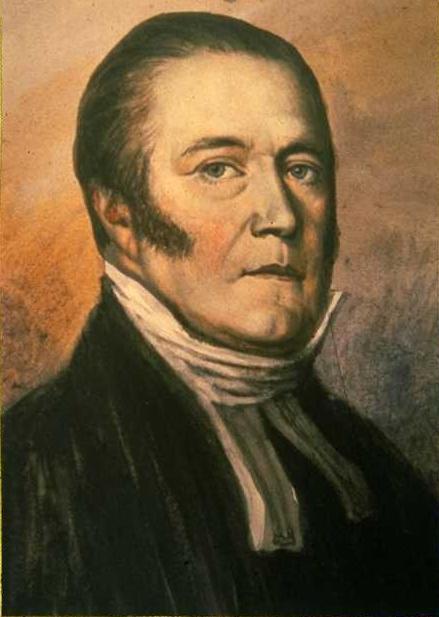
 

Bishop John Strachan

Bishop John Strachan was a key leader in the early Anglican Church in Upper Canada.  He was determined that the Anglican Church receive a monopoly (establishment).  He argued that a strong Church would help keep American influence at pay (he was worried about American Methodist clergy travelling back and forth over the border).  The government never really said yes for several reasons:

1) Precedent with French Quebec, which had been left free to be Roman Catholic

2) The trend in England was towards religious freedom and toleration

3) Many Canadian settlers and their provincial representatives were non-Anglican (eg Scots Presbyterians)


Nevertheless, the Anglican Church received considerable favours from the government including land and (the clergy reserves) and a near monopoly on its clergy being the only officials who could marry people.


Why So Many Kinds of Anglican Churches?


St Thomas, Huron Street, Toronto
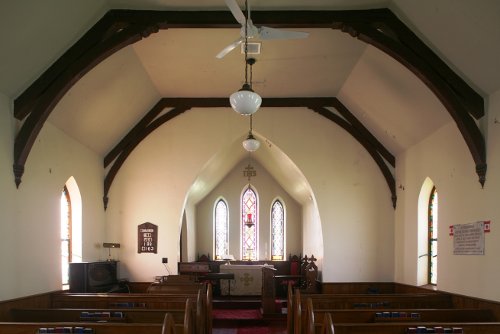
St Paul’s, Middleport (nar Brantford)

To understand the somewhat bewildering variety of styles of Anglican church (both in architecture and liturgy), we need to briefly understand the terms High Church and Low Church.  Originally the two terms had to do with politics;  High Church thought authority came from the top down (through bishops) and Low Church thought authority came from the bottom up.

Once synods and elections of bishops became the norm, the terms High and Low Church eventually transferred to styles of doing church.

If you went to church in Upper Canada in the 1850s, it would have looked much like Anglican worship anywhere for the last 300 years.  The clergyman in a cassock, surplice, preaching scarf and hood, stationing himself at the north end of the altar.  In part the justifications for this were scriptural:

 we have such a high priest, one who is seated at the right hand of the throne of the Majesty in the heavens - Hebrews 8:1;

he sat down at the right hand of God - Hebrews 10:12;

Thou sittest at the right hand of God - Te Deum.

And also there was a desire that the priest’s actions be seen by the communicants.  Also, the priest with his back to the people was seen as too Catholic or Papist.

Typical services on Sunday would have been Mattins, the Litany, Ante Communion, with a long sermon, all lasting 2 plus hours.  Communion would have been infrequent.  This style was sometimes called “High and Dry”.

Many older dioceses in Canada were first established by clergy from the Church of Ireland, which tended to be much more conservative and “lower” than some.

Eventually the Ritual or Communion Movement changed much church practice.  Coloured vestments, frequent communion, incense, and other liturgical practices  were introduced in some parishes, which caused much controversy, anxiety, lawsuits, and riots.  
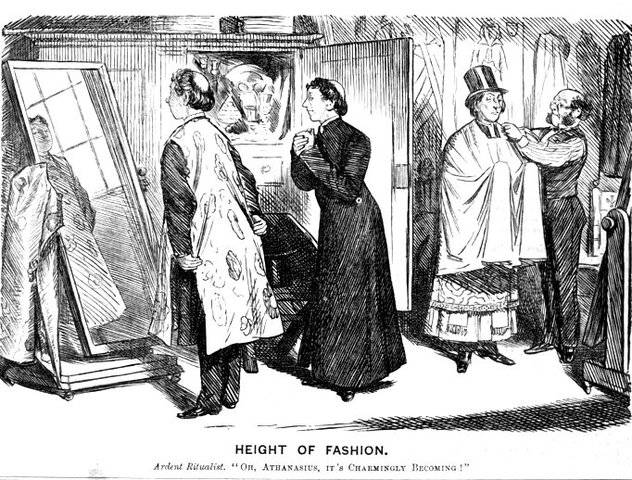
Cartoon from British magazine Punch making fun of ritualist clergy.

“If a clergyman took the ‘north-end’ at the Celebration of the Holy Communion h was a ‘Low Churchman’; if he took the eastward position he was a ‘High Churchman’.  If he spoke of the ‘Altar’ he was ‘High’; if he spoke of the ‘Table’, or the ‘Holy Table’, he was ‘Low’.  If he wore collard stoles he was very ‘High’; if he wore a black scarf or stole he was ‘Low’.  If he had a cross on the Altar, he was decidedly ‘High’;  if a cross was on the hangings, the book markers or the stole, he was ‘High’ (Hayes, Anglicans in Canada, 129).

Today these debates are largely lost in time, and most Anglican churches look the same, though there are some exceptions (All Saints Collingwood does things a little more “High” than some in our dealer).  It depends what seminary the clergy went to, what their personal practices are, what the local tradition of the parish is.  Most Anglican churches are happily Middle of the Road.

Other Canadian Changes

Election of Primates, loss of authority of the Archbishop of Canterbury, reflects an overall trend in the Anglican Communion.  As the colonies of the British Empire became independent, their Anglican churches developed their own systems of independent governance and often changed their names, so the Anglican Church in Kenya for example is simply called “The Church of Kenya”, the name “Anglican” being dropped.

Likewise Primates of national Anglican churches had their own authority within their churches, which is why, whereas Rome can tell the Catholic Church what to do and believe, there is no one authority in Anglicanism.

Other Changes:

Ordination of Women

Rev Florence Li Tim Oi, ordained May 1941 Hong Kong


Changes in Liturgy (introduction of the Book of Alternative Services, 1980s)

Ecumenical Talks with United and Lutheran Churches

Debates Over Gender, Same-Sex Marriage (during this debate, the term “experience” is often added to the traditional Anglican triad of “Scripture, Reason, Tradition” 

Decline of the Church and Predictions of “Extinction” by 2040s


Indigenous Christians and Reconciliation

Most of us know the story of the Doctrine of Discovery, the Residential Schools, and the church’s complicity in the government practice of assimilation.

Fewer of us know that there are still many indigenous Canadians who identify as Christians and as Anglicans.

In the 2011 National Household Survey of Statistics Canada, of 1,400,685 persons who self-identified as Aboriginal in private households, 889,315 (63%) identified as Christian. Of these, over 500,000 identified as Roman Catholic, and about 130,000 identified as Anglican.

Some of their stores give us hope and remind us of the importance of indigenous voices in our church.

Tobasanakwut Kinew was an Anishnable elder, respected academic, and spiritual leader.  He was born on a trapline in northern Canada and was a survivor of a Roman Catholic Residential School.  He was involved in the process that led to the Catholic Church’s apology to Canadian indigenous peoples for their treatment in the schools.

In his book “The Reason You Walk”,  his son, Wab Kinew (now the new premier of Manitoba” wrote that “My father lived long enough to see an apology and now he has lived long enough to show forgiveness”.


 “My father lived long enough to see an apology and now he had lived long enough to show us forgiveness as well.” p. 246 

 

Other changes in the Anglican Church of Canada that show our church’s indigenous heritage:

Practice of “land acknowledgements"

Decisions reached by consensus (eg, talking circles) rather than by parliamentary style motions and votes

Educational initiatives: (Mapping Our Ground, Blanket Exercise)

Cultural practices such as smudging, sweat lodges becoming more familiar

Use of the term “settler"

Indigenous Archbishops
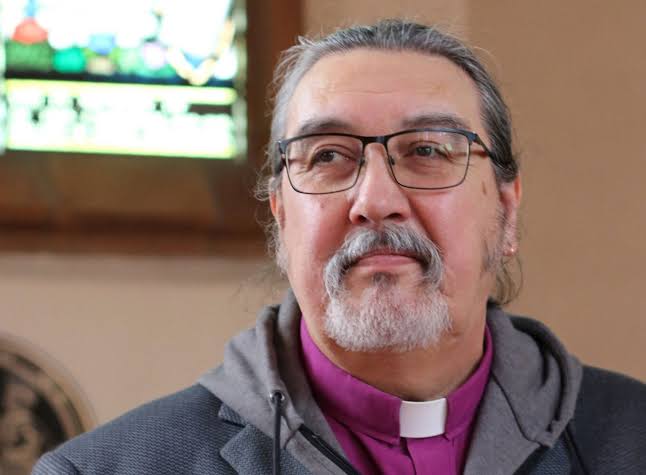
Indigenous Archbishop the Rt Rev. Chris Harper

Tuesday, March 21, 2023

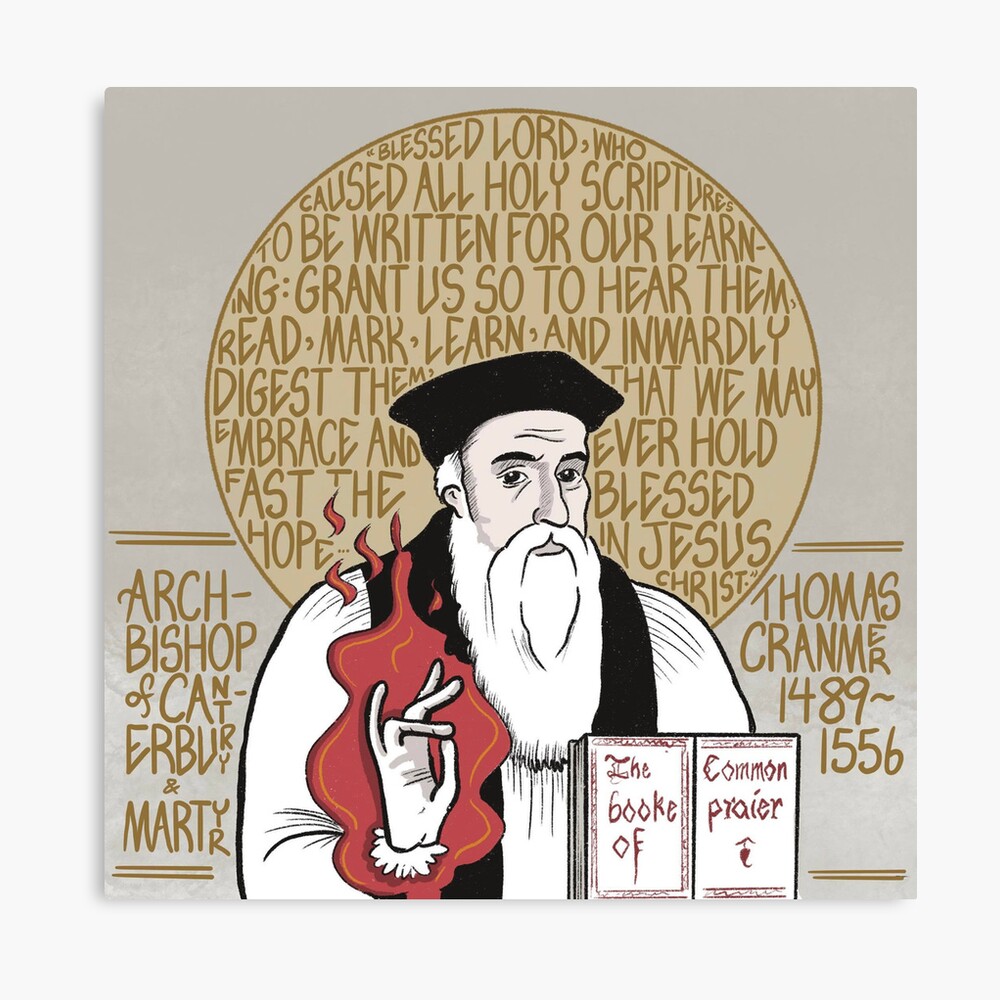
Remembering An Anglican Martyr, Thomas Cranmer


Today in the life of the church we remember and give thanks for Thomas Cranmer, died this day, 21 March, 1556

Thomas Cranmer was a Cambridge scholar who became arch- bishop of Canterbury in 1533 and guided the Church of England through its first two decades of independence from the Papacy.
When he assumed his office he was already committed to protestant views, but political conditions forced him to keep
hissympathies a secret. For over a decade he studied the issues which divided not only protestants from Catholics, but also the protestant movement itself.
His studies bore fruit when the political situation allowed him to begin serious reformation of the liturgy. He had a large hand in drafting The Book of Common Prayer, which was authorized in 1549. Three years later he oversaw a second edition of this Book, which he revised in such a way as to make its protestant doctrine unmistakable.
Soon afterwards he and his Prayer Book were overtaken by events when Queen Mary I came to the throne and restored England to communion with the Pope. Cranmer was imprisoned and endured a long, humiliating trial for heresy, at the end of which he recanted his protestant opinions in hopes of clemency.
The Queen refused to hear his pleas, and he was burned at the stake on this day in the year 1556. As the flames licked around him, he thrust out his right hand — the hand which had signed his earlier recantations — so that it might be the first to be burned; and that was the posture in which the onlookers last saw him, as the fire engulfed his body.
Collect
O God,
you endued your servant Thomas Cranmer
with zeal for the purity of your Church
and gave him singular ability
in reforming the common prayer of your people. Grant us such courage in our witness to your grace that in our families, communities, and nation
we may become the leaven of your justice and truth; through Jesus Christ our Lord,
who lives and reigns with you and the Holy Spirit, one God, now and for ever. Amen.
 
(From For All The Saints, Anglican Church of Canada Publication)

Wednesday, November 16, 2022

Judaism: Christianity's Slightly Older Brother?

Karl Barth once said that the Jews are the older brothers and sisters of Christianity, but how much older?    

I’ve always thought that in the gospels, when Jesus challenges traditions held by some, such as challenging the Pharisees’ understandings of Sabbath keeping or ritual purity, that these were long-established customs and traditions.    In fact, Judaism as it is presented in the gospels (admittedly not a reliable source) may not have been more than a century older than the Jesus movement.   At least, that’s the thesis of a new book by a Jewish archaeologist named Yonatan Adler.

Adler’s thesis is basically that Judaism didn’t take on its essential character until the Hasmonean dynasty in the 2nd century BCE, when Israel began to emerge from Hellenistic dominance.

I lack the knowledge to form a quick judgement on Adler’s thesis, but the scholarly reaction in this Smithsonian article is not hostile.  However, today, comments like this are leaving me slightly disoriented.

"Konrad Schmid, a biblical scholar at the University of Zurich in Switzerland, agrees that “before the Hellenistic period,” knowledge of the sacred text “was probably limited to small scribal circles centered in Jerusalem.” He speculates that the Hebrew Bible’s rules could have been conceived not as laws but as “a document depicting an ideal community.” He is unsure, however, if the text remained obscure to most Judeans as late as the second century B.C.E."


\

Tuesday, June 5, 2018

"The Church of the Ages": A Sermon Preached for the Anglican Military Ordinariate

Preached at the annual gathering of the Anglican Military Ordinariate of the Canadian Armed Forces, Cornwall, Ontario, 6 June 2018

Texts for the Commemoration of Wliiiam Grant Broughton, First Anglican Bishop in Australia: Ephesians 3:14-21, Psalm 112:1-6, Matthew 7:24-29

"I pray that, according to the riches of his glory, he may grant that you may be strengthened in your inner being with power through his Spirit, 17and that Christ may dwell in your hearts through faith, as you are being rooted and grounded in love."  Ephesians 3:16-17


When I first started coming to Cornwall, the preachers at the AMO (Anglican Military Ordinariate) eucharists were doddering old chaplains in the twilight of their careers. …  I just never thought that that my turn would come so quickly.


Nevertheless, I was excited when I learned that I was to preach on the day of the commemoration of a pioneering colonial bishop.  As a boy at St. John’s School of Alberta, I paddled in a voyageur canoe named Bishop Bompas, after the first Anglican Bishop of Selkirk.  As a theology student, as part of my indoctrination into the heroes and legends of Wycliffe College, I learned the story of Isaac Stringer, famously known as the Bishop who ate his boots.   As the second Bishop of Selkirk in the Yukon, Stringer escaped starvation during a long snowstorm by boiling and eating his sealskin boots.     It sort of went without saying in the college ethos that any good Wycliffe grad would do the same for the sake of the gospel.   Fortunately in my ministry I’ve never had to eat anything more than some ill-advised words or to have swallowed anything more than some pride, both of which are part of a good spiritual diet.


The William Broughton, who we commemorate today,  was not however a heroic or especially eager colonial bishop.  It’s true that not every bishop cuts an heroic, swashbuckling figure.  In fact Broughton was one of those English country parsons that you find in a Trollope novel.  A scholarly type, Broughton at first thought himself fortunate to gain the Duke of Wellington, the hero of Waterloo, as a patron.  Sometimes however, a powerful patron can be a mixed blessing, because the Duke decided that Broughton should be the Archdeacon of New South Wales in Australia.  Sometimes it’s stay grey in the shadows.  Broughton doesn’t seem to have wanted this assignment very much - he said at the time that 'there is no ground for congratulation on my appointment’.   Furthermore, it appears that the Duke exaggerated the size of the stipend he would receive - in fact it just barely covered his expenses.   Also, Broughton also discovered that what he thought would be a short posting was anything but - he would in fact stay for as long as the British government wanted, and it would in fact be his life’s work.  Those of us who have ever been beguiled by the seductive words of a staff check during posting season can probably relate to him.


Despite being lame and dependent on a cane, Broughton was willing to travel the long outback circuits of his archdeaconry, frequently being away from his home and family in Sydney.   The editors of For All the Saints certainly included him for his pastoral devotion, as well as for his diligent leadership.  The choice of today’s gospel reading from Matthew, (7:24-29) with its image of a house solidly built on rock, would warm the heart of any church administrator.  Broughton, like his contemporary Bishop Strachan in Upper Canada, laid the foundations for the Anglican church in England.   He worked with missionary societies to recruit and train clergy to serve a small and scattered population.  As the first Bishop of the colony he was a champion of education and built synodical structures for the church in Australia which would become a model for the communion.


So why is any of this important?  As Rowan Williams has observed, church history is God’s history.   The church across the ages, from generation to generation, is nothing less than God’s doing in the world.  The church is not human activity, and sometimes the church flourishes despite us.   William Broughton was a pioneer, but not all his plans were successful.  His dream of an independent seminary in Sydney failed, and he was disappointed by the Crown’s hands-off attitude to the colonial church.   In this respect, Broughton would have had much in common with his Canadian contemporary, Bishop Strachan. Both were high churchman in the political sense of wanting Anglicanism to be the national and established faith of the state, both were out of step with their age.  There would be no established church for the colonies.  Having lost these battles, both ended up believing that for the church to flourish, it must be solely dependent on the power and promises of God, on God’s word faithfully preached by a diligent and learned clergy, and on administrative and leadership talents of its bishops.


A perennial danger of our lives as clergy is to think that we are engaged in a human project, the success of which is largely based upon our efforts and skills.   The annual exercise of the brag sheet reinforces this mindset, as does the accrual of coins, diplomas, commendations, decorations, promotions, and all the other bric a brac of the successful career in military chaplaincy.    Were he here today, I am sure that Bishop Broughton would remind us that our business, if self-dedicated, is like the house built on the sand, soon washed away and forgotten. 


In his first charge to his clergy in Australia in December 1829, Broughton spoke of the priest, as “ministers of Christ and stewards of the mysteries of God:a “ pledged by engagements so awful that every one of us by whom they are regarded with becoming seriousness must tremble, in [our] attempts to fulfil them, under a sense of [our] insufficiency”.  Surely one of the great satisfactions and even inspirations of church history is realizing that others stood were we do now, contemplating the heavy spiritual lifts of the day, and realizing their own inadequacies but for the grace of God.   Broughton went on in his charge to say that the only reason he could “with any degree of confidence undertake the duties with which I am here entrusted …was because of his “assured belief that God, whose Providence has guided my steps, will give me grace and power … faithfully to take the oversight of his church , and rightly to divide the word of truth unto all followers of Christ Jesus, our Lord”.


Today’s reading from Ephesians was surely one of the texts that Broughton was drawing on for this assurance.   The Apostle Paul, so often accused of bombast and arrogance in our day, actually speaks of his profound dependence on the power of the gospel and the gift of grace to proclaim it.   Our strength to get out of bed and put on the uniform, our faith in our vocations, our love for those who come to us for counselling - where could we find these things if they were not given to us by the Spirit?  How terribly empty and tired we would be were we not “filled with all the fullest of God” (Eph 3.19).


In closing, let me fast forward from colonial Australia to very recent history, a hot afternoon in May in Hamilton as the church gathered to commend one of its own to God.  Those of us privileged to be at the funeral of our brother Rob Fead heard Bishop Spence speak luminously of how Rob held up the light in the darkness, showing it to his parishioners, to his reserve regiment, to the friends and family of Nathan Cirillo, and to so many others.   Rob was a strong man, but it was not his light, or his strength.  It was the light of Christ, the love of God, and the strength of the Spirit that dwelled within Rob as gifts which enabled his remarkable ministry.   Rob used them well, and now he has passed from our church to the church of the ages, to take his place with Broughton and Strachan and all the others, the heroic and the unlikely, who God has enabled and used for his good ends.  So may it be said of us after our time, that God was able to accomplish in us “abundantly far more than all we [could] ask or imagine” and so to [God] be glory in the church and in Christ Jesus to all generations, for ever and ever. Amen.”

Monday, February 27, 2017

Faith At The Fort: Garrison Religion In Toronto In The 1800s

It's been very quiet here since Christmas.   In my spare time, when not working or helping my wife's battle with cancer, I've been focusing on my hobbies, which are described in my other blog here.  


However, I did write a piece in December at the invitation of the Friends of Fort York, which preserve the historic war of 1812-era British fortification in Toronto. 


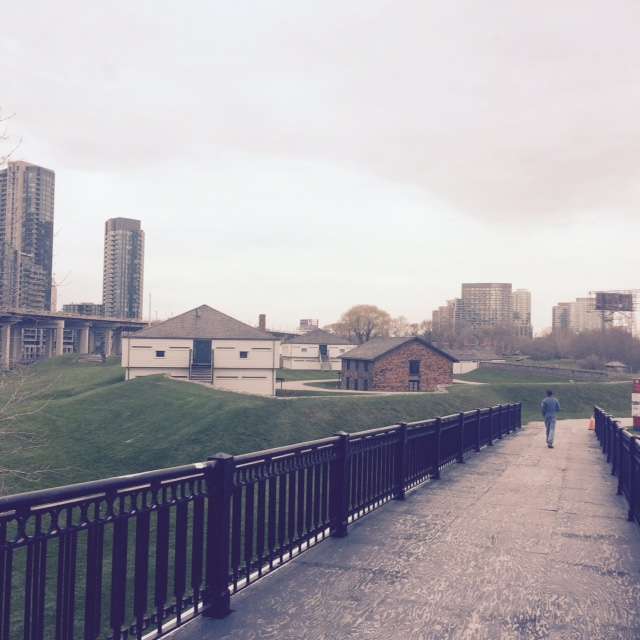
Pedestrian entrance to Fort York off of Bathurst Street.  The Gardiner Expressway, visible to the left, and the condo towers in the background, show how Toronto has grown since the early 1800s and how the lakeshore has been pushed back.  In its heyday, Fort York lay on the shore of Lake Ontario.


Given my slight expertise in military religious history, I was asked to write a piece on religion at the fort in the 1800s, a difficult subject given that so much of lived religion (actual beliefs and practices) is not nearly as well documented as is official religion (formal church history).


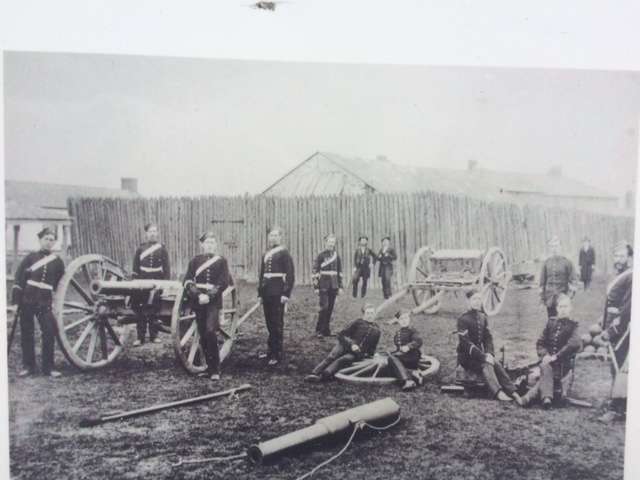
Members of a Royal Artillery battery at Fort York in the mid 1800s.  What did they actually believe?


While not an extensive piece of original research, I did get to look at some of the Toronto diocesan archives which show births, baptisms, weddings and funerals at the Fort, as well as some other original source material.


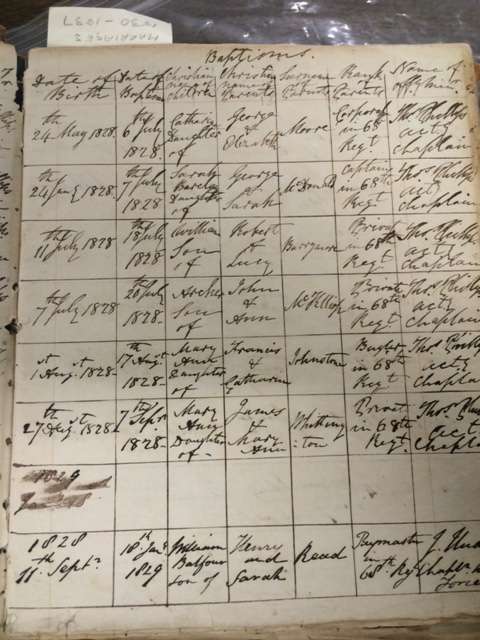
Baptismal register showing christenings of children born to military families of the British Army's 68th Regiment in 1828, and signed by the acting garrison chaplain.


It is impossible to generalize about lived religious life on the basis of the documents available to us.  While the British redcoat had a reputation as being foul-mouthed, drunken and irreverent.  While this may be true then as now of some soldiers, this stereotype ignores the influence of Methodism, missionary movements and Christian welfare organizations that actively reached out to British soldiers throughout the empire.  The stereotype also ignores the role of religion in the lives of Roman Catholics, Presbyterians and various non-conformers whose spiritual needs were not met by official military chaplains, who were almost entirely Anglican.   It is also impossible to generalize as to how official religion -- the round of church parades, weddings, christenings and funerals -- was received by soldiers.  To some, official religion may have been an irritant, but to others it may have been a reassuring if seldom thought of part of life.


 My conclusion in the article is thus that "While the average soldier may have been more comfortable in a tavern than on church parade, he may also have been more devout than is commonly supposed."


The article begins on page 3 here.

Thursday, September 20, 2012

Newly Found Papyrus Talks Of Jesus' Wife

We don't usually talk religion in the mess but I am so expecting to get asked about this story over a beer at happy hour tomorrow.

Saturday, January 9, 2010

Book review: Rodney Stark on The Crusades

My chaplain friend and colleague Paul Lynn, with the US Army currently at Fort Bragg, NC, shares my interest in reading and church history. Paul returned from theatre just before Christmas and he's been kind enough to pick up some of my posts on his blog Worth My Salt, to which I've added a permanent link here in the section "Blogs I'm Visiting".

Paul has written a review of church historian Rodney Stark's book on the crusades which I'm crossposting here. The word "crusades" has become ideological of late, figuring prominently in radical Islamist propaganda as favoured by Osama Bin Laden and others. A powerful revisionist school in western thought portrays the crusades as unwarranted aggression against peoples of other faiths. Paul's review has me curious to see how Stark works against that grain. MP+


Friday, January 08, 2010
God's Battalions: Book Review


I was about three quarters of the way through with this amazing book when I emailed a friend about it. My friend holds a PhD in Religion from one of the most prestigious universities in the U.S. His focus is Church History, specializing in the area of major concern from the book, "God's Battalions." My friend has also been a full professor for a lengthy bit of time, meaning, he knows his stuff.

I knew he would know the author. I wanted to get behind the intent of the thesis.

Here it is in final form on the last page (p. 248): "The thrust of the preceding chapters can be summarized very briefly. The Crusades were not unprovoked. They were not conducted for land, loot, or converts. The crusaders were not barbarians who victimized cultivated Muslims. They sincerely believed that they served in God's battalions."

The author, Rodney Stark, of Baylor University cooks up a great book. It is scholarly, heavily footnoted, and he interacts with other reputable historians throughout. But, it is very readable!

I think back to reading David McCullough's early American history in "1776," and how much of a fun and fascinating read that was. For the reader, especially those interested in Christian history here, "God's Battalions," felt like a 1776. The comparison doesn't come because I'm combining Christianity-Americana, but essentially it is relevant to where I am, and perhaps you, too. If not, it's certainly provokes a historical paradigm shift.

In God's Battalions one can not analyze the Crusades without first reviewing the "Muslim Invaders," in Chapter 2. If your Christian History from college has become fuzzy, this will certainly shore it up. The layout of the geography, and key leaders and players make it come back in focus.

I loved the detail of the medeival military minutiae, e.g., armor, weapons, tactics, strategies, methods of killing devices, descriptions of cavalry and infantry, and Knights, as well as the heart and ethics of Soldiers or Christian Crusaders. I also loved the portraying of vivid battle descriptions. Hooah! And, pardon me, if you find this offensive, but I found myself comparing modern American Soldiers to European Crusaders. Of course there were gaping differences, but many similarities as well. You will find yourself connecting some dots that have been hanging in limbo.

My friend cautioned me that this wasn't Stark's forte, but I was impressed with the depth in which he reflected and wrote. It doesn't come across off-the-cuff. So, God's Battalions becomes in many ways an "existential," or historical "re-do," in Army parlance. What many of us have commonly come to think about the Crusades, Stark undercuts it with a look beyond the Karen Armstrong kind of popular synoptic regurgitation.

If you pick it up, like me, you may have much trouble putting it down. I'm not going to be specific here, but if I were a pastor there are some specific take-aways that could apply to "mission" and "ministry to men." I loved it. And, I highly recommend it.

Friday, February 27, 2009

A model of biblical proportions

This story combines the Mad Padre's love of a) things religious with b) things historical with c) crazy modeling pursuits. As a friend of mine commented, when the English farmer who built this massive model of King Herod's temple dies, his long-suffering wife should open it to tourists and charge admission. Has to be seen to be believed.

Saturday, March 22, 2008

Why is it called Good Friday?

One of my wargaming friends sent me an email the other day asking me to put on my priest's hat and asnwer a question that his six year old had put to him. It was a cracking good question! Why do we call it "Good" Friday?

Turns out that there's not a quick or clear answer to this question. My best liturgical history (Frank Senn's excellent History of Christian Liturgy) is at the parish office, but I went to the shelf and found this in an ancient tome, Evan Daniel's The Prayer Book: It's History, Language and Contents (written sometime in the 1800s - my edition, the 22nd (!), was published in 1909 and was first owned by a Walter Jones of Anglesey, Wales, a student at Huron College here in London, ON - rest eternal grant unto him, O Lord, and may light perpetual shine upon him).

Daniels reports that "The name Good Friday is peculiar to the Church of England". In the ancient Christian church, the day was simply called the Paschal Day, or later the Dies Parasceve (Day of Preparation) or Dies Dominis Passionis(Day of the Lord's Passion). Back then, the main focus of Easter was preparing new Christians, who were baptized on the Easter Saturday vigil. Good Friday as we know it, a day of commemoration of Christ's death, came later. By the time of Innocent I (ca 400AD) an element of great solemnity and fasting marked the church's observance of what we now call Good Friday.

The earliest use of the term "Good Friday" Daniel documents in England goes back to the days of Henry VIII, though the term doubtless goes back earlier. Pre-reformation liturgies on Good Friday stressed the veneration and adoration of a wooden cross, and my own guess is that the term "Good Friday" enters English through late-medieval piety, which focused on goodness of God's son and the pathos and suffering of his death.

For all the young ones out there including my friend's six year old, I would simply say that Good Friday means the day something good happened out of something bad, when God's son, who was good, died so that he could take away bad things that we might be good (as in the hymn, "There is a Green Hill Far Away" with that lovely line, "He died to make us good".

Mad Padre

Mad Padre
Opinions expressed within are in no way the responsibility of anyone's employers or facilitating agencies and should by rights be taken as nothing more than one person's notional musings, attempted witticisms, and prayerful posturings.

Followers

Blog Archive

Labels