Showing posts with label Lent Madness 2023. Show all posts

Tuesday, April 4, 2023

Lent Madness: Jonathan Daniels vs Chief Seattle

Good morning hagiophiles:


Today, when Jonathan Daniels faces off against Chief Seattle in the penultimate matchup of Lent Madness, also happens to also be the anniversary of the death of Dr. Martin Luther King.


Fifty five years ago today, Dr. King was murdered in Memphis, TN.  He died for the same cause that Jonathan Daniels willingly laid down his life, because they believed that all men and women bear the image of God and thus are deserving of dignity.    In that respect, Chief Seattle stands alongside them, for he saw in his people the same gifts of the Creator as were claimed by the colonists who dispossessed his people.


In all the tragedies of history, if we look hard enough, we can see what Dr. King saw, that the moral arc of the universe and of God’s purposes bends slowly but surely towards the good.


In that spirit, here is a small gift for Holy Week, some words of Dr. King on Easter:


Easter comes out ringing in terms that we all hear if we seek to hear it, that the soul of man is immortal. Through the resurrection of Jesus Christ we have fit testimony that this earthly life is not the end, that death is just something of a turn in the road, that life moves down a continual moving river, and that death is just a little turn in the river, that this earthly life is merely an embryonic prelude to a new awakening, that death is not a period which ends this great sentence of life but a comma that punctuates it to more loftier significance. That is what it says. That is the meaning of Easter. That is the question that Easter answers – that death is not the end.

Source: “Questions That Easter Answers,” sermon, Dexter Avenue Baptist Church, Montgomery, AL, April 21, 1957

- 

Blessed be their memories, and blessed be your voting today.

Vote here:   https://www.lentmadness.org/2023/04/chief-seattle-v-jonathan-myrick-daniels/

Michael

Thursday, March 30, 2023

Lent Madness: Bertha vs Seattle

Sorry, no Lent Madness email from me yesterday, but I did say that I had less and less to say as this goes on.


While I felt some sadness for Florence Li Tim-Oh’s defeat, I had a strong suspicion at the start that Jonathan Daniels would take the Golden Halo, and it looks like he’s the favoured one at this point.    


Today is a matchup that only Lent Madness could give us, an Anglo-Saxon queen vs a West Coast indigenous chief.  What do they have in common?  They are both friends of God, and it pleases me to imagine their conversations around the heavenly banquet table.   What gifts do they embody that we might ask for?  Would we ask the Spirit for Sealth’s steadfast faith and prophetic voice for his people in the face of adversity, or for Bertha’s determination to win her husband and people over to Christ?


Since the final posts at www.lentmadness.org focus on saintly kitsch, and since the saints’ lives are traditionally associated with legend and story to inspire the faithful, I leave you with this spring gift, the story of how the robin got its red breast.  It may be a little kitschy, but as I hear robins at sunrise now, I’m grateful to God for them and for spring:

Read it here:


 Vote for Bertha or Sealth here:  


Blessings this day,
 
Michael

Thursday, March 23, 2023

Lent Madness: Daniels vs Bakhtia

As we inch closer to the end of Lent, the stakes in our Lent Madness matchups get higher and the decisions get harder.


I missed writing on yesterday’s match of Blandina vs Brendan of Clonfert, and sad as I am to see an Irish saint of legend go down to defeat, I wasn’t surprised that he lost to Blandina.   I just finished listening to an interview with Tom Holland, the historian who wrote a cracking book on the history of Christianity called Dominion (you should read this book this summer).  I put the link to the interview below.


Holland cited Blandina as one of the most influential saints and models of holiness in the Christian faith.  One point he made is that while Blandina’s noble Christian mistress also perished in the persecution, history doesn’t remember her name, whereas we know the name of her slave, Blandina.  That says something about the appeal of Christianity to slaves, a class that through all of the ancient world, were considered more as livestock than as humans.


Holland’s second point, and this applies to Jonathan Daniels as well, is that suffering and pain in Christianity become meaningful, and even noble, when it suffering is considered an imitation of Christ.  While we all hear sermons about the call to take up our cross and follow Jesus, only martyrs actually do it.  So any Lent Madness matchup, however silly and educational they maybe, that features an actual martyr, triggers our most profound emotions as Christians.


Jonathan Daniels may not have started his Christian life choosing to seek a martyr’s crown, but he willingly put himself in a place and position where he received that honour.    The Civil Rights era was a time when some American white churches, particularly Anglicans (Episcopalians),  chose to stand beside their African American brothers and sisters.   Some, like Daniels, could have made a token gesture of youthful solidarity and then spent the rest of their clerical careers in some privileged church.  Daniels saw Christ in Selma and chose to follow his saviour and his cross to go back there.


With all reverence to Bakhtia, I think the martyr will win today’s match.

Blessed be their memories.  Vote here.


M+


51: Tom Holland on the Christian History of Pain

The PloughCast


How did the crucifixion of Jesus change how humanity thinks about suffering? Peter Mommsen speaks with the well-known historian about the way that Christianity challenged and transformed classical ideas about suffering and the good life. They discuss the contrast between the story of Laocoön and of the crucifixion of Saint Peter, as portrayed in two contrasting artworks in the Vatican. Then they discuss the nature of crucifixion, how pain was seen by the Romans, and the utterly subversive way in which Christianity transformed the understanding of suffering in the West. They talk about why it took so long for it to become common to portray Jesus suffering on the cross in Christian art, and how late medieval understandings of the self and the body contributed to this, and explore the ways that contemporary political movements incorporate Christian ideas outside of the context of Christianity. Finally, they look at the lives of several exemplary Christians, whose lives of redemptive suffering in imitation of Christ make no sense except under the paradigm of the Christian transformation of the meaning of suffering. 

Listen on Apple Podcasts: https://podcasts.apple.com/ca/podcast/the-ploughcast/id1555276343?i=1000605273687


Tuesday, March 21, 2023

Lent Madness: Hooker vs Bach

Welcome, Halo Hopers, and welcome to Tuesday’s Matchup, after we say a brief prayer for poor Edmund the Martyr King, who will henceforth remember as Totally Dead and Buried St. Edmund, as he was utterly trounced by Bertha’s fans.  The Queen of Kent, or Big Bertha as I hear they’re calling her, goes on to face either Chief Seattle or John Donne.  


When I was once visiting a long term care home, I met a lady who had been a professional musician, piano and organ, and I asked her who she loved to play the most.   “Bach, Bach, Bach, Bach”, she said, as a radiant smile spread across her face.   I am sure angels in heaven never looked so beatific.


So, with all that good feeling for Bach, let me just put in a brief word for Richard Hooker and Team Anglican.   It so happens that on this date in 1556, Thomas Cranmer, Archbishop of Canterbury, was burned at the stake by the authorities of Mary Tudor, during her brief attempt to return England to Roman Catholicism.   


Fast forward thirty years after the death of the founder of Anglicanism, and as we read today on lentmadness.org, a bedraggled Richard Hooker arrives in London as the rector of Temple Church.  There, in a church that was a hotbed of Protestant and Puritan enthusiasm, Hooker preaches that the souls of those who died under Roman Catholicism before the Reformation are saved by the grace of God.


Seems an odd thing to think about now, but in an England where memories of “Bloody Mary” and poor martyred Cranmer were still fresh and where Protestant Elizabeth Tudor had enemies all over the place, it was a gutsy and gracious thing for a mild and scholarly man like Hooker to preach.  It’s one of the reasons why I love this unassuming hero of Anglicanism.


So, I am sure that Bach will crush Hooker, but today I’m flying the flag for my man Richard.   Vote as your conscience and musical tastes dictate.  Vote here:  https://www.lentmadness.org/2023/03/johann-sebastian-bach-v-richard-hooker/


Blessed be their memories,


Michael


--

Monday, March 20, 2023

Lent Madness: Bertha the Pious vs Edmund the Pierced

Good morning divine devotees, and welcome to Monday’s Lent Madness. 

 Today we find that Florence Li Tim-Oi has taken her place in the Elate Eight, edging out Enmegahbowh who placed a respectable second. As I mentioned last Friday, we can take solace in that a Canadian would win, either way. Today we’re back to Merrie Olde Anglo-Saxon England, which was generally Merrie except for the Vikings, the massacres, the martyrdoms, the heresies, and all that other stuff. 

 Amidst all this unpleasantness, we find Bertha of Kent, serenely wandering an empty pastoral English landscape, wearing a bright red cloak and listening to a lush soundtrack.


 If you want to buy the CD of the full film, you can do so here.

 I liked how Bertha was described as a “silent influencer” of her royal husband. It’s my experience in ministry that behind every *occasionally* churchgoing husband is a pious and prayerful wife. It’s amazing how many Dark Ages queens seemed to have influenced their husbands - St. Margaret of Scotland is another example. 

As for poor St Edmund, the martyr king and patron saint of pincushion makers, I had thought briefly that the English town of Bury St Edmunds in Suffolk got its name because he was buried there, but not quite. “Bury” comes from the Germanic “burg” meaning fortress, from which we get our modern word “borough”. However, after he was shot full of arrows and then beheaded by the Vikings, St. Edmund was buried there. 

His shrine had a tradition of miracles and was a famous tourist and pilgrimage site in the Middle Ages. During the Reformation the shrine of St. Edmunds was torn down and looted, as so many saints’ shrines were, since the Reformers and later Puritans had no use for saints or shrines. Thus our little game of Lent Madness is part of a slow process of recovery of famous Christians whose names are gradually being reclaimed as worthy of memory. So how will you vote? 

Draw you aim, vote here, and let your arrow find it’s mark.

Blessings this day, Michael+

Friday, March 17, 2023

Lent Madness: Florence vs Enmegahbowh

Happy St. Patrick’s day to you!


Today, as predicted, the people chose for myrrh of Joanna and less of Augustine.  She will go on to face Brendan or Blandina, so which should be a tight match either way, and we can expect Joanna to show little myrrhcy to either opponent.    


When I was in seminary at Wycliffe College, I had the pleasure of studying alongside several indigenous men, one of whom had a distinguished career in street ministry in Toronto, and the other is now Bishop Saskatoon, National Indigenous Anglican Archbishop and Presiding Elder of the Sacred Circle.   We called him Chris back then.   As he would probably say with his deadpan humour, not bad for a former ambulance driver from Onion Lake.  


The point is that God calls us all.   As Peter realizes after the Spirit sends him to baptize a Roman soldier,  “‘I truly understand that God shows no partiality” (Acts 10.34).  Florence and Enmegahbowh both show us how God is far more disinterested in gender and race and status than we in his churches have been in past  (and Lord knows, we still have some motes in our eyes to get rid of!).


So whether you vote by choice or just use a coin toss to decide between these two, just remember that God chose both.  Also, if national pride enters into it all, both have a claim on our Canadian hearts, Enmegahbowh as a member of the Ottawa nation, and Florence who graciously adopted Canada at the end of her long life.


Blessed be their memories.


You can vote here:  https://www.lentmadness.org/2023/03/florence-li-tim-oi-v-enmegahbowh/#more-22296

Thursday, March 16, 2023

Lent Madness: Augustine vs Joanna

Greetings Saint Boosters:


Well, now it gets hard.  With Martin de Porres crushing poor Maximus the Maimed, we now get into the battles of the Saintly Sixteen!  Every one of these contenders has their fans, so someone’s going to lose, though, I hasten to add, thanks to God’s grace and the blood of the Lamb, we are all in the winners’ circle.   Phew!


If Maximus’ fate is any indication, then a learned and wise theologian will probably lose out to a simple saint of service like Martin.   So, I don’t rate Augustine’s chances much against Joanna.   I think people will want myrrh of her and less of him (see what I did there?).


Fortunately, most theologians are humble folk who know that there is something innately ridiculous about filling pages attempting to capture the essence of mysteries.   Hence,  in today’s Lent Madness post, the lovely story of the boy at the seashore telling Augustine that the mysteries of the Holy Trinity were an “incomprehensible ocean”.   Most theologians, from Thomas Aquinas to Karl Barth, knew that writing books is a way of passing time before eternity, and if those books help the church, then that’s God’s grace at work.


So Joanna, a woman who had so much to lose (wealth, privilege, a powerful husband) and who still followed Jesus, will probably get the nod, and why shouldn’t see?  I’m sure that the wise Augustine will smile and step aside, with only the faint envy that of the two them, it was actually Joanna that walked and talked with Jesus.


You can vote here:

https://www.lentmadness.org/2023/03/augustine-v-joanna/


While you’re there, why not take a chance on guessing how the rest of the brackets will play out?

https://www.lentmadness.org/brackets/saintly-16-percentage-bracket/


Cheers and blessings,

 
Michael

Tuesday, March 14, 2023

Lent Madness: Diego vs Donne

Welcome to Tuesday’s Lent Madness.    I confess I was a little surprised at how easily Jonathan Daniels won against Rutilio Grande,, but most of the people who play Lent Madness are Americans and Episcopalians, so not really a surprise that they’d go with their home team.  Still, as Saint Abba once said, the winner takes it all.


And now, with apologies to Olivia Newton John, let’s get metaphysical,  metaphysical …


Fairest morrow to thee, devotees of saints most holy,

To choose betwixt whom is but earthly folly,

For who saves’t but thou, O God, whom thine elect dost know?

For us to choose, tis but vain and silly show.


OK, how’s that for my impromptu tribute to one of the great metaphysical poets, John Donne, that most poetic of the saints, and most saintly of the poets, whose merits thou ….  OK, STOP!  ENOUGH!


Sorry, start again.   Seriously, all I remember about John Donne from first year English Lit was that he was seriously smart, stupidly handsome, led a wild and romantic youth, and then turned his considerable talents as a (largely incomprehensible) poet of love to the service of Jesus.


In contrast, Juan Diego never wrote any poems that I’ve heard of, nor had I even heard of him until Lent Madness this year.  Diego’s simple and sincere love of the Virgin goes head to head with Donne’s education and silver tongue.  Who will win?


Blessed be their memories.


You can vote here:


https://www.lentmadness.org/2023/03/juan-diego-v-john-donne/

Monday, March 13, 2023

Lent Madness: Daniels vs Rutilio

Happy Monday, Halo Fans, and welcome back to this week’s Lent Madness.  


The wannabe Irishman in me was pleased that Brendan of Clonfert navigated his way to safe shores in the Saintly Sixteen.


It’s been said that Sunday morning is the most segregated time in American life.  I certainly saw that first hand when my late wife and I would travel to Mississippi to visit her family.    The family church was in an older part of town from which the white residents had largely moved away to newer suburbs.  Nevertheless, the congregation remained almost entirely white.    My first Christmas Eve there I asked Aunt Vera where the African Americans were.  “Oh honey”, she drawled, “they have there own churches”.


If church life was that divided in the 1990s, imagine the racial and social forces arrayed against people like Jonathan Daniels thirty years previously.   For liberals in the white American churches of that era, the Civil Rights struggle was the social justice issue of the day.   Doubtless there were people then, as now in our congregations, who said that politics and church should not mix, but I think the testimony of the modern day martyrs like Jonathan Edwards and Rutilio Grande speak to the better angels of our consciences.


It’s impossible for me to make any conscious vote today other than to make a coin toss.   But I will say that while Anglican clergy today in North America are safe to go preach and ally with the downtrodden, it is still very different in Latin America.  The two Jesuit priests murdered by drug cartels in Mexico last year speak to the vital role of the Catholic Church as the voice of the poor and the indigenous in a part of the world that most of us only think of when we plan our winter getaways.


Blessed be their memories.  


You can vote here:

https://www.lentmadness.org/2023/03/jonathan-daniels-v-rutilio-grande/#more-22249

Friday, March 10, 2023

Lent Madness: Brendan vs David

Good morning hagiophiles and welcome to Friday, as too more saints from from the hotbeds of the early Anglo-Irish church go head to head.  The Saintly Sixteen is fast filling up.


But first, we bind a fond adieu to Cuthman of Steyning, and wish him and his mum well.   The wise and learned Leoba goes on to face either Maximus the Confessor or Martin de Porres, the patron saint of fabric cutters (esoteric joke there).


I’ve always had a soft spot for Irish saints in Lent Madness, and still carry a wound in my heart for how St. Gobnait the Holy Beekeeper of County Kerry  lost out in a previous year.   


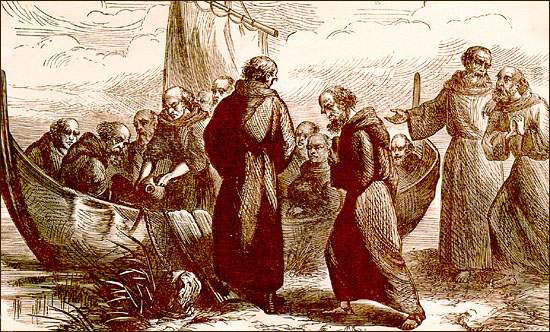
So another native of Kerry, Brendan, that mad seafaring, exploring Irish holy man and his intrepid crew of monks, deserves our respect and admiration just for his seafaring.   According to one medieval account, The Voyages of Brendan the Abbot, he was in his seventies when he made his longest journey, he and his companions in a curragh, a wooden framed boat covered with oxhides.  I doubt any Diocesan insurance policy would support such a venture today!


It always amazes me that so many Christians in the dark ages set off in wee boats with only rudimentary navigation and a strong trust in the Lord.    Small wonder that the nave, the main part of the church, was originally called navis, Latin for boat.


Brendan may have bitten off a voyage too far going up against St. David.  While there’s a good reason that he’s not the patron saint of church summer camps (his rule of life for his monks was rather harsh), David is of course famous as the patron saint of Wales.  For centuries his feast day was a secret known only to the Welsh, until someone leeked it.   OK, that was a terrible joke, and also unkind to daffodils, which are also associated with David.


Of the many legends around his birth, my favourite is that he was baptized by a blind monk, but when water from the font splashed onto his eyes, the monk was given his sight.  Hats off to David’s parents, who entrusted their infant son to a blind monk to hold.


So an interesting matchup, as these two Celtic Tiger Monks go head to head.   If I had to put money on this, which would be a minor sin, I’d go for David by a small margin, but my wannabe Irish heart is with Brendan.


Blessed be their memories.


You can vote here, scroll down for the voting buttons.

https://www.lentmadness.org/2023/03/brendan-of-clonfert-v-david-of-wales/

Thursday, March 9, 2023

Lent Madness: Cuthman vs Leoba

Lent Madness:  Cuthman vs Leoba


No surprise that Chief Seattle has taken his place in the next round of Lent Madness.    Poor Botulph, it wasn’t even close.


So another day,, and two wonderful saints that most of us have never heard of until now.  God is indeed good.


I can’t add much to the lovely story of St. Cuthman except to say that I discovered he is still well remembered in Steyning Parish Church, a short distance from Worthing in the south of England.    He was also remembered in a play called The Boy With the Cart: Cuthman, Saint of Sussex.  You can hear a short piece of audio from that play in which Richard Burton reads the story of how Christ the carpenter helped Cuthman build his church.  


While Cuthman was a simple and holy man, and very much a local saint, Leoba on the other hand was a wise and learned theologian.  If she was alive today, she would doubtless be a respected seminary professor, going to international conferences.    It’s always revelatory to realize that, with the constraints of gender in the early centuries of the church, women could be revered and respected voices.   


There’s a slight crossover with JS Bach, in that both have connections to Fulda in Germany.  


I have predicted Cuthman to get the win here, based largely on the charm of his devotion to his mom, but we’ll see.


You can vote here:   https://www.lentmadness.org/2023/03/cuthmann-of-steyning-v-leoba/#more-22228


Blessings this day,  MP+

Wednesday, March 8, 2023

Lent Madness: Botulph vs Chief Seattle

Good afternoon saintly supporters:

First, apologies for dropping the ball in the last few days, my own halo has definitely slipped.  

In the last few days, we've seen our first real squeaker of a match, in which Blandina narrowly edged past Simeon Bachos,  AKA the Ethiopian Eunuch, by 1 per cent.   Last we've heard, Simeon has conceded and has not made any accusations of electoral fraud, which was a very saintly thing to do.  Blandina's  victory occurred just on the eve of the Feast of Perpetua and her companions, a young woman who was martyred in 2nd century North Africa during another round of persecutions of Christians by the Roman authorities. Perpetua was a young mother and she and four other believers, two of them slaves, refused to renounce their faith and refused to make sacrifices to the Roman gods.   For this they were tortured with wild animals before finally being executed.  There are thus many similarities between the stories of Perpetua and Blandina, and both show the wide appeal of Christianity in the Roman world to those groups - slaves and women - who had the least value in their world.   

During our bible study today, we discussed yesterday's close race between Eric Liddell and Josephine Bakhita.  Several people said they knew nothing about Liddell except his portrayal in the film Chariots of Fire, and no one had heard of Josephine until Lent Madness.  We all agreed that despite the impossible choices of these matchups, the real fun of Lent Madness is just learning about these extraordinary people.   Eric Liddell, sadly, has booked his fiery chariot to take him home and away from Lent Madness. Josephine's life reminds us that slavery persisted in the West well into the 19th century, and indeed still persists in many forms such as sex trafficking and various forms of indentured work.    I like to think of Josephine watching over and protecting those migrants from North Africa still washing up on Italy's shores today.   

Today's matchup includes Botulph, of whom no one really seems to know much.  I did find an article on this Dark Ages Suffolk Saint which said he was a saintly man and a wise teacher, with a side hustle as an exorcist.  One medieval account reports that when he came to build his monastery on the shores of the River Alde, Botulph first had to evict some demons who were squatting there:

At the approach of our blessed teacher Botwulf, the place breathed out a most acrid black smoke, and, not realising that flight was imminent, [the demons] echoed out terrible cries. ‘We have occupied this place for a long time, thought we would occupy it forever, we have got nowhere else ... When the whole world is lit up by your merits, why do you come poking into our dark corners? You are behaving inhumanely, and neglecting all love, in driving us poor things, exiled by the rest of the world, even from this place of solitude.’

So Botulph gets some marks for being tough on demons, even if the account sounds rather plagiarized from Mark's gospel.
 
Chief Seattle certainly deserves to be better known.   While there are stirring words attributed to his famous speech online, they probably have as much credibility as the account of Botulph's exorcism.  However Sealth, to use his proper name, deserves to be remembered as a representative of all the inddigenous peoples who refused to be erased from our colonial history.  The robust presence of his ancestors in our church, and their demands for justice, are a reminder that God works in human history and bends it to God's good purposes.
 
Fearless prediction:  nobody needs to be sleepless in Seattle over this vote, Sealth will triumph and Botulph will finish on Bottomph.

Blessed be their memories.

Cheers and blessings,

Michael

Friday, March 3, 2023

Lent Madness: JS Bach vs Harriet Monsell

Greetings, hagiophiles!


So poor Stanislaus was martyred anew,  and Edmund survived the slings and arrows of Lent Madness to go on to the next round.   


One of the hard-fought lessons of twenty years of ordained service is that clergy and church musicians don’t always get along.  I once knew a music professor, a brilliant organist and choir director, who thought he ran Sunday mornings and ostentatiously did the crossword during the rector’s sermons.  He said the sermons were boring but I always thought he saw church as a performance and resented the times when the focus wasn’t on him.  


I’ve also seen clergy who ran roughshod over musicians, telling them what they could and couldn’t play and not respecting their legitimate contributions to the service.   All of which is to say that I quite enjoy working with Barry, the music director at All Saints Collingwood.  I feel like we are coequal partners working together for the glory of God, which is how it should be.


What a pleasure, then, to learn from today’s Lent Madness post that J.S. Bach was a man whose music came out of a deep personal devotion to God and to God’s worship.    How many Christians have been moved by his compositions, such as his Mass in B Minor and his Passion of St. Matthew.   Friedrich Nietzsche, who was no great friend of our fish, said of Bach’s St. Matthew Passion that ”One who has completely forgotten Christianity truly hears it here as gospel.”


Harriet Monsell served God just as devoutly as Bach, but her service came from her hands and compassion.  Today we are grateful for the gifts of Anglican monastics like the Sisters of St. John in Toronto, but we take them for granted.    It’s lovely to think that women like Harriet, or men like Richard Benson of the Cowley Fathers, were inspired to rekindle the monastic tradition that the English Reformation had pretty much snuffed out.


Just today I met a woman who is an activist, small but full of compassion for the poor, who is very secular and yet totally a spiritual descendant of Harriet Monsell.   Just as our souls thrill to Bach’s soaring masses for choir and organ, so do our hearts moved by those rare people who combine love for God and love for their fellow humans.   


Goodness, this is a hard one.   Will Bach be back for the next round, or will voting for Harriet become a habit? 


Blessed be their memories.  


You can make today's pick here:  https://www.lentmadness.org/2023/03/bach-v-harriet-monsell/

As always, scroll down to see the voting buttons.


Cheers and blessings,


Michael

Thursday, March 2, 2023

Lent Madness: Stanislaus the Martyr vs Edmund (the also martyred)

Greetings Halo Fans!


So another day, another hagiographic smackdown.    First, let’s honour Dorothy Sayers for coming in a surprisingly close second to Enmegahbowh, who I would say is a very strong contender for this year’s Golden Halo.   Dorothy, you can retire to the drawing room, but please don’t leave the house, the Inspector will want a word with you.


Today’s saints both have two things in common, in that they are both saints of national memory, and also that they both suffered a violent death.    It does rather make me wonder why poor Edmund isn’t known as Edmund the Martyr since he was done in by hostile Vikings, whereas Stanislaus, who was done in by his equally hostile boss, gets to call himself “Stanislaus the Martyr”.  Doesn’t seem fair, really.   


So two martyr saints, of which there are many in the church’s tradition.    Stanislaus’ death has strong echoes of Thomas Beckett, killed in his cathedral by a hostile king, and a much more modern martyr, Bishop Oscar Romero, also killed while saying mass.  


Perhaps because of modern terrorism, we think of martyrs today as being fanatics, often violent fanatics, so it’s easy to lose sight of the fact that the word martyr originally meant witness.    In the Christian tradition, a martyr is someone who through their faith and willingness to suffer death pays tribute to Christ who voluntarily accepted his own death.


I mentioned in my comments about Olga of Kiev that the Dark Ages got their name for a reason.   The Netflix series The Last Kingdom is set in the England of Edmund’s time, and not surprisingly is incredibly violent.   The series depicts the death of Edmund, who is much less heroic than he is in legend, a not surprising portrayal given the secular bias in the entertainment industry.


I suspect that Edmund will get the nod because his Englishness will speak to our Anglican biases as voters.    We’ll see.  And speaking of English saints, spare a thought for another English saint whose day it is, St. Chad, a perfectly nice fellow who actually avoided a violent death!


Blessed be their memories.


You can vote here - scroll down to see the voting buttons.


https://www.lentmadness.org/2023/03/stanislaus-the-martyr-v-edmund/comment-page-2/#comments


Blessings this day,


Michael

Tuesday, February 28, 2023

Lent Madness: Monica vs Joanna the Myrrhbearer

In a narrower margin of victory than I expected, Richard Hooker defeated Scholastica, whose name sounds like she should be the patron saint of elementary school book clubs.  Richard goes on to represent Anglicanism in the battle of the Saintly Sixteen.    I’m still working on a motto for him - “HOOKER’S A LOOKER” , maybe?   Let me know if you’ve got anything better.


Monica should be, as I said earlier, the patron saint of mothers worried about the souls of their adult children.   Augustine, as we know, wandered wide and far from the path of faith as a young man before he heard the call.   The story he tells in Confessions of his “conversion” has echoes of the story of Saul becoming Paul in the Book of Acts. As Augustine wrote of Jesus, “Too late I came to love thee”.   Surely, Monica’s prayers for her wayward son must have been at work somewhere.  


John Nava, Study for Saint Monica, oil on canvas, 2003.


Later in life, Augustine regretted the pain he had caused his pious mother:  “I cannot sufficiently express the love she had for me, nor how she travailed for me in the spirit with a far keener anguish can when she bore me in the flesh.  


Augustine had one child, an illegitimate boy named Adeodatus (“Given by God”), who died shortly after his baptism.   Monica had dearly wanted to adopt him and raise him as her grandson, and herself died at fifty-nine.


In a lovely essay in Plough Quarterly, Susannah Black Roberts calls Monica “our spiritual grandmother”.  While was only briefly and tragically a grandmother, Black writes that “all those who have converted after reading the Confessions, and all those whose hearts found rest in the doctrines of God’s grace which he articulated, and all those who have found their household in the church which her son did so much to build: these too are her grandchildren” (https://www.plough.com/en/topics/life/relationships/monica-of-thagaste)


Joanna the Myrrhbearer may have a stronger claim for fame because whereas Monica’s son worshipped Jesus, Joanna knew Jesus and paid his bills.   In that respect, she may deserve to be the patron saint of church treasurers.  


She is mentioned twice mentioned in the book of Luke, once as part of the administrators of the disciples (8:3) and  more famously as one of the women who go to the tomb to anoint (myrrh was a burial spice) Jesus’ body (24:10), only to find the tomb empty.  Thus, Joanna is honoured as one of the first to bear the Christian message, “He is risen!”.   Speaking of tending the dead, Joanna is also honoured by tradition in the Orthodox church for recovering (and presumably burying) the head of poor John the Baptist after his execution. 


Saint Joanna recovering the head of Saint John the Baptist


One wonders, given that the Baptist and Jesus were both popular preachers, and given that her husband worked for Herod's killer, if Joanna paid a price for her faith. Joanna deserves the memory and honour of the church today as a person who had all the advantages of class and power,  but who dedicated her life to following Jesus. 


The connection of myrrh with the Nativity story also links Joanna with the Magi as those who honoured Jesus.   I discovered a wonderful website dedicated to Joanna which calls on us to be “modern myrrh bearers”:

“We can identify the modern equivalent of myrrh in our lives, some intrinsically valuable way of living - controlling our actions and speech - that like myrrh will fight corruption in its modern, cultural sense.  And we can make that thing of value, that myrrh, our gift to Him.  The White Angel will beckon to us, and wait patiently to give us the Good News”.  (https://modernmyrrhbearers.com/what-is-a-modern-myrrhbearer/)


Blessed be their memories.


I am currently three for four in my predictions thus far.  I’ve picked Joanna to go up against Augustine, which would be a blessing to Monica, if you think about it, as that would just be awkward.


You can vote here - you’ll see the buttons when you scroll to the bottom:

https://www.lentmadness.org/2023/02/monica-v-joanna/


Blessings to you this day,


Michael


Monday, February 27, 2023

Lent Madness 2023: Hooker vs Scholastica

Good day Saint Supporters!


So Bertha of Kent sent Olga of Kiev packing in our last matchup, which is probably fortuitous, as "VOTE KENT THS LENT!" is a great slogan, and honestly, I don't know what I would have done with Olga.  So on to today's matchup, by way of an esoteric anecdote.


I studied theology at Wycliffe College, a famously low-church seminary.  One day in chapel during Lent, our principal, George Sumner, was preparing to celebrate.   Our sacristan (the luckless student in charge of worship) noticed that he was wearing a faded blue stole (blue being the colour for Advent) that looked like a rat had been chewing on it.  The poor sacristan knew that purple is the liturgical colour for Lent, and did her best to enforce the rule.”


“Principal Sumner!”, she said, in a horrified whisper, “Your stole isn’t purple!”


“Really?”, he said in his Boston accent, pretending to examine the stole.  “Well, it’s purple enough” and off he went into chapel.


While he didn’t say so, Principal Sumner was invoking the thought of Richard Hooker, one of our saints in the ring today.    Hooker, an Anglican priest and theologian, lived in a time of intense conflict in the Church of England.   Reformed clergy, influenced by the most extreme trends of protestantism as advocated by the likes of Calvin and Knox, were deeply hostile to priestly vestments and any other kind of worship that seemed Catholic.    Conservative clergy looked to the past and wanted to continue some Catholic traditions carried over into the Tudor church.


Hooker was one of those peaceful fence-sitting moderates who seem so rare today.  His response to these church debates was to invoke a Latin term, adiaphora, which means “things indifferent”.  Essentially, Hooker said that whereas Jesus said we must do some things, like remember him during Communion, Jesus didn’t say anything about other things, like customs in worship, so do them if you like or don’t do them, whatever makes you happy.   So Hooker wouldn’t have been greatly offended by a purple stole worn during Advent.  Could any debates over worship in your home parish be settled by someone saying “Adiaphora!” in a loud voice? 


Today we remember Hooker for a huge body of work, including guides on how to read and interpret scripture that we still follow today.   I would say his main contribution was to chart the “media via”, the centre way in Anglicanism that keeps us united despite the differences in style and customs between our congregation


Whereas Hooker definitely lived and wrote (a lot!), Scholastica, on the other hand, is a rather shadowy figure who may or may not have existed.   She was widely known and admired in the early medieval church, and several Anglo-Saxon writers told stories about her, including the charming one about how she prayed to God to send the rainstorm to keep her brother St. Benedict and his companions for a long chat and a (chaste) sleepover.


It was not long after St. Benedict’s pioneer rule for male monastic communities that the first communities for women began to appear in Europe.   Given the celebration of virginity and chastity among women that stemmed from the cult of the Blessed Virgin Mary, it’s not surprising that the first convents had strict rules about sexual morality and chastity.  Scholastica seems to have been most well known to the early church as an example of chastity.  Stories about her were written and used as tributes to real-life, noble born English women, like Hild, the 6th century Benedictine Abbess of Whitby, who played important roles in the growth of the church in England (see https://d.lib.rochester.edu/teams/text/whatley-saints-lives-in-middle-english-collections-life-of-st-scholastica-introduction).


I suspect today that Hooker will win the day over Scholastica because he’s a famous Anglican, and Lent Madness is, after all, an Anglican geek fest.   However, spare a thought for the wise and pious Scholastica, who reminds us that the saints don’t have to be real to inspire us.


Here's the link for voting:  https://www.lentmadness.org/2023/02/scholastica-v-richard-hooker/


Blessings this day,


Michael

Saturday, February 25, 2023

Lent Madness 2023: Olga vs Bertha

Good morning and welcome to this one and only Saturday Lent Madness email from Fr. Michael.   It’s been lovely to hear from some former parishioners and to add some new friends to this list.    It’s a fun project for me to send out these commentaries and I hope you’re all enjoying this Lenten learning opportunity.


Isn’t it interesting that Olga of Kiev comes up for voting around the one year anniversary of the Russia-Ukraine War.  Knowing something of the minds of Scott and Tim, the clerical chiefs behind this project, I’m pretty sure that’s not an accident.


The hair-raising story of Olga and her revenge on the killers of her husband might shock us, though to be fair, Olga has her equally dangerous sisters in Jael and Judith from the Hebrew scriptures and apocrypha  (Judges 5:24-26; Judith 13), perhaps proving what Kipling once said about the female of the species being more deadly than the male.   We might however put Olga in context by remembering that the Dark Ages got their name for a reason.   The world of Bertha of Kent, one of feuding petty kings, was equally dangerous, though Bertha herself seems to a non-bloodthirsty sort of saint.


Olga on the other hand is one of those nationalistic saints of European Christianity whose memory is resurrected in times of crisis and war.    For Ukrainians today, she is one of the symbols of national resistance, and her icon has been morphed into Saint Javelin, an image of the fierce saint in Ukrainian uniform, wielding an anti-tank missile called a Javelin - see https://www.saintjavelin.com/collections/saint-olha

Whether this adoption of St. Olga is blasphemous or an appropriate tribute is a matter of opinion (I’ve heard both).


There's some more discussion on Olga and the Ukraine war here:

https://theconversation.com/saint-olga-of-kyiv-is-ukraines-patron-saint-of-both-defiance-and-vengeance-178019


Bertha of Kent, on the other hand, appears to have been a pious and righteous woman all her life, as opposed to Olga, who converted later in life.  If you were confused by the bio of her on the Lent Madness website, the Augustine she welcomed to Kent was not Augustine of Hippo, who had been dead for some centuries, but another Augustine, St. Augustine of Canterbury.   Augustine was apparently a popular name back then.


The chapel that King Ethelbert gave to his saintly wife still functions today, as part of a two-point parish of the Church of England known as St. Martin and St. Paul (https://www.martinpaul.org/contactus.htm).   Parishioners of All Saints Collingwood or other historic churches can imagine the work of the building committee in maintaining a church that is 1400 years old!   Bertha and her chapel also remind us of something that Bishop Stephen Neill once said about Anglicanism, that those of us who go to the ancient churches of Britain feel a deep sense of kinship with the pre-Reformation past, and sense that this has always been our church.  


I noticed today when I voted on the Lent Madness site that the percentages and totals of votes cast were already displayed before I voted.   I’m hopeful that this is a glitch, as it’s better I think to vote with one’s heart and not with the majority.   That being said, I had thought Olga would do well, given widespread sympathy for the Ukraine, but it appears I was wrong to pick her going forward.   I was right about Florence and Augustine, so I guess I’m two for three so far.  How about you?


Blessings this day.


Michael+

Friday, February 24, 2023

Lent Madness 2023: Florence vs The Count

Walk down the long hallway between the nave and the hall at All Saints, Collingwood, or go to any other church where photos of past clergy are displayed, and starting in the 1970s and 1980s you will see the faces of women deacons and priests.  Indeed, walk into any parish in our Diocese, and chances are good the celebrant and/or preacher will be a woman.   It seems normal to us now, but it was made possible in part because of the life and witness of Florence Li Tim-Oi.


Florence’s call to Christ was made possible by the work of missionaries who took the gospel to Asia in the 1700 and 1800s.   History as we now understand it tries to acknowledge the greed, racism, and violence of imperialism, but as Christians we believe that God works in human history, and the growth of the church in China and Japan is part of God’s work.  Taking the name Florence from her hero, Florence Nightingale, Tim-Oi began her ministry amidst another terrible phase of history, the wars between China and imperial Japan.


Because of the war, the Anglican Bishop of Hong Kong decided to ordain her to do the work of a priest where the male clergy had been killed or rounded up.  Florence carried out her incredibly demanding ministry amidst hunger, fear, and the brutal Japanese occupation of Hong Kong and the surrounding regions.    Often she had to journey in disguise as an old woman to go unnoticed by Japanese soldiers.   There is an inspiring account of her wartime ministry, in her own words, here:  https://montrealdio.ca/li-tim-oi/


I’m not sure what was worse, the attempts of the Chinese Communists after the war to deny her vocation (she was made to cut up her vestments) or the efforts of the Anglican church to deny her ordination to the priesthood.  Florence endured both with patience and humility, and was duly honoured by the church in later life.    Canada was honoured that she chose to end her days in our country and in our church.


Compared to this humble and heroic life, I feel a bit sorry for the odds against poor Nicholaus von Zinzendorf.  As a Count and a German nobleman, he could have had a pretty comfortable life, dressing well, hunting, dancing, consuming copious amounts of schnapps and snuff and whatever else German aristocrats did in those days.


Instead, Nicholas fell in love with Jesus, and devoted his life to living in community with German settlers in North America.    His heart went out to slaves and indigenous peoples, and he lived out his belief, as he said in a sermon, that “There can be no Christianity without community”.   


Nicholaus thus reached beyond the Lutheran church of his ordination to serve the German protestant churches in North America  known as Moravians.    The Moravian Church is one of the oldest protestant churches, committed to the common good, suspicious of wealth and capitalism, and deeply intentional about a common discipleship regardless of race, and it survives here, especially in western Canada.  There is a wonderful statement about Moravian beliefs here:   https://www.rioterracechurch.org/who-are-moravians-


I doubt that Nicholaus will go on to the Saintly Sixteen, especially with Canadian Anglicans whose hearts and votes will likely go to Florence.  But, you know what?  Nicolaus would be ok with that.  As he said in one of his sermons, "Preach the gospel, die and be forgotten. ” 


Blessed be their memories.


You can vote here: https://www.lentmadness.org/2023/02/florence-v-nicolaus/

Scroll down to see the voting buttons.


Wednesday, February 22, 2023

Ash Wednesday Thoughts On The Communion of the Saints

Perhaps it’s because I’ve been thinking about saints lately, there was  moment during our Ash Wednesday worship this morning when I noticed something in the liturgy that I had never thought about before:


Most holy and merciful Father,

we confess to you, to one another,

and to the whole communion of saints in heaven and on earth,

that we have sinned by our own fault in thought, word, and deed;

by what we have done,

and by what we have left undone.


Confessing our sins and offences to God, I readily understand, as we do that as Anglicans whenever we worship.


Confessing our sins and offences to one another, I can understand, as part of being part of the community of the church is a willingness to seek forgiveness and to forgive for the inevitable offences that arise when we live together.


Confessing our sins and offences to the “saints in heaven” however is something that I had never much thought about.    Why would the saints need our confession?   Why would they need to forgive us?


In Revelation, St. John describes seeing “a great multitude that no one could count, from every nation, from all tribes and peoples and languages, standing before the throne and before the Lamb”, worshipping Jesus, who has ‘guide[d] them to springs to the water and life” and ‘wipe[d] away every tear from their eyes” (Rev 7.9-17).


This passage reminds us that we as the church temporal live our allotted time on earth in the fellowship, or communion, of the saints who have gone before us and who are know blessed to be in the company of God.  This fellowship includes all those whose names and acts are known to us (even via Lent Madness!) and those humble saints whose names are remembered only by God, but who are just as loved by God.  


At our bible study today, someone asked if we could disappoint the saints in heaven or “let down the team” if we fall short in our earthly Christian lives, as we inevitably will, being human.    I think it's more helpful to be reminded of the passage in Hebrews, that we are “surrounded by so great a cloud of witnesses” who cheer us on and encourage us as we run our own spiritual races.  


Another way to think of the communion of saints is provided in a lovely recent essay by Peter Mommsen (https://www.plough.com/en/topics/justice/culture-of-life/yearning-for-roots) .  Writing on our fascination with genealogies and ancestry, Mommsen notes even those of us with family trees to research find that within a few generations, our ancestors are merely strangers, whose genetics blur into the vast pool of human DNA.


In contrast, the Bible’s insistence on genealogies, all those “begats”, including the Davidic bloodline of which Jesus’ adoptive father Joseph is part, reminds us that while biological kinship is important to God, far more important than the “transmission of genes” is the “grand intergenerational story into which Jesus was born, the story of God’s covenant with Israel, of sin and exile, and of the promise of redemption”.  In this family, anyone who seeks to do the will of Jesus is our kin.


As Mommsen concludes, “In Christian teaching, this redefined family is known by another name: the communio sanctorum, the fellowship of saints.   In this great intergenerational family, we are linked by a bond of brotherhood and sisterhood to believers from every era of the human story, past, present, and yet to be born”.


Thus, the stories that we read about as we play Lent Madness are really our family stories, stories of our ancestors,  But, unlike a human genealogy such as we might get from ancestry.com, these ancestors exist in the eternal present of God, they see us, and they cheer us on to our own finish lines, when we shall join their blessed company.


What a lovely way to think about Lent Madness!


Blessings this day,  Michael

Mad Padre

Mad Padre
Opinions expressed within are in no way the responsibility of anyone's employers or facilitating agencies and should by rights be taken as nothing more than one person's notional musings, attempted witticisms, and prayerful posturings.

Followers

Blog Archive

Labels