Showing posts with label Christianity and Islam. Show all posts

Tuesday, July 22, 2014

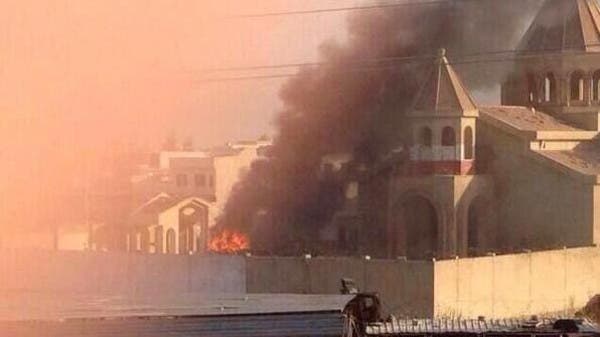
"Even Genghis Khan Didn't Do This": Mosul Empties Of Christians


Several Christian news sites are reporting that jihadists in ISIS-controlled Iraq are marking the homes of Christians with a graffiti tag, the Arabic sign “nun”, the first letter of the word “nasara” meaning “Nazarene” or Christian.   The meaning of the tag is a warning that the Christians must flee or be killed.  Today one of my friends, Gene Packwood, has started using the “nun” sign as his Facebook avatar as a sign of witness.  

While I don’t know how widespread the use of this symbol is in Iraq, BBC News is reporting that a significant expulsion of Christians from parts of Iraq is underway.   The monastic community of Mar Behnam, southeast of Mosul, was given short notice by ISIS fighters to leave, and were forced to abandon the monastery’s relics.   Mar Behnam was founded in the 4th century AD, and has been a pilgrimage site and part of the Syriac Catholic Church.   The BCC also reports that Mosul’s Christian population has largely fled, after being given an ultimatum to leave, convert, or pay an ancient Islamic tribute tax known as the jizya.  A similar ultimatum was given to the Christian community in the Syrian city of Raqqa earlier this year.  The English branch of Al Arabiya reports that an 1800 year old church in Mosul and its library have been burned, and a tomb thought to be that of the prophet Jonah has been destroyed.

Christians mourning this persecution of our brothers and sisters in iraq should also remember that ISIS is doing much the same or worse to Shiite Muslims and destroying their shrines and holy places.   We need to pray for them as well as for our fellow Christians.

it’s tempting to see this mayhem as proof of the irrationality and dangerous nature of religion, but for a broader view, for those who have the time, I recommend a piece by Gregory Gause of the Brookings Institute on how sectarianism is being used as a weapon in a larger Middle East cold war.  Here’s an excerpt.

"The current confrontation has an important sectarian element, but it cannot be accurately understood simply as a 'Sunni versus Shia' fight. Applying such a framework can distort analytical focus, oversimplify regional dynamics, and cause Iran and Saudi Arabia's motives to be misunderstood. Riyadh and Tehran are playing a balance of power game. They are using sectarianism in that game, but both have crossed the sectarian fault line in seeking regional allies. The regional cold war can only be understood by appreciating the links between domestic conflicts, transnational affinities, and regional state ambitions. It is the weakening of Arab states, more than sectarianism or the rise of Islamist ideologies, that has created the battlefields of the new Middle East cold war. Indeed, it is the arc of state weakness and state failure running from Lebanon through Syria to Iraq that explains the current salience of sectarianism. Given how difficult it will be to reconstruct stable political orders in these and other weak states, the likelihood is that the new cold war will be as protracted as the Arab cold war was."


Thursday, June 30, 2011

"We Never Felt We Were Among Strangers"

Second interfaith post for today. I actually noticed this Canadian Press piece in the local paper a few weeks back and meant to post it. The story reconfirms my gratitude for the many gifts that our Mennonite brothers and sisters bring to the church. MP+


By Brenda Suderman (Canadian Press)
Fri Jun 17 2011

Mennonite theologians, Iranian Muslim clerics discuss views of human nature

WINNIPEG — They visited Winnipeg to talk about their theological understanding of human nature, but seven Iranian Muslim clerics also came away with some practical examples of how Christians live and express their faith.


“People were very friendly and it was a warm environment,” Mohammed Fanaei Eshkevari said after attending a Sunday morning worship service at Bethel Mennonite Church.

“We never felt we were among strangers.”

Fanaei Eshkevari and six of his colleagues from the Imam Khomeini Education & Research Institute in Qom, Iran, met at Canadian Mennonite University earlier this month for three days of closed-door discussions with seven Mennonite theologians from Canada and the United States.

It marked the fifth formal meeting between Shia Muslim scholars from Iran and Mennonite scholars, and the first time the dialogue met in Winnipeg. The previous Canadian meetings took place in Toronto and Waterloo.

The Winnipeg event also marked the first time Iranian Muslim women were involved, with nine female graduate students attending as observers and staying an extra week to study peacemaking from a Christian perspective.

Read the whole piece here.

In Afghanistan, Different Faith Leaders Talk Together

An encouraging story from the UK MOD about how Christian military chaplains can help engage with locals in religious dialoge. MP+

Religious leaders meet and forge relationships in Helmand
A People In Defence news article
30 Jun 11

A shura was recently held in central Helmand between local elders and religious representatives of the Afghan forces, Royal Marines and Gurkhas all currently working together in the area.

Members of the Afghan Army and Police, 45 Commando Royal Marines and 2nd Battalion The Royal Gurkha Rifles (2 RGR) are all operating in the Nad 'Ali (South) area of Helmand province.

The shura between their religious representatives came about when the local elders heard that the Gurkhas' religious advisers were planning a visit to the Nepalese soldiers operating in Nad 'Ali (South). They then organised the shura for the representatives of the different religions to come together and discuss the similarities shared by their faiths and forge a better understanding of each other.


Religious leaders representing the Muslim, Christian, Hindu and Buddhist faiths attend a religious engagement shura at Chah-e Mirza in Nad 'Ali (South), Afghanistan
[Picture: LA(Phot) Andy Laidlaw, Crown Copyright/MOD 2011]


Read the whole article here.

Wednesday, March 2, 2011

We have been orphaned today!” A Christian Martyr in Pakistan

A second politician who sought reform of Pakistan's blasphemy laws has been killed.
Back in January when I posted here about Salman Taseer, a man I'd never heard of until his murder by Islamic extremists angry at him for championing the cause of a CHristian woman. Taseer was a Muslim politician who was sympathetic to the rights of Christian and other minorities in Pakistan. Today the Christian cabinent minister charged with protecting those same minorities, Shahbaz Bhatti, was also murdered. AlQaeda and the Pakistani Taliban Movement in Punjab province have taken responsibility for his killing. Bhatti, 42, was a Roman Catholic and Pakistan's only Christian cabinent minister. According to media supports, he was travelling without security the day of his killing.


Shahbaz Bhati

Here is an excerpt from the Globe and Mail's coverage:

With the death of Mr. Bhatti, Pakistani Christians lost their most prominent advocate. Christians are the largest religious minority in the country, where roughly 5 per cent of 180 million people are not Muslim. They have very little political power and tend to work in lower-level jobs, such as street sweeping.

“We have been orphaned today!” wailed Rehman Masih, a Christian resident of Islamabad. “Now who will fight for our rights? Who will raise a voice for us? Who will help us?”

The assassination drew swift condemnation from Christian leaders elsewhere.

A Vatican spokesman, the Rev. Federico Lombardi, said the slaying was an act of “terrible gravity.” He noted that Mr. Bhatti had met with Pope Benedict XVI in September and affirmed his commitment to peaceful relations among the religious communities in mainly Muslim Pakistan. The Vatican said the killing shows the pope's warnings about the danger to Christians in the region were justified.

In Britain, the Archbishop of Canterbury, Rowan Williams, and the Archbishop of York, John Sentamu, expressed shock and sorrow over the killing. “This further instance of sectarian bigotry and violence will increase anxiety worldwide about the security of Christians and other religious minorities in Pakistan,” they said in a statement.

They urged Pakistan's government to protect Christians and bring the perpetrators to justice.

The U.S. ambassador to Pakistan, Cameron Munter, also condemned the assassination, calling Mr. Bhatti “a Pakistani patriot.”


BBC coverage can be found here.

In Mad Padre's opinion, these two murders underscore the quandary of the West's relations to Pakistan. We spend billions of dollars on what we think is an ally against radical Islam, and yet this ally is either unwilling or unable (or both) to protect the rights of its non-Muslim minorities. Going beyond platitudes and trying to extract guarantees from Pakistan for the reform of its blasphemy laws and security of is minorities would likely only destabilize the regime further. It looks we have a losing hand here.

Please pray for the soul of Mr. Bhatti and for all religious minorities in Pakistan.

Mad Padre

Mad Padre
Opinions expressed within are in no way the responsibility of anyone's employers or facilitating agencies and should by rights be taken as nothing more than one person's notional musings, attempted witticisms, and prayerful posturings.

Followers

Blog Archive

Labels