Showing posts with label Remembrance Day. Show all posts

Saturday, November 9, 2024

The End of History? A Homily for the Twenty Fifth Sunday After Pentecost (Yr B)


A Homily for Remembrance Day and for the Twenty-Fifth Sunday After Pentecost, Preached at All Saints, Collingwood, Anglican Diocese of Toronto, 10 November, 2024.

Year B Texts for this Sunday:  Ruth 3:1-5, 4:13-17; Psalm 127; Hebrews 9:24-28; Mark 12:38-44


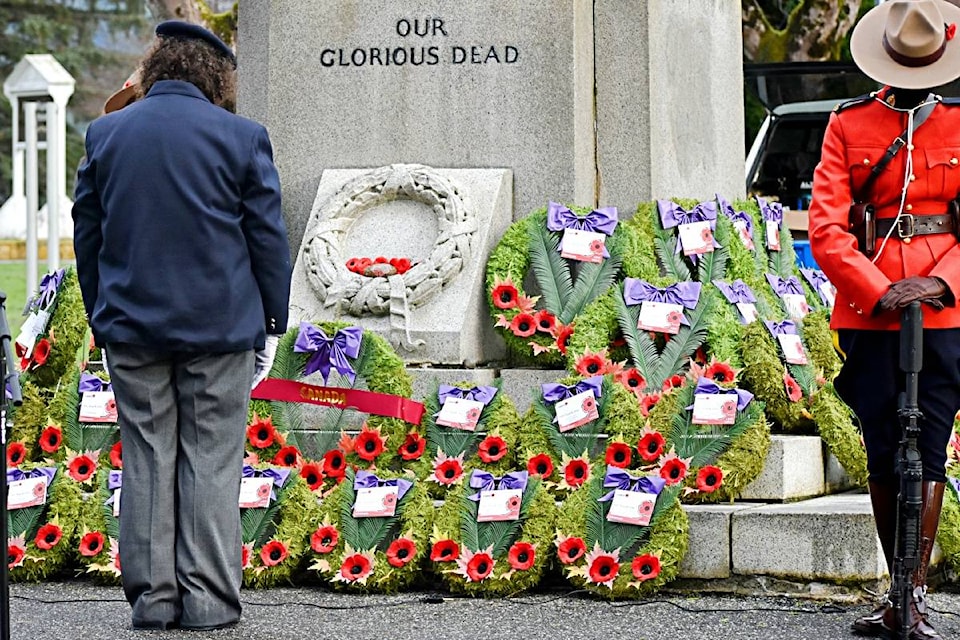
One of my abiding memories of Remembrance Day is of standing beside my father at the cenotaph.   Even in old age, he would stand erect, as he was taught as a youth on the parade square.  Remembrance Day was the only day I would see his medals, pinned to his coat - medals from the Second World War, from Korea, and from his Cold War service.


The men and women of his era are almost all gone now, and yet they gave us the world we grew up in and took for granted.  It was not a perfect world, but it was a reasonably stable one.  We had clear ideas about freedom, democracy, human rights, and international law.   We believed that smaller countries should not be invaded and brutalized by larger ones.   Then, in the 1990s, the Berlin Wall fell, the Cold War ended, and we all thought we’d come to a good place,  thanks to the work started by the greatest generation.  Some people even said that we had come to the end of history.


History never goes away that easily, and this week it seems like we’re in a new and ominous era of history.  On this Remembrance Day, it seems as if all the good work and sacrifice we remember is in danger of being lost. The world is getting darker, and is being carved up by despots and strongmen.   For decades we looked to America to protect and defend us, but after this week it’s clear that America is turning inwards, trusting in a strongman for protection and greatness.   Smaller countries like Canada now feel exposed and vulnerable.  If anyone is going to protect our values, it will have to be ourselves, assuming that we can still agree on what our values are.


Where we go from here is a conversation about civics and politics, and indeed, Remembrance Day, at least at during public services at the cenotaph, has always been about civics and politics.    Remembrance Day for the church, well, that’s a little more complicated.    Yes, we want to give remember and to give thanks for those who went before us, and yes, we pray that something good may come of their sacrifices.


At the same time,  I think that we the church must never forget that that God is greater than human history.   On Remembrance Day we are Canadians, but we are also followers of Jesus Christ and citizens of his kingdom.  We never see the kingdom of God clearly in this life, we only catch glimpses of it.   That’s because the kingdom of God  is found somewhere between hope and future, but it is real and it is the answer to all of our fears and darkness.    Our second lesson from Hebrews reminds us that “has appeared once for all at the end of the age to remove sin by the sacrifice of himself” (Heb   ).    In other words, the forces of fear, darkness, and hatred have already been defeated because Jesus carried them to the cross for our sakes.


Because the letter of Hebrews was written to a Jewish audience that understood the rituals of the Temple in Jerusalem, the message for that audience would have been clear: Jesus’ sacrifice on the cross  is the only sacrifice that matters, because it was done once for all.  Without the cross, all the efforts of all the priests, all the rituals, all the animal sacrifice, would be in vain, and sin and suffering would continue.


For us as Christians at Remembrance Day, I think we can draw a similar conclusion.    While we honour the sacrifices and the victories of the past, we also acknowledge the final sacrifice and the victory of Christ.   Without Christ, we would be trapped in an unending history of sacrifice and suffering, but, as Hebrews reminds us, we are “eagerly awaiting” the return of Christ that will truly be the end of history.


Eagerly waiting for Christ’s return does not mean that we are fatalistic, ignore the problems of the world,  and wait for pie in the sky.   Jesus gave his followers work to do in the meantime, the work of loving God and loving our neighbour.  In our gospel reading today, when Jesus notices the widow, he isn’t just praising her piety, he’s asking who has reduced her to such poverty (Mk 12:38-44), because the kingdom of God is also a kingdom of justice.  So yes, we have good work to do. We need to notice those that Jesus notices, and care for those he cares for. A dark world needs those who witness to the light, as Christians have been doing for two thousand years.    Maybe now more than ever, our neighbours need us to be a people of light and hope.


As I noted this week in our parish newsletter, we are a few weeks away from Advent.    Advent is a time of waiting for the return of the king.  It’s a time of trust that God will set the world to rights.   It’s a time when we light candles to show that we keep faith in the darkness.      So if the events of this week have left you troubled and fearful, then let us keep Advent with hope and confidence, trusting that Christ, the Alpha and Omega, will come to free us from darkness, free us from sin, and free us from history.


Tuesday, November 14, 2023

Guest Homily: The Rev. Canon Gordon Mintz on Remembrance Day Sunday

The Rev. Canon Gordon Mintz is a retired Canadian Forces Chaplain and part of our clergy team at All Saints, Collingwood and our Regional Ministry of South Georgian Bay.    Here is the text of the sermon he preached here at All Saints for us last Sunday.


The texts read for this Sunday:  Wisdom 3:1-9, Psalm 78:1-7; 1 Thessalonians 4:13-18; Matthew 25:1-13


Today we gather in a world rife with conflict in the Holy Land, Ukraine and many other places and yet in the midst of this trial, tribulation and angst - part of what we do today is remember and give thanks. We do not glorify war or the human lusts for power and prestige that that are often behind oppressive conflicts. But we do commemorate the selfless commitment and dedication shown by the soldiers – Canadian daughters and sons who fought so bravely at places like Afghanistan, Korea, Passchendaele and Vimy Ridge.  As Christian this is so much more than an act of remembrance.  Our scriptures today invite us to delve into a belief that shapes us, a gratitude that molds us and a faith that re-members us, that reconstitutes us, and forms us as Christ-followers.


This has echoes of our great remembrance in the Eucharist. When we remember the sacrifice of Christ and what He did for us, we partake in its deep meaning and the real and life-giving presence of Christ in which our faith is re-membered, re-appropriated, and entered into fully shaping us, our belief and therefore our choices and behaviours psychology tells us.   Eucharist means giving thanks. When we remember the sacrifice of our soldiers, sailors and air women and men we fully partake in the gift they have given us - the freedom they fought for that we are the beneficiaries of.  That belief, that faith, was their driving motivation.


Belief is so important. Psychologists know that Belief informs and shapes behavior – you will likely have heard that phrase that “perception is reality”. Of course, this kind of relativism is not a truism. It is true that while our internal perception does not define external reality, one’s perception can become one’s reality. This fact makes theology and faith even more important in shaping our worldview and especially what is ultimate reality and we see this theme in our scriptures this morning.  What we believe about the world and ourselves and the meaning of it all is the framework from which we choose how to behave and our emotional responses to the journey before us. 


This perception and reality tension was perfectly illustrated for me by a young airman I was deployed with on Op Unified Protector. This was the UN mission to protect the Libyans from the violence being perpetrated by Gaddafi. It was James’ job to go out and paint the bombs dropped in combat on the nose of the fighter jets which is a long-standing tradition. He was so enthused for this task at the beginning of the deployment, but remarked one day, “Padre, this is not as fun anymore”. The reality of the destruction and collateral damage changed his perception even in what was seen as a just cause. It yielded a great opportunity to have a significant conversation about values and purpose and what motivated him. 


What did our veterans believe they were fighting for?  That was clear – they fought as gift for us - a gift of a free world.  They were inspired by the firm belief that God was calling them to stand against tyrannical forces to give us a better future.  Some would say it is and was all such a waste.  Unfortunately, to see Afghanistan return to many of its previous ways reinjures our soldiers who fought and were affected by that way and seems to negate the sacrifice of our soldiers. This is exactly what our scripture from Wisdom refers to in verse 2 In the eyes of the foolish they seemed to have died, and their departure was thought to be a disaster.

However, we are reminded that though it was a great sacrifice it was not at all a waste  

1 - But the souls of the righteous are in the hand of God, and no torment will ever touch them. And verse 9 continues Those who trust in him will understand truth, and the faithful will abide with him in love, because grace and mercy are upon his holy ones, and he watches over his elect. 


This is the belief that shapes us and the gratitude that re-members us and reorients us to divine things and ultimate realties.  Matthew reminds us that we will hear of wars and rumours of wars; (6:24) and exhorts us saying see that you are not alarmed; for this must take place. Wars, famines and earthquakes will all happen and are called the beginning of the birth pangs (v.8). We can hear the sense of expectancy, something new coming, a divine purpose unfolding.


Our opening hymn picked up on this theme as well with its imagery of another country, another ultimate reality, and did you notice its notable properties - her fortress is a faithful heart, her pride is suffering; and soul by soul and silently her shining bounds increase, and her ways are ways of gentleness and all her paths are peace (opening Hymn – I Vow to Thee, My Country, words: Cecil Spring)


The psalm (116) also echoes this theme of belief that shapes us:

3 The snares of death encompassed me;

   the pangs of Sheol laid hold on me;

   I suffered distress and anguish. 

And here we have the hinge of belief where this passage turns

4 Then I called on the name of the Lord:

   ‘O Lord, I pray, save my life!’ 

8 For you have delivered my soul from death,

   my eyes from tears,

   my feet from stumbling.


The fruit of belief couldn’t be clearer. Continuing our tour of this theme in this morning’s readings, we jump to 1 Peter where Paul talks of the fruit of belief as the outcome of your faith:

8 Although you have not seen[b] him, you love him; and even though you do not see him now, you believe in him and rejoice with an indescribable and glorious joy, 9 for you are receiving the outcome of your faith, the salvation of your souls.


The re-membering and shaping function of faith and gratitude is explicit and is ours to grab hold of as the fruit of faithful yearning for Christ, for truth, for justice and for peace. 

Finally, our gospel highlights the same redemptive theme of belief being the key to our salvation and changing of our worldview and eternal circumstance.

John 6.40 This is indeed the will of my Father, that all who see the Son and believe in him may have eternal life; and I will raise them up on the last day.”


The reality is we live in a broken world that can be painful and even violent. But our spiritual resilience, like that of our soldiers, is buttressed by having our perception informed by the reality, the fact, that God is still on the throne. There is a Divine purpose unfolding no matter how chaotic our world looks. Perhaps most importantly, you and I are invited and even called to be instruments and participants in God’s plan of salvation and victory. We don’t need an army to do that – we need the fortress of a faithful heart. 


God’s ultimate promise for us is that God will dwell with us – Immanuel – God with us. There will be no more mourning, no more crying, no more pain. We will get out of our cycles of violence and war because all of that both has been, and will be, gathered up in Christ the Prince of Peace. Right remembering is about more than setting aside a day in a year to remind ourselves of the historical facts. Remembering rightly is about what we believe and how we live and in the light of the gifts of sacrifice at Vimy, Passchendaele, Juno Beach and so many others.  And even more importantly, remembering is about appropriating anew the victory Christ won for us against sin and oppression.  Because that my brothers and sisters is the foundation of the redemption and purpose laid out in our scriptures this morning.  That is the “so what" of this remembering. It is so much more than a poppy worn in gratitude and remembrance. It is a thanksgiving that shapes us and draws us back into God’s plan and purpose for a world where swords are beaten into ploughshares and tyranny and oppression are forever defeated. But this is a costly victory. Many have given their lives for it including our Lord and Saviour. 

We will remember them! Amen.


Mad Padre

Mad Padre
Opinions expressed within are in no way the responsibility of anyone's employers or facilitating agencies and should by rights be taken as nothing more than one person's notional musings, attempted witticisms, and prayerful posturings.

Followers

Blog Archive

Labels