Showing posts with label All Saints King City. Show all posts

Saturday, April 30, 2022

A Farewell Homily to All Saints, King City

Preached at All Saints, King City, Anglican Diocese of Toronto, on the Third Sunday of Easter, 1 May, 2022.

Well it’s time to say goodbye and time to say thank you.  Thank you for the privilege of being your priest for almost two years.   It was a long interim by normal standards, but these last two years haven’t been normal times, have they?  

I’m grateful to all of you for your kindness and hard work in keeping the church going through Covid.  When I came in on Thursday and saw so many busy people setting up for the rummage sale, I realized how much pent up energy and muscle memory has been there all through these last pandemic years, just waiting to be unleashed as we return to normal, whatever normal will look like in the years ahead.


Speaking of the pandemic, I’m grateful for those of you who gritted your teeth and learned to Zoom and who proved them wrong about old dogs and boomers not learning new tricks.  I’m enormously appreciative of the faithful who gathered to pray online, or who returned to the pews to pray with masks and, to be honest, some nervousness.   I’m thankful for those of you who continued to faithfully support the church in all the months when we couldn’t (and still don’t!) pass the collection plate.   For all of you who joined the PAR program, thank you, and for those of you who haven’t yet, there’s still time (I can’t resist one last stewardship appeal!).


So today’s very short homily is built around the idea of thankfulness.   In my life I’ve worked in academia and in the corporate sector, in the military, and in the church, and I’ve learned that the best leaders are the ones who say thank you with sincerity and with frequency.   Being thanked is how people know that they are members of a team and not just resources to be exploited.


That being said, the church is slightly different.   Clergy aren’t leaders in the secular sense, though leadership is part of the job, to be sure.   I’ve always believed that the clergy’s role is primarily to point to Christ and to remind congregations that they are God’s people, living in the kingdom of God and living out kingdom values.   In the church, all thankfulness is ultimately directed to God, to whom, as our eucharistic prayers remind us, “it is right to give our thanks and praise”.


God gave us God’s Son to remind us that we loved, forgiven, and given new life.   As followers of Jesus, we are remade as God’s people, called as light and hope for the world around us.   All Saints has been faithful to that call since 1857.   The saints have gathered here in King through good times and bad, through wars and depression and multiple (!) pandemics.   Thanks and praise has been offered through times of hope when a new church was built, and thanks and praise continued as the new church attracted fewer and fewer people as the culture seemed to turn away from God.  Since 1857 priests have come and gone, some more successful than others, but God was always here, the love of Jesus always called you forward, and the Holy Spirit always empowered the saints.


So today I thank God for you, the people of All Saints, the latest of the generations to whom God has been faithful to.    I’m thankful that God has given you a talented and dynamic new priest whose vision and hopefulness will inspire you.   I’m thankful that God has blessed you with financial resources that many churches lack, and I’m sure you’ll use them well.   I’m thankful that God has given you the resilience and creativity to adapt to new ways of doing and being church.   You will need that creativity in the years to come.  Finally I’m thankful to God for bringing us fellow disciples who have come to Canada from countries scarcely known when this church began in 1857.    As we saw so wonderfully on Easter Sunday, the future of the Anglican church is global, and I encourage you to embrace more refugees, more new Canadians, and more diversity.


Finally, dear saints, I’m thankful that Joy and I have been part of your story.   We’re thankful for your warm welcome, we leave a part of our hearts with you, and we assure you of our prayers for the bright future that certainly awaits you.


Sunday, April 24, 2022

Words of Peace: A Sermon for the Second Sunday of Easter


Preached at All Saints, King City, Anglican Diocese of Toronto, King City, Ontario.  The Second Sunday of Easter, 24 April, 2022.

Acts 5: 27-32; Psalm 150; Revelation 1: 4-8; John 20: 19-31 


19 When it was evening on that day, the first day of the week, and the doors of the house where the disciples had met were locked for fear of the Jews, Jesus came and stood among them and said, “Peace be with you.”

 Today I want to talk about a particular aspect of our liturgy, the Sharing of the Peace, and about how that action in the middle of our service becomes hugely meaningful in light of today’s gospel reading from St. John.   The risen Jesus appearing to his disciples, his threefold greeting “Peace be with you”, and the grace, forgiveness, and affirmation inherent in this greeting to these disciples who abandoned and betrayed Jesus before his death, all help us understand the special greeting that we exchange right in the middle of our Sunday service.

 The Peace as an action, that moment when we move around and deliberately greet one another, is a relatively new in Anglican worship.    Some of you will remember that in the old Book of Common Prayer, there was a formal exchange between the priest and people just after the Prayer of Consecration:

 The peace of the Lord be always with you.

People.  And also with you.  (p. 83)

 Then with the Book of Alternative Services, the Peace moved to a place just after the confession and absolution.  The words were the same as the BCP, but the BAS liturgy encouraged the people to “greet one another in the name of the Lord”.

 It seems like The Peace is different in every parish.   I’ve been in grand stone cathedrals where people sat as far apart from one another as they could, and exchanged brief glances and slight nods at one another during the Peace.   Other parishes are much more exuberant.   People shake hands, hug, chat, seek out and welcome strangers, and it often takes a long time to call you back to order.  I suspect that you at All Saints were the chatty. Huggy type before Covid, and will be afterwards.

 Not everyone shares the Peace in the same way.   It’s one of those moments where our extrovert and introvert personalities are clearly on display.   The important thing is what we _say_ during the Peace.  Most of us say something like “God’s peace be with you”  or “The peace of Christ” or just “peace”.   Why do we use these words rather than a phrase that we might say if we greeted one another on the street, like “It’s nice to see you” or “how are you” or “how’s it going?”

 Surely the answer to this question lies in the link between our liturgy and today’s gospel.   What happens between the risen Christ and his disciples in that room makes it possible for us to say these words to one another.  The fact that Christ says “peace be with you” to these people huddled behind a locked door allows them to let go of their fear and guilt and start the process of becoming the church.    Christ’s saying “peace be with you” gives the disciples, and us, a way to imagine our own identities as church, as an Easter people.  So, the words “Peace be with you” in our greetings during the liturgy are important because peace is Christ’s great gift to the disciples in John 20, and to us today.

Let’s take a moment to remember the context of today’s gospel, to better see how powerful Jesus’ words of peace are to the disciples.   In the first half of John 20, Mary Magdalene has seen Jesus in the garden, outside his tomb, and has told the disciples about her meeting him. We would think that they might have been filled with hope and joy by Mary’s report, and that they might be out searching for the risen Christ, but to the contrary they are barricaded behind locked doors.  We are told that the disciples are fearful for their lives; certainly the detail that it is nighttime, when they would be most fearful is relevant.  

 Jesus comes in the middle of the night, stepping into their fear, shock, grief, and mourning.    He passes through the locked door as if to say that their fear and self-protectiveness don’t matter.   He comes to confirm the words of Mary Magdalene and the hope which the disciples don’t seem to allow themselves to believe.  He comes despite his own death, in his physical body with the wounds still on him, and he says “Peace be with you” and when he says these words, he says let go of your fear, for fear and grief and mourning and the dark of night have lost their power over me and over you.

 The first thing we can say about our sharing of the peace is that our action in the liturgy takes its meaning because of the resurrection of Christ.  We share the Peace in a place where there may be memories and even ghosts for some of us.   We can look around this church and see where saints now departed used to sit,  but when we say “Peace be with you”, we are reminding one anther that we are an Easter people, following the same Christ who rose from the grave and who undid the power of death.  We are reminding ourselves to let go of our fears, of our concerns for the seemingly unforgiving power of age and mortality over our bodies, and to remind one another that as the Lord is risen, so those we love and mourn are safe in his keeping, and that we will see them again on the day of resurrection.   By saying “Peace be with you”, we say, “May life, and hope, and joy, and promise, be with you”.

 The second thing that connects our sharing of the Peace with the words of Jesus in the locked room is the context of forgiveness and reconciliation.   We know from the passion stories of the other gospels that the disciples have let Jesus down in many ways.  They could not stay awake in the garden when he asked them to keep watch with him, they deserted him when he was arrested, and Peter, who swore that he would never abandon Jesus, denied knowing Jesus three times.   Presumably the disciples, particularly Peter, are feeling guilt and remorse as well as grief, and yet when Jesus comes he does not accuse or reproach them.   His words “Peace be with you”  are words of forgiveness - he gives the disciples peace from guilt and self-loathing.

 Thus, the second thing we can say about our sharing of the peace is that it is connected to the church’s work of forgiveness and reconciliation.   When Jesus says to the disciples,  “If you forgive the sins of man, they are forgiven them if you retain the sins of any, they are retained” (Jn 20:23) he is also speaking to us.    Our act of sharing the Peace comes after the confession and absolution.   The knowledge that we as imperfect people are forgiven our sins allows us to face on another and to remind us that we all enjoy that same grace and love.    All of the frictions that are part of church life - our ways of stepping on one another’s toes, saying unkind or impatient words, our foolish rivalries over our roles and ministries - these all must be set aside if we are truly to receive the Peace that Christ gives us from our own sin and guilt.    By saying “Peace be with you”, we say “I’m sorry for what I’ve done, and I forgive you for what you have done.”

 The third thing that connects our sharing of the Peace with the words of Jesus in the locked room is the context of doubt and imperfect belief.    Thomas is the one disciple who cannot believe, despite the testimony of Mary Magdalene who saw Jesus in the garden and the disciples who saw him previously in the locked room.   He has essentially called his friends liars, or at best, deluded.   And so when Jesus says “Peace be with you” the third time, it seems directed specifically to Thomas and to his scepticism.  His words “Peace be with you” are again words of forgiveness, but also words of hope and encouragement, as if to say, “Thomas, you will believe”, and they lead to Thomas making the most fulsome profession of faith of anyone in the gospels, “My Lord and my God!” (Jn 20:28).

 Thus, the third thing we can say about our sharing of the peace is that it is connected to our doubts as much as to our faith.   We may call ourselves a people of faith, but our faith is not uniform.  Not all of us may believe as readily, or as completely, as do those around us, but when we say “Peace be with you”, we are saying that it’s ok to be where you are in you own journey of faith.   The exchange of “Peace be with you” removes our temptation to apply some sort of  faith test and to want to think that we have to be some sort of super-believer.   The words “Peace be with you” gives those who need it permission to be a Thomas.  For those who are doubtful, to hear and receive the words “Peace be with you” is to be told that it’s ok to be doubtful, that lack of faith is not a sin, but rather is merely human.  At the same time, the words “Peace be with you” opens the possibility that the work of the Holy Spirit will bring a person to also say, with Thomas, “my Lord and my God”, and for the doubtful this may be exactly the sort of encouragement they one day need.

 There are of course other scriptural lenses through which we can view and better understand this important part of the liturgy.  Of course there is the Hebrew sense of peace as shalom, the fundamental value and gift of the kingdom of God. Jesus’ breathing on the disciples and his words “Receive the holy spirit” remind us of the vision of the valley of the dry bones in Ezekiel (37:1-14), or of the story of Pentecost (Acts 2), which speak to the Holy Spirit’s work of revival and unification which make the church possible.   Sharing the peace can draw us out of isolation and into community, it brings us together regardless of age or race or class, and makes us one.    But in the light of John 20, we see the Sharing of the Peace as what it is, a sign of grace from the God who loves us, forgives us, gathers us together and empowers us to go on - and these are things that we can do for one another when we turn to them, extend a hand, and say “Peace be with you”.


Sunday, April 17, 2022

The Stone was Moved - A Sermon for Easter Sunday


Preached at All Saints, King City, Anglican Diocese of Toronto, 17 April, 2022.   


“Early on the first day of the week, while it was still dark, Mary Magdalene came to the tomb and saw that the stone had been removed from the tomb.” (John 20:1)


Just as Dickens’ begins A Christmas Carol by telling us that we have to understand that Marlowe was “as dead as a doornail” if anything wonderful is to come from the story to follow, the first thing we need to understand about Easter Sunday is that there was a stone. 


In the resurrection story, in each of the four gospels, the stone is mentioned. It was a big stone, a boulder. It needed to be large enough to close an opening that, at the very least, would have allowed a crouching man to enter. In Matthew’s gospel, we are told that Joseph of Arimathea had a “great stone” rolled in front of the tomb of Jesus (Mt 27:60). Matthew adds that the stone is there to stay, because the chief priests have it “sealed” to prevent the disciples from stealing the body (Mt 28:66). In Mark’s gospel, the women want to go to the tomb to anoint Jesus’ body, but they know that they will need someone to “roll away the stone for us from the entrance to the tomb” because the stone is “very large” (Mk 16:3).


Today we don’t use stones to seal graves, but we still seal them, at least on those increasingly rare occasions when the dead are not cremated. Stand by a graveside after the family and the mourners have left, and you’ll see the men in coveralls come out from hiding. While the funeral directors watch attentively, the truck is positioned and the vault lid is hoisted down into place. The hydraulic crane makes it look light, until you hear the thud as the lid falls into place.


 Then the green astroturf covers are removed from the mounded dirt, and the backhoe gets ready to do its work, sealing the vault with the weight of all that earth. It’s done quickly and efficiently, and there’s a kind of ministry to it as these men close the graves of our loved one and make it possible to nature to do it’s healing work. Grass will grow, the wound in the earth will heal, and the place will become peaceful. But it’s impossible to watch this work and not be tempted to think, how final this is, how irreversible it is is. In this respect, the vaults and lids of our loved one’s graves, like the stone in front of Christ’s grave, underscore the terrible reality of death. Death, like stone and concrete, is real, cold, heavy, and final.


If you’ve ever stood beside a bed in a hospital or a nursing home after a death, you will know this feeling. Slowly it dawns on you that the person you loved is gone from you, removed as surely as if they had been sealed behind a great stone. I well remember the feeling as I helped my brothers empty my father’s room after his death. We worked mechanically, each of us aware of the terrible finality of the moment. The man who had raised us, inspired us, and loved us was gone. To be sure we had memories, we had his example, and we had some keepsakes, but our father was gone. No more corny puns, no more chances to say I love you, no more squeezes of his hand. The great rock that separates us from the dead had been rolled into place and sealed him away from us.


Given the reality of death, it’s difficult for many Christians to take Easter that seriously. I personally know some who tell me that it’s ridiculous to believe in the resurrection. Such people might say that Easter is merely a poetic way of saying that Jesus lives in our hearts and lives as a spiritual presence, like my father lives by example and memory to me and my brothers. But tell such people that a great stone was rolled away, that Jesus returned from the land of the dead, and you are asking too much of them.


“Early on the first day of the week, while it was still dark, Mary Magdalene came to the tomb and saw that the stone had been removed from the tomb.” (John 20:1). 


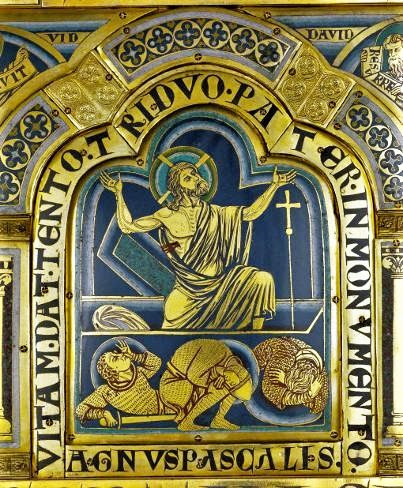
In medieval art, Jesus is sometimes depicted as emerging, not from a cave, but from what looks like a stone vault or sarcophagus. A heavy looking lid has been tossed to one side, as casually as a sleeper might throw back the covers in the morning. The figure of Jesus is muscular, his expression determined as he raises his hands to heaven in triumph and thanksgiving. 


This picture reminded me of the force behind the event that John is describing. The Easter story begins with this sign that God has done the unbelievable. That great rock, so final, so immovable, has been brushed aside by God’s power. All through our Lenten journey we’ve heard hints of this power, such as the voice that calls Lazarus from his tomb. All these stories have suggested what God has sent Christ to do. Now the promise is fulfilled. The rock is moved. Jesus is walking in the garden. Death has no dominion. Nothing is beyond the power of God.


A preacher once said,  “No Easter, no faith”. These are words that challenge us to believe big or go home.  As St. Paul reminds us, "if Christ has not been raised from the dead, our preaching is useless and so is your faith (1 Cor 15:12-20ff).  If we don’t want to accept a God who blows the lids off graves and brings the dead to life, then our preaching and our worship our empty. But if we want a Saviour who can move boulders, revive hopes and bring us to life, then our worship is glorious and our hopes our rich and we are to be envied, not pitied.


Go forth and believe big. Ask God to remove the biggest boulders in your lives: the stones that keep our hearts from loving, the boulders that we can’t let go of because of our guilt and shame, the heavy rocks of grief that lock us away from the world. When these stones seem too big for you, you’ll find a muscular and living Saviour, putting his shoulder to them and rolling them away, and calling you forth into the light. 


Go forth today and love big. The love of Jesus for us was so big that he went to the cross for us. His love for us was so strong that it brought him back from the dead, because he knew that there were people like Mary in the garden, like you and I, that needed his love. Receive his love, draw strength from it, and share it with others.


Go forth today and trust big. For those of us with loved ones on the other side, who have let them go behind the heavy lid of death, don’t lose heart. Nothing can keep us from the love of God and the life of God. Those rocks and stones will be moved, and the dead will be raised.


“Early on the first day of the week, while it was still dark, Mary Magdalene came to the tomb and saw that the stone had been removed from the tomb.” (John 20:1). Alleluia, Christ is risen.

Sunday, April 10, 2022

A Mind Is A Terrible Thing to Waste: A Homily for Palm Sunday.

Preached on Sunday, 10 April, 2022, at All Saints, King City, Anglican Diocese of Toronto.  Readings for this Sunday:

Isaiah 50:4-9a, Psalm 31:9-16, Philippians 2:5-11, Luke 22:14 – 23:56


“Let the same mind be in you that was in Christ Jesus” (Phil 2:5).

Do you want to improve your mind? I can’t think of anyone who wouldn’t want to improve their mind. If you’re a parent, you want your children to develop their skills and be good learners. During our careers we are challenged to be active in continuing education and professional development, to keep our skills sharp. Seniors too are encouraged want to keep the mind active to stave off dementia, whether it’s doing crosswords, reading, taking courses at night school, or learning languages or, of course, Wordle.

All of these pursuits pale in comparison to what we are asked to do as Christians. Today, in our second lesson, we hear Paul’s challenge to “Let the same mind be in you that was in Christ” (Phil 2:5). Do any of us really think that we can do this extraordinary thing that Paul is asking of us? Surely Jesus had no ordinary human mind. He knew things that others didn’t, as we saw three weeks ago when he knew the secrets of the Samaritan woman at the well (Jn 4). He had the mind of a great and serene thinker. His mind was full of great love and patience, even at the end of his life. Our minds however are cramped and undisciplined, full of dark and worried thoughts. How could our minds ever become Christ-like? I suspect that if we voice this objection to Paul, he would say “Exactly! That’s exactly why you need the mind of Christ”.

What can we say about this mind that Paul wants us to have? At the beginning of our second lesson, Paul says clearly that Christ “was in the form of God” and had “equality with God” (Phil 2:6). Paul suggests that Jesus, as one of the three persons of the Trinity, knew God completely, including knowing the mind of God. That for me, if you’ll pardon the expression, is a mindblowing passage I can’t imagine anything more beautiful or peaceful than knowing the mind of God. For Jesus to set that glory and equality aside and come to earth to be one of us is an amazing testimony to how much God loves us and wants to help us.

After Jesus became human to serve us, how much of God’s mind did he still know? In his book Simply Christian, Bishop Tom Wright says something that I found helpful. He thinks that Jesus didn’t walk around knowing that he was divine the way you and I know if we are hot or cold, male or female. Wright suggests however that Jesus knowing that he was part of God’s mission. Because of his deep prayer life and his sensitivity to God’s will, Jesus knew that “He was called, in obedience to the Father, to follow through the project to which that love would give itself freely and fully” (p. 119). To that extent, we can say that Jesus knew the mind of God better than any person who ever lived. To borrow the title from a recent movie, Jesus had a beautiful mind, fully aware of God’s love and God’s desire to rescue his creation from human sin.

If we go beyond these generalities and look at the rich feast of scripture for today, Passion Sunday, we can say some specific things about the God-mind of Christ that Paul wants us to have.

Jesus has a humble mind. He sets aside his equality. In Paul’s wonderful phrase, he “emptied himself”. Yes he comes into Jerusalem like a king, but there is no chariot, no army of grim soldiers with sharp swords, only a simple figure riding a donkey. He doesn’t put on airs, he doesn’t strut, he doesn’t ask for special treatment. He doesn’t want to be an earthly king because he knows the limits of earthly power.

Jesus has a determined mind. In our first lesson, Isaiah says of God’s servant that “I have set my face like flint” (Isa 50:7). If you look at the face of the simple man riding that donkey, you don’t see a meek and mild face. Instead you see a face as intent and as resolved as any athlete or soldier. You see someone who isn’t fooled by the crowds and the hosannas, who knows that pain and death are at the end of the road, someone for whom there is no turning back.
Jesus has an alert mind. He is, as Isaiah describes him, the “teacher” who comes to help the weary (Isa 50:4). In the garden of Gethsemane, we see him literally as the teacher who is surrounded by sleepy students. Jesus alone stays awake and alert, ready to do what god wants him to do, waking others from sleep.

Jesus has an obedient mind, obedient as Paul says “to the point of death – even death on a cross” (Phil 2:8). He is human enough to want to live – twice, Matthew describes him in the Garden of Gethsemane, asking his Father to spare him (Mt 26:39, 42) – but when he sees Judas come with the soldiers, Jesus accepts the job God has given him, the job that only he can do.

Jesus has a loving mind. In Matthew’s account of the last supper, we see Jesus spending his final hours with his friends. The disciples don’t know it yet, but in giving them bread and wine Jesus is showing them how he will give himself for them on the cross, “for the forgiveness of sins” (Mt 26:28). Jesus can look around the table and know that some of these sins will be in the future – betrayal, denial, fear – and yet his love for these ordinary people rises above any anger or disappointment that he might understandably feel.

“Let the same mind be in you that was in Christ Jesus” (Phil 2:5). Or, in other words, make yours a beautiful Christ-mind But how do we do this? I think that if we fall into the trap of seeingJesus as a moral example, and saying that we have to be me more like him, it won’t work. It’s like trying to tell an amateur golfer that he can improve his game by being more like Tiger Woods. That’s only a recipe for frustration. The golfer might like to be like Tiger Woods, but there’s only one Tiger. Our minds aren’t normally humble or determined or alert or obedient or loving. Our minds are more like the disciples, doubtful and sleepy and frightened. Fortunately for us, it’s not about trying harder to be like Jesus.

Look at the first word of today’s text: “Let the same mind be in you that was in Christ Jesus” (Phil 2:5). When a friend says “Let me do this for you”, or a musician says “let me entertain you”, you’re not being asked to do the thing yourself. Rather, you are allowing the other person to do something for you. Jesus wants you to allow his mind to enter yours. It’s not an invasion. It’s not an obliteration of the person you once were. Rather, it’s like an invitation to dance with someone. You may not be a good dancer, but you can follow the lead of the other dancer and together as dancers you can become something more beautiful and more graceful than you were by yourself.

C.S. Lewis once said that it’s the job of “Every Christian to become a little Christ. The whole purpose of becoming a Christian is simply nothing else” (Merely Christian p. 177). Day by day, week by week, Jesus comes knocking on the doors of our hearts and minds. It’s up to us to let him in. We let Jesus in when we present a child for baptism and ask Jesus to be part of that child’s life. We let Jesus in when we agreed to be confirmed as young people. We let Jesus in when come to the altar and hold out hands to take Holy Communion. We let Jesus in when we pray, when we serve, when we put another’s needs before our own.

You don’t need a university degree to have a beautiful mind. I’ve met quite a few university people with very unpleasant and barren minds. You do however need Jesus to have a beautiful mind. A beautiful mind is humble enough to serve, determined enough to follow, alert to what God is asking, obedient to God’s will and loving others despite their faults. That’s the mind of Christ. This Sunday we celebrate Christ’s entry into Jerusalem, but we really celebrate his willingness to enter into our hearts and minds. Will you Let the same mind be in you that was in Christ Jesus?

Saturday, April 2, 2022

What Was She Thinking? A Homily For The Last Sunday Of Lent

Preached at All Saints, King City, Anglican Diocese of Toronto, 3 April, 2022. Readings For The Fifth Sunday Of Lent, Year C: Isaiah 43:16-21, Psalm 126, Philippians 3:4b-14, John 12:1-8


1 Six days before the Passover Jesus came to Bethany, the home of Lazarus, whom he had raised from the dead. 2 There they gave a dinner for him. Martha served, and Lazarus was one of those at the table with him. 3 Mary took a pound of costly perfume made of pure nard, anointed Jesus' feet, and wiped them with her hair. The house was filled with the fragrance of the perfume. 4 But Judas Iscariot, one of his disciples (the one who was about to betray him), said, 5 "Why was this perfume not sold for three hundred denarii and the money given to the poor?" 6 (He said this not because he cared about the poor, but because he was a thief; he kept the common purse and used to steal what was put into it.) 7 Jesus said, "Leave her alone. She bought it so that she might keep it for the day of my burial. 8 You always have the poor with you, but you do not always have me." (John 12:1-8)

What was Mary thinking? Judas must have thought that as he sat that night in Bethany and watched the sister of Lazarus making a spectacle of herself at the feet of Jesus. The way John tells the story, dwelling on the fact that Judas is a thief preoccupied with money, we are led to think that Judas sees that Mary's action is a terrible waste. All that "costly" perfume, wasted in this one action. We aren't told what motives Judas might attribute to Mary for choosing to do this expensive act. Her motives don't seem to matter to him. It is as if Judas, already on the outside of the circle of disciples and looking in, simply can't understand why she would do such a thing, even for Jesus.

What was Mary thinking? Why would she do such a thing for Jesus? For friendship and love, certainly. and perhaps for gratitude. We know from earlier in John that Lazarus and his two sisters, Mary and Martha, are friends with Jesus. After Lazarus dies, it is the sisters who send for Jesus, and John tells us that Jesus comes because he "loves" them. Perhaps Mary is thinking of her love for her friend, and of her gratitude to him for returning Lazarus to her and to Martha.

What was Mary thinking? Besides love and gratitude, perhaps she feels concern and even fear for her friend. After Jesus raises their brother from the dead, news of this action spreads quickly, so that the Jewish leaders were afraid of Jesus and plot to kill him. John tells us that Jesus could no longer travel in the open, but had gone to a place near the wilderness (Jn 11:54). Pretty soon all of Jerusalem is buzzing with speculation as to whether Jesus will dare show his face (Jn 11:55) and now here he is, in Mary's home, on his way to Jerusalem and danger, maybe even death. We can't tell if Mary understands why her friend Jesus feels he has to go to Jerusalem, but perhaps she understands enough to be annointing him as if he were already dead. Annointing a person's body is part of getting ready for a funeral, which is what Jesus seems to refer to when he says "Leave her alone. She bought it so that she might keep it for the day of my burial.".

What was Mary thinking? If she was thinking that her friend might die, was she also thinking of how he might enter Jerusalem, triumphantly, like a king? In the Jewish tradition, kings were annointed with oil to show that they were consecrated, set aside for certain tasks (see Exodus 40:15; 1 Samuel 16:12). It may be that by her action she recognizes that Jesus is indeed a king, a certainty that is in contrast with Pilate's mocking question later on, "so you are a king". And what sort of king will Jesus be? The fragrance which permeates the house with fragrance contrasts with the stench that filled the tomb of Lazarus where he had been for four days before Jesus arrived. and here is Lazarus, alive and healthy, sitting in the midst of that fragrance. It is as if Mary senses, somehow, that her action of annointing with this perfume as much to do with resurrection as it does with the funeral, and points to Jesus special role as the king who God sends to conquer death itself.. but more of that at Easter

And so to us, as we watch Mary at Jesus' feet. What are we thinking? Are we thinking of excess? If we saw it done today would we think it a waste, as Judas does? Would we cringe, finding Mary's actions too familar, too intimate, too over the top?

If, however, we think as Mary seems to have been thinking, then we may see something of our own call to discipleship in her action. We see the idea of selfless service to others, for Mary’s posture, washing Jesus feet, will be the same posture that Jesus will take a few days hence in John’s gospel, a posture often reenacted in worship on Maundy Thursday, when he wraps himself in a towel and kneels to wash his disciples’ feet.

If we see Mary’s action as a gift of love and concern for a dearly loved friend, then we see something of God’s love for us. The extravagance of Mary’s generosity, pouring out all that costly perfume, points us to the extravagance of God’s grace and love, just as we saw last Sunday in the parable of the Prodigal Son in Luke. We are reminded that God’s love for us does not count costs, and we will see that extravagant love, most clearly and terribly, when we look to the cross on Good Friday.

If we see Mary's action not just as friendship but as worship, the outpouring of devotion for the son of God, then we may see a posture that we have resisted or not embraced fully in our own devotional lives. As we approach Easter, we have the opportunity to renew our devotion and love for Jesus, our compassion as we see him led to the cross, our gratitude to him as he hangs and dies there, and our wonder and joy as he returns to us - for really, what have we to offer, but these things?

What was Mary thinking? We can only guess by her actions. What are we called to think as we draw near to Holy Week? If this gospel story reminds us of our love and devotion to God and his son, if it reminds us of our call to service to others, and if it points us to the fragrant victory of life over death, then we are well prepared for the miracle of Easter.

Sunday, March 27, 2022

The Hard Work of Being Friends Again: A Homily for the Fourth Sunday of Lent


Fourth Sunday of Lent.  Preached at All Saints, King City, 27 March, 2022.  Readings for this Sunday:  Joshua 5.9-12; Psalm 32; 2 Cor 5.16-21, Luke 15.1-3,11b-32


18All this is from God, who reconciled us to himself through Christ, and has given us the ministry of reconciliation; 19that is, in Christ God was reconciling the world to himself, not counting their trespasses against them, and entrusting the message of reconciliation to us. (2 Cor 5:18-19)

Today I want to speak about the ministry of reconciliation and what it means in our lives as church and as followers of Jesus.  We hear the word reconciliation every Sunday at the start of our 10:30 liturgy, as we pray for reconciliation with indigenous brothers and sisters.  We pray it daily, so it’s important that we understand it and that we sincerely commit ourselves to it.

Reconciliation literally means to make people or parties friendly again.  It’s from the Latin words “re” (again) and “conciliare”, meaning to unite.   To reconcile therefore means to bring together in harmony those who were once estranged or hostile.   As anyone who has been through marriage counselling, or who has tried to bridge some form of estrangement, reconciliation is hard work.    It involves honest speech, genuine sorrow for past offences, and new forms of being together.

As an example of how difficult reconciliation may be, let me share a story from a friend of mine, an academic who specializes in contemporary Rwandan literature.    You will recall that in 1994, the African country of Rwanda suffered a terrible spasm of genocide in which at least half a million of the minority Tutsi tribe were killed by the majority Hutus (Rwandan genocide - Wikipedia).   A civil war followed, and eventually both sides had to learn to live with one another again.

How do you reconcile with a neighbour who has killed and raped your loved ones?   That was the problem all over Rwanda, because the killings happened in villages, in churches, and in schools.   People often knew their killers.  You could take the leaders to the Hague and prosecute them in the International Criminal Court, but millions of people had to find their own ways to overcome hatred.

My professor friend studied a process of reconciliation where those who had participated in the genocide were sent to live with the survivors.    They moved in, helped to work the farms and businesses of those they had killed, and helped support the families of their victims.    As you can imagine, this was a hugely difficult process for all involved, it required long and difficult conversations, tears, and forgiveness begged and given.  The result was that people who had demonised and killed one another were able to break the spell and see one another as fellow humans, all bearing the image of God.

We are made in the image of God as an act of friendship.   God wants our friendship.  As the American theologian Dallas Willard says, God likes us, that’s why he invested in us and made us to friends.    The Genesis story of Adam and Eve’s disobedience in the Garden, whether we choose to understand it literally figuratively, s about humanity choosing to walk apart from God and go it’s own way.   The way we chose is called sin, it began with Cain’s murder of Abel and it stretches all the way to Mariupol, the videos and images from which serving to remind us that sin is an objective reality.

The story of our faith, ever since Genesis, is the story of God pursuing our friendship, through the prophets, through his Son, through the cross, and beyond to our present day.   Over and over, God reaches to us the hand of friendship, and, if choose to accept that hand in good faith, then we are called to stretch out our other hand to someone else.   As Paul says, this is the “ministry of reconciliation” that God calls us to in Christ.   As we are loved, so are we to love.  It’s that simple.

One of the things that I give thanks for in the life of our Diocese is that we are beginning to take this ministry of reconciliation seriously.   Faithworks is reconciliation because it makes us friends with those who have been estranged from society by poverty and neglect.   Our educations around race  and indigenous relations are reconciliation because they call us to be friends with persons of colour from whom we have been estranged by history, colonialism, and indifference.    Our work around creation is reconciliation because it calls us to be friends with those who are most at risk from climate change, and indeed to be friends with the planet God has given us.

All these causes are worthy ones, but let us be wary going forward that we see them only as political or social projects.    This Fourth Week of Lent, as the cross comes more clearly into focus, let us remember the great cost God paid to reconcile with us,  to put our sin and hostility aside so God could again be friends with us.   Let us remember that God’s love and friendship come to us at a price that God paid freely and gladly.   And let us remember that, if we accept God’s friendship, we must pay it forward if are to truly live in God’s kingdom.


Saturday, March 12, 2022

God's Guideposts: A Homily for the Second Sunday of Lent

 Preached at All Saints, King City, Anglican Diocese of Toronto, Sunday, 13 March.   Readings for this Sunday:  Gen 15:1-12,17-18; Ps 27; Phil 3:17-4:1; Lk 13:31-35

Brothers and sisters, join in imitating me, and observe those who live according to the example you have in us.  (Phil 3:17)


You’ve probably noticed that shortly after I joined you as your interim priest, I’ve started referring to you collectively as “saints”.   I say that to remind you of the generosity of God, who in Christ wants us all to be transformed and made better.    The Greek word “hagios” means holy ones, and when Paul would write his letters to various churches, he would address them as “holy ones”.   Today’s second lesson from Philippians begin with this greeting:

“To all the saints in Christ Jesus who are in Phillippi, with the bishops and deacons:  Grace to you and peace from God our Father and the Lord Jesus Christ” (Phil 1.1-2).

Paul was using the term “saints” in part to compliment these new Christians and to encourage them to continue in the faith, but he was also using the term to remind these congregation were being remade in the new life and new identities that God in Christ had called them to.   The same applies to us.

I think it’s important to keep in mind that God has plans for us, that God wants to improve us and bring us closer to God’s self, and so I like that this parish is named “All Saints”, because the name reminds us that we God has God’s sights on all of us, that we’re all part of God’s improvement plan.

So there are saints – all of us – and then there are “Saints” with a capital S, the heroes of our faith.    How do we in the Anglican tradition understand this latter group of saints.   Our understanding of them is a little different from that of our Roman Catholic and Orthodox friends, who see them as means or channels of God’s grace.   

As Anglicans we think of the saints as role models, as people that we should imitate.    One of our prayer books explain it this way:

“… the history of God’s mighty acts of salvation is always a personal history. The Church believe that the divine purpose of justice, mercy, and love is revealed in the story of particular persons.   Indeed, it is through the stories of individual saints that the Almighty renews and strengthens the witness of ‘the holy people of God’ (For All the Saints 11).

This idea of the role model is absolutely behind Paul’s exhortation to the Christians in Philippi to “join in imitating me, and observe those who live according to the example you have in us”.  This statement might strike you as being quite egotistical, as many often perceive Paul to be.   But think about what we all expect of coaches, mentors, and role models.   Don’t we want such people to be examples of good practices and skills that we want to adopt?

Imagine if you were going to a gym and wanted to hire a fitness instructor.   Wouldn’t you want to hire someone who was clearly in good shape, who had studied disciplines such as anatomy, and who had the experience and the skills to improve you?  Just as the same is true of music instructors and college professors, it’s also true of fellow Christians who can be role models of our faith for us.

Before Covid, Joy and I liked to go to the monastery of the Society of St. John in Boston to participate in one of their weekend guided retreats.  One of the monks would lead us in several sessions over the weekend, helping us to pray, meditate, and listen to God.   That a person would give up their worldly life and travel to devote themselves to prayer and spiritual disciplines gives the brothers authority and credibility.

Paul had the same credibility.  Whatever you may think of him (as a Paul fan, I’m in a bit of a minority), remember that Paul used to be Saul, a persecutor of the church, until he was literally transformed by Jesus into Paul, the teacher and evangelist and church planter.   When Paul told the Philippians to imitate him, be was pointing to himself as a sign of how God could turn a life around.

If you don’t want to imitate Paul, there are lots of other Christians you can turn to as role models.  Some are long dead, such as those we call the Communion of Saints, those Christians whose lives across the centuries have been memorable for their piety, their charity, their bravery, and even their eccentricity!  Some of us are currently playing a game called Lent Madness, where we get to learn about 32 saints from across the centuries and vote for our favourite.   You can learn more and play along at our parish Facebook page or at www.lentmadness.org.

Your own saint may be someone who was a role model to you in your own life, perhaps a Sunday school teacher, a grandparent, or your confirmation teacher.  It may be someone who is sitting here today, who models a particular aspect of the Christian faith for you.  For all you know, you may have helped someone else as a role model of the faith.  These personal saints can play as transformative a role in our lives as any saint n a stained glass window.

 Here's a final thought on why we need saints as role models.   Paul tell the Christians in Philippi to “stand firm in the Lord” (Phl 4.1).  Another variant of this thought occurs in our Lenten prayer for the Breaking of the Bread: “if we hold firm, we will reign with him”.  What does standing firm mean? 

In this season of Lent, we are encouraged to think about the traditional disciplines of prayer, fasting, almsgiving, and scripture reading that bring us closer to God.   We also acknowledge that there are lots of things that are trying to pull us away from God.  

Recently I read about a spiritual retreat where “the retreat leader led participants in discerning formational forces at work in our lives. Churches, schools, families, friends, neighborhoods, media, advertising, employers, professional organizations, etc., affect us daily, for better and for worse. At the end, the leader reminded participants, “Remember that as you leave, you will renter the multibillion dollar formation machine that is American media and advertising.”

The leader’s point was that we are exposed to many influences that try to shape our opinions, our personalities, even our souls.  Not all of these influences are necessarily what Paul would call “enemies of the cross of Christ”, but many of these influences seek to align us with selfishness, materialism, hatred, and violence.   

Looking to the saints is one way of re-aligning ourselves with the values of our faith, whether the saints are historic, stained glass figures, or personal saints who have shaped our lives.  In an age where so many forces try to pull us away from God, the saints are like those radar beacons that guide aircraft at night and in fog.   In short, the saints are guideposts that lead us home to Jesus.

Saturday, March 5, 2022

The Almsgiving Challenge: A Sermon for the First Sunday of Lent

Preached at All Saints Anglican Church, King City, Sunday, 6 March.  Readings for this Sunday:  Dt 26:1-11, Ps 91:1-2,9-16; Rom 10:8b-13; Lk 4:1-13


Ukrainian children being fed at the Hungarian border.  The Scotsman: Ukraine refugees: Where are Ukrainian refugees going, Ukrainian refugees in the UK, and how to help Ukraine refugees | The Scotsman

"So now I bring the first fruit of the ground that you, O Lord, have given me." (Deut 26:10)

Amidst all the chilling images and videos we’ve seen from the Ukraine war this last week, we’ve also seen some that inspire us with scenes of courage and compassion.  I’ve been given hope by the Romanians and Poles driving to their countries’ borders with supplies and rides for Ukrainians fleeing the fighting.   Likewise in Germany people are showing up at train stations, greeting the shellshocked refugees and offering to put them up in their homes.   It’s said that the sheer numbers of refugees will exceed the wave of Syrians who came to Europe in the last decade, so compassion and money will be in high demand for months to come.

Refuge and refugee seem like two poles of the modern human experience.   Those living in security and safety can suddenly find uprooted strangers on their doorsteps.   One of the tests of a society is how it deals with those in need.   Are the refugees turned away, like the ships of Jews in the 1930s who were denied ports in North America and were sent home to the coming Holocaust, or are they welcomed, fed, and housed? 

Refuge and refugee.  Today’s first lesson from Deuteronomy speaks to a people who have found refuge and who remember their past as refugees.    As is often the case with the Hebrew Scriptures, our biblical ancestors are reminded that they were once slaves in Egypt, that they were rescued by their faithful God, and given a land of their own.  “So now I bring the first of the fruit of the ground that you, O Lord, have given me” (Deut 26.10).  This is the “all things come of thee, and of thine own have we given thee” sentiment of the old Prayer Book.  It is the same spirit that animates our stewardship and giving today.   The theology is simple:  as we are blessed, so may we be a blessing to others.

Refuge, and refugee.  Today is the first Sunday of Lent, a season when we the church go back to basics.   Lent calls us to return to those basic practices that mark us as disciples of Jesus.    The liturgy of Ash Wednesday, which we prayed here, calls us “to observe a holy Lent by self-examination, penitence, prayer, fasting, and almsgiving, and by reading and meditating on the word of God” (BAS 282).  These words identify “almsgiving” as a core Christian practice.   The word “alms” is from an old English word that ultimately comes from the Greek word “Eleos” meaning “mercy”.  To give alms is to show mercy, to give as an act of charity in its original meaning of love for others (Latin caritas).   The call to show charity and to give alms is found all through the Old and New Testaments, perhaps most notably in Matthew 25:31-46.

Today, on this first Sunday of Lent, I am asking you to consider making almsgiving one of your spiritual disciplines.   I realize I will only be your interim for a little longer, and could be considered a “lame duck”, so I may have depleted my stock of moral authority.  However,  I’ve challenged your hearts and wallets before and many of you have stepped up, so here’s one last challenge.   If it is within your means, I’m asking you to figure out your daily income over the course of a month, and then try and set that much money aside over the course of this Lenten season.  If that’s not within your means, then set your own goal. I’m calling this the Almsgiving Challenge.

Who will receive this money you set aside?  That’s up to you.  Part of the Almsgiving Challenge is for you to choose a charitable organization to receive the money you set aside during Lent.    By charitable organization, I don’t mean All Saints.    It’s true our parish is running a deficit, and that needs to be addressed by regular weekly and monthly giving and through our PAR program.   Sustainable finances for our parish should be our baseline, not our stretch goal.  This Challenge is about a donation outside our walls, in addition to what you normally give to All Saints.

You’re free to use the Almsgiving Challenge to benefit any agency or charity you wish.   If you want to support the Red Cross appeal for Ukraine, or if you want to support Ukrainian refugees through the United Nations High Commission for Refugees, or some other related cause, go for it.   For our part, Joy and I are going to give a day’s income to support our Diocesan Faith Works 2022 program, which starts this week. 

We’ve chosen FaithWorks because this is a terrible time to be poor, to be food insecure or marginally housed.    Inflation is climbing, the cost of food and shelter and transport and energy are only going to increase.  I’m acutely aware of how ridiculously privileged I am, and I don’t think my soul could find peace if I didn’t do something.  This year Bishop Andrew has also allowed FaithWorks to raise funds for indigenous reconciliation, including a memorial garden in Toronto to help us remember the Residential School children.  So we’re going to write a cheque to FaithWorks but as I said, you’re welcome to choose your own cause.

I don’t want to track donations, I’m going to leave this entirely to you as the Spirit moves you.   In the spirit of the gospel reading for AshWednesday, this is private, between you and God.  I pray that this practice of intentional almsgiving will empower us all through a sense that we are working with God to bring about God’s purposes in an increasingly grim world.

May God bless you this Lent, and may God bless your almsgiving and those who receive it.


Saturday, February 26, 2022

Weird and Wonderful. A Sermon for the Last Sunday After Epiphany


  Preached at All Saints, King City, Anglican Diocese of Toronto, Sunday, 27 February, 2022.   

Readings for this Sunday:  Ex 34:29-35; Ps 99; 2 Cor 3:12- 4:2; Lk 9:28:28-36. 


They appeared in glory and were speaking of his departure, which he was about to accomplish at Jerusalem (Lk 9:31).

I was once chatting with a bright young person, an engineer by training, about the story of creation in Genesis, and he asked me, “can you believe in physics and religion?”   As we explored his question, I realized that he was asking me, essentially, whether faith and reason were compatible.

I began my answer by saying that I agree with a long tradition of Christian theology and philosophy which hold that faith and reason are compatible. In the case of Genesis, I said that personally I did not want to disregard the evidence of geology (particularly the fossil record) and physics (specifically, studies of the age of the universe) which on the surface seem to contradict the biblical account of the world being created in seven days.

I noted that some biblical scholarship takes a figurative account of the creation story, noting that the Hebrew word for “day” in Genesis can mean “age” or “a long time”, and so what we could have is a poetic account of creation that is compatible with an evolutionary perspective. I cited one of my professors from seminary, John Bowen, who liked to say that the process of creation (a literal account of seven days vs evolution) is one of those things that Christians can disagree one, since the mechanics of creation are not creedal.

When we got to the New Testament, however, I told my engineer friend that my beliefs would seem decidedly irrational to someone outside of the faith. As a creedal Christian, meaning someone who believes in the historical teachings of the church, I believe that the historical man Jesus was also the Son of God, a person of the Trinity, that he died, rose from the dead, returned to heaven, and will come again.

There, I said it. Doesn’t sound very rational, does it? There is nothing in the world of science that I can appeal to or take refuge in to support my belief, no equivocation in translation of words in the bible. You either believe this stuff or, because it doesn’t sound rational, you don’t. Or, as some Christians do, you treat it all as a lovely fantastic fable that contains some spiritual truths, but honestly, I’ve never found that a very satisfactory compromise.

Our gospel story of the transfiguration today is decidedly irrational. Jesus goes up a mountain with two of his friends. He meets two figures from the Old Testament, Moses and Elijah, who are somehow recognizable as themselves and who seem to have some sort of afterlife. Jesus then is transfigured, becoming “dazzling” with glory, and then a heavenly voice from a cloud is heard.

As one of the sheep in our weekly cartoon, Agnus Day, comments, “Jesus is talking with two dead guys and his head becomes a light source. How much weirder can it get?” Indeed. Which is why I’m grateful for this gospel story, because it shows us the true nature of the God we worship.

There are several times in the gospels that we see the true nature of Jesus. The greek has a word for this true nature, doxa. We translate this word as “glory”. When the shepherds see the angels announcing the birth of Jesus, we are told that the glory of the Lord shone around them. At Jesus’ baptism, we also hear the voice from heaven, reminding us who Jesus is. The vision of Jesus here on the mountain reminds us of “the two men in dazzling clothes” who appear to the women in the empty tomb in Luke 24.

In all these places, as in the Transfiguration, it is as if we get a glimpse of heaven, of the things that will be, breaking through the veil of our earthly reality. These things give us hope, and remind us of the God that we worship.

Why don’t we see God this way all the time? Perhaps it's because the glory of God, were it to remain with us, would be oppressive, even coercive, demanding our obedience and submission. But God doesn't work that way. Most of the time his son is fully human, a human who laughs, goes to weddings, shares meals, becomes irritated, suffers, and dies.

It’s been said that the time between now, Transfiguration Sunday, and Good Friday, the end of Lent, is framed by two mountain tops. The first is the mountain we visit today, the mountain where God is revealed in glory through his Son. The second mountain is Golgotha, the place of the skull, which we visit on Good Friday. Is God revealed in glory through his Son at Golgotha, on the cross? It depends on what you define as glory.

The cross is, as St. Paul reminds us, an instrument of shame and pain, but it becomes glorious because Jesus chooses to go there, for us. Rather than a dazzling glow that confounds and blinds us, the cross, as painful as it may be, is something we can contemplate and remain with, even take upon us, for it becomes an emblem of the way that Jesus calls us to follow – a way of self-giving, of care and love and forgiveness of others. It’s through the cross, and following the cross, that we see others, and where others can see God in us.

How can others see the glory of God in us, in we who aren’t very glorious or very impressive to look at? Paul says in our second lesson that we too, as Christ’s followers, are caught up in his glory, and being changed by it. “And all of us, with unveiled faces, seeing the glory of the Lord as though reflected in a mirror, are being transformed into the same image from one degree of glory to another; for this comes from the Lord, the Spirit” (2 Cor 3:18).

Do you remember how Paul famously defined love? He said that “4 Love is patient; love is kind; love is not envious or boastful or arrogant 5 or rude. It does not insist on its own way; it is not irritable or resentful; 6 it does not rejoice in wrongdoing, but rejoices in the truth. 7 It bears all things, believes all things, hopes all things, endures all things.” (1 Cor 13:4-7). God’s that love isn’t manufactured human sentiment as we might find on a Hallmark card. That love is the gift of the Spirit, it is the same love for us that God shows for humanity on the cross.

The glory of God offends and contradicts reason, but even more confounding to reason is the idea that we, God's people, can be transformed by and show that glory to the world in the life and love that God calls us to.

I can't explain or rationalize this to others with the same comfort that I can talk about creation. What I can do, what we can do, is listen to Jesus carefully and attentively, as the voice from the cloud calls us to. We can follow him, live as he calls us to live, and open ourselves to the love of God which is the gift of the Spirit. In so doing, we have the promise that we too, ordinary, unremarkable, flawed human beings, will find ourselves transformed and able to stand in the full glory of God.


Mad Padre

Mad Padre
Opinions expressed within are in no way the responsibility of anyone's employers or facilitating agencies and should by rights be taken as nothing more than one person's notional musings, attempted witticisms, and prayerful posturings.

Followers

Blog Archive

Labels