
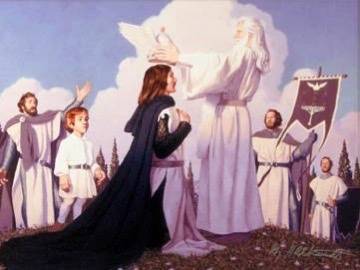
Artwork by the Brothers Hildebrandt
JRR Tolkien’s The Lord of the Rings was hugely influential in my early life, when I thought of it in secular terms as a pr-eminent work of fantasy. As a scholar later in life, I came to appreciate Tolkien’s work a synthesis of early European myths combined with his own poetic sensibility. As an older man and as a Christian, I’ve slowly come to appreciate the deep faith that undergirds his writing, something that is more elusive and yet perhaps more satisfying than the more accessible faith on display in C.S. Lewis’ Narnia books.
This week I’ve been thinking through a marvellous short essay by Thomas Ward, a professor of philosophy at Baylor. Ward identifies a subtle disconnect between Tolkien’s Lord of the Rings books and the film adaptations by Peter Jackson, which, while widely (and, I think, rightly) acclaimed, a disconnect which involves our contemporary preference for flawed rather than exemplary characters.
"Modern storytelling focuses on characters overcoming their own inner conflicts, even as they overcome the conflict that drives the main plot. There’s nothing wrong with this except when, as a kind of storytelling orthodoxy, it eradicates other compelling ways to depict character. Tolkien gave us a few characters who were simply excellent, not without grief or doubt but with no moral weaknesses to prevent them from acting well in the extremely difficult circumstances the book describes. Faramir, Aragorn, Gandalf, Treebeard, even poor Sam: in the films these are all less excellent than they really are.”
As a scholar of philosopher Boethius, Ward is well suited to understand Tolkien’s grand theme, that evil is always fundamentally weaker than good. The characters in Tolkien who model the good best - Gandalf, Aragorn, Treebeard - possess a power that comes from their intrinsic virtue and from their mastery of fear and base emotion. In the film, Gandalf quails before the Ringwraith, Aragorn kills Sauron’s spokesman with some sneaky swordplay, and Treebeard is a "doddering fool” who only does the right thing out of anger rather than out of moral choice. As Ward notes, while these characters in th book are icons of virtue, in the films they become mirrors in which we see our own flaws.
"Again and Again, where the book gives us characters with extraordinary, exemplary goodness, the films change the story to make these characters less good. But while Jackson makes the best characters less good than they are in the book, he makes no evil character less bad than he is in the book.
What does it tell us about our own era that our villains can be thoroughly evil but our heroes can’t be thoroughly good? We’re weighed down by despair, and therefore prone to cynicism. We can recognize goodness when we see it, and we are attracted to it – this is why nearly all popular stories continue to make the good guys win – but we don’t really believe that the good is more powerful, more fundamental, than the bad. The bad is more basic, more real, than the good. So a villain need not be complicated by a tug toward the good (though plenty of villains are portrayed this way, appropriately so), but every hero must be conflicted."
My friend James, who is a much better Tolkien scholar than I am, agreed with Ward’s thesis and added his own observations about the difference between the Elves in the book and in the films: “Tolkien’s elves are high minded, intellectual, deeply spiritual, alien but inherently good people but have been written over by Michael Moorcock;s Elric Saga and Dungeons and Dragons where elves are arrogant tropes for aristocracy and class warfare. Which i why most people like the earthy, ‘working class’ dwarves over the ‘poncey’ elves."
Perhaps the prince we paid for the Jackson film adaptations was to have them reinterpreted according to the secular age, and perhaps too that was made possible by Tolkien’s famous aversion to allegory. After all, Tolkien’s work has inspired people led people in directions - swords and sorcery fantasy games, ecology and counter culture - other than to a fulsome Christianity. Other works would be more resistant to Jackson’s levelling of the moral playing field. Could an adaptation of the Narnia stories be satisfying were Aslan to be flawed?
As a person of faith, I need to reread Tolkien to remind myself of the moral clarity that Ward sees in him, and which was there all the time for those who value moral clarity and depictions of virtue.


