Showing posts with label Literacy and Literature. Show all posts

Thursday, January 22, 2015

The Vanishing Internet (And Why It Should Be Archived)

I’m currently writing an MA thesis, and as I start piling up the chapters and the footnotes, I find that perhaps a quarter of my citations either include URLs to web-hosted versions of sources that are also available as print sources, or exist exclusively as web-hosted sources.    In “the Cobweb”, an article in this week’s New Yorker magazine’s Annals of Technology series, Jill Lepore notes that the problem with sources hosted on the web is that they don’t stick around as long as we think.  “The web”, she writes, “dwells in a never-ending present.  It is - elementally - ethereal, ephemeral, unstable, and unreliable”.

Lepore talks about something called “link rot”.  Here’s an example from my own research.  Yesterday I was checking a secondary source where the author cited numerous references in the form of URLs hosted on Canada’s Department of National Defence servers.  However, when I checked one of those references, the URL no longer existed.  It had been taken down or overwritten.  The secondary source I was using said at the top of its list of footnotes that “All web citations were active at the time of the writing of this article” or something to that effect, but in the two years since the author had written that article, at least one footnote no longer worked.  Probably more than one no longer worked, if Lepore’s data is right.


Lepore cites a 2014 Harvard Law School study which found that “more than 70% of the URLs within the Harvard Law Review and other journals, and 50% of the URLs within United States Supreme Court opinions, do not link to the originally cited information”.   Another study suggests that of 3.5 million scholarly articles published in academic journals from science, technology and medicine published between 1997 and 2012, one in five links “suffers from reference rot”.

Libraries have always been subject to attrition, loss, rot and even physical destruction, but somehow they’ve survived and knowledge has been transmitted over time.   To make that transmission easier, scholars invented the footnote.  But now the footnote itself is in danger of being made unstable as more and more knowledge moves to the shifting sands of the internet.

Here’s an example of how the internet vanishes and why its loss matters.   After the downing of the Malaysian Airliner over the Ukraine last summer, we knew that Russian-backed separatists were likely behind it because they boasted of it over social media.  Those media traces were soon scrubbed, but they were captured by self-proclaimed internet archivists. As Lepore puts it, “One day last summer, a missile was launched into the sky and a plane crashed in a field.  “We just drowned a plane,” a soldier told the world.  People fell to earth, their last passage.  Somewhere, someone hit “Save Page Now”.

But, because most pages aren’t saved, knowledge is vanishing, paradoxically, as the capacity of the internet expands.  

These thoughts will remain here until I either delete this blog or some VP at Google decides that Blogger is no longer part of its business strategy, and Blogger, like Geocities before it, is bulldozed.  Just a small example of what Lepore is talking about.

Saturday, April 5, 2014

Violence Inseparable From Pity: George Packer On The New War Fiction

What’s going on under that hat?

It seems for now that the face of the returning veteran, as far as the media is concerned, is the late Fort Hood shooter Ivan Lopez,  Yesterday on the Foreign Policy website, Gordon Lubbold noted that the media were connecting the wrong dots about Lopez.  " It remains unclear what caused Lopez to do what he did. But his four-month tour in Iraq - in 2011, clearly not the darkest days there, and at a time when few Americans were even seeing combat - was not enough to draw the conclusion that Lopez' mental illness was combat-related.”   This tragic episode may have more to do with the largely civilian trope of the disgruntled employee’s workplace shooting spree and suicide than it does with a soldier processing the experience of combat.   Since Lopez took his own life, we will never know for sure.

The story about Lopez broke last week just as I was digesting a very fine essay by George Packer in The New Yorker magazine on the emerging literature of war, as told by veterans, in the 21st century.   Readers of this highly intermittent blog will know that this is a subject I’ve been interested in for a while.  I’ve reviewed several books, some by veterans, on their experience of the Iraq war as told through the lens of literature and fiction.  Kevin Powers’ The Yellow Birds, which I reviewed here in September 2012.  

Packer is much better equipped as a critic to comment on this latest generation of war writing than I am.  His essay launches from an important critical touchstone, Paul Fussell’s influential study The Great War and Modern Memory, but notes the many differences between the young soldier writers of the trenches and the ones who came home in the last decade.  Here’s an excerpt.

The wars in Iraq and Afghanistan fully meet Fussell’s description of the ironic: they were worse than expected. Both began with hubris and false victories, turned into prolonged stalemates, and finally deserved the bitter name of defeat. The shorthand for Iraq, from “Mission Accomplished” to Falluja, Abu Ghraib, civil war, the surge, U.S. withdrawal, and the ongoing sectarian killing, is a story of exploded illusions. The first wave of literature by American combatants in these long, inconclusive wars has begun to appear—poems, memoirs, short stories, novels. Their concerns are the same as in all war writing: bravery and fear, the thin line between survival and brutality, the maddening unknowability of the enemy, tenderness, brotherhood, alienation from a former self, the ghosts of the past, the misfit of home.

But Iraq was also different from other American wars. (So far, almost all the new war literature comes from Iraq, perhaps because there weren’t many troops in Afghanistan until 2009, and the minimum lag time between deployment and publication seems to be around five years.) Without a draft, without the slightest sacrifice asked of a disengaged public, Iraq put more mental distance between soldiers and civilians than any war of its duration that I can think of. The war in Iraq, like the one in Vietnam, wasn’t popular; but the troops, at least nominally, were—wildly so. (Just watch the crowd at a sports event if someone in uniform is asked to stand and be acknowledged.) Both sides of the relationship, if they were being honest, felt its essential falseness. A tiny number of volunteers went off to fight, often two or three times, in a war and a country that seemed incomprehensible. They returned to heroes’ welcomes and a flickering curiosity. Because hardly anyone back home really wanted to know, the combatant’s status turned into a mark of otherness, a blessing and a curse. The title of David Finkel’s recent book about the struggles of soldiers returned from Iraq, “Thank You for Your Service,” captures all the bad faith of a civilian population that views itself as undeserving, and the equivocal position of celebrated warriors who don’t much feel like saying, “You’re welcome.”

Packer mentions a number of other writers that I wasn’t aware of until now, so for that reason alone his article is wroth reading.  As a chaplain, I am grateful to Packer for telling me about Iraq veteran Phil Klay’s book of short stories, particularly “A Prayer In The Furnace” which tells of a chaplain trying, and largely failing, to preach to a group of Marines.  "The story can end only in irony: the chaplain alludes to Christ’s Passion, and Rodriguez spits in the grass. Some of the men will remain alone for years, perhaps their whole lives. But some will begin to recognize their own suffering in the stories of others. That’s what literature does."

The story of Ivan Lopez may have nothing to do with PTSD, but the way his story is being reported may say more about our trying to understand this handful of veterans in misunderstood wars, the disempowered 1% who served, than it ever will with him.  As one of Klay’s characters puts it after returning home from Iraq and meeting a girl who misunderstands him, “I don’t have PTSD, but I guess her thinking that I did is part of the weird pedestal vets are on now."

Friday, May 24, 2013

The Canadian Forces iPad Pocket, War, And Literacy

Now that warmer weather is here I like to travel about the base on my bicycle, and found that I faced a problem. I didn't have my small backpack with me and I needed to transport my iPad. How was I to do it?

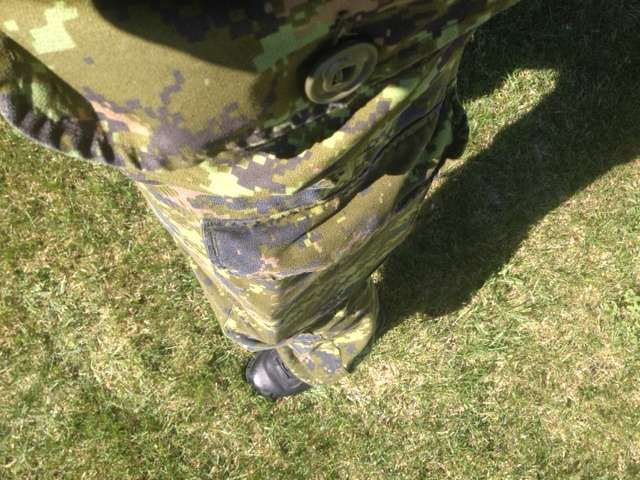
Fortunately, Queen and Country have clothed me with fairly capacious side pockets in my trousers. Would the iPad fit?

Success!

This solution would only be useful in garrison. I certainly wouldn't recommend it in the field, but then again, I doubt I'd take my iPad into the field. But as I cycled around that day, I recalled reading the late Paul Fussell's book Wartime: Understanding and Behaviour in World War Two, and how his description of the "Penguin pocket". British and Commonwealth troops were issued with serge battledreaa uniforms that had a pocket above the left knee suitable for carrying an entrenching tool (though I've never seen period photos showing this use for the pocket, it seems jolly uncomfortable when going prone suddenly), a field dressing, or similar kit. Because the pocket was perfectly sized to carry one of the ubiquitous Penguin paperbacks that sustained literary minded soldiers in the field, it was named the Penguin pocket.

My inner historian found that a pleasing echo of the past, and I suspect that Fussell might have found it amusing, though I heard him speak once in the late 1980s and he seemed a bit of a curmudgeon to me, so who knows. I was reminded of a Major I knew at Suffield who told me once while climbing a mountain that as a young officer in the early 1990s he took two barrack boxes of books with him to Yugoslavia, and of them all his favourite was an anthology of poems chosen and loved by the British General Wavell. It was called Other Men's Flowers and was published in 1944. I suspect it occupied more than a few Penguin pockets. There was a lovely piece by Ian Jack in the Guardian from 2005 on Wavell, his book, and the lost art of memorizing verse which you can find here.

If I were to deploy somewhere for a long spell I would probably take a few print books with me, but would likely opt to stuff my iPad with as many ebooks as possible and take my chances. And I would take some comfort in the fact that I was part of a long tradition of soldiers who found space, somewhere in their kit, for that weapon most capable of keeping the mind and soul alive, the book.

Wednesday, March 6, 2013

When A Nation Forgets To Read

Novelist David Toscana is talking here about his own country of Mexico, but I would say that his words could be applied to my own, or any other, country.

"When my daughter was 15, her literature teacher banished all fiction from her classroom. “We’re going to read history and biology textbooks,” she said, “because that way you’ll read and learn at the same time.” In our schools, children are being taught what is easy to teach rather than what they need to learn. It is for this reason that in Mexico — and many other countries — the humanities have been pushed aside.

"We have turned schools into factories that churn out employees. With no intellectual challenges, students can advance from one level to the next as long as they attend class and surrender to their teachers. In this light it is natural that in secondary school we are training chauffeurs, waiters and dishwashers.

"This is not just about better funding. Mexico spends more than 5 percent of its gross domestic product on education — about the same percentage as the United States. And it’s not about pedagogical theories and new techniques that look for shortcuts. The educational machine does not need fine-tuning; it needs a complete change of direction. It needs to make students read, read and read".

Read the whole essay here.

Monday, July 25, 2011

Book apps: A reading revolution, or the end of reading?

As I post this I am sitting in a coffee shop in a strange town, with an old fashioned print book (PAtricl Hennessey's The Junior Officer's Reading Club) balanced on my knee, while synching, updating and charging my iphone before I hit the road. End of reading? Don't think so. Maybe mixed media reading? And as for the article below, I confess I would buy an ipad as soon as I can afford one, if only because I can't find the New Yorker reliably here in AB and I can't read it on my iphone. MP+


JOHN BARBER
From Saturday's Globe and Mail
Published Saturday, Jul. 23, 2011 6:00AM EDT
Last updated Saturday, Jul. 23, 2011 10:12AM EDT


The On The Road app sells for $16.99, compared to $10.88 for a paperback on Amazon and $9.99 for an electronic copy of an earlier “deluxe” edition. “The app itself has all the text of the book and then it’s got five times more material,” Morrison notes.

But the economics of book apps are still a matter of guesswork. “We’re in this experimental stage,” Morrison says. “We’ll see how this one does, figure out how much it costs us and, if we were going to do more, how many we would have to sell to make it worthwhile.” It will be a very long time before the last of the 1,500 titles on the Penguin Classic backlist get apped, he added. “At this point, they are very time-consuming, so we have to pick our shots.”


Read the whole piece here.

Tuesday, March 9, 2010

My ebook choice is made

Readers of Mad Padre (bless you!) will know that I've been struggling with making a choice about an ebook reader, and a number of you made some helpful decisions.

What settled the decision for me was the need to get a personal cell phone when I learned that I'd be spending a considerable amount of time this year away from home on military courses. So I looked at Apple's iphone and it was an easy choice.

Downloading apps on the iphone is quite easy, and I knew that Amazon had an app version of their Kindle ebook reader for the iphone. It took literally three minutes to get the app installed on my iphone, and then to use it to search Amazon's Kindle store. By chance I had just finished a short story by Ursula K. Leguin, and wanted to read more of her work, so my first ebook purchase was her short story "The Bones of the Earth", which cost a couple of bucks. I found the text easy to read, a crisp and elegant font on a clear, offwhite background. The pages can be thumbed easily, sliding from left to right or vice versa, and there is a navigation bar to allow you to jump around in the book, though that is taking some getting used to.

Today during a break in class I'm reading the New York Times daily email and there's a review of The Surrendered, a new book by Korean-American writer Chang-Rae Lee. The novel is partially set during the Korean War, which sounds interesting, so I check the Kindle store and it sells for $11.99 US as an ebook, compared to its print price of $26.95. Chapters, by comparison, lists it at $33.50 Cdn with an online price of $22.11. I chose to download a free sample, which appears to give a complete chapter, more than enough to make a purchase decision.

I love my iphone for its other functions as well, but I'm very happy with it's worth as an ebook reader, and from what I can see I like the economics of ebooks. It's worth mentioning in closing the article that appeared today in The Globe and Mail about the Canadian publishing industry's unease with Amazon wanting to open a distribution centre in this country. I love my local bookseller back in Greenwood, NS, and I'll continue to buy print books there, but in I can see myself reading more books off my iphone and fewer off the printed page. As more people catch on to ebooks (and I'm hardly an early adopter), I think the print distribution debate will soon be moot.

Saturday, March 6, 2010

Notable Quotable: Craig Mod on ebooks

Craig Mod is a technology blogger quoted in the New York Times as saying “Print is dying. Digital is surging. Everyone is confused. Good riddance." As the NYT summarizes Mod, the real breakthrough will be when ebook platforms and readers get beyond the need to replicate the experience of reading and turning printec pages:

"For hundreds of years, we’ve been consuming information on static pages, and for the most part, this content has been presented with a beginning, middle and end. Nonlinear, digital platforms will prompt a new range of thinking about stories and how to tell them."

Meanwhile, in a piece that the NYT ran on Feb 28th, Motoko Rich reviewsthe economics of ebooks, and suggests that the current price point of an ebook, around $12.99, were to go any lower, it would undermine profitability of publishers as a whole.

Wednesday, December 16, 2009

Electronic Rights Battle for Older E-Books

Continuing to track the news on the growth in e-books. An article in today's New York Times discusses the publishing battle over older books. When I was on a library board, we worried over the pressure to replace traditional print book stacks with internet computer terminals, new media shelves, etc. While these changes were good responses to changes in literacy and how people today find and consume information and cultural products, it did mean that fewer shelves meant that older books became harder to find outside of used bookstores. Ebooks many well bring many older titles back into print, provided that the rights issue can be figured out. MP+

Legal Battles Over E-Book Rights to Older Books
By MOTOKO RICH
Published: December 12, 2009

William Styron may have been one of the leading literary lions of recent decades, but his books are not selling much these days. Now his family has a plan to lure digital-age readers with e-book versions of titles like “Sophie’s Choice,” “The Confessions of Nat Turner” and Mr. Styron’s memoir of depression, “Darkness Visible.”

But the question of exactly who owns the electronic rights to such older titles is in dispute, making it a rising source of conflict in one of the publishing industry’s last remaining areas of growth.

Read the whole article here.

Thursday, November 26, 2009

Toe Still in the Water on EBooks

As Christmas approaches I've been considering making an e-book reader my present to myself. However, there are too many questions for me to have firmed up a decision. I haven't heard yet whether Amazon's Kindle reader is going to be available in Canada any time soon. Sony's reader is another choice, but Sony's selection of titles is still limited to mass-market best-sellers for the most part, and the free stuff available from Google which might augment Sony's small library is, from what I can see, all public domain and therefore old. Not that old is bad, but I'm looking for a way to digitally read recent publications that interest me, and if I could put a digital subscription to a newspaper and/or magazine, like the New Yorker, on the same platform, that'd be bonus. David Pogue, techguy for the NYT, writes today that Amazon is moving to open up it's ebook store (380K titles thus far) for non-Kindle platforms, which is pretty smart of them I think since it doesn't look like any one ebook platform is going to be dominant any time soon.

Some sensible advice from Slate's tech guru Farhad Manjoo is to wait and see what Apple's entry into the market will be. I've got enough paper books on my bedside table to wait for them, and Advent is the season of waiting.

One thing Pogue said that stuck with me is what an amazing time we live in for literacy and communications.

"But two things are for sure: e-books are evolving at a screaming pace, and their appeal goes well beyond gadget freaks.

In short, 2009 was a year like any other year: filled with breakthroughs and breakdowns, progress and pushback. Still, we stand at an amazing point in high-tech history. Our airplanes offer wireless Internet, we can make free Skype calls to China and talk for hours, and our children edit video for homework."

Sunday, October 18, 2009

Libraries and Readers Wade Into Digital Lending

This story from the NYT on how libraries are beginning to offer ebooks caught my eye for several reasons. As a former library board member, it was clear that even ten years ago the changing nature of literacy and changes in media were going to challenge libraries to diversify their holdings. Also, of late I'm looking into ebooks, though I am still trying to determine if I want to go the Amazon Kindle route or the Sony ebook reader route. Depends on what's available for either platform, but either way, if I can borrow ebooks from my library, then it doesn't matter what the holdings are in my small town library and that's a big plus. MP+

Here's the article from the NY Times:


Libraries and Readers Wade Into Digital Lending

By MOTOKO RICH
Published: October 14, 2009

Kate Lambert recalls using her library card just once or twice throughout her childhood. Now, she uses it several times a month.

The lure? Electronic books she can download to her laptop. Beginning earlier this year, Ms. Lambert, a 19-year-old community college student in New Port Richey, Fla., borrowed volumes in the “Hitchhiker’s Guide to the Galaxy” series, “The Lovely Bones” by Alice Sebold and a vampire novel by Laurell K. Hamilton, without ever visiting an actual branch.

“I can just go online and type my library card number in and look through all the books that they have,” said Ms. Lambert, who usually downloads from the comfort of her bedroom. And, she added, “It’s all for free.”

Eager to attract digitally savvy patrons and capitalize on the growing popularity of electronic readers, public libraries across the country are expanding collections of books that reside on servers rather than shelves.

The idea is to capture borrowers who might not otherwise use the library, as well as to give existing customers the opportunity to try new formats.

“People still think of libraries as old dusty books on shelves, and it’s a perception we’re always trying to fight,” said Michael Colford, director of information technology at the Boston Public Library. “If we don’t provide this material for them, they are just going to stop using the library altogether.”

Read the whole article here.

Sunday, November 30, 2008

Do Books Have a Future?

If you've followed Mad Padre for a while, you know that I'm a bibliophile. In face, I'm sitting here in my little room at Canadian Forces Base Borden, my home for another 12 sleeps (not that I'm counting!), and I'm looking at this stack of books that I've accumulated in the last three months:


Hmmm, and that picture doesn't include the volume of Karl Barth's Church Dogmatics I brought out with me. I'm hoping I can ship this pile home in the unaccompanied baggage allowed me by the military, but I'm not exactly sure where they'll go when I get home.

Maybe I need to embrace the kind of future that James Gleick discusses in yesterday's New York Times, a future in which the published book may be entering a golden age of "the long dreamed-of universal library, its contents available (more or less) to every computer screen anywhere".

For my part, I'm taking some tentative steps in that direction, learning to access and manage books digitally via Google Reader, at the same time as I learn to use Itunes. But the problem, as Gleick notes, is that people like books. While it's true that I probably spend more time per day reading on a computer screen than I do reading the printed word on paper, I want to have a book in my hand, and I want it to last. Some of my most cherished books, including a Folio Society reprint of Kipling's poems that my dear friend Patsy gave me when I left my parish, are aesthetic as well as literary treasures, and that's the hope that Gleick offers the printed book. However, as he notes, the internet and the digitizing initiative of Google now means that there are millions of titles, copyrighted but out of print, that have been rescued from limbo and are now available to we book lovers.

Here's the article by Gleick.

Oh, and if you have any spare room on your bookshelf, give me a shout.

MP+

Sunday, July 27, 2008

Save the Pacific Northwest Tree Octopus! Thoughts on Whether the Internet is a Good Thing


It's a cephalod, it spends part of it's life cycle in trees in the Oregan rainforest, it's an endangered species, and over 90% of people who learned about it on the internet think it actually exists. A study at the University of Connecticut by Donald Leu, who researches literacy and technology, introduced 48 students to a website on the mythic Northwest Pacific Tree Octopus. Nearly 90% of the the 48 participants decided that the website was a reliable source of information and was not a joke, even though the site has links to conservation organaizations such as "greenpeas" and even though it offers the disclaimer that "This site is not associated with any school or educational organization,other than the Kelvinic University branch of the Wild Haggis Conservation Society."

Our house is currently embroiled in a larger debate on whether the internet is good for knowledge and cognition. My wife Kay is firmly in the camp of Nicholas Carr, whose piece "Is Google Making Us Stoopid?" appeared recently in Atlantic Magazine. “What the Net seems to be doing is chipping away my capacity for concentration and contemplation,” he wrote, confessing that he now found it difficult to read long books. A friend of mine who teaches history at a major Canadian university has made comments which seem to confirm Leu's study, and has to carefully restrict his students from using unauthorized internet sources in their papers.

Since I'm the glass is half full type, I'd like to believe the parent quoted in Motoko Rich's article in a recent New York Times, who argues that her kids reading something, even if online, is better than not reading at all. Perhaps the icon of literacy for the next generation will be the open laptop rather than the open book.

Read the whole article.

Mad Padre

Mad Padre
Opinions expressed within are in no way the responsibility of anyone's employers or facilitating agencies and should by rights be taken as nothing more than one person's notional musings, attempted witticisms, and prayerful posturings.

Followers

Blog Archive

Labels