Showing posts with label Worship. Show all posts

Friday, June 19, 2020

Friday Theology: Oliver O'Donovan On The Role Of The People In Liturgy


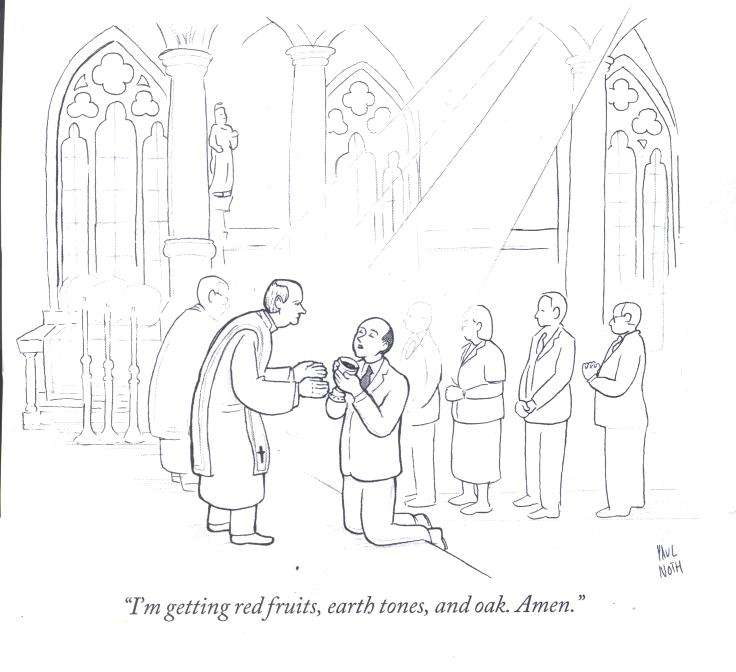
(A Scene of Profound Theological Reflection) 

It’s often observed that the word liturgy, which we think of as “worship” or “a religious service”, originates in two Greek words, laos (people) and eras (work), and that the word liturgy thus means something like “the work of the people”, although the nuances can be argued.


As an Anglican Christian, I appreciate that our prayer is common, meaning that there is clearly defined role for the people, who, with the priest or minister, come together to give praise and thanksgiving to God.    In this regard, our liturgies are formative, in that thanks to our shared roles as clergy and people, we are taught and shaped by our worship.


At the end of his chapter on “Moral Communication” in his book, Self, World, and Time: Ethics as Theology, the Anglican theological Oliver O’Donovan finishes his discussion of the role of the Lord’s Prayer in the Sermon on the Mount with a meditation on the importance of the first person pronoun in our liturgy.  O’Donovan’s insight that prayer should feature “we” rather than “I” helps me to explain a slight discomfort that I have sometimes felt in attending some evangelical protestant religious services.  This discomfort (and this is not meant as a criticism of evangelical forms of worship so much as an awareness of a difference) arises from the sense that the worship leader or pastor’s experience of faith and belief is normative, for example, in whatever ad lib explanation of communion is offered before the action itself, so that the congregation is left as best they can to map their own experience to what they hear expressed.


Here’s O’Donovan:


At the very centre of this text of moral teaching (Mt 6:1-18) there is the teaching of a prayer - not only how to pray, that is, but what to pray.  Precise words are prescribed.  If we have understood the relation of prayer to moral thought, we shall not be surprised at this.  That such words should be open to private and public elaboration (economical elaboration, if we take Jesus’ warning seriously!), that they should generate noble liturgies and passionate private intercessions may be taken as a matter of course.  Yet the words are not merely an outline, a set of heads of advice or agenda items.  They are themselves a possession of irreplaceable importance in forming the “we”, the community of moral practice (italics mine).   That is why they should be placed - the bare text without embroidery or expansion - at the core of every Christian liturgy.  


The conception of worship as magnified personal self-expression, a large-screen projection of the “i”, obstructs the formation of the community by depriving lay members of the congregation of their proper ownership of the words of prayer.  If the primary material for common reflection, replacing hymns and prayers that can be learned, possessed, and used by every worshipper, comes to be the spontaneous feelings of the minister and the autobiographies of selected model Christians, there is no room for the interaction of community and individual to develop.  The model “I” overwhelms the (genuinely) personal contribution of the worshipper with a fake personality, imposing sentiments, moods, narratives, and reactions even to the minister, who affects them at the price of forcing his or her real personality into a straitjacket, trying to be the one and single and embracing personality that will serve for all.


In traditional liturgies the occasional appearance of the first-person singular (in baptism and at the recitation of the creed) points to the Holy Spirit’s grafting of the believer into the community.  Yet its comparatively restricted liturgical presence and its total absence from the prayer Jesus taught, where the first-person is always plural, points to the common identity built up by prescribed prayer, the “we” within each and every “I” can realize itself.   The formal and predictable character of liturgy, giving us a purchase on the common “we”, enables us to accomplish a personal self-offering together with all others who are gathered for worship.   The liturgical consideration of the “we” is one aspect of what should be meant by that pregnant, if elusive phrase, “ecclesial density”.


Sunday, April 21, 2013

Stanley Hauerwas On Memory And Eucharistic Practice

Not everyone understands what eucharistic practice is all about.

American theologican Stanley Hauerwas, however, nails it in this video from The Work of the People, a liturgical resource ministry that I've noted here in past. We ran this video before Communion last Sunday in chapel. Note that I couldn't get this to run on my iPad, so you may need Windows to make it work.

Thursday, March 28, 2013

Notable Quotable: Father Gene On Maundy Thursday And "Good Ritual"

From my good friend Gene Packwood's blog on the meaning of tonight for Christians:

Foot washing can be a challenge for those who are not used to it—all a bit too up close and a little creepy. Eleven years ago a woman wrote me the following note after Maundy Thursday worship and her first experience of foot washing:

Lent is one of the Church seasons when I quietly reflect on Jesus’ journey to the cross and his crucifixion. Maundy Thursday seems to me to be almost as sorrowful a day as Good Friday. The foot-washing ceremony is something I never took part in. This year as Maundy Thursday approached several of my friends told me what a powerful service they thought the foot-washing was. After a day and night of prayer and meditation, I realized that pride had kept me from the foot washing. Because of my hammer toes and rotten looking feet, I had never wanted anyone to see them. At the Maundy Thursday service, I was still ambivalent about having my feet washed. Images of Jesus washing his disciples feet flooded my thoughts and I said to myself, “Do it.” As my feet were being washed, a feeling of great humility came over me. As they were being dried, I felt a great desire to wash another’s feet. While doing so, I was filled with ecstasy and great emotion. I felt myself to be in a more spiritual realm. My soul was filled with wonderment and love. I was at the foot of the cross; a more fervent believer than ever before.

Why was this experience so powerfully moving for this dear saint? When words aren’t enough, we perform rituals. A good ritual says something more than mere words can say. That’s what rituals are for. So we take a tuna casserole over when someone has had a loved one die. We give an aching spouse a back-rub. And we wash feet. Not because the feet need cleaning, but because our souls do. And we go the altar to eat little wafers and take tiny sips of wine, not because our bodies need them for sustenance, but because our souls do.

Nonetheless—All may, none must, some should.

Saturday, March 23, 2013

Liturgical Awesomeness From The Work Of The People

This post is a shout out for The Work Of The People (TWOP), a digital content provider for Christian worship. Taking it's name cleverly from a literal translation of the Greek words behind "liturgy", The Work of the People provides professionally produced, interesting, and theologically orthodox videos suitable for use in worship, in small groups, bible studies, and such. Here's a sample:

In some ways I am a lucky fellow to be a chapel worship leader in the Canadian Forces. In my soon-to-be three years at Christ the King Chapel at Suffield, I've asked for and received some amazing resources that a small parish could only dream of, including two large flat screen monitors and a computer to run content on them. In other ways it's frustrating asking for something other than hardware, such as a subscription to TWOP's content. The military is fussy about software, and wants to have security guarantees before it will install programs or allow for downloadable content. It took a while to convince the IT powers that be that my chapel uses a standalone computer, and that TWOP's worshop videos pose no threat to national security.

I do think, though, that their content poses a threat to complacency and boredome in the pew. If you are a pastor or a worship leader, I encourage you to look at their material. If you are a parishioner or a member of a congregation, talk to your pastor or worship leader and ask them to check it out. We're in the second week of using this material in the worship life of my small chapel, and people are excited. When I ordered all this hardware two years ago, I hoped that we might do something exciting with it, and, to quote from The A-Team, I love it when a plan finally comes together.

Mad Padre

Mad Padre
Opinions expressed within are in no way the responsibility of anyone's employers or facilitating agencies and should by rights be taken as nothing more than one person's notional musings, attempted witticisms, and prayerful posturings.

Followers

Blog Archive

Labels