Showing posts with label Military History. Show all posts

Tuesday, May 11, 2021

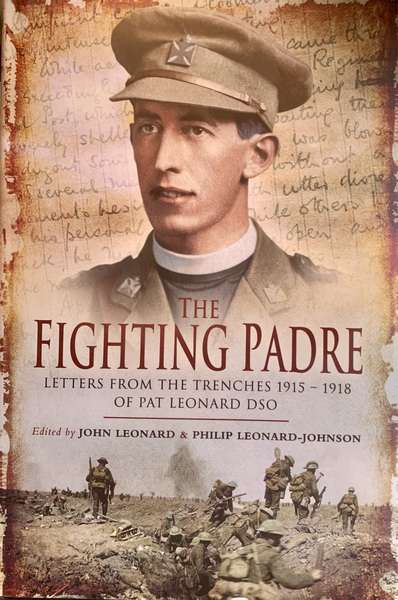
Books on the Go: The Fighting Padre, the Great War Letters of Pat Leonard

 I made the mistake of browsing the excellent Pen and Sword website recently and in due course three books arrived in the post (trans-Atlantic mail has improved remarkably since the start of Covid) including this collection of letters from a British infantry chaplain of the Great War, Pat Leonard.


Leonard was a young Anglican clergyman whose youth and vigorous physique (he was an accomplished boxer, hence his nickname “The Fighting Padre”) allowed him to thrive in the trenches when older clergymen quickly broke down under the physical demands of frontline service.    He was attached to a British Army infantry brigade, and later in the war transferred to the Royal Flying Corps, supporting a number of different squadrons and aerodromes and earning a respectable amount of flying time in the observer’s seat.

Chaplain memoirs and letters are a fairly niche subject.   For the clerical reader, it’s always interesting to see how frontline padres tried to support the men under their care, often travelling long distances between units to bury the dead, offer the sacraments, counsel and encourage.  For the general reader, they offer a fascinating look at daily life in a war zone, in and behind the front lines, and glimpses of the culture of the men they served.  Chaplains were almost all civilians before the war and thus lacked much military knowledge, but they were observant, intelligent and articulate, and so they offer a great “fish out of water” look at the war around them.

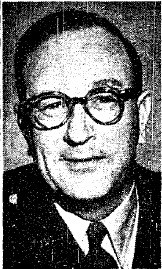
I wanted to read this especially because Leonard was friends with a chaplain hero of mine, Philip (Tubby) Clayton, who ran “TocH” or Talbot House, a soldier’s rest centre in Poperinghe, a town within the Ypres Salient.  Tubby’s picture is on the left of this blog’s header - his own memoir, “Tales of Talbot House”, is a brilliant book in is own right.  

I’ve just started and haven’t met Tubby or any aircraft, but have found Leonard an engaging and friendly guide to life in the trenches.  I've just finished a difficult account of him having to break the news to a soldier that a court martial had sentenced him to death for murder, and spending the night with him before his execution - a remarkably common account in Great War chaplain memoirs, I find.  Leonard praises the man for his courage in turning to God and facing the firing party, but the story interrupts the generally cheery tone of his letters and for a moment we see the cost that this young men of faith had to bear.  I doubt I could have born such a cost for any length of time.  Huge respect for these Great War padres.

Cheers and blessings,

MP+


Monday, November 12, 2018

Faithful Till The End: Canadian Military Chaplains in the Last Days of the Great War


No Canadian scholar knows the history of Canadian military chaplaincy in the Great War better than my friend, Dr. Duff Crerar.   In these notes which Duff kindly shared with myself and CAF chaplain colleagues, Duff describes the ministry of Canadian padres in the last months of the war and on to demobilization.   It is a harrowing story of chaplains pouring themselves into their work and in some cases working themselves to death.  My thanks to Duff for telling their stories.  MP+
The Pursuit to Mons and the Padres

The Canadians captured Cambrai on 9 October, having again surprised the Germans by a night attack. Already attempting to make a general withdrawal, the enemy gave way before they could blow all the critical bridges. The Second Division’s 20th and 21st Battalions saw off a surprise counter-attack by German tanks, but it was clear that the Germans were making another retreat.

The Canadians had broken through at the critical point of the Siegfried line.  Valenciennes was the next fallback for an army rapidly running out of men. Over twenty German divisions were disintegrating because they could not be reinforced. Crown Prince Rupprecht doubted that his troops would hold to December.

The chase was one. Canadians would bombard a German position, patrols would investigate, and report the Germans gone or in the process of leaving. Or, there would be a hurricane of machine gun fire, shrapnel and high explosive. Currie ordered his troops to proceed with caution, especially as the trail of sabotage and scorched earth combined with heavy rain to make casualty evacuation almost impossible. The Allies were outrunning their supply lines. Canadian soldiers, enjoying the experience of being greeted as liberators, were pausing for impromptu civilian hospitality. Belgians were handing out much of their precious hoarded food, which meant the Canadians had to rush some of their own rations forward to feed the over one hundred thousand liberated civilians.

The Germans had not all given up. Postwar critics who charged Currie with needless casualties in the last week of the war were oblivious or unwilling to acknowledge that German machine guns and artillery continued to oppose the advance, and that in many sectors local counter-attacks required continued operations. The Germans gave every intention to fight for Valenciennes, flooding the defences along the Canal de l’Escaut, with five –understrength – divisions guarding the gateway, Mount Houy. Rebuffed when he offered his artillery assets to assist the British, Currie grimly knew (after the British failed to take Mount Houy for the third time) that his troops would have to take the hill, and ruffled more than a few British senior officers by refusing to throw his troops in without full preparations. He and Andrew McNaughton, his gunnery expert, honoured their vow to purchase victory with shells, not men.

On 1 November, the all-Canadian attack blasted the Germans out of Mount Houy: the shattered survivors surrendered to a mop-up attack by the 10th Canadian Brigade. The 12th Brigade entered Valenciennes, and on 3 November the city was declared free of German defenders.

Canadian troops in Valenciennes after its capture on 3 November, 1918.

By then, General Ludendorff, de facto commander in chief of the German Army, had been dismissed. Attacks by Australians and Canadians on 4 November struggled to mop up the snipers and machine gunners left behind to cover the all-out retreat. The casualty rate plummeted, but Canadians felt them even more deeply as it was clear that war was almost over. It is a terrible thing to die at the end of a war. Most important, both to Currie and his Army Commander, General Horne, was the reality that German soldiers were not all giving up, but often continuing to cause casualties in pockets of determined resistance. The Germans gave every indication they would fight for Mons. Currie’s plan to encircle it and break in simultaneously fell afoul of such isolated pockets of the enemy. On 10 November, a company of the RCRs and another of the 42nd Battalion moved in to clear out Mons. After causing a few last minutes casualties, the Germans melted into the mist. At eleven, the Armistice took effect. Already a riotous celebration was brewing up in the city centre. It was St. Martin of Tours day, the patron saint of chaplains.

Canadian chaplains had kept pace with the troops, though 3rd Division Senior Chaplain Louis Moffit reported that holding services and large gatherings fell by the wayside in the constant shifting and shelling. Reports preserved from this period in Chaplain Service records are few. Another half-dozen chaplains were wounded by shells. Father T. McCarthy had been with the 7th Brigade constantly, and was reported among the first troops entering Mons.  Conditions had been brutal, and more than one padre could not express what they had seen in genteel tones. A.E. Andrew, an Anglican chaplain to the Royal Canadian Regiment, recently awarded the Military Cross for his work with casualties (including stepping in when most of the officers had been killed or wounded) in October, let off steam during the celebrations that followed, making some frank comments about the high command which got into the Canada Gazette. The Assistant Director of the Service, A.H. McGreer, noted “he used language which is commonly employed by officers of all ranks, and I am sure he never dreamed of all his statements being reported… If it comes to a court martial they can’t convict him, I’m sure of that… Andrew got the MC the other day…” Word of Andrew’s remarks at Cambrai, when told that he did not belong up front – “if the men can go, I can” – had percolated through the Division. After they had cooled down, the authorities let him off with a warning, and a transfer.  


W. B. Carleton, a priest from Metcalfe, Ontario, received a surprise when the French Army conferred the Croix de Guerre for his intrepid work with the 3rd Division Artillery. Carleton would return as a Senior Chaplain to the Canadian Army in 1940.

Other chaplains were showing signs of strain as the pressure of operations turned into the march to occupation across the Rhine and restlessness to get home. Sickness, nervousness and other disorders were reported by several padres: chronic bronchitis, a sign of exhaustion, and hard to treat in the pre-anti-biotic era. His Brigade reduced to a skeleton by casualties, B.J. Murdoch was returned to Britain on sick leave, exhausted and insomniac. He was given early discharge and returned to New Brunswick, though the psychological scars of being under fire relentlessly in the last 100 days would haunt him for the rest of his life. Almond learned that one of his former chaplains, Salvation Army officer Charles Robinson, who had reverted to combatant ranks in 1916 and been awarded a Military Cross at Vimy Ridge, had been killed in September and was buried near Arras. Just previously word had reached headquarters that a Methodist Chaplain, Eric Johnston, who had been in action continuously with the Canadian Machine Gun Battalion since Amiens, trying to spend a week with each company across the Corps, had been evacuated sick to #20 General Hospital, where he died of pneumonia.

Other padres found the change in moral climate and the breakup of units for repatriation seemed calculated to undo their work. Roman Catholic chaplains went to the Belgian hierarchy as well as the British Army authorities to fight a soaring V.D. rate. F.G. Sherring, a decorated Anglican Chaplain, exploded in rage when his 2nd Division Artillery units were scattered, ruining his plans to distribute comforts ranging from cigarettes to underwear -- as well as his Christmas and New Years’ religious services. Fortunately for him, his near-seditious remarks about the high command were expressed in reports to his chaplaincy superiors, who quietly filed them away without action or comment.

Throughout the rest of the winter and early spring of 1919, the Canadian chaplains prepared for the peace. Many occupied themselves in teaching in the Khaki University, and some took advantage of the program to add to their own education. Nearly two dozen made the journey to Buckingham Palace to receive decorations from King George V.  Often they ran into chaplains of other denominations which they had served alongside, and which they might never see, much less work with again. John Holman reminisced about urgently throwing up sandbags alongside a priest to protect an advanced dressing station before taking heavy fire, both in their shirtsleeves in the Amiens heat. Many took part in the conferring of battalion colours, now being brought over from England or being consecrated for the first time, in drumhead services in Germany and Flanders. Others found themselves, in moments of inactivity, thrown back to moments which they had pushed into the back of their minds during the victory autumn. They saw faces. They recalled brief, intense, often whispered confidences. They remembered the men they had helped, many, to die. Percy Coulthurst, Ewen MacDonald, Thomas McCarthy, Canon Scott just out of hospital in England and W.H. Sparks flashing back to ministering, stretcher to stretcher, reciting, “The Lord is my Shepherd”.

For many chaplains with the Corps, the end of combat meant the pressure to get letters written, some perhaps which they probably had wished to avoid. Murdoch found himself awash in letters of sympathy to kinfolk in Canada. His Montreal battalions, Highlanders, and working men left widows and orphans, bereaved parents who needed some reassurance and comfort. Their men had died well, suffered little, and had the ministrations of the priest or minister they needed and deserved in the hour of their death. On their return, more than one followed the example of George Kilpatrick, by 11 November the Senior Chaplain of a Division, who personally visited the homes of every soldier from the 42nd Battalion who had died overseas. As harrowing is that could be, there were some consolation for padres, as more than one family was grateful for every scrap of news about their loved one they could provide. They were touched, and often inspired by another kind of bravery and resolute courage they witnessed among those who had only waited, and waited.


One of the most perceptive padres to write his superiors in this period was A. B. MacDonald, a priest who would return to his Calgary church and devote his life to veterans after the war. He had spent days among the refugees who streamed back during the last weeks of the German retreat, hearing pitiful tales of deprivation and atrocity. He had been only a few miles from Mons when his gunners ceased firing on the 11th. As he looked around him, at the devastated land and lives, and contemplated his own men coming back seeking order out of chaos at home, he knew he needed help.

MacDonald reached out to J.J. O’Gorman, the doughty priest who lit the fuse which exploded in Ottawa and led to reform of the Catholic chaplaincy, now returned to direct the Catholic Army Huts overseas. He asked for copies of popular and influential tracts by Catholic authorities on social questions, family life and the pronouncements of Leo XIII on the church’s role in society. He intended to translate, rewrite and paraphrase their contents to adapt them to Canadian conditions and Canadian veterans. “The practical application of social science in Canada will be completely different from England”, he noted. Lt. Col. W.T. Workman, in London, ensured that he would have Rome leave.

By the summer of 1916 MacDonald was back at Sarcee Camp in Calgary. He noted to A.L. Sylvestre, his Senior Chaplain in Canada, that the veterans would open up and trust the uniformed padre, or one they had known overseas. He recommended that the Permanent Force be granted permanent chaplaincies. Sylvestre was sympathetic, but Ottawa was already preparing the demise of the Chaplain Service. MacDonald was probably the last chaplain standing on the day it was officially demobilized -- 1 January, 1921. The Great War was really over: now came the Peace to endure, and overcome.


Sunday, November 4, 2018

Remembering Canada's First Black Military Chaplain

A colleague here at the Canadian Forces Chaplain School and Centre was reviewing our new chaplain history curriculum and asked me why our first African-Canadian chaplain was not included.   Because I didn't know the story, I said, and now I can share it with you.


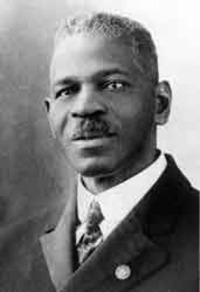
The Rev. William Andrew White was the Baptist pastor of a black congregation in Truro, Nova Scotia when the Great War began.   American by birth and the son of former slaves, White came to Canada through the network of the African Baptist Association and attended seminary at Acadia University in Wolfville.  


African Canadians were not allowed to enlist in the Army until 1916, when the government authorized No. 2 Construction Battalion, consisting of black soldiers led by white officers.    Rev. White actively recruited for this unit, and half of its strength came from Nova Scotia.  White was appointed as the Battalion chaplain was the only African Canadian to be commissioned as an officer during World War One.


The Dictionary of Canadian Biography gives this account:


Some members of the battalion trained in Windsor, Ont., and the rest in Pictou, N.S., and later Truro. In March 1917 the unit embarked for England. They were attached to the Canadian Forestry Corps (Jura Group) and relegated to the status of “company” because they were about 300 men under strength. In May they were sent to eastern France, where they worked alongside white troops during logging and milling operations but were segregated the rest of the time. Their chaplain had a hard row to hoe: white soldiers would not accept his ministrations, even when they otherwise lacked the services of a clergyman. Nevertheless he was an unmitigated force for good across racial lines. Such were his courage, moral authority, and physical stature that he once interposed himself between his unit and a group of white men to avert a riot.


Given the racial prejudices of the day, it was a significant step for the Chaplain Service, thanks to its director, John Almond, who was progressive for his time.   Almond had tried to send an Anglican Metis chaplain to serve Canadian Indigenous detachments scattered through France, but his request was turned down by CEF Headquarters which disapproved of "roving commissions".  Almond had also wanted to send a Jewish chaplain to France, but HQ likewise objected, claiming that "there were no concentrations of Jewish troops large enough to merit [their own chaplain]" (Duff Crerar, Padres in No Man's Land, 2nd ed, p. 68).


Padre White survived the war and died in 1936.   His CEF record may be found here.  He deserves to be better remembered as a significant figure in the history of the Royal Canadian Chaplain Service.

Tuesday, October 23, 2018

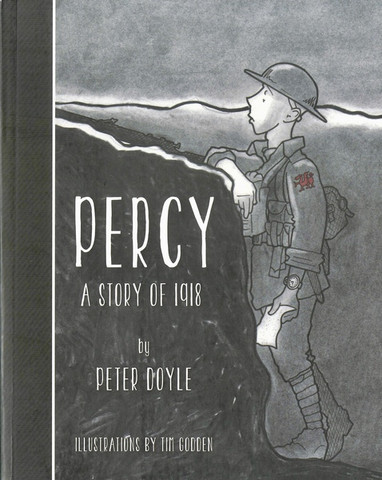
Book Review: Percy, a Story of 1918


Percy: A Story of 1918, by Peter Doyle with illustrations by Tim Godden. London: Unicorn Publishing Group, 2018.  ISBN: 978-1-911604-81-5

Percy is a collaboration between a distinguished British historian of the Great War, Peter Doyle, and illustrator Tim Godden to tell the story of a young lad who left his life in a coal mining village in Wales to serve in the infantry in the final year of the War.  It is a true story, told thanks to the discovery of the young man’s letters to his sweetheart Kitty, which turned up years later in a flea market.

While aimed at older children and young adults, I thoroughly enjoyed Percy.   The first chapters make an accessible social history of what life was life in the coal pits of Edwardian Britain.  Suffice to say that the men and boys who went into those mines required just as much courage as they would have needed to face the trenches.   It was a dangerous and dirty life, and Doyle tells the story with realism and sympathy while never sliding into sentiment.

We then follow Percy into the Army as a volunteer, wanting to do his bit like his brother and the other men of his village.   Doyle takes us through the disorientation of his training and deployment to France, all the while comforted by letters to and from his sweetheart Kitty.  The tale is told with great empathy not only through Doyle’s words but through Tim Godden’s wonderfully vivid watercolours.   Godden is a noted artist, specializing in the Great War and in sports figures of the early twentieth century.   there isa wonderful charm and simplicity to his work, and it is perfectly suited to this project.

I won’t tell you how the book ends, except to say that I found it immensely powerful and moving.    Percy Edwards was just one of millions of boys and men caught up in that vast conflict, and in this little book Percy becomes a kind of Everyman, speaking for all of them.

Percy: A Story of 1918, is available on Amazon.  I ordered mine from Amazon UK, and it took a while getting to me in Canada, but it was worth the wait.

MP+


Thursday, September 13, 2018

Remembering Canadian Great War Chaplains in the Hundred Days


The text below is from an email sent by my friend and colleague, Dr. Duff Crerar, author of Padres in No Man's Land (McGill Queen's 1995, 2nd ed 2014).   Duff regularly sends Canadian chaplains these emails to tell us what our predecessors did on certain notable dates, and thus to remind us of our legacy.  MP+


Canadian Chaplains and breaking the Drocourt-Queant line.


German Wire - Part of the Drocourt-Queant Line Fortifications


By 17 August, the Canadian Corps had clawed deeply into German lines at Amiens. As the push ground down in the maze of old 1916 trenches, General Currie and Third Army Commander Rawlinson pushed for a relocation of the Canadians to where the Germans would not expect an attack. British Commander Douglas Haig concurred and persuaded the Supreme Allied Commander Ferdinand Foch to agree. Currie’s force was transferred to General Horne at Arras. Here the Germans had fortified a strong belt of defences, thirty kilometers deep, as far back as the partially-drained Canal du Nord. Behind it lay Cambrai. If the Canadians could break in here, the German defences southwards would be turned and the whole front opened for exploitation.


The Canadians had to work fast: Currie had two divisions in the line by August 23. They would jump off three days later, backed by the other two divisions and the 51st Highland Division. Twenty-six Brigades of Artillery and one British Tank Brigade joined in the attack. The first skirmishes at Neuville-Vitasse were over in minutes: hearing the Canadians were in the line, the German defenders were already evacuating the objective when the attack began at 3.am. After great initial gains the offensive ground down in heavy rain, bogged tanks and accidental attack by friendly air forces. When the Canadians finally outran the range of their guns, it was time to pause.


On 30 August the First Division carried out a textbook breakthrough and capture of the critical launching points for the new attack and held them against heavy counter-attacks.  Currie planned a renewed attack for 2 September while his guns blasted fields of uncut wire. Altogether, over 101,000 Canadians and 47,000 British troops were under his command.


The breakthrough, once again, was sudden and decisive, and the advancing Canadians again outran their artillery coverage. German flank attacks hit the 15th and 16th Battalions hard, leading to hand to hand combat in the wire until tanks arrived. Heavy resistance occurred in the central area, though by the end of the attack the critical Mont Dury was taken and held. The D-Q line was cut, but Currie would plan a separate and final assault to cross the Canal du Nord. The Germans left in between the Canadians and the Canal banks were already streaming back to dig in on the other side.


Throughout these operations, the Canadian padres worked as they had at Amiens. Father F.L. French, Senior Chaplain, Canadian Corps, was able to have up to twenty of his priests flow between medical posts and stretcher parties. About twenty padres “jumped off” with attacking waves, while the artillery chaplains visited guns, wagon lines and manned burial parties.


George Taylor accompanied his Seventh Brigade battalion on the 28 August attack, which ended in Jig-Saw Wood. Snipers re-wounded men even as he was dressing them. Thirsty men greatly appreciated the coffee he had in two thermos bottles stuffed in his haversack. He rounded up about sixty German prisoners to carry stretchers, but heavy shelling made it so hazardous that he held off making a second trip until after dark. Then, assisted by the Medical Officer, he brought out the rest by moonlight.

German prisoners, possibly waiting to carry the Canadian on the stretcher to the rear.


G.A. MacDonald, taking over as Senior Chaplain, 4 Division from the wounded A.M. Gordon, reported that his padres were busy across the field meeting reinforcements with encouragement, writing letters to next of kin, assisting at RAPs. He had acquired a certain notoriety at Amiens by accompanying the 54th Battalion onto the final objective.  G.H. Sparks visited all the batteries in his care, and then reported to a Dressing Station, from 3:30 am to almost noon. In that time he wrote seventy-one letters while offering prayer for patients and with staff.


The Van Doos had lost their padre, Father Desjardins, to gas on 28 August, so Father Fortier took over, encountering a wounded Georges Vanier, who would lose his leg in the event. The Medical Officer offered alcohol to Vanier, but Fortier advised against it, to keep his head clear. Vanier took the padre’s advice. Fortier gave the future Governor General absolution before he was carried to the rear.


One of the most extraordinary deeds of courage was carried out by E.E. Graham, on behalf of the French Canadian unit, when in broad daylight he made repeated trips under fire to pluck half a dozen Van Doos off the barbed wire. Although recommended for a Victoria Cross, the Army chose to award the Distinguished Service Order instead. On 2 September he spent the day with the battalion as it attacked the D-Q “Switch”. Although in hospital at this time, Father Ambrose Madden, M.A., also was awarded the D.S.O. for his service at Amiens, where he received his third wound of the war.


Frank Buck’s work with the 46th Battalion in the opening days of September included several days at the RAP under heavy shelling. He led stretcher parties and went forward for a second day under fire as the Battalion advanced. For his work at Drury and St. Quentin he was awarded a Military Cross, one of several awarded to padres after the fight.  Military Crosses also went to S.E. McKegney (58th Battalion), Fathers C.A. Fallon (102 Battalion) and Thomas O’Sullivan (Engineers). They had exposed themselves to heavy fire locating wounded in open country, offering first aid, and seeing to their evacuation.

Coffee stall operated by the Canadian Chaplain Service during the Hundred Days fighting.   Note the hasty sign beneath the "Art Mun Depot Harcourt" sign. Photo courtesy of Dr. Duff Crerar.


There were casualties, as well. E.E. Graham’s charmed life was interrupted on 30 September, by leg wounds which forced him to the rear. Chaplains who were exhausted or winged by enemy fire had to be replaced in a hurry. Senior Chaplain Louis Moffit found one, an ordained Lieutenant in the 42nd Battalion who was recuperating from minor wounds after Amiens. He was taken on Chaplain Service Strength in October. W.G. Clarke, a Baptist, was given speedy ordination in England and taken on strength, as was J.G. Gibson, a Methodist minister in the ranks.


Father James Nicholson almost became a casualty when he and the Medical Officer plunged into a dugout full of armed Germans at Monchy Le Preux. The startled Germans surrendered to him instead. Cyrl D’Easum also turned up, after burying 78th Battalion casualties in the open, with another eight Germans who had insisted on surrendering to him. His reckless work with the wounded and dying while under machine gun fire was recognized by the award of a Military Cross.

Wednesday, June 6, 2018

Remembering Some D-Day Chaplains

It’s June 6th and a friend of mine on Facebook informed me about one of the first army padres ashore on D-Day.  Chaplain Julian Ellenberg was an Anglican priest assigned to the 8th Infantry Regiment of the US Army’s Fourth Division.  8IR claimed the honour of being the first infantry regiment to land from the sea on D-Day, as opposed to the airborne elements already inland.

Ellenberg was awarded the Silver Star for his work with the wounded on Utah Beach while under heavy fire.  Read more about him here.

Also today I learned about another US chaplain, a Roman Catholic priest and a Franciscan, who was killed on D-Day while attempting to secure a truce with German forces to arrange for the care of wounded personnel.  He served with the 508th Parachute Infantry Regiment of the 82nd Airborne Division.  

His story is told here.

 Some years ago, I reported on receiving the eucharist from the communion kit of a Canadian padre, Walter Brown, who was also killed on D-Day.  Padre George Alexander Harris, who served with the Canadian Parachute Regiment, was also killed on D-Day.

Friday, September 29, 2017

Book Review: The Vimy Trap (2016) by Ian McKay and Jamie Swift


Hello!  I am trying to get this blog back into service as part of my ongoing professional military development.  This is a book review that I submitted to the Canadian Military Journal this week.  The authors' left-wing perspective will be quite foreign to most members of the Canadian Armed Forces, but hearing a different voice is often a valuable experience.  MP

The Vimy Trap: Or, How We Learned To Stop Worrying and Love the Great War
By Ian McKay and Jamie Swift. Toronto: Between the Lines, 2016. 372 pages,  $22.93.


The Vimy Trap is an extended critique of the place of the 1917 battle of Vmy Ridge in Canadian identity.  McKay, an academic, and Swift, a journalist, have spent their careers examining Canadian history and institutions from a left-wing perspective.  As their book’s title snarky title suggests, they reject the idea that Vimy was a foundational moment when a true Canadian identity and nation were born.   This provocative book is intended for a general audience, and is clearly intended to challenge a history that we have gotten very comfortable with.   

 McKay and Swift are at their best when describing the process by which Vimy Ridge became an iconic battle for Canada.  While tactically successful, Vimy Ridge did not have a strategic result.  In fact, Vimy was the sole bright spot in the failed Anglo-French Arras offensive of April 1917.   Other Canadian actions, such as the Hundred Days in 1918, had far more effect on the outcome of the war.    However, Vimy was the first time that the Canadian Corps had fought together, (albeit with significant British support), a point of pride to Canadians who took part in the fighting. 

 Immediately after the war there was disagreement as to whether Vimy should be selected over other Canadian battlefields (Hill 62 in the Ypres Salient was a candidate) to be the site of a national memorial.   By 1922 Vimy had been selected, in part because the scenic view, and the contract for the design of a monument was awarded to Walter Allward,  The driving force for the Vimy memorial came from William Mackenzie King, who first became Prime Minister in 1921.  As McKay and Swift note, King was a pacifist, and saw the Vimy monument as a way to condemn the “futility of war” while acknowledging the coming together of all Canadians in a great common cause.  Allward, the designer, wanted the Vimy monument to be a “sermon against the futility of war”.

McKay and Swift’s main thesis is that this ideal of a monument to peace was hijacked by a militaristic, nationalistic view of Canadian history that ignored the horrors of World War One.   The authors describe this view as “Vimyism”, meaning a glorification and simplification of war, a desire to see Canada as always being on the side of right, and to see the battle of Vimy Ridge as the birth of a nation that was in fact far from unified.  This idea of “Vimyism”, which becomes a long screed against militarism, is where McKay and Swift overplay their hand while pointing at some important truths.

 McKay and Swift are right to remind us that Canada had no common or romanticised understanding of war in the decades after 1918.   There was a sizeable peace movement, fueled by trade unions, unemployment, social issues, pacifist clergy, and antiwar soldier writers such as Charles Yale Harrison, whose novel Generals Die In Bed (1928) is often hailed as the Canadian version of Remarque’s All Quiet on the Western Front.   However, in the late 1930s Canadian pacifism largely gave way to a grudging belief that a war against Nazi Germany was necessary.   “Vimyism”, claim the authors, developed in the last fifty years as a whitewashed version of Canada’s military history, so that Vimy is portrayed by everyone from Pierre Berton to Prime Minister Justin Trudeau as a glorification of Canada’s military history and a celebration of a common Canadian resolve to fight tyranny and win.

 In a rambling second half, the authors argue that for Vimyism to succeed as the myth of Canada’s birth in fire, much has to be forgotten, from the horrors of war as described by Harrison, to French Canada’s alienation from the war, the segregation of black Canadian soldiers in construction units, and the poor treatment of indigenous soldiers who did not receive proper pensions.  Vimyism for Swift and McKay also means forgetting the injustice of shooting of twenty-two Canadian soldiers, many of them young and psychologically wounded, for cowardice.   From the sales of war toys in the gift shop of the Canadian War Museum to Vimy tours for schoolchildren, the authors cast a wide net in looking for evidence of Vimyism as a false but “uplifting and sacred story of [Canadian] origins” that betrays the true horror of war.  To prosecute their case, McKay and Swift often use “what about” arguments, like supposedly noble Canadian soldiers executing prisoners or employing poison gas, or snide dismissals such as the comment that military intelligence and martial music are contradictions in terms.  All of these arguments are intended to expose Vimyism as a lie, though one can ask whether it’s fair to judge the Canada of 1917 by today’s standards.


Members of Joint Task Force Nijmigen participate in a short commemorative ceremony at the Vimy War Memorial at Vimy Ridge on July 15, 2017, prior to the 101st International Four Day Marches Nijmegen,  in the Netherlands, 18-21 July, 2017.  Photo MCpl Charles A. Stephen, CAF

It’s hard to imagine any members of the Canadian Armed Force embracing The Vimy Trap, though I suspect that this would not bother McKay and Swift, who seem to see militaries as part of the problem.  Contrary to McKay and Swift, it is possible to see Vimy in a way that is free of myth and romanticism while still recognizing it as an important battle.   Indeed that was how its participants saw it.  Sergeant Percy Wilmot of NS, who died of wounds after the battle, wrote that “Canada may well be proud of [our] achievement”.[i]  


One of the monuments placed at Vimy after the battle by members of the Canadian Expeditionary Force.   Canadian War Museum.

 The Vimy Trap is nevertheless useful as an opportunity to reflect on how the CAF uses military history to perpetuate its values.   Young NCMs are frequently taken on tours of Vimy Ridge and other First World War battlefields.   In my experience, when our members see cemeteries full of Canadians as young or even younger than themselves, they are not moved to militaristic zeal.  In fact, quite the reverse.   Older members with combat experience immediately connect the war dead with their own friends and comrades lost or wounded in Afghanistan.   Militarism for the CAF is not the problem.     Perhaps for our leadership, the challenge is to use places like Vimy Ridge honestly, as historical moments, stripped of myth and full of pain and horror, yet still capable of teaching the military ethos of courage, self-sacrifice, tactical skill, and aggressiveness.


[i] Tim Cook, Shock Troops: Canadians Fighting the Great War, 1917-18 (Toronto: Viking, 2008), 147.

Tuesday, April 18, 2017

Book review: Hugh Sebag-Montefiore, Somme: Into The Breach

A small addition to my modest resume of military writing.  This book review on a 2016 book on the First World War's  Battle of the Somme was published yesterday in The Strategy Bridge, an online journal.  I was very happy to have my piece selected by The Bridge.


While the Canadian Corps had a minor part in the latter phases of the Somme campaign, 1 July was a black day for Newfoundland, and thus my decision to start the review with the Canadian Armed Forces' centenary commemoration of Beaumont Hamel last year.   Sometimes military and national memory concerns itself with tragedy as much as with victory.   The sacrifices of the Newfoundlanders at Beaumont-Hamel were as real and noteworthy as were those of the Canadians at Vimy, even if the latter is hailed today as a source of national pride.  The Somme is a fearful reminder to military planners and leaders of the terrible price that others must pay for their mistakes.


MP+

Monday, April 10, 2017

Remembering Canada's Army Chaplains at Vimy Ridge


This week, starting on Sunday, marks the centenary of the Battle of Vimy Ridge, when the Canadian  Corps, fighting together, achieved a significant victory on the Western Front during World War One.  Vimy is often regarded as part of Canada's coming of age as a post-colonial country, as this backgrounder in the New York Times explains.

Canadian historian Duff Crerar, an authority on Canadian chaplains in the Great War, has been regaling his friends with stories of how our padre ancestors supported the Vimy battle.  I have collected his emails and images below and am happy to present them.  MP+

Preparing for the Battle - 1

The First Canadian Division moved into its pre-Vimy quarters around the old Chateau of Ecoivres in mid-March. In the upstairs hall rested a large model of Vimy Ridge, which officers and men came through to study. In the garden was a billet filled up with tall racks of bunk beds, packing in almost 1500 men, with a high platform at one end, from which Canon Scott gave nightly lectures after the band played a brief concert. To keep morale up, he encouraged written questions to be handed up to him which he would try to answer in an uplifting way. The first night everyone had a good laugh at Scott’s expense when the note was read aloud without previewing or censorship: “When do you think this God dam war will be over, eh?” On April 4 the news came the America had joined the Allies, which partially answered the question that stumped him a few nights before.


Canon F.R. Scott, the senior chaplain with the First Division, wades through mud with some of his troops.   In his mid fifties, Scott was an old man in the trenches, and was famous for enduring hardship to be with the troops.

In the daytime, as Scott moved back and forth visiting trenches and headquarters, he often donned a private’s uniform, but still was easily identified by his white hair and clerical collar. All around him he noted the stacks of ammunition accumulating, pitying the horses which dragged heavy loads until some died of exhaustion. At night the road to Arriane Dump and the narrow plank road connecting it with the St. Eloi road was crowded with trucks, wagons, limbers, horses and men crowding each other in the blackout and often forcing each other off into the deep mud on either side. Through the tumult and furious cursing in the darkness the Senior Chaplain would make his way, joking that the horses and mules, at least, could not understand the profanity directed at them.
With permission of a local family, Scott fixed up a private shrine with canvas over the windows, which he dubbed “St. George’s Chapel”. Each morning at 0800 he celebrated Holy Communion, with the troops standing in and around the altar. Underneath a shell-battered crossroads named Maison Blanche, a large cavern sheltered one of the battalions in reserve, where Scott would drop in to hold services. Scott was famous for breaking up gambling when he encountered it, but one night men of the 16th, holding hot cards, promised to come if he let them finish their hand. After announcing that he would hold the service until the game was over, almost everyone there joined the service.
Behind the hamlet of Anzin the heavy guns and howitzers occasionally let loose, carefully seeking out their future targets, and startling bystanders not aware of their well-camouflaged hideouts. But enemy fire could still strike the best-concealed by chance. Canadian Railway troops died when a German shell hit their billets. Scott buried eleven of them on the hillside.


Chaplains of the 4th Division, Canadian Expeditionary Force, France 1917

Preparing for the Battle -2

From the Report of Major A.M. Gordon, Sr. Chaplain, 4th Canadian Division dated 17 March, 1917

All Unit commanders except for one have welcomed regular worship parades in 4th Division. During the trench raids in preparation for the main attack all his chaplains have been either in battalion Headquarters or Advanced Dressing Stations. Other chaplains maintained Chaplain Service coffee stalls where hot drinks were dished out to the men going forward or coming out of action. During the raid on 15 March, Chaplain George Farquhar served at the Regimental Aid Post with the Medical Officer, at the request of both the battalion commander and the M.O.
24 March, 1917: Sr. Chaplain Gordon to Acting Adjutant and Quartermaster General, Canadian Corps, requesting sites for Chaplain Service Coffee Stalls directly on the routes to be taken by the troops of 4. Canadian Division during the Vimy Attack, in areas relatively safe from shelling.
4 Division dispositions of Chaplains for Vimy Ridge Battle (Report by Major the Rev. A.M. Gordon, 4 Div. Sr. Chaplain)
  • 3 Protestant chaplains at the RAPs, 1 Protestant at the Advanced Dressing Station on the Arras Road, 2 Roman Catholic chaplains at relay point for ambulances and stretcher bearers, Two Protestant chaplains at the Main Dressing Station # 11 Canadian Field Ambulance, with two Roman Catholic chaplains alternating duty there for round the clock coverage. One Protestant chaplain will cover the #12 Field Ambulance, while one will serve as spare for coffee stall, burial party and battalion coverage. Gordon leaves his most junior chaplain in the office and goes forward to supervise and assist in the 4th Divisional front line area.
Chaplains in action

The Chaplains of the 2nd Division left extensive reports which can be matched with contemporary trench maps and aerial photographs to demonstrate how they followed the attacking troops, setting up aid posts and working with casualties in captured dugouts and trenches. D.E. Robertson’s report begins with jumping off with the second wave of attackers, accompanying medical officers and others setting up advanced posts on the far side of Thelus. From 1400 onwards Robertson and a Medical sergeant operated an advanced aid post in a dugout in Bois Carre, which treated men coming in from many battalions, and many wounded Germans as well. Robertson scrounged rations and a German camp stove and was able to provide hot and cold drinks to the wounded and the stretcher bearers. He stayed on in the dugout through the next few days “During all the time, I tried to speak a word of comfort or offer a prayer with the wounded. I took the names of home folks, and any messages they wished me to send. This meant writing scores of letters. Near Bois Carre I established a  cemetery primarily for the 4th battalion, It has been recognized by the Graves  Registration Commission. I buried twenty six men belong to the 14 and 31st Battalions, and of the Trench Mortar Battery. On the night of the 12th we moved back to the old German front line. “ The return was complicated by he and eight others taking turns bringing back a wounded German they had found in the bottom of a trench, nearly frozen The mud was so deep that it took several hours to get the man under shelter. Looking back, he noted that every soldier he had personally greeted the night before the attack had either been killed or had passed by him, smiling but wounded, going the other way after the battle.


Aerial photo of the Vimy battlefield, showing some of the trench systems.  Bois Carre, where Padre Roberton worked in a Regimental Aid Post and later buried some of the dead of the attack, is the dark square on the right middle.

George Wood, following Canon Scott’s directions, followed the 4th Battalion up Elbe Trench with the quartermaster to set up a coffee stall and food stand for the troops on the day of the attack. By the time of the attack he claimed all 800 men had been distributed a “pint of steaming hot coffee”. At 04.25 he went forward with the Battalion Headquarters and stretcher bearers, unhit by stray German shelling, though a direct hit killed the Adjutant and several other officers just ahead of him. Also killed was the Artillery Liaison officer for the 27th battalion, and while the medical officer remained behind to tend the wounded, Wood and the unit commander reached a dugout in Rocade Trench, where the forward Headquarters was to be located. The dugout was already too crowded with wounded, so the signallers and the commander moved on while Wood, with his scissors, gauze and iodine tried to tend the fifteen wounded men who had crawled into dugout. Two men who had been shot in the lung and groin he hastily bundled off to the rear on stretchers carried by German prisoners.
About two hours later Wood caught up with the medical officer and bearers in an aid post between the German second and third lines known as Bastion Tunnel. Here the air circulation was so poor that candles would not stay lit. the next morning he jointed Robertson at the Bois Carre aid post.
Remaining in the line, Wood and two companies of his battalion supported the 8th and 9th Battalion attacks on Farbus, and Arleux. He moved his aid post into Arleux, marvelling at how little damage had been done to the buildings, early in the battle. Three weeks later when he returned, it had been obliterated by the fighting.
During a lull in the shelling one night, Robertson left the Bois Carre dugout and tried to go over the freezing ground looking for wounded who might die of exposure. “I felt glad to think that all the wounded had mostly gotten in, for I found none anywhere. In one case I thought I had come on one, for half way down the entrance of a partially caved in German dugout, I saw a man sitting, his head bowed, and hands folded, and by his side a prayer book. I got no answer when I called, so I crawled down, for I felt sure he was still praying. He must have died so a little time before. He was a little German. Peace be to him”.


Bois-Carre Commonwealth Cemetery today.   It is the resting place for 232 Canadians killed at Vimy.  Bodies are still being discovered and identified today.

Monday, February 27, 2017

Faith At The Fort: Garrison Religion In Toronto In The 1800s

It's been very quiet here since Christmas.   In my spare time, when not working or helping my wife's battle with cancer, I've been focusing on my hobbies, which are described in my other blog here.  


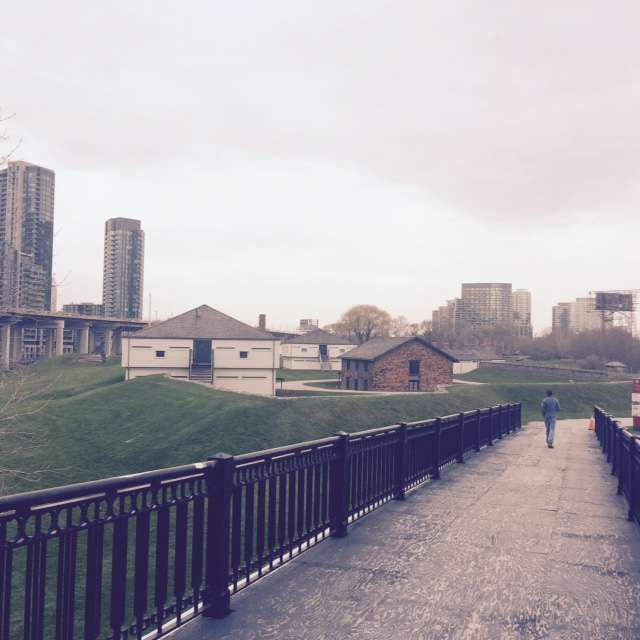
However, I did write a piece in December at the invitation of the Friends of Fort York, which preserve the historic war of 1812-era British fortification in Toronto. 


Pedestrian entrance to Fort York off of Bathurst Street.  The Gardiner Expressway, visible to the left, and the condo towers in the background, show how Toronto has grown since the early 1800s and how the lakeshore has been pushed back.  In its heyday, Fort York lay on the shore of Lake Ontario.


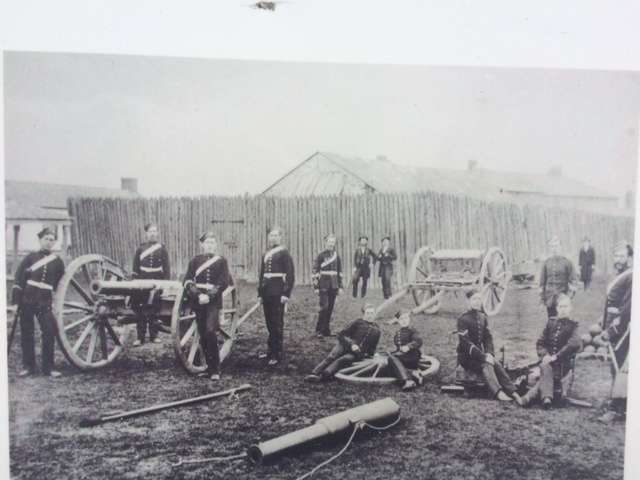
Given my slight expertise in military religious history, I was asked to write a piece on religion at the fort in the 1800s, a difficult subject given that so much of lived religion (actual beliefs and practices) is not nearly as well documented as is official religion (formal church history).


Members of a Royal Artillery battery at Fort York in the mid 1800s.  What did they actually believe?


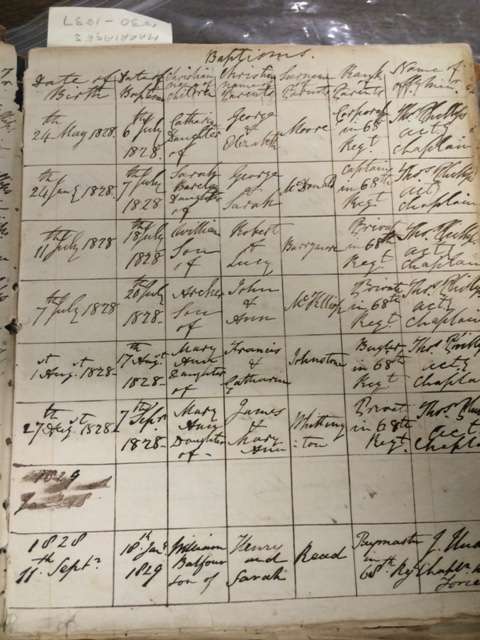
While not an extensive piece of original research, I did get to look at some of the Toronto diocesan archives which show births, baptisms, weddings and funerals at the Fort, as well as some other original source material.


Baptismal register showing christenings of children born to military families of the British Army's 68th Regiment in 1828, and signed by the acting garrison chaplain.


It is impossible to generalize about lived religious life on the basis of the documents available to us.  While the British redcoat had a reputation as being foul-mouthed, drunken and irreverent.  While this may be true then as now of some soldiers, this stereotype ignores the influence of Methodism, missionary movements and Christian welfare organizations that actively reached out to British soldiers throughout the empire.  The stereotype also ignores the role of religion in the lives of Roman Catholics, Presbyterians and various non-conformers whose spiritual needs were not met by official military chaplains, who were almost entirely Anglican.   It is also impossible to generalize as to how official religion -- the round of church parades, weddings, christenings and funerals -- was received by soldiers.  To some, official religion may have been an irritant, but to others it may have been a reassuring if seldom thought of part of life.


 My conclusion in the article is thus that "While the average soldier may have been more comfortable in a tavern than on church parade, he may also have been more devout than is commonly supposed."


The article begins on page 3 here.

Monday, October 31, 2016

Book Review: Brian Castner`s All The Ways We Kill and Die

My military ProD reading lately has included Brian Castner, one of the writers to have emerged from America`s post-9/11 wars. A US Air Force EOD (Explosive Ordnance Disposal) officer, Castner commanded teams of EOD operators in Iraq. In 2012, he wrote The Long Walk Home, a memoir of his time there, and his struggle to make peace with his memories, emotions and PTSD. In 2016, he published All The Ways We Kill and Die, chronicling his attempt to make sense of the death of a fellow EOD operator in Afghanistan. This second book is by turns a memoir, a piece of journalism, and an of-the-moment military history of the Improvised Explosives Device (IED), the signature weapon of the wars in Iraq and Afghanistan. Both books feature an unsparing honesty and a clear, bitterly beautiful prose style. Civilian and military readers alike will want to get to know this writer. I am very happy to say that my review of Castner appeared today in the online military journal, The Strategy Bridge. You can find it here. MP+

Tuesday, August 2, 2016

Military Picture Of The Week


From the DND / RCAF website:  Wing Commander John “Moose” Fulton, D.F.C., A.F.C., photographed on June 12, 1942, was the first commanding officer of 419 Squadron. He died on July 29, 1942, at the age of 29, and his name is engraved on the Runnymede Memorial in the United Kingdom, which records the name of airmen who have no known grave. PHOTO: DND Archives, PL-7742


I learned the story of "Moose" Fulton today on the Royal Canadian Air Force website, in a story about a recent reunion of his 419 Squadron in Kamloops, BC.  419 Squadron was part of the British Commonwealth Air Training Plan, and prepared fighter pilots for combat.  To this day, it is named after it's first commander.
 
419 “City of Kamloops” Squadron was named in honour of their beloved first commanding officer, John “Moose” Fulton, who grew up in Kamloops and from whom the squadron personnel received their designation as the “Moosemen”. 419 Squadron, whose unit badge portrays a charging moose, is reputedly the only Canadian squadron named after a person. And to this day, all 419 Squadron commanding officers retire their own call signs for the duration of their command and take the call sign “Moose” in honour of “Moose” Fulton. 

A very touching montage of photographs, including the only surviving member of 419 Squadron from World War Two, may be found here.

Wednesday, July 27, 2016

War and Memory: The Example of Fromelles

An excellent piece on the War on the Rocks blog this week offers some interesting comments on the social and cultural rationales for war memorials.


Fought on 19 July, 1916, Fromelles was the first major action by Australian troops on the Western Front.   What was intended to be an attack in support of the British Somme offensive turned out to be a costly and pointless disaster.   Over 5,500 Australian soldiers were killed, wounded or captured in one day, the bloodiest in Australian history.


Australian Army memorial service at Fromelles.


As Joan Beaumont notes in her article, it wasn't until the 1990s that Fromelles became well known to Australians, and significant and expensive efforts to identify the dead began, including a dedicated Commonwealth War Graves Cemetery (the first in 50 years) and DNA tests on exhumed remains to identify living descendants in Australia.

Here is a passage from Beaumont's article that I found highly interesting.

No one questioned why many millions of dollars was spent on this exercise. No one, at least publicly, debated the precedent of using DNA to identify the missing. Nor did any one query whether “closure” was needed for relatives who had never known the missing of Fromelles, nor truly experienced grief.

The missing of Fromelles, it seems, spoke to phenomena that have fueled the growth of war memory globally in recent decades: the explosion of genealogy and the desire to locate family stories in bigger, more universal narratives of the past. The new rituals of Fromelles also testified to the continuing salience of the implied contract between citizen and state that underpins a voluntary system of enlistment for military service. In a liberal democracy, where the rights of the individual are a core value, those who choose or are required to die in the defense of the state are considered entitled to be honored individually. This was the ideal that informed the work of the Imperial War Graves Commission in the years after World War I, one of the first mass conflicts in which rank-and-file soldiers were granted their own grave and headstone carrying their name, age, and date of death.

It is a message that still resonates in a society that, for all its individualism and intolerance for the death of the young, requires some individuals at least to be willing to die for the collective good in defense of the nation. Be that service in Afghanistan, Iraq, or United Nations humanitarian interventions, these men and women must be assured that their deaths will be honored, as were those of the men who served before them. Hence, press accounts of the reburials at Fromelles invoked the high diction of war (devotion and honor) and spoke to the need for “a proper send-off” and “a fitting farewell at last” for the “fallen sons” who “can finally be laid to rest with honour.”

What I find striking here is the absence of reflection on religion and spirituality in this analysis.  While the Christian cross continues to be used on the graves and monuments, a holdover from the religiosity that influenced the establishment of War Cemeteries and monuments after the Great War,
the emphasis now, as Beaumont sees it, is on personal meaning (genealogy) and the social contract between the liberal state and its present and future soldier volunteers which offers the consolation of a fitting memorial to any potential sacrifice that may be asked of them.  


Troops of the Australian 53rd Battalion wait for the order to attack at Fromelles.  Only three of the men shown here survived the battle
.

Having matured beyond the ethos of God, King and Country that motivated the volunteers of 1914-1918,  the increasingly secular, independent countries of the former British Empire today must find their own rationales for commemorating the past.   For Australians, like Canadians, the fallen of that war may embody the price that our nations had to pay to win their independence from the paternalism of the imperial era.

I recently had a conversation with a retired Canadian military chaplain, a Newfoundlander, about Beaumont-Hamel, a Somme battlefield where the Royal Newfoundland Regiment, part of the British Army, was essentially destroyed in an hour.  Beaumont-Hamel was essentially the Newfoundland equivalent of |Fromelles, on a smaller scale.   As elsewhere on Day One of the Somme, the Newfoundlanders were ordered into interlocking zones of machine gun according to a plan that, in hindsight, was criminally flawed.  According to my Newfoundlander friend, Beaumont-Hamel exposed the colonial nature of the war, in which British generals and politicians were willing to sacrifice colonial troops just as readily as their own.  It became harder for Newfoundlanders and others to be willing junior partners in the imperial project after the First World War, and the Second World War finalized the dissolution of imperial ties.

This July Canadian soldiers visited Beaumont-Hamel and other parts of the Somme battlefields for ceremonies marking the hundredth anniversary.   For these young soldiers, those resting in the war cemeteries of Europe are honoured national ancestors, and in some cases, as with another chaplain friend of mine, an actual great uncle who never came home to Newfoundland.   For the officers, one hopes that these cemeteries are salutary lessons of how great a responsibility they have to learn their craft and learn it well, for in war mistakes are paid for in lives.  For all of us these places should be, as Beaumont notes, reminders of the social contracts we make with volunteer militaries, and of the care we should take in deliberation before we call on them to make more sacrifices.

MP+


Sunday, March 27, 2016

Easter 1916 In The Trenches - Remembering Anglican Chaplaincy In The Great War

 This article is part of a series I am contributing to the newsletter of the Anglican Military Ordinariate, the clergy of the Anglican Church of Canada serving in the Canadian Armed Forces, as part of an ongoing celebration of the centenary of the Great War.   The complete edition of the newsletter for Easter 1916, as well as past versions, may be found here.  MP+


By Easter 1916, the Canadian Army in France had finished its apprenticeship of war and was starting to gain its reputation as an aggressive, modern force of shock troops.  With 36 combat battalions in three divisions in the line in France, and a Fourth Division soon to join them, Canada was hitting its stride of near full mobilization.   Its armed forces had doubled since the Canadian Expeditionary Force had first formed in 1914.   The CEF now included within its ranks specialists in tunnelling for the cat and mouse game of laying and detecting vast subterranean explosives planted under enemy trenches, while aggressive Canadian raiding tactics, first by night and later by day, had been approvingly noticed by the British Commander in Chief, Sir Douglas Haig.


France was not the only theatre of operations.   Canadian medical personnel operated in the Middle East, and two hospitals had been established at Mudros, a barren section of the Greek island of Lemnos (modern Limnos), to support the failed operation at Gallipoli.  Personnel and patients there suffered cruelly from inadequate water and rations, weather and disease, including scurvy.  The war diary of one of these hospitals conveys a sense of hardship in this one entry:  “Sickness among Officers, Nursing Sisters and men becoming prevalent.  Admission to Hospital of dysentery cases increasing daily.  The fly menace is very great, also the dust, and poor food supply very trying”.   It was at Mudros that Mary Frances Munro died,  the first of 47 Canadian nursing sisters to die in the Great War.  A native of Ontario and a graduate of Bishop Strachan School in Toronto, she died of illness and is among the Canadians buried at the Portianos Commonwealth Cemetery on Limnos.


Canadian military medical staff on Lemnos, ca 1916, from a Globe and Mail article, 2015.


Even in England, far removed from the hardships of Mudros, chaplaincy was challenging.  George Wells, the Anglican padre assigned to Shornecliffe military district, worried about how the Canadian soldier was “getting a very bad name” because of the temptations to “immoral behaviour” in “objectionable houses” and from those “soliciting in the streets”.  Wells worked hard to protect his soldiers, “those who were the pawns of war”.  His attempts to have such establishments put off limits were not sympathetically received by senior officers, who tended to blame the troops’ bad behaviour on the inadequate moral influences of their chaplains.  As Duff Crerar notes, the padres working in training camps faced an uphill battle.  Alcohol was easily obtainable, leadership was heavy handed, routines were tedious, and mandatory church parades were widely hated.  Social work in such conditions was especially challenging, but Wells had some success in championing unwed English mothers and getting Canadian soldiers to take responsibility for them.  In the near-Victorian morality of the period, one has to see this as an especially fearless and prophetic ministry.


For the CEF in the trenches, April 1916 was a cruel month.  Following the German offensive at Verdun, there was great emphasis on offensive action to relive the pressure on the French Army.  Just south of Ypres, Canadian troops were committed to a battle that became known as the St. Eloi Craters (27 March – 16 April 1916).  Four large mines were detonated under the German lines, but instead of the hoped-for breach, vast craters were created in the soggy landscape, complicating maneuver and navigation in the dismal landscape.   While some ground was won, the battlefield was “under constant enemy shelling, and men had been forced to crouch in mud-filled ditches and shell-holes, or stand all day in water nearly to their waists with no possibility of rest”.   During a relief in place under these appalling conditions, the Canadian 6th Brigade was caught in a German counterattack while badly strung out and not in defensive positions.   The Canadians were thrown back with heavy casualties, and the ground was retaken by the Germans.   The battle dragged on for days as an artillery duel before it ended, leaving 1,373 Canadians killed or wounded.  The Canadian official history describes St. Eloi as a “fiasco”, and its costly lessons were taken to heart in future trench offensives.


One of the St. Eloi Craters, Canadian War Museum


 One of the regiments hard pressed in the St. Eloi battle was the 6th Brigade’s 29th (Vancouver) Battalion.   Its chaplain was an Anglican, the Rev. Cecil Caldbeck Owen, a graduate of Wycliffe College and the Rector of Christ Church, Vancouver (today’s Christ Church Cathedral).  Owen, a vigorous man in his middle age, and widely popular in Vancouver, had long been a militia chaplain, and he went overseas with the newly formed 29th BN in May of 1915.  His 22 year old son Harold was by then already in France as an infantry officer.  


Padre Owen (right) with his son, Harold, in front of the Christ Church rectory, Vancouver, 1915, from Living Stones: A History of Christ Church Cathedral


 Christ Church granted Owen leave to serve in the CEF, and despite worries about his parish’s finances and attendance, he gained a reputation as a dedicated front-line chaplain.  He would have gone into action at St. Eloi still coping with grief, for his son Harold had been killed in action on 1 February, 1916.  Owen made a three hour journey on horseback to be present at Harold’s funeral, and like his colleague Canon Scott, continued in his ministry after losing his son to the war.    After the war, Owen served as a hospital chaplain in Vancouver, and was present at the dedication of the Vimy Monument, where he spoke of how “We must educate our children in the finer aspects of courage and sacrifice which emerged during the war so that they will remember the heroism and the deeper lessons which should have resulted from it”.  Sadly, war would ask another sacrifice of him.  Owen’s adopted son Luder Keshisian, an Armenian refugee, was an RCAF pilot in the Second World War, and was killed over Germany in June, 1944.   Padre Owen died in Vancouver on Christmas Eve, 1954, 


For those troops not in the line, Easter Sunday 1916 (24 April) happened to coincide with St. George’s Day, which was not lost on troops of English heritage.  Canon Scott, in the Ypres Salient with the First Division, describes how the engineers “built me a church, and a big sign over the door was first used on Easter Day … and we had very hearty services”.  For those Canadians in the nearby town of Poperinghe, like the Queen’s Own Rifles  which observed Easter Sunday with a church parade, there was the possibility of a visit to Talbot House, an all-ranks refuge created by an enterprising English Anglican, Padre “Tubby” Clayton.  


Talbot House, or “TocH” as it was known, offered soldiers a chance to worship in the chapel upstairs (which rocked alarmingly when packed with men) or to remind themselves of civilian life in the comforts of its drawing room and garden.  Visitors first saw a sign enjoining them to “Abandon rank, all ye who enter here”.  Padre Clayton knew the Canadian chaplains like Canon Scott, and welcomed many Canadian visitors.  He wrote that “Canadian churchmanship impressed me not a little.  For six months in 1916 a Canadian sergeant-major was the Vicar’s warden; and it was he who most appropriately welcomed the Archbishop of Canterbury on his memorable visit to the House early that summer.  Almost the first Canadians I saw were two tunnellers, who on a weekday morning set out from the old French dug-outs beyond Vlamertinghe at 5am and arrived at the Chapel for the celebration (then at 6:30 on weekday), having heard that the service was held daily, and being quite prepared to forgo their chances of breakfast at the end of a ten-mile walk.”  


While TocH was a refuge, it was not a shelter.  Poperinghe lay within the Ypres salient, and as Clayton wrote, shells “crossed and recrossed the roof from three points of the compass”.  The congregations who knelt and prayed in TocH’s small chapel had to return to an even more dangerous front line.  A long war and uncertain survival still lay before them.    For padres like Clayton, all they could do was to try andfind these momentary places and times of grace for the troo, and commend the men to God in the terrible battles to come.


Padre Michael Peterson+

Mad Padre

Mad Padre
Opinions expressed within are in no way the responsibility of anyone's employers or facilitating agencies and should by rights be taken as nothing more than one person's notional musings, attempted witticisms, and prayerful posturings.

Followers

Blog Archive

Labels