Military members have to walk a line between their own political beliefs and what the State asks of them as members of the profession of arms. In principle, it is fairly simple: do nothing to bring disrepute on the government that you serve, but be ready to disobey an unlawful order and/or resign if your ethics and moral values make it impossible to continue to serve.
Military members owe the same loyalty to the government of the day that civil servants do, but with the extra burden of realizing that unlike workers in, say, Finance or Vital Statistics, they have the unique capability and organization to take power and replace a government that is not to their liking.
Times of social and political polarization make it especially tempting for the military to see itself as a political actor, in the long Bonapartian tradition of the Man on the White Horse. In the especially fraught politics of the US, the number of recently retired senior officers endorsing political candidates rises each year, lending their influence and example to serving members who may feel similarly tempted. In this excellent essay, LCol Cavanaugh, an American Army officer, proposes a Code of Conduct to keep the military apolitical.
While Canada's military is a sliver of the size of its US counterpart, and has always stayed out of active politics, I have personally seen Canadian Armed Forces members, identifiable online as such, criticize policies of the Government of Canada on social media. Non-commissioned members have associated with racist and extremist groups, thus violating the CAF's commitment to diversity and to mirroring the face of Canadian society. I would suggest that LCol Cavanaugh's proposed Code of Conduct works just as well for us, if the words "Canada" and "Canadian" are substituted for United States and American.
There are dark days ahead. Military members have a duty and a responsibility not to make them any darker.
MP+

Showing posts with label Military Ethics. Show all posts
Showing posts with label Military Ethics. Show all posts
Tuesday, November 13, 2018


Saturday, April 15, 2017
A Meditation For Good Friday
This was part of a series of dramatic monologues that people in my parish were asked to come up with for the Stations of the Cross yesterday. Each Station was presented by a voice of someone who was present there, and was followed by a meditation and a prayer. This was mine, and there were many that were much much better.
Second Station Jesus Takes Up His Cross
John 19:13-17
When Pilate heard these words, he brought Jesus outside and sat on the judge’s bench at a place called The Stone Pavement, or in Hebrew Gabbatha. Now it was the day of Preparation for the Passover; and it was about noon. He said to the Jews, ‘Here is your King!’ They cried out, ‘Away with him! Away with him! Crucify him!’ Pilate asked them, ‘Shall I crucify your King?’ The chief priests answered, ‘We have no king but the emperor.’ Then he handed him over to them to be crucified.
My name is Pollo. Sergeant in the tenth century, second cohort, Third Legion. Twenty years service, marched clear across the empire and back three times in that. Seen a thing or two, I can tell you.
I remember because it was Passover, lots of strangers in Jerusalem, things were on edge and the high mucky mucks in the Palace wanted extra security. So me and my lads drew extra duty, out in the crowds, watching things and then when they arrested that fellow, Jesus, well, it was all a mess, wasn’t it?
I had trouble with the new recruits, cuz they was all nervous, with the crowds shouting and all. And Pilate, him mucking around being indecisive, and asking the crowd what they wanted, this Jesus or Barabbas. I wouldn’t have done it that way, no sir. I would have had me lads wade into the crowd, swords out, settle them down, show em Rome was boss, that’s my style. Anyway, that was above my pay grade, wasn’t it.
So it was decided, like, and Centurion Quintus, he brings this Jesus over to me, and says, Pollo, here’s your man, get him up the hill smart like, and I saluted and said yes sir, like you does. Now I could see that Pilate’s guard had roughed him up bad, which was a problem for me, since he still had a way to walk and him being all messed up, well that was my problem now. Wasn’t fair, was it? So I says, Right, sunny Jim, there’s your lumber, get hauling. It wasn’t the whole cross, see, just the beam that they nailed the arms to, the poles were fixed in the ground. Our lads what did the crucifying, they were pros, they could get twenty men raised up high in a morning and still have time for dice and wine.
Now normally, they’re all Boo hoo, I have a wife and child, have mercy but this Jesus was quiet, just stood there, quiet, like a lamb, which was odd, so I looks at him, and I thinks, hang on, he’s that same bloke what I saw on the donkey, a week ago, when he came into the city, the crowds all adoring and welcoming him, like. That wasn’t half strange, seeing how they all turned on him, and what was more, he didn’t look like a king, but he looked, I dunno, special, like. Different, y’know? I says to him, Well, your highness, where’s your people now? Not much of a king, are you? And I meant it as a joke, like, but it came out all sad, sympathetic, like, and he just looked at me, then he turned to his cross, like he had his duty, same as me.
I could see him trying to lift the wood like a good un, but he was right played out and finding it hard going. Normally I’d give a fellow a taste of the whip, or have the lads tickle him with spears to get him going, but none of us wanted to do that. Now me, I’m a simple soldier, can’t explain it, but it just seemed, well, wrong. Even Glavus, my youngest soldier, he was even wanting to help this man, can you believe it? Back in ranks, i shouted, and I could see I had to something, and quick. We had to get him up the hill and onto his cross, because those were our orders, weren’t they? We was following orders …
John 19:13-17
When Pilate heard these words, he brought Jesus outside and sat on the judge’s bench at a place called The Stone Pavement, or in Hebrew Gabbatha. Now it was the day of Preparation for the Passover; and it was about noon. He said to the Jews, ‘Here is your King!’ They cried out, ‘Away with him! Away with him! Crucify him!’ Pilate asked them, ‘Shall I crucify your King?’ The chief priests answered, ‘We have no king but the emperor.’ Then he handed him over to them to be crucified.
Meditation
For the Romans, the cross was part of a system of brutality and discipline that made their empire work. The men who ran the empire, like the soldier Pollo, had their orders and they did their duty.
Two thousand years later, the world still works that way. Some men made nerve gas and put in bombs, other men loaded the bombs onto planes, and other men dropped those bombs on a village because they had their orders. Then as now, rebellions have to be crushed, power has to be reestablished, kings must protect themselves.
How does Good Friday challenge these earthly systems of power. By lifting the cross to his shoulders and taking it on himself, what does Jesus say about how God’s power works? As Christians, and as the Church, how does Jesus teach us how to live in a world of earthly power?
Prayer
Gracious God, thank you for your son and for his willingness to lift the cross on our behalf. Teach us how we as your people can also embrace the cross, and show the world how your love and grace are the source of your power.
Monday, October 3, 2016
The Interrogator's Confession: A Book Review of Consequence: A Memoir by Eric Fair

Consequence: A Memoir is the confession of a good man who became
complicit in evil. Eric Fair, an
American and a Christian with a strong sense of vocation to God and country,
found himself working as an interrogator in Iraq, where he became involved in torture
and war crimes. With unflinching
honesty and a total absence of self-pity, Fair tells the story of his time as a
private contractor tasked with extracting intelligence from Iraqi detainees
during the American occupation of the mid-2000s. While never asking for our sympathy, he shows
how a seemingly decent person can continue to make compromises and excuses for
their moral failures until they find themselves in a spiritually catastrophic
place.
Born to a middle class family in a
depressed Pennsylvania steel town, Eric Fair was a timid child who found a
refuge in his family’s Presbyterian church.
While he became more robust in high school, his childhood left him with
a profound respect for protector figures and a sense that he had a calling to a
career in law enforcement. In 1995,
after university, Fair chose enlistment in the army as a brief means to an end,
since training as a military policeman would make him an attractive candidate
to civilian police departments. Instead
he was selected to become a linguist in Arabic.
In describing his time as a young
NCM in the Army, as a member of a conservative church, and as a civilian police
officer, Fair reveals a sense of disquiet and even alienation from cultures
that were intolerant and violent. The
murder of a soldier in his unit, who was suspected to be gay, haunts him. The violence of being a street cop proves
disillusioning, while the judgemental culture of his church culture alienates
him. As he finds himself estranged from
the institutions and ideals that gave him his moral purpose, Fair struggles to
find purpose and meaning in his life.
In 2003, a diagnosed heart defect
left Fair unemployable as a policeman.
By then the second Iraq War is underway, and friends are encouraging
Fair to go there as an Arab linguist, while his wife is encouraging him to go
to seminary because she admires his sense of compassion and thinks he would be
a good pastor. Driven by his sense that
he was called to serve and protect his country, he begins to research civilian
contractors and government agencies that might employ him as a linguist. “I don’t listen to Karin, and I don’t listen
to the voices telling me to be patient, or consider changing course. I apply to seminary to appease these voices
and silence the advice. In the meantime,
I chart my own path back. I intend to
make Iraq the first step”.
It’s not uncommon to see men, still
young and vigorous, who deny the betrayal of their bodies after a heart attack
or similar illness. In 2003, as the US
was hiring a legion of civilian employees to administer Iraq, it was easy for
Fair to get hired without a medical exam.
While he may have wanted to recover his self-image as a soldier and
protector, the disorganized and unprofessional nature of his private-sector employer
troubles him. He is assigned to Abu
Ghraib, a former prison of the Saddam regime now used to warehouse the many
Iraqis being rounded up in US sweeps, where Fair’s job will be to interrogate
these men and decide who poses a threat.
The assignment fills him with dismay and leads him to this disturbing
revelation:
“In Scripture, God
often works in prisons, but he is never on the side of the jailer. He is always on the side of the
prisoner. The realization brings on a
physical reaction. My hands shake. My face warms. I feel nauseated. The sensation is terrifying. Prayer in Iraq is dangerous. I am beginning to realize that I’m not on
God’s path. I’m on my own.”
What happened in Abu Ghraib is well
known. While Fair was not involved in
the worst excesses that were documented in now-infamous images, he is honest
about his own role there. Extreme
methods of interrogation, including sleep deprivation, stress positions, and
physical intimidation, were standard and he participated in them. Fair’s time in Iraq, his return to the US
and subsequent physical and mental collapse are honestly described and make for
harrowing reading. In 2006 he spoke to the media about his role in Iraq and was
involved in the US government investigations into torture in Iraq. Some of the final pages of the book are
redacted, the blocks of black ink testifying to the official secrecy and even
guilt that lingers over this period.
An opening quotation from the
medieval Jewish philosopher, Maimonides, seems to signal Fair’s purpose. Maimonides wrote that “a person is not
forgiven until he pays back his fellow man what he owes him and appeases
him. He must placate him and approach
him again and again until he is forgiven”.
The reader may struggle to decide if he or she is indeed placated, or if
Fair is even seeking our forgiveness. At
times the book feels like nothing more than an extended confession, to which
our task is only to bear witness. In
April of this year, after the book was published, Fair told National Public
Radio that while his book offers “long
discussions about why those things happened ... and how difficult it was to
sort of break from those expectations of being a soldier … none of that matters. I made horrible mistakes.
... I have a responsibility to confess those things openly."
For
military chaplains, Fair’s book offers much food for thought. It invites us to reflect on the vanities that
may lie concealed in our sense of vocations, and whether our projects and
identities come from ambition rather than true calling. Fair’s confession shows how easy it can be
to rationalize our involvement with evil, and how we can compound the moral
damage by cutting ourselves off from God when we persuade ourselves that our
prayers are unworthy of him. Finally, as
moral and ethical advisors in these dangerous and alarmed times, Fair reminds
chaplains of the need for truthful language about how we humans injure one
another, rather than using dishonest words such as “enhanced
interrogation”. As Fair told NPR, “I
think that the minute you violate another human being's will … we have an
obligation to call that torture.” [i]
[i] http://www.npr.org/sections/parallels/2016/04/04/472964974/it-was-torture-an-abu-ghraib-interrogator-acknowledges-horrible-mistakes
Tuesday, April 5, 2016
"I Made Horrible Mistakes": Regrets Of An American Torturer

Diagram of stress positions, from a US military handbook for interrogators.
A day after reading a very disheartening Religious News Service story about how nearly two-thirds of Americans support torture, I was given fresh hope when I listened to NPR's incomparable Terry Gross speaking with an American former interogator who worked in Iraq's infamous Abu Ghraib prison.
Eric Fair worked for a private contractor employed by the US military as an interrogator in Iraq. A former soldier, his knowledge of Arabic qualified him for the work, though he admits there were times when he was reliant on translators to understand what the prisoners were saying. He has just published Consequence: A Memoir, which has been well reviewed by the New York Times.

Eric Fair
I refuse to suggest that torture is successful on any level. And I'm not sure that it matters; it shouldn't matter to anyone in this country. I'm not sure why we've gotten to this point where we start to talk about the effectiveness of torture, as if that makes any difference whatsoever.
Torture is wrong. Americans, all Americans, should know better. That's what makes us attractive; what makes us attractive is the way we do things, it's the example that we set. What makes us attractive is not how tough we are or how good we are at extracting information, and anyone who thinks that way I think fails to understand what this country is about. So I've left that discussion about whether or not torture is effective or not behind. It simply doesn't matter.
At a time when a Reuters and Ipsos poll finds 63 per cent of Americans (and 82% of Republicans) believing that toture is jsutified if it can "obtain information about terrorism activities", Fair's voice is honest and important. I'll review his book here in the near future.
Tuesday, March 29, 2016
Book Review: Annie Jacobsen's The Pentagon's Brain: An Uncensored History of DARPA
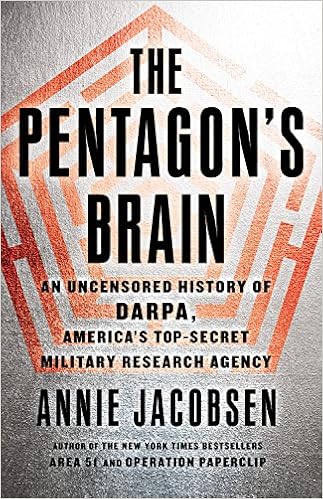
The Pentagon’s Brain: An Uncensored History of DARPA, America’s Top Secret Military Research Agency (New York: Little, Brown and Company, 2015).
Annie Jacobsen
Since 1958, DARPA, the Defense Advanced Research Projects Agency, has connected the US military with the academic and scientific expertise that it relies upon to maintain its technological advantage over present and likely future adversaries. Journalist Annie Jacobsen has done a competent job of telling the story of this cooperation, within the limits of what information is unclassified and thus accessible. A book with a subtitle that includes “Top Secret Military Research Agency” warns the reader that there are limits to what it is likely to tell them. Jacobsen admits in her conclusion that “DARPA’s highest-risk, highest-payoff programs remain secret until they are unveiled on the battlefield” (451). Given the limits of what she does not know, she tells a fascinating story of ingenuity and hubris, which ends with troubling ethical and moral implications.
Jacobsen begins her story with Castle Bravo, the codename of an operation in 1954 to test a new thermonuclear or hydrogen bomb on the remote Bikini Atoll, 2650 miles west of Hawaii. The test was part of an effort to stay ahead of the Soviet Union in the nuclear arms race. The Castle Bravo bomb took advantage of new technology to miniaturize warheads, so that the weapon detonated on Bilini was vastly more powerful than the Hiroshima bomb a decade before, and yet was not much larger. The explosion was far more powerful than anticipated, to the point where the observers in a concrete and sand-covered bunker nineteen miles away wondered if they would survive the massive shockwave.
Jacobsen uses Castle Bravo to set up her main theme, that scientific and technological progress threatens to outstrip our ability to manage it, not to mention our ethical preconceptions of how war is supposed to work. Another example, similar to the scale of the Castle Bravo explosion, was the first test in 1960 of a massive radar in Greenland, which would allow NORAD (North American Defence Command) to detect Soviet missile launches. The radar system was so powerful that its signals were detecting the rising moon, a quarter of a million miles away, and the primitive software was interpreting the signals as an attack. It took human ingenuity and judgement to cancel a response and recalibrate the radar. Similar wise judgements, Jacobsen recounts, prevailed in the eventual ending of above ground nuclear tests, by the superpowers, and the cancellation of bomb projects so vast that they would destroy continents. Politicians, scientist, and military leaders could all agree that nuclear technology could never be used in war because there was no way to guarantee that it would not escalate, and no defence if it did. In her final chapters, Jacobsen warns that we may not be so lucky with the technologies, including autonomous fighting systems (killer robots) and artificial intelligence, that DARPA is currently researching.
If human foresight and wisdom saved us from nuclear war thus far, that same wisdom is conspicuously absent in other chapters. Jacobsen describes two episodes, one in Vietnam and the other in Iraq and Afghanistan, where military success depended on understanding the culture and motivation of human opponents. In both cases, DARPA was tapped to recruit anthropologists and social scientists to help the US military understand why guerrilla insurgencies (the Vietcong in Vietnam and various insurgencies - Sunni, Shia and Taliban -in Afghanistan and Iraq) were motivating and recruiting their fighters. These were questions that military leaders and technology could not answer. The results, especially in the case of Vietnam, were not encouraging and provide a depressing spectacle of human folly. When the civilian scientists concluded that the corrupt South Vietnamese regime and policies of forcible resettlement of peasants into fortified villages were creating insurgents, their findings were ignored, because they did not support the dominant paradigm that Communism was to blame. Today, as Robert Kaplan points out in his recent book Asia’s Cauldron, we know that the Vietnamese have a long history of fighting invaders, and that Communism had far less to do with the struggle against the US than was supposed at the time. Fears of falling dominos throughout Asia blinded the US to the role of simple, robust nationalism as a motivator.
In Iraq and Afghanistan, social scientists were recruited into so-called Human Terrain Teams (HTTs), to help US commanders understand the tribal societies they were confronting, as counterinsurgency tactics forgotten post-Vietnam had to be relearned. In so cases, HTTs were successful in helping troops to understand the human dimension of a complex and messy battlefield. However, some in the civilian academic community felt that mapping the human terrain of what the military calls the “battlespace” could enable other groups within the military to identify high-value targets for capture or elimination, and that the work of civilian social scientists within the HTTs was not furthering the goal if impartial academic research. One of the things one learns from Jaoobsen’s book is that when a DARPA program is green lighted, enormous sums of money flow. Since the growing HTT program was farmed out to civilian defence contractors like BAE systems, unqualified people may have been hired, as this article suggests. Eventually the Human Terrain program became a target for politicians crusading against waste, and the programs were scaled back, rebranded, or discontinued.
Because Jacobsen’s narrative is chronological, her book reads as a long series of projects that seemingly have little to do with one another, other than that their funding and research went through DARPA. As a sequence, nuclear bombs, anthropologists in Vietnam, drones and IED jammers in Iraq and Afghanistan, and research on neurological enhancements and robots in the present day, all suggest a series of frenzied and trendy research programs, driven by the exigencies of the large wars America feared, and the small wars it found itself in. I would suggest looking elsewhere for a military / historical perspective on why the US needs research agencies like DARPA. Max Boot’s 2006 book, War Made New: Weapons, Warriors and the Making of the Modern World, would be one example of such a perspective. Boot’s analysis of military technology’s evolution since 1500 shows a series of revolutions in weapons, tactics, and technology, each more remarkable and more compressed than the last, but each fatal for those powers that make poor choices. Jacobsen’s book falls partially within what Boot calls the Information Revolution (c. 1970-2000), when America gained a decisive advantage in computer technology for weapons and command and control systems. However, as Boot notes, having chosen to ride that tiger, the stakes involved have gotten higher and higher as the edge becomes less and less decisive. Boot writes that:
"America’s early lead in the Information Revolution can easily be lost - it may be being lost already - if it does not stay at the forefront of military developments. Other countries and even subnational entities such as al Qaeda have an opportunity to exert power that would have been unthinkable before the spread of personal computers, cell phones, satellite navigation devices, and other Information Age technologies” (p. 16). "
Jacobsen is write to end her book on a cautionary note as she worries about the implications of applying AI and robotics research to military uses. She does not, however, note that other powers are undoubtedly working on the same systems. The ease with which Russia could destroy Ukrainian field units in 2014-15 was through their own use of battlefield drones and computer controlled weapons systems. If Jacobsen’s book is about technology as a Pandora’s box opened by soldiers and scientists, then that box was opened long ago, and, now opened, will take more than one world power to close.
Friday, October 9, 2015
Was Kunduz A War Crime?
A week after US warplanes bombed a hospital run by Doctors Without Borders (MSF) in Kunduz, Afghanistan on 3 October, killing over twenty staff and patients, Afghanistan, there is some debate as to whether the bombing was a war crime.
On 8 October, Dr. Joanne Liu, the President of MSF issued a statement that included these words.
"It is precisely because attacking hospitals in war zones is prohibited that we expected to be protected. And yet, ten patients, including three children and twelve MSF staff, were killed in the aerial raids.
The facts and circumstances of this attack must be investigated independently and impartially, particularly given the inconsistencies in the US and Afghan accounts of what happened over recent days. We cannot rely on only internal military investigations by the US, NATO, and Afghan forces.
Today we announce that we are seeking an investigation into the Kunduz attack by the International Humanitarian Fact-Finding Commission (IHFFC). This Commission was established in the Additional Protocols of the Geneva Conventions and is the only permanent body set up specifically to investigate violations of international humanitarian law. We ask signatory States to activate the Commission to establish the truth and to reassert the protected status of hospitals in conflict. MSF has called the event a war crime and has demanded an international investigation."
Whether these attacks constitute a war crime, a deliberate breach of the Geneva Convention protections on hospitals in war zones, will be up to the IHFFC, which BBC News describe as a "never-used body" to determine.
A week after the event, some facts are apparent. The hospital, seen here in this photo from an MSF factsheet on the bombing, was clearly marked as such, and its location was known to NATO and Afghan authorities.

The MSF has denied claims from the Afghan government that enemy forces were operating on the hospital grounds.
This week the New York Times reported that the US forces involved were apparently not in a position to confirm what was happening at the hospital when they ordered the strike.
“Obviously, the investigation is still underway, but Campbell’s thinking now is that the Americans on the ground did not follow the rules of engagement fully,” said one of three American officials, all of whom emphasized that no final conclusions had been reached and that the inquiry could yield different reasons for what transpired.
Under Article 18 of the Geneva Convention, hospitals enjoy protected status in war zones provided that they are being used as hospitals, as this UN commentary on the Article notes.
A civilian hospital must have the staff (including administrative staff) and the equipment required to fulfil its purpose. It must be organized to give hospital care. That is the essential point. It is not necessary for the hospital to function permanently as a hospital. The Diplomatic Conference considered that establishments converted into auxiliary hospitals as an emergency measure consequent upon the events of war, should not be excluded from the protection of the Convention (5), as such hospitals are very often established in the combat area itself, and their need for protection is thus all the greater. The deciding factor is, as has just been mentioned, that it must be effectively possible to give hospital treatment and care, and that necessarily implies a modicum of organization.
Clearly the hospital in Kunduz was organized to provide care, and was entitled to the protection of the Geneva Convention.
In an interview with NPR, an American law professor noted that to convince a court or tribunal that this a war crime, as something more than an accident, would be difficult.
Still, it is a high bar to call the Kunduz attack a war crime, says Robert Goldman, who teaches international law at American University.
"Are we going to have to make some kinds of reparation and so forth? Well, I think, you bet," he says. But, he cautions, it will be difficult to make a case that this was an intentional attack on a protected place — rather than just a case of poor intelligence or negligence.
"The burden would be on the prosecution to establish beyond a reasonable doubt that this was an attack willfully undertaken in the knowledge that it was an object entitled to protection," Goldman says. "That is a very, very high hurdle."
At the very least, the bombing of the hospital in Kunduz was the result of haste, the "fog of war", chaos, and poor communications. It should not have happened. It seems unlikely that those who bear responsibility will face international justice, but the doubtless will face internal investigation, and possibly reprimand and dismissal. Beyond those consequences, those who called the mission, authorized it, flew it, and fired the weapons will face the moral consequences and injury for the rest of their lives.
On 8 October, Dr. Joanne Liu, the President of MSF issued a statement that included these words.
"It is precisely because attacking hospitals in war zones is prohibited that we expected to be protected. And yet, ten patients, including three children and twelve MSF staff, were killed in the aerial raids.
The facts and circumstances of this attack must be investigated independently and impartially, particularly given the inconsistencies in the US and Afghan accounts of what happened over recent days. We cannot rely on only internal military investigations by the US, NATO, and Afghan forces.
Today we announce that we are seeking an investigation into the Kunduz attack by the International Humanitarian Fact-Finding Commission (IHFFC). This Commission was established in the Additional Protocols of the Geneva Conventions and is the only permanent body set up specifically to investigate violations of international humanitarian law. We ask signatory States to activate the Commission to establish the truth and to reassert the protected status of hospitals in conflict. MSF has called the event a war crime and has demanded an international investigation."
Whether these attacks constitute a war crime, a deliberate breach of the Geneva Convention protections on hospitals in war zones, will be up to the IHFFC, which BBC News describe as a "never-used body" to determine.
A week after the event, some facts are apparent. The hospital, seen here in this photo from an MSF factsheet on the bombing, was clearly marked as such, and its location was known to NATO and Afghan authorities.
The MSF has denied claims from the Afghan government that enemy forces were operating on the hospital grounds.
This week the New York Times reported that the US forces involved were apparently not in a position to confirm what was happening at the hospital when they ordered the strike.
The Special Operations Forces also apparently did not have “eyes on” — that is, were unable to positively identify — the area to be attacked to confirm it was a legitimate target before calling in the strike, the officials said.
Regardless of what mistake may have been made, General Campbell told a Senate committee on Tuesday that the strike was ultimately the result of “a U.S. decision made within the U.S. chain of command.” He took responsibility for the sustained bombardment of the medical facility, which he said took place in response to an Afghan call for help.
“Obviously, the investigation is still underway, but Campbell’s thinking now is that the Americans on the ground did not follow the rules of engagement fully,” said one of three American officials, all of whom emphasized that no final conclusions had been reached and that the inquiry could yield different reasons for what transpired.
Under Article 18 of the Geneva Convention, hospitals enjoy protected status in war zones provided that they are being used as hospitals, as this UN commentary on the Article notes.
A civilian hospital must have the staff (including administrative staff) and the equipment required to fulfil its purpose. It must be organized to give hospital care. That is the essential point. It is not necessary for the hospital to function permanently as a hospital. The Diplomatic Conference considered that establishments converted into auxiliary hospitals as an emergency measure consequent upon the events of war, should not be excluded from the protection of the Convention (5), as such hospitals are very often established in the combat area itself, and their need for protection is thus all the greater. The deciding factor is, as has just been mentioned, that it must be effectively possible to give hospital treatment and care, and that necessarily implies a modicum of organization.
Clearly the hospital in Kunduz was organized to provide care, and was entitled to the protection of the Geneva Convention.
In an interview with NPR, an American law professor noted that to convince a court or tribunal that this a war crime, as something more than an accident, would be difficult.
Still, it is a high bar to call the Kunduz attack a war crime, says Robert Goldman, who teaches international law at American University.
"Are we going to have to make some kinds of reparation and so forth? Well, I think, you bet," he says. But, he cautions, it will be difficult to make a case that this was an intentional attack on a protected place — rather than just a case of poor intelligence or negligence.
"The burden would be on the prosecution to establish beyond a reasonable doubt that this was an attack willfully undertaken in the knowledge that it was an object entitled to protection," Goldman says. "That is a very, very high hurdle."
At the very least, the bombing of the hospital in Kunduz was the result of haste, the "fog of war", chaos, and poor communications. It should not have happened. It seems unlikely that those who bear responsibility will face international justice, but the doubtless will face internal investigation, and possibly reprimand and dismissal. Beyond those consequences, those who called the mission, authorized it, flew it, and fired the weapons will face the moral consequences and injury for the rest of their lives.
Wednesday, September 16, 2015
Jeffrey Toobin on ''Cafeteria Government''
Whatever one thinks of Ms. Davis, Jeffrey Toobin's short essay on the New Yorker website raises some interesting points about whether religious accomodation amounts to "cafeteria citizenship" and even to "cafeteria government".
If citizens (and now in the US, small business and family-owned corporations thanks to the SCOTUS Hobby Lobby ruling) are free to decline some obligations (eg, to serve customers, to provide certain kinds of health care) on the basis of their religious beliefs, what degree of accomodation should be allowed to government employees? Is it acceptable for a govrernment to accomodate the beliefs of its employees by allowing them to decline to perform certain tasks, such as issue marriage licenses to same-sex peole, provided that there are other government employees that are willing to perform those same tasks? What are the limits to such accomodation? Voluntary military service comes to mind as one government sector where all employees must be willing to perform, enable or at least sanction certain actions, specifically acts of violence at the behest of a lawful authority. Are there comparable cases where accomodation is not possible in government service?
Thursday, June 18, 2015
One Human Cost Of The Drone War

While amusing (at least, amusing i suppose to pilots) the caption of this image suggests that it can’t be that easy being an Air Force drone operator. Besides the disrespect from pilots of manned aircraft, who are legendary for their egos (Air Force joke: how can you tell if someone is a pilot? They’ll tell you) even as they may be an endangered species, it turns out that there are psychological and even spiritual costs to operating unmanned aerial vehicles. These issues have been explored in a recent film, “Good Kill”. That film was reviewed fairly positively in the New Yorker last month, though Anthony Lane felt that its pursuit of its themes “depersonalized conflict, collateral damage, and modes of modern imperialism” was done in ways that “strain to insure that its meaning is as clear and as cloudless as the Nevada skies”.
Two days ago the New York Times published a story on how drone operators are subject to operational and post-traumatic stress, and how drone operations are being cut back because of high attrition rates among operators. The article includes mention of how US Air Force chaplains are among a “human performance team” of mental health professionals who have high level security clearances in order to meet with any operators in the facility at Creech Air Force Base in Nevada “if they are troubled”. That would make for some heavy pastoral lifting, to be sure, and hopefully the chaplains are doing more than just encouraging people to get back in their seats and fly another mission.
I said in my title that drone pilots and operators are “One Human Cost of the Drone War” but of course there are other costs. A 2014 installation in the fields of Pakistan aimed to show US drone operators the face of a child orphaned by a drone strike. In November of 2014, Steve Coll wrote a memorable piece for the New Yorker on what it is like to live in a region where drones operate regularly. Since at least 2011 various third parties, including the Columbia University Law School. have been calling for disclosure of civilians, primarily in Pakistan but more recently in countries like Yemen, who have been killed in drone strikes. Earlier this month the NYT reported on how some US lawyers are seeking to get a US government apology for two Yemeni men killed by mistake in a drone strike in 2012. The relatives of the two men were apparently offered a bag of cash, sequentially numbered US currency, but to date the only US apology issued for an accidental death from a drone was issued to the families of two Western hostages. In November of 2014, the Guardian reported that civilian deaths in US drone strokes numbered over 1100.
None of the above comments are meant to demonize US drone operators. The NYT piece reminds us that there are human costs on both sides. Drone operators have high-definition video images to show the effects of their strikes on buildings, vehicles, and people. It’s impossible to imagine that these images do not have the power to haunt and trouble these operators. As media pundits debate the wisdom of putting “boots on the ground” and sending soldiers back into places like Iraq, it should be remembered that the West has been very comfortable, even complacent, in conducting a remote control war for years now, targeting the so-called high value targets (HVTs) that emerge, one terrorist leader replacing the other. The Israelis call this approach “mowing the grass”. In this ongoing hunt for HVTs, a certain degree of “collateral damage”, meaning deaths of civilians either caught in the blasts or targeted mistakenly, is tolerated. Should we as citizens accept this process when it seems that increasing numbers of men and women operating the drones can no longer accept it?
Thursday, July 24, 2014
Is PTSD A Defence For Moral Lapses? The Case of Senator Walsh

In yesterday’s post on military medals and integrity, I mentioned that embellishing one’s credentials is a fairly common failing. A case in point is U.S. Senator John Walsh (Democrat, Montana), who has in past tweaked his resume to make it sound more impressive. According to today’s New York Times, Senator Walsh’s congressional bio once said that he was a graduate of the University of Albany, State University of New York, when “he actually earned his B.S. degree from what was then known as Regents College, an adult learning institute that issued degrees under the umbrella of the University of the State of New York”. That may not seem like a big deal, and Senator Walsh amended his bio (without comment) when a political newspaper looked into his credentials.
A bigger deal, reported today, is that when Senator Walsh was an officer in the US Army, and was a student at the US Army War College in Carlisle, PA in 2007, he appears to have plagiarized the final paper for his Master’s degree. The NYT piece offers numerous examples of how Walsh included the material of other authors in his essay without quotation marks, often changing a word or two. While some of these sources were footnoted, the absence of quotation marks is crucial. Any undergraduate knows (or should know) that quotation marks tell one’s reader that the words and thoughts are not one’s own, and any attempt to suggest otherwise is a serious instance of academic dishonesty. A War College faculty member is quoted in the NYT article as saying that the importance of academic honesty is something that is made quite clear to the students - “We drill that in incessantly”.
A postgraduate degree in contemporary western militaries is a significant rung on the career ladder to senior rank, or, in military slang, a “check in the box” necessary for promotion. While any university instructor will tell you that academic fraud is a serious problem on college campuses, one would hope that military officers would have a sounder understanding of personal and professional integrity than a callow undergraduate.
Senator Walsh has told the Associated Press that his war experience in Iraq led to Post Traumatic Stress Disorder which affected his judgement. “I don’t want to blame my mistake on PTSD, but I do want to say it may have been a factor. My head was not in a place very conducive to a classroom and an academic environment”. In the same interview, he said that he “didn’t believe” that he had plagiarized his paper.
It’s tempting to think that in the hyper-partisan climate of US politics, Senator Walsh’s opponents will try to exploit this story. A Montana Democrat is already using the words “smear campaign”. However, to be fair, the Senator’s military credentials, including his War College degree, doubtless made him an attractive candidate in the first place. At some point the voters will decide, but the story does raise a troublesome question about whether PTSD can be used as a defence for lapses of moral judgement, even if, as in the Senator’s case, it is a curiously high-functioning form of PTSD.
It would be interesting to hear the Senator comment on the following hypothetical scenario. A young veteran, attending college, is sitting in his or her professor’s office. They are discussing the student’s paper which, like the Senator’s, uses other people’s ideas without properly acknowledging them. The veteran pleads PTSD. What should the professor say?
Friday, July 18, 2014
David Rothkopf on the "Ragged Edges" of Modern Conflict

Barring some awful, “Guns of August” style massive conflict that may be waiting around the corner (an uncomfortable thought in July of the centennial year of 1914, when so many tinderboxes are scattered around the world), the conventional wisdom of military near-futurists is that wars will be messy but essentially small-scale, asymmetrical, low-intensity affairs, where smarts, technology, and agile use of politics and media will give one side or the other an edge.
The temptation of such scenarios is thinking that these sorts of conflicts can be managed and their human cost can be minimalized, marginalized, rationalized and generally explained away. In the last few days, however, we’ve seen dead Palestinian children on a beach or a shattered civilian airliner, its human cargo suddenly and horrifically extinguished, reminding us that the human costs of even limited war will always be more unpredictable than the war-managers would like.
Today on the Foreign Policy website, David Rothkopf muses on these sudden and brutal costs occur at the “ragged edges” of contemporary war, and suggests that human cost, always unpredictable and surprisingly horrific, indicts the “hubris” of leaders who think that they can control the uncontrollable. The medievals, with their idea of the Wheel of Fortune as a symbol for the uncertainty of the world and a warning for the ruler who might trust his fortunes to war, seem closer to us, and wiser, than we might think.
In the first half of the twentieth century, wars were formally declared and were governed by treaties and rights regimes such as the Geneva Convention, which went some way towards mitigating, or at least contextualizing, the grievous costs of total war. Bombing cities and killing civilians was horrible, but it could be justified, however dubiously: it was reciprocal (they bombed us first), it was necessary (those civilians also work in war plants and support their government), it was existential (we need to do whatever it takes to win, or our civilization will be lost), or even humane (the harder we bomb, the sooner they’ll give up and in the end we’ll save lives). It was possible to bomb enemy cities and still expect that certain standards of humanity would prevail, so that, for example, captured aircrew would be treated properly as POWs by the same people they had bombed. As Rothkopf notes, in total war, the term “collateral damage” doesn’t make much sense, since one does what one has to do to prevail. In total war, all damage is proximate. There is no collateral.
Post Iraq and Afghanistan, the temptation for the West is to get out of these messy and indeterminate wars, to retreat to within the relative safety of ourborders, and to manage the risks of entering or avoiding small wars and conflicts as cleverly and carefully as we can. However, in our globalized world, civilian airliners, like the ocean liners of the early 20th century, will continue to link cities. Last week I flew across the Atlantic to Rome, and other than the usual vague annoyances at airport security (which make us acknowledge, however lightly, the possibility of terrorism), I never imagined that there was any greater risk. For the last decade we’ve thought about shoe bombs and underwear bombs and box cutters. I am sure that the people on MH17, even if they looked at the maps on their TV screens and realized they were flying over the Ukraine, never thought for a moment that they could be swatted down by a conventional missile developed and built in the late Cold War. Likewise, I am sure that most people on the RMS Lusitania never imagined that war would touch them until a German torpedo struck them. While there were debates about whether Germany and Britain violated an international agreement known as the Cruiser Rules (the Germans by firing on a civilian ship without warning, the British for putting munitions on a civilian ship), it triggered a crisis that eventually brought the United States into the Great War. That consequence was probably not foreseen by the German war planners when they first decided to use their submarines to declare a zone of war around the British Isles. Collateral damage then, as now, can have unpredictable consequences.
It will be interesting in the days ahead to see what can be learned about the downing of MH17, and about the responsibility for that act and where, if anywhere, it leads the world community that still wants to believe in the ideal of safe civilian air traffic, if not in any greater responsibility for the prosecution of war crimes. As for Israel’s Gaza incursion, I heard an Israeil diplomat to the US make this statement of belief in the possibility of the carefully managed war on the PBS NewsHour this Wednesday.
"And I think we should wait, hopefully, when this operation will come to an end, and we will get a good understanding of what happened.It’s important to realize Hamas uses the Palestinian population as human shields. They put missile batteries next to schools, mosques, hospitals. They are doing everything they can to put the Palestinian population in Gaza into harm’s way.Israel is doing everything it can, whether it’s dropping flyers, calling people, sending text messages, taking all sorts of actions to get the Palestinian civilians out of harm’s way."
I don’t personally know what to think about Israel vs Gaza. I can see the validity of arguments based on Israel’s right to exist and its need to be recognized as a state as a precondition to peace. I can see why Palestinians can see themselves as an oppressed and occupied people, living in what is essentially a walled ghetto. But I fear, listening to the Israeli envoy on Wednesday, that there is the comfort of a script unfolding, a script that says war can be managed politically and technologically with minimum collateral damage, and I fear that this comfort is illusory and that, one day, this script will go horribly wrong.
Wednesday, June 4, 2014
Worth Repeating: Amy Davidson on the Bergdahl Trade
As more and more of the backstory of the US trade of Guantanamo detainees for its soldier, Bowe Bergdhal, emerge, and as the story becomes increasingly politicized, I would say that there are some clear ethical and legal threads that need to be followed.
First, while numerous stories from his military peers are now out there as to how Bergdhal intentionally deserted and thus jeopardized the lives of comrades sent to look for him, I don’t think these stories trump his right to come home. When other US soldiers were accused of crimes against Iraqi and Afghan civilians, they were brought back to the US to face justice. The same principle should apply to alleged deserters. If the phrase “Leave No One Behind” counts, it shouldn’t have moral exemptions. As the only US soldier to be help captive by the Taliban, his health, which was apparently declining, and the declared intent of the US to withdraw from Afghanistan, made this the right time to bring him home. If I was Bowe Bergdhal’s father, I would want my son to face military justice in the US rather than to be punished by allowing him to linger in Taliban hands. There will surely be a Board of Inquiry into his capture, and if the BOI leads to charges and even a conviction for him, better and more just for Bergdahl to be confined in a military prison such as Leavenworth. It also seems to me to be common sense that when soldiers deploy to future conflicts, they need to know that their country will do all that it can to bring them home, whatever the political costs may be.
Second, the controversy over the trade of five supposedly high-value captives for Bergdhal, as Amy Davidson writes in The New Yorker, merely remind us of the morally compromised position that the US placed itself in by refusing to treat them as Prisoners of War according to internationally-agreed on Laws of Armed Conflict.
"These five prisoners, known to be Taliban commanders and officials, were ones the Obama Administration had said should be held indefinitely, because they posed a threat. However, it was not prepared to charge them with any crime. One thing that the angry response to the trade revealed is that the implicit definition of “indefinite,” in many quarters, was “forever.” But indefinite means indefinite; when you have what, despite the frippery of various review boards, are essentially extrajudicial imprisonments based on the judgment of the executive, you might have people who get out a lot sooner than one would expect, too. Want to be more sure that the people now at Guantánamo stay prisoners for an extended period of time? Then convict them of something; give them a sentence.
Similarly, Guantánamo’s advocates have long dismissed legal (and moral) doubts by repeating the word “war,” arguing that these are battlefield prisoners. But prisoners of war get released when conflicts end. The main affiliation of these prisoners is the Taliban, not Al Qaeda, and their fight is the war in Afghanistan, which is winding down. (John Bellinger makes this point in a post at Lawfare.) They also get exchanged. One can’t have it both ways: there are laws associated with prisoners of war, too. The phrase “P.O.W.” is not just shorthand hand for “don’t have to go to court.”
Perhaps the Obama Administration did break the law in not notifying Congress before making a prisoner exchange. I’ll leave that question to my American friends to debate, though I do agree with Davidson that a law apparently designed to keep certain certain people detained forever is a curious sort of law.
Tuesday, June 18, 2013
Is Syria The West's Latest Moral Failing?

First, a small preamble to this post. I have no special expertise in foreign policy. I'm just a guy who watches and reads the news, and who has been trying to make sense of the ongoing debate (which apparently has been resolved, sort of), as to whether the West should intervene in the Syrian Civil War. Last week I posted a review here of UK historian Michael Burleigh's book Moral Combat, an ethical study of good and evil in World War Two. I suggested in my review that Burleigh makes the case that it is still possible to think about war with moral clarity. Thinking of Burleigh in light of what's going on in Syria set this post in motion.
As the death toll climbs towards one hundred thousand in Syria, and some political figures in the West are comparing this moment to our moments of shame in the 1990s when we did nothing in Rwanda or Bosnia, I've been wondering if it is possible to speak coherently of good and evil in the Syrian conflict, and whether there is a moral case for the West to intervene.
Last week Aaron Miller wrote that while the present moment shows much peril in any Western (which in practice wouuld be mostly American)intervention, there is also the fear that history will look back and judge this moment, like Rwanda and Bosnia, a moral failing. "From where we sit today, it is easier to reach the conclusion that Syria is a trap for America. But once Obama's term concludes, there will be a different evaluation. People will forget the details and circumstances --they will only see the dead and the wounded, the refugees and the physical devastation. They will want to know why America wouldn't or couldn't do more. And that's partly why the pressure to do something will grow. Obama knows that Syria is the key story line in the so-called Arab Spring and that his own legacy will suffer unless he moves to counteract the negative appraisals currently gathering force. So, does he want to share the legacy of the last Democratic president, who failed to intervene in Rwanda and almost in Bosnia, too?"
There are lots of military reasons why intervention at the level of the no-fly zone would be a bad idea. It may very well be that the West has shot its bolt in Iraq and Afghanistan, and now has neither the force, the money, nor the political will to project much strength into the region. Nevertheless, as of this weekend, with US President Obama's decision to start arming the Free Syrian Army, it now appears that we are taking some steps into the conflict.
Leaving aside questions of how we proceed tactically, there is still time to ask why we should proceed. Is there an ethically compelling case for acting? The best, and most depressing, Syria analysis I've seen yet on FP comes from Marc Lynch. His article is well worth reading, but here's a quick summary. If the West wants to be idealistic, that is, if we are truly interested in ethics and humanitarian relief, then the only way to end the war and save more lives is to deal with Assad and his backers, including Iran and Russia, to bring about a peace that would allow the Assad regime to survive in some form. Such a policy might be a "stunning success" in terms of ending the fighting. allowing some return of refugees, and opening the door to rebuilding and redefining of boundaries, but from a realist point of view, it would be an "epic disaster" that would strengthen the position the Syria-Iran-Hezbollah triangle and weaken Israel's position.
From a realist point of view, Lynch says, the best thing to do would be to strengthen the rebels and prolong the war, thus bleeding our rivals. "From this perspective, Hezbollah's entry into the fray and the fall of Qusayr are not necessarily a bad thing -- Washington now has an opportunity to strike directly at one of Iran's most valuable assets in the Middle East. The enemy's queen, to use a chess metaphor, has now moved out from behind its wall of pawns and is open to attack. Fear of a rebel defeat -- and of a victory for Hezbollah and Iran -- should squeeze more cash and military support out of the Arab Gulf, Europe, and the United States." Unfortunately, this view pretty much guarantees more deaths, more displacement, and the spread of sectarian conflict between Sunnis and Shias throughout the Middle East. This course of action leads to a future of proxy warfare in the middle east for a generation, and from a humanitarian point of view is morally bankrupt.
So we have two depressing options. Idealism says to pursue a diplomatic, humanitarian solution at the expense of regional security and the balance of power. Realism says we should stoke a proxy war that will kill more people and further destabilize the region, and hope that by degrading our rivals something better might emerge.
To resolve this dilemma, I thought I would go back to Michael Burleigh thinks about Syria. His most recent comment, from April of this year, wasn't encouraging. Speaking of his own country, the UK, he writes, "Cameron’s government is once again full of moralising outrage, raising fears that it might soon be willing to send our war-weary forces into yet another hopeless conflict in the Middle East. Why this sectarian civil war concerns us, rather than Arab armies we regularly equip with billions of pounds worth of high-tech weaponry, remains a mystery to many British people. And if [we send] in troops, the result would be nothing less than a catastrophe." Clearly, Burleigh does not think this is an historic moment to rival Munich.
It may well be that, as Conrad Black wrote in yesterday's National Post, only the peoples of the region, Turks, Persians, and Arabs, can sort out the future of the region, and if so, the most we can do is to provide humanitarian aid where possible. I wonder, though, if that pragmatism will be enough for the ghosts of Rwanda and Bosnia, whose presence, however insubstantial, still haunts us as we debate what we should do in Syria.
For Christians, I think our responses to this terrible situation are somewhat more straightforward. There remain almost a million refugees from this war and their numbers seem to be increasing. Several of the denominational magazines that come across my desk now feature advertisements appealing for donations to organizations working with presons displaced by the war in Syria. As the Canadian Presbyterian magazine put it, indifference is not an option. Besides supporting these organizations as part of our own stewardship, we need to remind our elected representatives that the cause of displaced persons matters to us. Now is also a good time for Christians to reach out to local Moslem communities, and pray with them. Finally, we need to pray for our leaders, that God give them the courage and the wisdom to choose peace over the temptations of realism, security, and war without end.
Tuesday, June 11, 2013
Book Review: Michael Burleigh, Moral Combat: Good and Evil In World War Two
It's been a while since I posted a book review here. This review was published in the Spring 2013 edition of Dialogue, the journal of the Canadian Armed Forces Chaplains Branch.
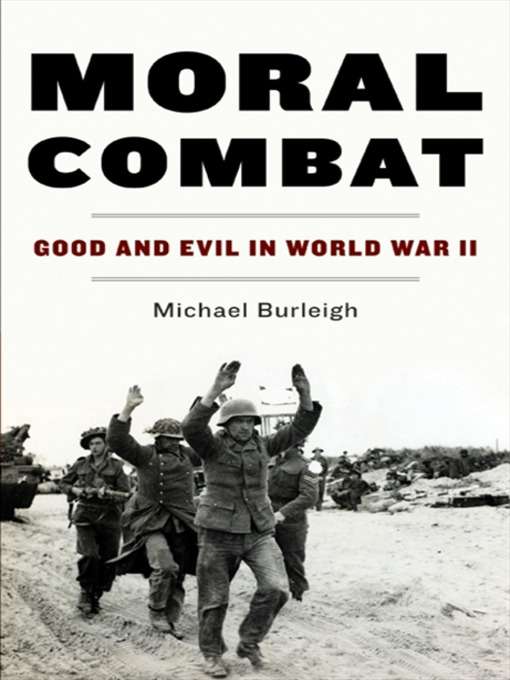
English historian Michael Burleigh’s 2011 book, Moral Combat: Good and Evil In World War Two (New York: Harper Collins, 2011), is well worth reading by anyone who gets paid to think about military ethics and the use of force. The moral history of World War Two is important because it was, for the Western democracies, a conflict between doctrines of just war, which Burleigh defines as “a series of injunctions about the lawful authorisation of armed conflict and the relationship between ends and means”, on the one hand, and the need, on the other hand, to defeat institutionalised and industrialised evil and barbarism by any means necessary. The outlines of this conflict have been obscured not only by time but by decades of revisionist history, postmodern ambiguity and moral relativism. Burleigh’s book is a convincing rebuttal of these trends, and shows that it is possible to think about war with moral clarity and vigour.
History can be a depressing thing to contemplate. Regular, recurring examples of human failure can threaten to undermine our faith in moral judgement. The decision made in 1938 by France and Britain at Munich to hand over three and half million Czechs to Nazi Germany was, as Burleigh argues, a failure of “moral conscience”. Contemporaries, like France’s Prime Minister Daladier, felt that Munich was only “preparing the way for the destruction of Western civilisation and of liberty in the world”. When one compares Munich to the Yalta Conference of 1945, when the Allies handed the Poles from German to Russian tyranny, it can be tempting to adopt a stance of moral relativism. Slogans such as “history is written by the victors” or, as a young CF Captain told me recently, “We’re in Afghanistan for big oil”, illustrate the prevailing relativistic notion that all war aims are somehow equally corrupt and venal.
The first part of Burleigh’s book is a ground-clearing exercise, rebutting the view that the Western democracies and their enemies were morally equivalent. This exercise is accomplished by a detailed examination of the ideology, governance, and industrialised repression and murder of the police states of Nazi Germany and the USSR”. The police states, he writes, served a cause that was “responsible for the arrest, torture, imprisonment or execution of vast numbers of people because of their class or national origin, with the lucky merely having their lives ruined”. Both regimes abjured moral universalism, dismissing it, in Trotsky’s words, as “papist-Quaker babble about the sanctity of human life” and replacing it with the view, spoken by Hitler, that “the strongest man is right”.
It has been said that the most unethical thing the western democracies could have done in World War Two would have been to lose. In the second half of his book, Burleigh carefully analyzes the “moral calculus” of the Allied war effort, from special operations in occupied Europe, to an alliance of expediency with the USSR, to the bombing of German cities. Burleigh notes that the bombing campaign, still controversial today, was the subject of intense moral debate at the time, a debate impossible to imagine in the dictatorships. It was also a theological debate, with many churchmen, including the Rev. John Collins, a Bomber Command chaplain, condemning the effort as immoral and “soul destroying”. These voices were not universal. William Temple, the Archbishop of Canterbury, felt that the “worst of all things is to fight and do it ineffectively”. Likewise Cyril Garbett, the Archbishop of York, concluded that “it is the lesser evil to bomb a war-loving Germany than to sacrifice the lives of our fellow countrymen who long for peace, and to delay delivering millions now held in slavery”.
It was the opinion of politicians and generals, not church leaders, that decided the fate of the vanquished in 1945, and as Burleigh notes, rebuilding and the rule of law prevailed over rough “victor’s justice”. The Nuremburg and Tokyo trials established precedents and models that are followed today in The Hague. By comparison, “One needs only to imagine a war crimes trial conducted by the Nazis to reach the conclusion that Nuremburg was fair by the lights of the day”.
Burleigh’s book demonstrates that it is possible to think through historical events with moral clarity, and even with moral outrage. As he notes in his introduction, his subject is morals and not moralising, which are as different to one another as religiosity is to religion. World War Two involved millions of responsible adults confronted with difficult decisions and an often “overpowering” temptation to immorality. In such a context, it is indeed remarkable that “a vestigial regard for decent or lawful conduct survived at all”. Seventy years later, in our own age of terror and counter-terror, our militaries, governments, and peoples continue to confront moral temptations in a much more ambiguous war. As chaplains and ethicists, we have a role to play in arguing that it is possible to think and act with moral clarity.
Wednesday, May 22, 2013
Men In Uniform Behaving Badly - The Sad Parade Continues

This sad looking fellow is a face that should live in military infamy. It belongs to a Lt. Col. Jeff Krusinski, who was in charge of the US Air Force's program to prevent sexual assault until he, well,ummm, oh dear, this is awkward, until he sexually assaulted a woman in a Virginia parking lot. Judging from the mug shot, he got the worst of it, which is in itself not a bad thing. When news of this story broke recently, the US Secretary of Defence announced that he would take a personal interest in seeing Krusinski was properly punished, which pretty much guarantees the acme of military career flameouts.
Unfortunately, it gets worse. Following revelations that the number of reported sexual assaults in the US military had risen six percent from 2012, going from 3,192 to 3,374, several other military men charged with the safety of their female peers and subordinates in uniform have also been accused of the very offences they were charged with preventing. Last Friday, Tom Ricks mordantly proposed a new competition, asking "Has your base's sexual assault czar been arrested yet?", in response to stories that two other US servicemen with duties similar to Krusinksi's had been relieved of duties and charged. One was accused of stalking his ex-wife, the other was accused of "pandering, abusive sexual contact, assault and maltreatment of subordinates." The issue has become sufficiently prominent that NPR's Tom Ashbrook recently dedicated an hour to it.
Lest I come across as being smug at the expense of the US military, I should note that a Canadian Forces base commander was recently relieved of his command and "faces a charge of sexual assault and two charges under the National Defence Act — disgraceful conduct and drunkenness". It is not the first time in this officer's career that he has been in trouble for sexual misconduct. While I don't have any current data for the prevalence of sexual assault in the Canadian Forces, the Ottawa Citzen reported in 2011 that the number of sexual assault complaints made in the CF in 2010 was 176, slightly up from the 166 complaints made in 2009.
I think we are seeing several trends happening here. The first is that as western militaries cease to be exclusively male preserves, and as lawmakers and elected officials charged with military oversight now include prominent and outraged women, we will see fewer excuses for male soldiers to behave badly. The second is that the current approach to fighting sexual misconduct in the ranks is now revealed as being badly flawed. It will no longer be enough to create a program aimed at preventing misconduct and giving it to an underperformer to administer. In my own experience in the military, I've seen examples of posts and programs aimed at making people virtuous, such as the Unit Ethics Officer, given as secondary duties to nonentities because no one else wants them. Making ethics or sexual assault prevention the responsibility of one person, especially someone whose career has stalled, is pretty much a guarantee that the idea behind that program won't be taken seriously.
Another trend, and I'm surprised that no one has mentioned it in this context, is pornography. Perhaps its the elephant in the room, but I think it needs to be discussed in relation to the issue of how women are mistreated in the military. Not to put too fine a point on it, but the military culture tolerates, and even encourages, the consumption of porn. In the case of the Canadian officer I mentioned above, his earlier misconduct seems to have been linked to porn. Feminists have been saying for decades that the consumption of pornography encourages men to objectify and dehumanize women, and I agree with this basic argument because I see it in my military peers. I don't see a way to make pornography magically disappear, but I don't see any way forward for militaries composed of men and women until we can start talking about it.
Thursday, February 21, 2013
Thinking Ethically About The New Cool War
On the Foreign Policy website today, David Rothkopf uses the term "Cool War" (new to me) to describe so called "cyberwar", the use of computer hacking and digital attacks by state actors on one another. A very current example of cyberwar was in the headlines this Tuesday with the Mandiant report on Chinese Army hacking of US computer networks. Here's Rothkopf explaining why the "Cool War" is different from the "Cold War" that those of us over the age of thirty remember.
"This new war is "cool" rather than "cold" for two reasons. On the one hand, it is a little warmer than cold because it seems likely to involve almost constant offensive measures that, while falling short of actual warfare, regularly seek to damage or weaken rivals or gain an edge through violations of sovereignty and penetration of defenses. And on the other, it takes on the other definition of "cool," in that it involves the latest cutting-edge technologies in ways that are changing the paradigm of conflict to a much greater degree than any of those employed during the Cold War -- which was, after all, about old-fashioned geopolitical jockeying for advantage in anticipation of potential old-school total warfare.
The Cool War is largely different not only because of the participants or the nature of the conflict, but also because it can be conducted indefinitely -- permanently, even -- without triggering a shooting war. At least that is the theory."
I hope that someone in the legal and military comunity who thinks about Laws of Armed Conflict (LOAC) is tracking this. LOAC is geared to kinetic conflict, where bullets and bombs are employed to cause physical harm, and is designed to protect the innocent (civilians, non-combatants) from violence and ill treatment. The sanctions exercised by the world community (eg, the International Criminal Tribunal for the former Yugoslavia in the Hague, NL) are designed to deter the leaders of states or sub-state actors (militias, guerrilla armies, etc) from war crimes committed in a kinetic conflict through fear of arrest, prosecution and imprisonment.
What fear, other than the fear of escalation to a kinetic, military conflict, deters those who order cyberattacks on other countries and, by extension, on their people? It's one thing to steal plans from a major defense manufacturer, but what happens when Cool Warriors start touching the lives of populations? In an increasingly fragile and technologically dependent world, this future is not hard to imagine. What if banking were to crash for an extended period, causing economic crisis and even hunger? What if the power grid were brought down in the depths of winter, or air transport was halted by the hacking of navigation aids, satellites, etc? What if civilian populations are displaced, harmed, or even killed by these actions? Could those responsible be charged with war crimes? Could these crimes even be defined?
One thing is for certain. We are, as Rothkopf writes, "in the midst of a sea change in the way nations project force". It would be helpful for the international community to discuss how we might limit the uses of this new force, while we still can.
Wednesday, February 20, 2013
"Drones Are Like Laparoscopic Surgery"
Another tip of the beret to Mad Padre's Man In Dublin for putting me on to this piece in Slate Magazine by William Saletan defending the West's use of drones in places such as Afghanistan and Yemen as being the best possible way to reduce civilian casualties. It's tempting to see a vindication of Saltaan's argument in the release today of a U.N. report saying that "For the first time in six years the number of civilians killed in Afghanistan declined", although as this New York Times article suggests, the decline may also be due to other factors, such as the ongoing drawdown of NATO ground troops.
While Saletan rightly points out that drones are still creepy for a bunch of reasons, I think he's right that they are preferable to conventional aircraft and bombs when there is time to identify the target with minimal risk. A human pilot coming in fast and worried about ground fire does not have the luxury of time and careful study of the target, as Canadian troops in Afghanistan learned to their grievous cost.
Thursday, January 24, 2013
More On Drones And Privacy/Policy Issues

In 2008, when I was being posted to 14 Wing in Greenwood, Nova Scotia, my realtor at the time was quite excited about the prospect of the Wing standing up a UAV (unmannaed aerial venicle, or drones) squadron. The influx of new personnel, he argued, would be good for home prices and should coincide with the send of my posting, giving me good resale prospects. There would also be a boost for the local economy,new stores, etc. I wonder now how many local residents would have welcomed the prospect of frequent drone training flights and incursions on their privacy.
This story from US National Public Radio (NPR) from upstate New York talks about the impact of military training flights of drones on the civilian community and the privacy issues involved. Those domestic privacy rights issues are also discussed here in an NPR interview with a law professor. http://www.northcountrypublicradio.org/image.php/EmpireWire20110117a.jpg?width=220&image=http%3A%2F%2Fwww.northcountrypublicradio.org%2Fnews%2Fimages%2F%2FEmpireWire20110117a.jpg
Besides domestic privacy issues, the larger issue I think is the use of drones to target and kill high value targets associated with terrorist organizations, the transparency of policies around drone use to the electorate, and the compatibility of these policies with universally accepted Laws of Armed Conflict. A useful discussion of these issues occured last night on the PBS News Hour:
Watch Exploring Effectiveness, Consequences of Drone Warfare on PBS. See more from PBS NewsHour.
Saturday, December 8, 2012
What's With The Generals?
It's been a while now since the fall of US General David Petraeus from his post-military job as head of the CIA and all the weird stuff about half naked FBI agents, duelling socialites, and fluffy emails that followed. I first read about Petraeus in journalist Tom Ricks' book on the US-Iraq war, Fiasco, where he emerged as one of the few smart and capable US generals to have emerged from that sad business.
Since the Petraeus business there have been a lot of clever but predictable jokes on late night TV about the "military adultery complex". A more thoughtful comment came from Adam Gopnik in The New Yorker magazine, who wondered why we are surprised that generals should give in to a basic human instinct. "Desire", Gopnik writes, "is not subject to the language of judicious choice, or it would not be desire, with a language all its own. The point of lust, not to put too fine a point on it, is that it lures us to do dumb stuff, and the fact that the dumb stuff gets done is continuing proof of its power."
I agree with Gopnik that senior military men can be led by lust to do dumb stuff just as well as ordinary mortals, even though militaries tend to frown on sexual misconduct. Anyone in The Canadian Army familiar with the downfall of General Menard will know this to be true. However, after reading "General Failure", hisarticle in the current issue of The Atlantic Magazine, I find myself agreeing with journalist Tom Ricks that what a general does with his genitals is the least of the problem.
Going back to the US Army's experience in Western Europe from 1944-45, Ricks notes that the sacking of senior commanders (6 Army divisional and 5 corps commanders) was quite common. This is not surprising, he argues, since a general must master a highly demanding skills set, and be able to lead in a complex situation of maximum stress and physical demands. Not everyone met that standard, and the demands of facing a professional and competent German army required pitiless culling of inferior leaders. Compare that era to America's last ten years of war, where an internal culture of military careerism, abetted by an outside lack of interest and understanding of the military by civilian journalists and politicians, protects lacklustre generals. As Ricks writes, "Relief of generals has become so rare that, as Lieutenant Colonel Paul Yingling noted during the Iraq War, a private who loses his rifle is now punished more than a general who loses his part of a war."
Ricks' Atlantic article is a condensed version of the argument in his new book, The Generals: American Military Command From World War Two To Today, reviewed herein the New York Times. This book is definitely one I am hoping to read over the Christmas holidays.
If you want more of Ricks on this subject, you can watch his Dec 4 interview on the PBS News Hour here.
Wednesday, September 26, 2012
Again With The Drones: NYU/Stanford Study Addresses Social/Cultural Impact Of Drone Warfare In Pakistan
I've posted on several items in the military/political news regarding the West's increasing reliance on Unmanned Aerial Vehicles (commonly called drones) to conduct military actions and extra-judicial killings as part what we have come to call the War on Terror. These articles have focused on the usefulness or counter-productiveness of these weapons on foreign policy aims and on their implications for military ethics and the laws of armed conflict.
Living Under Drones, a joint study by academics and Stanford and New York universities is the first, to my knowledge, to focus on the impact of drone warfare on a population and culture. The researches conducted numerous interviews in Pakistan, the main theatre of US UAV/drone operations. Their findings challenge the prevalent idea that drones are a surgical and precise weapons system, and suggests that a very small percentage of the thousands believed killed by drone strikes in Pakistan were actually key terrorist leaders.
This paragraph from the report (p. 11) is worth quoting in full, as it speaks to what the report claims is the impact of sustained drone warfare on the culture and lives of the people living beneath them: Drones hover twenty-four hours a day over communities in northwest Pakistan, striking homes, vehicles, and public spaces without warning. Their presence terrorizes men, women, and children, giving rise to anxiety and psychological trauma among civilian communities. Those living under drones have to face the constant worry that a deadly strike may be fired at any moment, and the knowledge that they are powerless to protect themselves. These fears have affected behavior. The US practice of striking one area multiple times, and evidence that it has killed rescuers, makes both community members and humanitarian workers afraid or unwilling to assist injured victims. Some community members shy away from gathering in groups, including important tribal dispute-resolution bodies, out of fear that they may attract the attention of drone operators. Some parents choose to keep their children home, and children injured or traumatized by strikes have dropped out of school. Waziris told our researchers that the strikes have undermined cultural and religious practices related to burial, and made family members afraid to attend funerals. In addition, families who lost loved ones or their homes in drone strikes now struggle to support themselves.Besides rekindling the ethical debate on whether drone technology gives the executive branch an illegal, or at least an extrajudical, power of lethal sanction, to my mind it also raises other questions. The whole policy of COIN (counterinsurgency warfare), widely touted as the only viable means of ending the wars of the last decade, and especially Afghanistan, rests on the idea of winning the hearts and minds of the people while isolating and fighting the insurgents. But if, as the report requests, drones make whole populations fearful and then hostile to the US and to the West, then is this technology working for us or against us?
Subscribe to:
Posts (Atom)
Mad Padre

Opinions expressed within are in no way the responsibility of anyone's employers or facilitating agencies and should by rights be taken as nothing more than one person's notional musings, attempted witticisms, and prayerful posturings.