Showing posts with label Death and Dying. Show all posts

Wednesday, November 8, 2023

Homily For All Souls

Preached last Thursday, Nov 2, 2023 at All Saints, Collingwood, Anglican Diocese of Toronto.

Readings:   Wisdom 3.1-9, Psalm 116:1-8; 1 Pet 1:3-9; John 6:37-40


Tonight we join with other Anglican churches who are rediscovering the deep meaning of All Souls.


I say rediscovered because this service was not part of our Reformed heritage.  The early Reformers saw prayers for the dead as being unnecessary and wrong, in part because of the absolute grace of God in the resurrection of Jesus Christ by whom the dead are also promised resurrection, but also because in the late middle ages the Roman Catholic Church had monetized prayers for the dead as a way of getting them out of Purgatory.


We as Anglicans have never believed in Purgatory and we have never believed that the dead need our prayers.


So why has this service in returned?   


In part because we as North Americans have increasingly turned away from the reality of dead.    Few of us have laid out and washed a loved one’s body.    Many families ask for celebrations of life rather than funerals, which is a well meaning denial of the reality of death.


As Christians, the reality of death is built into our faith in the form of the cross.   Nothing can be more real than death if we look to the cross on Good Friday.    Acknowledging the reality of death gives us permission to mourn as we should, to shed real tears, and feel sorry for ourselves, something that a celebration does not really permit.


But we also know that our faith only asks us to mourn for a while.  If Christ is not raised, as Paul says in First Corinthians, then we are to be pitied (1 Cor 15.19).   


The resurrection assures us that the dead we mourn are safe in the care and love of Christ, and promises us that they, and we, will have life again.


Until then, our prayers for the dead are an acknowledgement of our loss, but they are also an acknowledgement of our love and our hope.   What is prayer really but the expression of love and hope? 


And that hope is buttressed by the yesterday, the Feast of All Saints, and our belief that the dead join in the great communion of saints where they join with God and the Lamb in love and prayer for us.   


So,  when we pray for the dead, we say, in effect, I love you, I miss you, I’m glad you’re safe, I’ll see you again.

Saturday, September 9, 2023

A Funeral Homily For Ann Bye

A Funeral Homily For Ann Bye

Preached at All Saints, Collingwood, Saturday, September 9, 2011


Today’s service is a first for me.  I’ve helped with many funerals over the years but never until today have I been at the funeral of writer of hymns.    The words of two of the hymns in this service were written by Ann, and they are full of a lively love for God and trust in God, two ingredients that make for a good hymn.

As the new priest here, I only had the pleasure of meeting Ann a few times at Pine Villa (where she was well cared for), so I don’t know the story of her life very well.   In our first hymn Ann gives thank to God the “lessons learned along the way” and I would have liked to asked her about those lessons and what she learned from her long life.

I suspect however that I have my answer in the four pages of notes that she left for her funeral.    Ann saw Christ as the light the guided her footsteps, she loved Jesus and she wanted to share her faith with others.   In her first hymn she speaks of her her praise is offered in “humility” and I love her for that.  Ann wanted this service to be about Jesus, and not about herself.

The Bible doesn’t say much about heaven.   Jesus says he goes to prepare a place for us, so we can be sure that heaven is a good place.  Sometimes when we imagine heaven, we think of it as a place where we have all eternity to do the things we loved to do on earth, which for some people I’ve met usually involves things like golf.    

In fact, the only thing the Bible is clear on about what we do in heaven is that when we will get there we will want to spend eternity being with and praising Jesus.  The Book of Revelation talks about the worship and singing of heaven:

“I heard the voice of many angels … [and] every creature in heaven and on earth and under the earth ad in the sea, and all the is in them, singing “To the one seated on the throne and to the Lamb be blessing and honour and glory and might forever and ever” (Rev 5.11-12).

So really, Ann got it right and I’m sure she is delighted to now be one of those voices.   Today Ann teaches us that all out worship, all our lives, and all our music should be dedicated to God, and for that as a priest and as a believer, I’m very thankful.  I look forward to one day hearing her voice in the heavenly choir.

Sunday, July 31, 2016

Giving A Good Accounting: A Sermon for the 11th Sunday After Pentecost

I am preaching this Sunday at the Parish of North Essa while the rector there takes some well deserved vacation. This two-point parish in the Diocese of Toronto is a gem of rural ministry and I am looking forward to being with their people again.


Texts this Sunday, Proper 13C, 11th Sunday After Pentecost:  Hosea 11:1-11 or Ecclesiastes 1:2,12-14; 2:18-23; Psalm 49:1-12; Colossians 3:1-11; Luke 12: 13-21


A story from Saturday’s New York Times made helped me understand today’s Gospel reading from Luke in terms of how God expects a good accounting of our lives, and what that good accounting might look like.


In 1994, doormen working at a posh apartment building on Manhattan’s East Side befriended an elderly man.   They first noticed him because as he walked he would often bend down and pick up scraps of trash, doing his bit to keep the neighbourhood tidy.  His first words to the doormen were written on a scrap of paper:  “Hi, my name is Bernhardt but call me Ben.  I can’t take, but I can hear.”  Over years of friendship, Ben would bring the doormen coffee and Spanish newspapers, and teach them, via his written notes, how to improve their English.  Like others on the block, the doormen learned that Ben lived on social security in a small one-room apartment that cost ten dollars a day, and had almost no possessions.  Nevertheless he was unfailingly happy, loved talking to people and would stop to pet their dogs.  In return people showered him with shoes and clothes, and even tickets to the opera, which he loved.


Ben’s doormen friends would arrange Ben’s appointments for his many medical issues, and when he died of prostate cancer earlier this month, they raised the money for his funeral.  Because Ben had served in the military during the Korean War, they arranged for a military honour guard to be at his funeral.  One of his doormen friends, Mr.Jorge Grisales, kept the US flag presented at the funeral and plans to frame it and display it in his house.   Mr. Griasales told the New York Times that his friend “always smiled.  He never complained.  He was just wonderful. “  His colleague, Mr. Arias, said that Ben “had plenty of reasons to be unhappy.  But I never saw him unhappy.”


One could see Ben’s story as the polar opposite of the story of the wealthy man in today’s gospel from Luke.    While Ben had no wealth, he was rich in spirit and rich in his connections with other people.   His kindness, his interest in others, and the generosity he inspired are all important values in Luke’s gospel, as we have heard if we have been following the lectionary these last few weeks.  From the parable of the Good Samaritan to the story of Martha and Mary welcoming Jesus and his disciples (possibly a great number) into their house, this part of Luke’s gospel stresses hospitality, the generosity, love, and attention fo those around us that are demanded of those who wish to love and follow God.


By contrast, the prosperous farmer in Luke’s gospel may have abundant crops, but he seems impoverished in human relationships.   As Jesus tells the parable, we hear nothing of the man’s connections with others.  When he thinks about how he will cope with all his harvest, he doesn’t take counsel of family or friends.  All we hear is that he “thought to himself”.   His conversation with himself — “And I will say to my soul, Soul, you have ample goods laid up for many years; relax, eat, drink, be merry” (Lk 11:19) also has a solitary quality to it.   There is no of any others that he wishes to share his wealth with, which is not surprising, considering that if he shared his abundant crops with others, he would not have the problem of needing to build bigger barns.


Of course, it doesn’t work out sa the rich man planned, because he dies suddenly in the night.  Jesus finishes with the ironic comment, “And the things you have prepared, whose will they be?’ (Lk 11:20).  That comment reminds me of the end of Dickens’ Christmas Carol, and the scene which horrifies Scrooge so much, of his possessions being haggled over by others.   Jesus’ final comments may be addressed to the man in the crowd who asks him to intervene in a dispute over an inheritance.   Perhaps Jesus is saying to the man, do you not realize that just as you want your share of someone’s estate, so one day, perhaps soon, after your death others will want what you have?


I was thinking of this last week, when I helped a friend take home a piece of furniture she had bought at an estate auction.    As I walked through the warehouse and saw all of the small things of someone’s life being carted off by others - tables, spoons, plates - I found it impossible not to think of my own things one day being divided among strangers.   I’m not saying that there is anything wrong with estate sales, indeed, I would like my things to be enjoyed by others when I am gone, but there is a certain healthy awareness of our mortality that comes from attending an estate sale.  The knowledge that we can’t take our things with us should be healthy reminder that God judges us by what we do in life, rather than what we leave behind at our death.


As Christians, we believe that however long our lives may be, and however much we are blessed in life, we should live with the knowledge that on some day we will have to give an accounting to God for how we have lived.   Today’s gospel makes that point indirectly.  Jesus states this idea much more clearly in the Parable of the Talents, where three servants are judged by a king for how they have used the money he has entrusted to them (Matthew 25:14-30; see also Luke 19:12-28).   Later in Luke 12, Jesus makes the point another way, when he speaks of servants who must be ready at any time for their Master’s return (Lk 12: 35-39).  In all of these passages, Jesus reminds us that an accounting may be asked of us at any time, and warns us to be spiritually ready for that day.


At the beginning of July I learned of the death of a dear friend, whom I had met in the Army.  My friend had retired five years ago, returned to his home time, and was building a successful second career.  He had a lovely and loving family, and at age 49, should have had many happy years ahead of him, but on a Saturday morning he died suddenly on a golf course.  My friend’s funeral was amazing and showed a life that was truly, as Jesus said, “rich towards God”.   His wife and children showed the resilience of a marriage and family built on love and strength.  Army friends, all senior officers in middle age, carried his casket.   Family and friends spoke of a man man who gave freely to others as a father, a friend, a soldier and a colleague.   While everyone who filled that large church was shocked and saddened by this untimely death, we all knew that this was a life lived well, a life lived for God and for others, and we all knew that we were blessed by that life in so many ways.


It’s natural to want a long and healthy life, one that we can live to the full measure.   However, we also know that we are mortal.  Indeed, the church reminds us of that each year, on Ash Wednesday, when we are told to remember that we are to dust, and to dust we shall return.  Any congregation that worships beside a cemetery, like Christ Church St Jude’s where we were last week, knows this.  Our lives come from God, and at some point, perhaps sooner, perhaps later, we will be accountable to God for them.   My Army friend was very different from Ben, the man in my opening story.  Some would say that my friend could count more blessings, in that he had a comfortable life, a nice house, a family, a rewarding career.  Sometimes it is easy to mistake these things are goods in and of themselves, and to believe that blessings are things we should hold tightly, for feat that we lose them.  In fact, both men, my friend and Ben in New York City,  both lived good lives with good priorities.  For these two men, if the words of their friends and loved ones are any indication, and I believe that they are, then they gave a good accounting to God.  May the same be said of us at our passing.  Amen.


Monday, March 7, 2016

What Is The Good Death? Two Authors' Answers

With the Supreme Court of Canada grudgingly giving the federal government a little more time to prepare legislation on physician- assisted dying, and Canada's largest Roman Catholic Archdiocese joinining the debate, saying that it seeks to "protect vulnerable groups under Canada’s new law, and ensure that medical professionals who object to doctor-assisted dying on moral and religious grounds are exempt from providing those services", I suspect that this issue is on the minds of many.

Several times this winter, my neighbour B. and I have met in our driveays, leaned on our snowshovels and chatted.  B., a retired man somewhere in his seventies, is caring for his wife, who is dying of cancer and is struggling to manage her bodily functions and pain levels.  She has told B. that she would gladly die now if she could find someone to help her, which I can tell is distressing to him.  How many households across Canada have similar situations, I wonder.

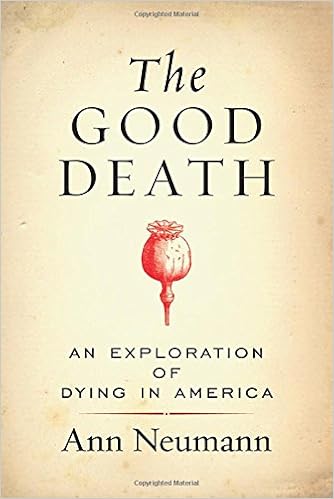
Today I learned about  Anne Neumann, who is a visiting scholar at the Center for Religion and Media at New York University.  Neuman has just published a book called “The Good Death: An Exploration of Dying in America”. 


In this brief review published by the Religion New Service, Kimberly Winston notes that according to Neumann, religion is never greatest in our social life than at the time of dying, and religion influences laws and health care practices that work against assisted dying.

"Religion is most prevalent around the deathbed in our country,” Neumann, 47, said in a phone interview from her home in Brooklyn, N.Y. “That is where it is resoundingly proven that we are not a secular nation.”

“The laws, medical practices and corporate regulations that surround death and dying continue to be strongly influenced by religion, whether it is in the delivery of health care through Catholic hospitals, whether it is in the rituals that medical practice is infused with, or whether it is simply in the language that we find acceptable around the dying.”

At the end of the day, Neumann argues, the dying should be the ones who decide how they die.

“A good death is whatever a patient wants,” Neumann said. “It is not up to me, to their legislators, to their priests, to their families. That is true informed consent. A good enough death is as close as we can get because humans are not perfect. We can get so much closer, but we will never have a perfect death.”

Another person who seems likely to agree with Neuman, and who has also just written on the subject, is the incomparable Diane Rehm, a broadcaster on US public radio whose husband of 54 years recently died of Parkinsons.  Here is an excerpt of her interview with Jeffrey Brown ot the PBS NewsHour:

Now in a new book titled “On My Own,” she’s addressing a more personal an raw topic, the death of her husband John after 54 years of marriage. John was dying owed with Parkinson’s disease in 2005 and moved into an assisted living facility in 2012.

Two years later, in steady decline, he decided to end his life. But with doctors legally barred from assisting, his only option was to refuse food, liquids and medication. His death came 10 days later. Diane Rehm lives alone now with her dog Maxie and with lingering grief and anger over her husband’s last days.

DIANE REHM: I so resented that John was having to go through this long 10-day process to die. He had said 10 days earlier he was ready to die, and it took him that long. It shouldn’t have, I don’t believe, taken him that long.
JEFFREY BROWN: You write: “I rage at a system that wouldn’t allow John to be helped toward his own death.”
He knew what he was going through. You two had talked this through, and he just wanted to let it happen.
DIANE REHM: He wanted to relinquish life. He didn’t commit suicide. He wanted to let go of life and be on to the next journey.

Diane Rehm's book would be a good companion to Neumann's, I think.  Both are on my list.

MP+

Tuesday, November 29, 2011

The Economics Of Death

Kudos to the Globe and Mail for running this latest piece in their series on end of life issues. As Canada's population ages along with the rest of the Western world, death will consume more and more of our health care dollars. Personally I welcome the discussion this article invites. While I worry that an economic analysis like this could lead us toward the sort of future envisioned by P.D. James in The Children of Men, where the aged are invited to quietly (and cheaply) off themselves, the reality is that Canada is looking at 300-400,000 deaths a year by the 2030s, when I will likely be approaching the end of my lifespan. With current costs of $30K+ for terminal illnesses or death from old age, that's a lot of money. Perhaps, as the article suggests, more frankness and honesty as to how we want to die (eg, "do not resuscitate’ or "no heroic measures" instructions) could be a good first step in making health (and death) care sustainable for the future. MP+


How much does dying cost Canadians?
lisa priest
From Tuesday's Globe and Mail
Published Monday, Nov. 28, 2011 8:44PM EST
Last updated Tuesday, Nov. 29, 2011 10:35AM EST


Of all the financially grim statistics confronting Canadian health care, this ranks among the grimmest: About 25 per cent of all health-care costs are devoted to caring for patients in their last year of life.

Provincial governments are scrambling to contain health-care spending, even as an aging population begins to place increasing demands on the system. Yet there is also a growing recognition among policy makers that they cannot make efficient spending decisions without a better understanding of the economics of death.

Whole article here.

Mad Padre

Mad Padre
Opinions expressed within are in no way the responsibility of anyone's employers or facilitating agencies and should by rights be taken as nothing more than one person's notional musings, attempted witticisms, and prayerful posturings.

Followers

Blog Archive

Labels