Showing posts with label Anglican Church. Show all posts

Saturday, September 5, 2026

Maker Of Heaven and Earth: A Homily for the Season of Creation


Every Sunday it’s our habit to say the Nicene Creed, which begins with the declaration that we believe in “one God, the Father, the Almighty, maker of heaven and earth, of all that is, seen and unseen”.  The Creed says a lot of things about God as Trinity, but it begins by describing God as creator of, well, everything, both the knowable, visible world of matter and physics and science, but also the mystical, invisible world of spirit, angels and heavenly realms.  And, between those two worlds, is us, humans, the beneficiaries of God’s creative acts.   So today we’re going on a little diversion and try to think through what it means for us to live in God’s creation.

I’ve chosen today because we’re at the start of what the Anglican Church of Canada calls the Season of Creation.  The inspiration for this idea comes from the Orthodox Church custom of observing September 1 as the Feast of Creation.   In 2019 our Anglican Church fixed Sept. 1 as the start of this season and extended it to October 4th, the Feast of St. Francis.  Our national church website explains that the Season of Creation is meant to be “an annual season of prayer, education and action to protect the gift of God’s creation.”   I’ll come back to the action and protection parts in a minute.

First, I think it’s fair to say that at some basic level, even if we aren’t theologians, we all know something about the Christian idea of Creation.   I’ll prove it to you with a snap quiz.

I’m going to quote part of a line from four well known hymns and I want you to finish the line.  Here goes.

  1. “This is my Father’s world, and to my list’ning ears ____________________________________

(all nature sings).

2) “All things wise and wonderful, all creatures great and small, all things wise and wonderful, _____________________. 

(the Lord God made them all)

3) “O Lord my God, when I in awesome wonder ______________________.

 (consider all the works thy hand have made).

4) “We plough the fields and scatter the good seed on the land, but it is fed and watered ________________.  (by God’s almighty hand)

Well done!  Many of you I’m sure have been singing these hymns since you were children,  and along the way these and other hymns have taught us about our faith.  They’ve taught us something that theologians call the Doctrine of Creation, and even though the word Doctrine sounds dry and scary, it’s pretty simple.

As children, and indeed as seminarians, one of the first things we are taught is that our lives and indeed the world around us are part of a gift from God that we call creation.

We need to note right of the top that creation is a theological word.   We might think it’s synonymous with nature or even the environment, but those words have a neutrality about them, whereas creation points to our belief that God’s first business is creation.

It’s also important to state that we as Christians can talk about creation without being anti-science.  The debate between evolution and religion is an old debate and a false dichotomy.   The creeds don’t require us to believe that the world was created in seven days vs seven billion years.  I once heard a professor say that science can date the Big Bang to somewhere around 13 billion years ago, but what happened before that is a matter for theologians.  That seems right to me.  I think it’s possible to speak of the entire universe as being created.

One of the gifts of indigenous spirituality is that it has helped us see God first and foremost as Creator.   The idea of creation being entrusted to us as stewards is there in scripture, but the indigenous world view of living in gratitude for the created world and in balance with the created world is a great gift.

I often hear your appreciation of creation as a gift thanks to our very talented and faithful intercessors.   Our Prayers of the People often expresses gratitude for this beautiful part of the world that we live in, and we also pray for those parts of the world and its people that are suffering.  We say these prayers because the church exists in the world, and we trust that God loves the world that God made and gifted to us.  

You might even say that the world depends on God for its existence.  Thomas Aquinas once said that the world  "is less like a house that outlasts its builder, and more like a sunbeam, which would vanish the instant the sun withdrew”. So we believe that God is the creator and the sustainer, and that should give us hope when we are tempted to despair by the state of the creation.

I don’t need to go into detail about the source of that despair.  We’ve all lived through days where the air was bitter with wildfire smoke.  We saw the summer heat in Europe rise to the mid forties, temperatures that kill the poor and elderly.  We saw the videos of the floods in Nepal caused by the collapse of a glacier.  Can we prove that the Nepal disaster caused by climate change?  Whatever the answer, it seems harder and harder to deny that human activity and fossil fuel has changed the world we live in.

Most of us here today won’t live to see how bad things could get, but our grandchildren will.   Last week our federal government released a report which said that since 1947, Canada has warmed two degrees and Northern Canada about 2.6 degrees.  If we do nothing, by the end of the century Canada will be 6.9 degrees warmer that it was before the Industrial Revolution.  That means more drought, more wildfires, and the end of Western Canada’s glaciers.  If we can reach the goal of Net Zero emissions by 2050, we can limit the damage, but that doesn’t look likely.  This June the Carney government admitted that Canada will not meet its 2030 greenhouse gas climates.

So what can we do?  I would say that the most important thing is not to lose hope.  Politically, you’ve got voices and votes.  Use them to show candidates that you care about renewable energy, green policies, and the future of the planet.

As Christians, I think we all need to be intentional about talking about the created world as a precious gift for all.  Maybe that starts with a stronger appreciation for where we live. The late poet Wendell Berry put it well when he challenged words like “the environment”, a word which he said “refers to no place in particular”.  Berry said that “The environment,” as we call it, is intimately with us. We’re in it. It’s in us. But also we are it, and it is us.” 

As Christians, that means that we all depend on a particular place, a part of the world, to give us life, to share with others, and to pass on to those who come after us.   One way to deepen that awareness might be to check out Creation Church, the initiative of our associate priest Amy as described in this month’s All Saints Alive.  Praying and worshipping in nature reminds us that our connection with God exists extends outside of this church building.  To quote Wendell Berry again, he said that he had to carry the gospels into the woods to see his need for them.   You may find that to be true for you as well.

Caring for creation also means caring for our neighbour.   We are somewhat protected from the climate crisis here in Canada, but other parts of the world feel it much worse, especially as first world countries cut their foreign aid budgets.    One initiative that we our national church has launched through our Alongside Hope agency is the Solar Suitcase project for Mozambique.  This project will provide small health clinics with a solar panel, lighting, and fetal imaging equipment to help women who give birth at night.   Each suitcase costs $6500 Canadian.   Wouldn’t it be wonderful if All Saints could raise the money for one of these suitcases by next Pentecost.   Do you want to embrace that challenge?

Finally, I would say that it all comes back to our faith in Jesus.   I changed our gospel reading for today to remind us that when we speak of God as Creator, we are speaking of the Holy Trinity.   St Paul wrote in Colossians that “all things have been created through him and for him . and in him all things hold together” (Col 1:16).  The hands that created the stars are the same hands that Jesus offers to us as our friend and guide in life.   He has, as they say, the whole world in his hands.  He always has held it.  Which means that our faith and trust in the promise of the resurrection should give us faith and trust for the future of the created world that is our gift and our privilege to share. 

That understanding of creation is part of the gospel. So is the idea that God is as present to creation now he was as at its beginning. The world is held in being at this moment as freshly as it was at the first moment of its existence. The cosmos is less like a house — as Aquinas put it — that outlasts its builder, and more like a sunbeam, which would vanish the instant the sun withdrew. God is not only maker, but sustainer. Another part of the good news of the doctrine of creation is, therefore, the good news of God’s presence.


Friday, August 28, 2026

Zero to Hero and Back Again: A Homily for the Fourteenth Sunday After Pentecost (A)

 Preached at All Saints, Collingwood, and St Luke’s, Creemore, Anglican Diocese of Toronto, Sunday, 30 August, 2026.  Readings for the Fourteenth Sunday After Pentecost (YrA):  Exodus 3.1-15, Psalm 26.1-8, Romans 12.9-21,Matthew 16.21-28


But Jesus turned and said to Peter, "Get behind me, Satan! You are a stumbling block to me; for you are setting your mind not on divine things but on human things.” (Mt 16.23)


You may recall that last year in October I wore a Toronto Blue Jays hat in church and we were all pretty excited that Canada’s team, as we called them, was bound for the World Series and it was a good run, all the way to game seven.  The Jays were our heroes. 


So where did the heroes go?   This year the Jays a below average team, scuffling with a bunch of other mediocre teams under 500 for an undignified wild card spot.  Last year we couldn’t throw enough money at Vladdy to hit home runs.  This year we would just like him to not hit so many ground balls into double plays.  It’s a little shocking how quickly our heroes turned into zeroes.


That phrase “hero to zero” came to mind this week as I thought of Peter in today’s gospel.    Poor old Peter!  Last week, when Jesus asked the disciples “who do you say I am?”, Peter totally aced the exam.  “You are the Messiah,” he exclaims,”the Son of the living God” (Matthew 16:16), to which Jesus basically says “Well done Peter, go to the head of the class!”   Jesus declares that Peter will be the “rock” on which he will build the church, which in the language of the creeds is the founding moment of the “holy, catholic, and apostolic church” that we are a part of, all because Jesus recognized that Peter was the hero needed to found and build the church.


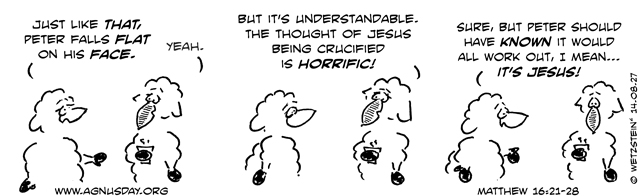
How quickly it all changes!  Here we are just a few verses later in Matthew 16, and Peter goes from hero to zero in a heartbeat!  Last week he was the rock on which Jesus would build his church.  Today he is demoted to stumbling block.  Hero to zero, or maybe better yet, Peter goes from rock to block.


 In Matthew’s gospel, this is the first time that Jesus predicts that he will go to Jerusalem and die there.  He describes his death (note the word “must” in 16.21) as an obligation, something he has to do.   This news is a shock for Peter, who has just identified Jesus as the Messiah, the anointed saviour of Israel.  Peter and the other disciples were doubtless raised on stories of Israel’s great military heroes from stories such as those in the books of Joshua and Judges, so this is all a bit much to take.  Peter surely wants a Messiah who wins.  Peter wants a conquering hero, not a loser zero,


Peter doesn’t just challenge Jesus, he “rebukes” him, which in is like telling the boss, “sir, that’s crazy talk”.  So it is that Peter goes from rock to block.    What Peter can’t recognize is that in telling Jesus not to go to Jerusalem and die, he is essentially repeating the temptation that Satan offered to Jesus in the wilderness to save himself from death, to which Jesus replied “Away with you Satan” (Mt 4.10).  


Peter becomes an obstacle on Jesus’ road to Jerusalem, literally a stumbling block (scandalon), which literally means something you can trip over but it also means a trap.   Thus we can say that Peter goes not just from hero to zero, but he goes from rock (the foundation of the church) to stumbling block.  Hero to zero.  Rock to blockhead.  Ouch.  Poor Peter.


All this background is necessary to help explain two ensuing phrases which give Christians a lot of trouble.  One is Jesus telling Peter that he is “setting his mind not on divine things but on human things”.  There is a temptation here, especially after hearing Peter called “Satan”, to think of an absolute division between heaven and b earth, so there’s  the divine, God stuff, and the earthly, human stuff, which is bad and maybe even demonic.     Call this way of thinking sacred versus secular.   At it’s worst, it’s cult or sectarian thinking, making believers want to have as little to do with the human world as possible.   At its mildest, it makes us compartmentalize God, so that we only occasionally think of ourselves as Christians and disciples while going about our business in the real or physical world.


This confusion is made worse when we don’t properly understand what it means to deny ourselves, take up our cross, and follow Jesus.   These words as they are often understood can reinforce the sacred/secular divide and make is think that a life focused on divine things must be a joyless life of abstinence and suffering, like the lives of the early Christian hermits in their hair shirts.    Which is all very strange when we remember that Jesus in the gospels went to weddings, visited the homes of people he loved, ate and drank with friends and was accused of being a glutton and a drunkard.    It all seems very hard to reconcile.


What if we didn’t have to think in terms of a faith that called us away from our earthly lives, but which instead enriched them?   What Peter doesn’t understand is that Jesus must go to Jerusalem not only to die, but also to live  (“and on the third day be raised” 16.21).   The cross that Jesus calls us to is thus not life-destroying but life-giving.  The cross gives us eternal life, but it also gives us life in the day to day of our lives.  


Our reading from Romans 12 gives us a good sense of what that life looks like:  rejoicing, blessing, befriending, companionship, all in the company of others.   The self that has to be denied in that life is the self that gets in the way of these things – cursing, hating, grudge-holding, pettiness, hatefulness, hoarding, and selfishness, fear and bigotry and racism.   No one wants to be that guy!   These are all the dark things that we need to take to the cross and give to God so that we are free to live the way God wants us to live.


This calling sounds like a life worth living, like our best possible life, and it is!  Our invitation to a better life as disciples is a calling or a vocation.  Now you might think that having a calling or a vocation to be a Christian sounds intimidating.  Can I live up to a calling?  Whar if I screw up?    And certainly we will, on any given day.   Even major league baseball players strike out and commit errors on the field.     If we slip up, Jesuswill say to us, as he says to Peter, “get behind me”.   Jesus never says “Get away from me”.   He only says that to Satan.  He won’t say that to us. Getting behind Jesus means retaking our rightful place as a disciple, as a follower.  I think for us it means more like get on board,  join the team, close up. Following Jesus means that we won’t get lost if we keep Jesus in front of us.  And if we follow Jesus, he will lead us to our best life.


Saturday, August 22, 2026

Fearful Disobedience: A Homily for the Thirteenth Sunday After Pentecost (A)

Preached at All Saints, Collingwood, and Good Shepherd, Stayner, on 23 August, the Thirteenth Sunday After Pentecost.

Texts for this Sunday:  Exodus 1:8 - 2:10, Psalm 124, Romans 12:1-8, Matthew 16:13-20.


“But the midwives feared God; they did not do as the king of Egypt commanded them, but they let the boys live.” (Ex 1:17).

Video version of this homily is here.


A powerful king is threatened by a group  of people in his country.  He gives orders to his servants that they are to reduce their numbers, to get rid of them.  Does that sound like it’s from today’s headlines?   From recent history?  From our first lesson?   All of the above?


Sometimes parishioners tell me that they don’t like the Old Testament, which, perhaps because I’m ornery, makes me want to preach in that direction, and today’s first lesson seems worth saying some things about.     Pharaoh’s decision to kill the firstbornJewish males in Egypt is more drastic than what’s happening around us today, but, as I said, a king who wants to get rid of certain threatening people sure sounds familiar.


So today we continue to hopscotch through the Book of Genesis.  We’ve fast forwarded from Joseph some years, and now there is a Jewish population in Egypt, useful as labourers, but there’s also a new king who “did not know” the story of Egypt’s debt to Joseph and doesn’t seem to care.   He’s given orders that all the firstborn Jewish boys are to be killed at birth.  A few brave women disobey this order, and so Moses survives to become  the man who leads God’s people to freedom.


Now Pharaoh’s order to kill the firstborn hasn’t currently been imitated, but sometimes there are just degrees of awful behaviour, going from bad to worse to worst.   Yesterday I learned that there are currently 1800 unaccompanied children detained within the US immirgration system.  While they are officially considered to be refugees, they are subject to deportation.


On July 31 of this year, a one year old child appeared in an immigration court in Arizona.  A judge ordered the child to file an asylum application before the next hearing, or face deportation.   Before July 31, a non-profit group represented unaccompanied children, but their contract was given to another organization whose lawyer said nothing that day in court.   So how is this child, or better yet, how this baby was supposed to file a claim on their own was a problem that apparently didn’t matter to the judge or to anybody in authority that day?   One also wonders what it is like to be a one year old alone in a detention system, where this child’s parents are and what they must be thinking, or whether they can be united with their child after the deportation.


So is the US government deporting a one year old as bad as Pharoah killing a child at birth, or are we just talking about shades of awfulness?   If you deport someone, a child or an adult, to a dangerous country like Liberia or Haiti, where they have no family, supports, or even language, is that more merciful than killing them at birth?  How are we as Christians and followers of Jesus supposed to respond to things that are clearly awful?


Shiphrah and Puah were not Christians.   They were ordinary women, midwives, whose names are preserved for us because “they feared God” more than they feared Pharaoh (Ex 1:15-16).  They chose to lie to power in order to save as many lives as possible.   Likewise, the child’s mother resists power by doing what she can to save her baby, and, when Pharaoh’s daughter finds the infant, “she took pity on him” (Ex 2:6).  She and her maids choose their own path of resistance, to raise the child in Pharaoh’s house, name him Moses, and he will one day lead God’s people to freedom.


What does “fear God” mean?  It doesn’t mean being afraid of God, in the sense of finding God scary and threatening.  Rather, it means respecting God, understanding and agreeing with God’s desire for justice and righteousness.  Fearing God for Shiphrah and Puah, for Pharaoh’s daughter and for you and I, means having a reliable moral compass.  It means the ability to distinguish between what God wants us to do, and what an unjust ruler wants us to do.


Recently a woman named Laurie, a gate worker at a US aiport, realized that ICE agents were looking for a woman waiting to board a flight.  She told the woman in question, who was shocked and said that she had all her necessary papers.  The woman chose to leave the airport.  When the agents questioned Laurie, she referred them to airline security and told them she couldn’t give them any information without a subpoena.  The woman they were seeking got in touch with Laurie, thanked her, and said she had made it safely home.


I don’t know whether Laurie is a Christian, but I can say that, according to my understanding, she fears God in that she is aligned with God’s sense of justice.  Across America today, people who have fully complied with US immigration programs are now in hiding.  Often churches are helping them in ways such as buying them groceries and doing their laundry. These are small acts of resistance, but they are decisions made by people who, llike Shiphrah and Puah, know what is right.


The Book of Genesis is, as I remarked last week, an ancient text but it retains the capacity to speak to us in our day, to help us understand our times, and to help us discern God’s purposes and desires for the world God loves.    Often the Old Testament anticipates the gospels.   Pharaoh’s daughter looked on the infant Moses with pity, in the same way that Jesus looks on hungry crowds and the suffering sick.   God’s love remains, and it is often manifested in our own decisions, even when we have to chose disobedience because we fear God.


Saturday, August 15, 2026

Opening The Door To Mercy: A Homily for the Twelfth Sunday After Pentecost.

Preached at All Saints’ Anglican Church, Collingwood, Anglican Diocese of Toronto, on the Twelth Sunday after Pentecost, 16 August, 2026.


Readings for this Sunday:  Psalm 133, Genesis 45.1-15, Romans 11.1-2a,29-32, Matthew 15.21-28 

 And he kissed all his brothers and wept upon them, and after that his brothers talked with him. (Gen 45:15)


One of the must-see plays at Stratford this year is their production of Shakespeare’s Tempest.  It’s a gorgeous spectacle to watch, full of action, and the acting is top notch, but I had partly forgotten that the play is a deeply moving statement about the power of forgiveness.


Prospero was a nobleman who was cheated out of his birthright by his brother and his accomplices.  Along with his daughter he’s been stranded on an island for many years, but since he is also a powerful magician, he has waited for his revenge.  Now, thanks to his magic powers, he has all of his enemies together, under a spell and  at his mercy.   But, in the fifth act, Prospero’s servant Ariel says that she would feel mercy for these helpless enemies.


Prospero is moved by Ariel’s kind heart, and he says 


Hast thou, which art but air, a touch, a feeling

Of their afflictions, and shall not myself,
One of their kind, that relish all as sharply,
Passion as they, be kindlier moved than thou art?
Though with their high wrongs I am struck to the quick,
Yet with my nobler reason against my fury
Do I take part: the rarer action is
In virtue than in vengeance: (Tempest 5: 2040-2047)


While Shakespeare isn’t an overtly Christian writer, this scene, Prospero’s change of heart, made me wonder if he was thinking of today’s first reading from Genesis, and the mercy Joseph shows to his wicked brothers.


Last week the lectionary’s hopscotch tour of the Book of Genesis dipped into the story of Joseph, and today we find ourselves almost at the end of that long story.   Last Sunday we heard how Joseph’s brothers, jealous of their father’s love for Joseph, plotted first to kill him, then relented somewhat and sold him as a slave to foreigners.


We don’t hear the middle part of the story, but I’m sure you know your bible or your Andrew Lloyd Webber to fill in the details.  Thanks to his prophetic dreams, Joseph becomes the second most powerful person in Egypt.   His situation is very much like that of Prospero.   He has his enemies at his mercy.  When he announces to them that ““I am your brother, Joseph, whom you sold into Egypt”, it could have been a total Game of Thrones moment, with the brothers dragged off to suffer torture and death.   


Instead, Joseph weeps with profound emotion.  It’s a remarkable  and refreshingly human moment. There is an ancient, remote quality about Genesis, that can sometimes make us think that this isn’t a story about actual people.  Sometimes the early books of the bible feel like mythology or legend, but here as Joseph breaks down, sobbing so violently that people hear him in the next room, it feels as fresh and as real as yesterday’s novel.  


It feels so real because we don’t know exactly where these tears come from.  Is it sorrow for a lost childhood, stolen from him by his brothers?  Is it joy at the thought of being reunited with his family?  Is it some cathartic experience of relief that he is capable of forgiving his bewildered siblings, a deep spiritual relief that he isn’t captive to some need for revenge?  We can’t be sure exactly, but this vivid climax to what is sometimes called one of the bible’s great novellas makes us think about how complex, and necessary, forgiveness and reconciliation can be in our lives. 


In Shakespeare, Prospero’s decision to be merciful comes from his “reason”.  Joseph’s compassion is theological, it comes from his sense that God has been at work in his story.  Joseph says to the brothers “now do not be distressed, or angry with yourselves, because you sold me here; for God sent me before you to preserve life” Gen 45.5).  It may not have been apparent to him when the brothers threw him into the pit, but Joseph firmly believes that God brought him to this place and this power, where, because of his dreams and the influence they gave him, he can save his family from starvation. 


 Unlike earlier episodes in the family history of Joseph’s ancestors, where God intervenes and speaks directly in the story, we don’t see God act first hand in the Jospeh story, but Josephs words to his brothers – “God sent me”, “God made me” – make it clear that these things have happened for a reason.   Thus, the story of Joseph and how he saves others from starvation is tied into the big story of Genesis, of God using Abraham and his descendants to be blessings to all peoples.  


Joseph is also a blessing to his family because he is able to forgive them, even if, as his sobs and tears suggest, forgiveness and reconciliation can be difficult and painful work.  The work of reconciliation is not easy.  Setting aside pain and injury is some of the hardest soul work we can imagine.  Several times this summer, as we’ve gone through Genesis, I’ve commented on how the story of Abraham’s family, with all its faults and intrigues and bad behaviors, is the human story, but Abraham’s family never breaks bad.   After all the tears and embracing, that lovely phrase at the end of today’s reading “after that his brothers talked with him” (45.15), shows that it is possible for ice-dams of guilt and hostility are broken, we can be restored to relationship with one another.  Joseph’s forgiveness makes our story possible, because the story, from Exodus to Israel, from the prophets to Jesus to the adoption of the gentiles in the body of Christ, is our story. 


I’ll finish by looking briefly at today’s gospel, because there’s a mercy moment and a teachable moment in there that saves Jesus from looking like a complete jerk.   Earlier, when he sent out his disciples, Jesus told them to “Go nowhere among the gentiles … go rather to the lost sheep of the house of Israel”(Mt 10:5-6).  And now a gentile woman is in his face, pleading for mercy because she has faith in Jesus’ power.   Calling her a dog is as cold and as rude as Jesus gets, and yet what happens when she insists on the same generosity that a dog under the table gets from its masters?  Does Jesus change his mind?  Is Jesus convinced to choose mercy?


There’s a lot of debate about this gospel reading, about whether Jesus, who is supposedly perfect and sinless, could at first be so rude and exclusive in his thinking, or whether Jesus needed to learn anything.  I would say that if Jesus was fully human, then his humanity included receptivity to new ideas, and the ability to change his mind and show mercy.   One could say that the turn to a wider mercy and grace in Matthew’s gospel begins here, when Jesus comes to see in this foreign woman as much faith and as much goodness as any Jew might possess.     If this is indeed a hinge moment in Matthew’s gospel, then the door to mercy is fully opened by Jesus’ last words at the end, telling his followers to go and make disciples of all nations” (Mt 28.19).


It’s sometimes said that the gospels are about grace versus justice.   Justice, at it’s worst moments, can look a lot like revenge, “an eye for an eye, a tooth for a tooth”, or as Shakespeare’s Shylock demands, “a pound of flesh”.   Mercy and grace sacrifice their claims on revenge so that greater and better things might happen.   Joseph forgives his brothers, and Jesus opens a door for the Caananite woman, a door so big that all of us gentiles can go through and become God’s family. So my question for us is this:  if Prospero, Joseph, and even Jesus can choose mercy, then what can we do to show mercy to others?

Saturday, August 8, 2026

Who's Got You? A Homily for the Eleventh Sunday After Pentecost

 His Strong Grip: A Homily for the Eleventh Sunday after Pentecost


Preached at Prince of Peace, Wasaga Beach, and Good Shepherd, Stayner, Anglican Diocese of Toronto, August 9, 2026.

Readings for the Eleventh Sunday After Pentecost (A) - Genesis 37:1-4, 12-28; Psalm 105:1-6, 16-22, 45c; Romans 10:5-15; Matthew 14:22-33 


But immediately Jesus spoke to them and said, “Take heart, it is I; do not be afraid.” (Mt 14.27)

In the original (1978) Superman, there’s a scene where Lois Lane (played by Margot Kidder) is falling to her doom, when suddenly, Christopher Reeve’s Superman soars upwards and catches her.  “Don’t worry, Miss, I’ve got you.”

Lois Lane looks downwards.  “You’ve got me?”  she says incredulously.  “Who’s got you?”  Margot Kidder plays that line brilliantly, amazed that she is being saved, and even more amazed at the person saving her.

So who’s got us?  Who’s got you?  Jesus has us, he has us clasped firmly in his grip.   And, as Peter discovers in today’s gospel, there’s no need to ask Jesus who’s got him.   He’s Jesus, the son of God, and he’s there for us.  That’s the point behind today’s gospel reading.

So there’s no Superman in today’s gospel (we’ve got Jesus, we’re good), but you could still make a pretty good action movie about today’s gospel reading.   There’s the storm, which is huge and terrifying.   Our translation today says that the boat is “battered” by the waves but the Greek word used has more of the sense that the boat is “tormented”.  This is a demon of a storm.   It’s dark.  The wind is howling.  The disciples are exhausted, they’re far from land, and tthe fishermen among them, men who know the water, know that they’re in deep, deep trouble. 

So if a raging storm wasn’t enough for our action film, then there’s Jesus, walking across the water in the early morning, looking like a ghost.   There’s the incredulous reaction of the disciples, Peter’s decision to step out of the boat, not confidently but nervously, his first steps as the waves rage around him, the sudden expression of fear as he sinks, and the strong hand of the carpenter gripping his wrist, a classic movie “I’ve got you” scene that’s played out on countless cliff or building ledges.

Most of the sermons I’ve heard (and preached) on this story focus on Peter as the hero.  These sermons urge us to compare Peter’s faith, his doubts, and his fears, to our own faith, our own doubts and fears.   We’re reminded that we need to keep our eyes on Jesus and urged to have faith in him so that we don’t sink below the waves.  

If we think that the purpose of this gospel story is that if Peter just had more faith, he would have been able to walk on water, well, that's just silly.  It's rather like saying, if only Lois Lane had been able to fly like Superman, she wouldn't be falling.  Sometimes I've heard the sermon preached to say just keep your eye on Jesus and you'll be fine, which is better, but it still takes a Superman to save Lois Lane, and it takes Jesus to save us.  So I would say that today's gospel is about Peter and the disciples so much as it’s about Jesus.  

So let’s think about the context of the story, about what Jesus has already done and what we should remember about him, even if the disciples forget.   Today’s story begins with Jesus sending the disciples on ahead in a fishing boat, sending away the crowds, and then going “up the mountain by himself to pray” (Mt 14.23).

Jesus often goes to lonely places to pray and to recharge through his connection with God his Father.   So why does Jesus need to recharge?  Because immediately before the walking on water story, Matthew has told us how Jesus attracted crowds, cured them, and then miraculously fed them because "he had compassion on them” (Mt 14.13-21).

So it seems odd that Peter sees Jesus “walking on the sea” and, with all these miracles fresh in his mind, says to Jesus “Lord, if it is you, command me to come to you on the water” (Mt 14.28).   Why the “if”?  Why the doubt?   Why would Jesus walking on the water be any more miraculous than Jesus healing and feeding people from food he has created on the spot?  It’s as if Peter hasn’t quite figured out who Jesus is.  He’s like Lois Lane, wondering who is this guy,  whose got him?

Perhaps the answer lies in the panic of the storm, the crashing waves threatening to swamp the boat.  It’s in such moments that our fears rise and our doubts make us want to put Jesus to the test:  “Lord, if you can get me out of trouble, then I will believe in you”.   

So why doesn’t Jesus just tell the storm to stop, as he’s done before (Mt 8.23-27)?  Why is he out in the storm in the first place, and why does he come walking across the waves, to be with the disciples?  Here it’s worth remembering that it’s in our worst moments that Jesus comes to us.   Our challenge in our own lives’ storms is to see and trust that Jesus is with us.

Also, the fact that Jesus chooses to walk on the water in the storm is another sign of who he is. Biblical scholar Nicholas Schaser notes that the Greek words used by Matthew (Jesus “went (elthen) to them, walking upon the sea (peripaton epi tes thālassa Mt 14.25)” are the same words that God uses when he asks Job “if he ever “went upon (elthes… epi) the springs of the sea (thalāsses) or walked (periepātesas) in the recesses of the deep” (Job 38:16 Septuagint).  

Likewise, when Jesus tells the frightened disciples,  “It is I; do not be afraid” (Mt 14.27), Schaser reminds us that these are the same words that “God says to Moses at the burning bush according to the Septuagint:  ‘I am’ (egō eimi)” (Exodus 3:14 Septuagint).   As Schaser notes, “If walking on water weren’t enough to reflect his divine status, Matthew’s Jesus repeats the very words of God”.

So Jesus in today’s gospel speaks the same words, with the same authority, as God his Father.    It is on of those moments where we see the full authority and power of Jesus, the same power by which God brought order out of the “darkness [that] covered the face of the deep” (Gen 1.1).

So while I’ve called attention to the divine power of Jesus, which I hope will comfort us in our moments of extreme anxiety and need, there’s also an aspect of vulnerability to Jesus in the larger context of Matthew 14.   Remember the crowds that were mentioned at the start of today’s story?  Their needs and wants distracted Jesus from his original intention of being alone in prayer because he had just learned that Herod had executed his cousin, John the Baptist (Mt 14.1-12).   

Jesus could have laid low at this point to avoid further attention from the authorities, but he is determined to heal and feed the crowds, and he is determined to go to Jerusalem, even if that means that he too will be killed.  Indeed, the last words of today’s gospel, “Truly you are the Son of God” (Mt 14.33), are essentially the words of the Roman soldier at the cross, “Truly this was the Son of God” (Mt 27:54).

So the larger message of this story is not just that Jesus is truly the Son of God with power over the waves and winds.   That is something that we, like Peter, should know and believe.   The good news in this story is that this all powerful Son of God is willing to die for us to save us out of his love and compassion for us.    Think of that strong carpenter’s hand reached out to clasp and save Peter from the waves, and imagine that same hand gripping your hand in your moments of need.  Jesus won’t let you sink.  “I’ve got you”, Jesus says to each of us.  There’s no need to ask Jesus who’s got him.  He is our saviour.  He is our God.   He is our superman.  

In our second lesson, we heard Paul say that the role of the church is to proclaim the good news of Jesus Christ (Rom 10:12-15).  Our message is simple and it is powerful.   Jesus, this strong and compassionate Jesus, died to save us, and will save us.   He’s got us.

Mad Padre

Mad Padre
Opinions expressed within are in no way the responsibility of anyone's employers or facilitating agencies and should by rights be taken as nothing more than one person's notional musings, attempted witticisms, and prayerful posturings.

Followers

Blog Archive

Labels