Showing posts with label Ethics and Society. Show all posts

Friday, August 19, 2016

Turning Chaplains Into Military Ethicists

The Canadian Forces Chaplain School and Centre (CFChSC) at Canadian Forces Base Borden, where I work, started its annual Intermediate Ethics Course this week. 


The course is a career course for CAF military chaplains to take early in their careers to prepare them for one of their roles as ethical advisors to command teams and to military and civilian personnel generally.   Building on the theological and religiously informed ethical systems that chaplains learned in their formation as clergy, we train them in a variety of ethical systems, including the CAF's Defence Ethics Program .  The training is practical, and uses concrete scenarios and case studies to prepare chaplains for the kind of real-world problems that they will face in the military context.


Chaplain candidates in fierce ethical debate.


One of the problems we face in our training in military ethics is that you need a foothold on both sides of this compound subject.    Most chaplains know something about ethical traditions through their theological formation, though they may know more about Christian ethics than they do about the classical philosophical traditions.    What they lack, sometimes, is a sufficient knowledge of the military environment to do apply the ethical traditions well.

To that end, I offered the class a short reading list of online resources to help them shore up their military knowledge, and to show them how some smart folks in the military community are tinking hard about ethics, particularly in light of new technologies and the changing battlespace.

This list may interest readers of this blog, either chaplain colleagues or folks who are generally interested in the subject.

1)
A privately published military blog – most articles authored by US defence community people including some serving military.   Lots on foreign policy, military news, leadership, strategy, and technology.
Articles like this one on killer robots make it worth the read for military ethicists.

2)
This online journal describes itself as “an international journal focused on strategy, national security, & military affairs”. 
Contributors are mostly US military, serving and retired, with some allied military contributors.
A quick use of the search feature for articles on “ethics”yields some impressive results:


3)
This military news blog is anything but boring.   Its masthead says:  “From drones to AKs, high technology to low politics, exploring how and why we fight above, on and below an angry world”.
 The articles on politics and culture offer food for thought for ethicists.
4)

A very funny and thoughtful blog by a serving US Army officer.   Star Wars fans will find things to like.
 
5) 
By a professor of philosophy whose research and publication interest is in military ethics. 
 
6)
Mostly US military – a group of active duty officers writing about the military and the military ethos.  Many of the contributors here are worth your knowing.  Many of them are also active on Twitter, which is a whole other thing to follow.
 
Enjoy these links and chime in on any others that you would recommend.
MP+


Tuesday, April 5, 2016

"I Made Horrible Mistakes": Regrets Of An American Torturer


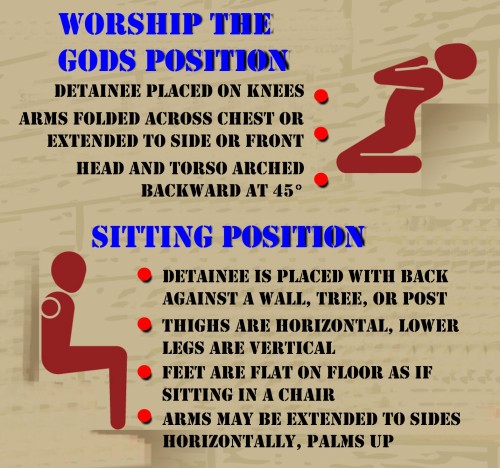
Diagram of stress positions, from a US military handbook for interrogators.
 

A day after reading a very disheartening Religious News Service story about how nearly two-thirds of Americans support torture, I was given fresh hope when I listened to NPR's incomparable Terry Gross speaking with an American former interogator who worked in Iraq's infamous Abu Ghraib prison.

Eric Fair worked for a private contractor employed by the US military as an interrogator in Iraq.  A former soldier, his knowledge of Arabic qualified him for the work, though he admits there were times when he was reliant on translators to understand what the prisoners were saying.   He has just published Consequence: A Memoir, which has been well reviewed by the New York Times.

 
Eric Fair
 
In the interview, Fair sounds like a man who has been psychically and morally injured by torturing others, and he is very clear that how whatever  linguistically disguises we may give it, like enhanced interrogation, torture is torture.  While he is willing to give his fellow interrogators credit for sincerely believing that their work may have saved American lives, that motive for him, loking back, is not sufficiently exculpatory (setting aside the important point that torture does not work).  He writes:

I refuse to suggest that torture is successful on any level. And I'm not sure that it matters; it shouldn't matter to anyone in this country. I'm not sure why we've gotten to this point where we start to talk about the effectiveness of torture, as if that makes any difference whatsoever.

Torture is wrong. Americans, all Americans, should know better. That's what makes us attractive; what makes us attractive is the way we do things, it's the example that we set. What makes us attractive is not how tough we are or how good we are at extracting information, and anyone who thinks that way I think fails to understand what this country is about. So I've left that discussion about whether or not torture is effective or not behind. It simply doesn't matter.

At a time when a Reuters and Ipsos poll finds 63 per cent of Americans (and 82% of Republicans)  believing that toture is jsutified if it can "obtain information about terrorism activities", Fair's voice is honest and important.  I'll review his book here in the near future.

Wednesday, September 16, 2015

Jeffrey Toobin on ''Cafeteria Government''


Whatever one thinks of Ms. Davis, Jeffrey Toobin's short essay on the New Yorker website  raises some interesting points about whether religious accomodation amounts to "cafeteria citizenship" and even to "cafeteria government". 

If citizens (and now in the US, small business and family-owned corporations thanks to the SCOTUS Hobby Lobby ruling) are free to decline some obligations (eg, to serve customers, to provide certain kinds of health care) on the basis of their religious beliefs, what degree of accomodation should be allowed to government employees?  Is it acceptable for a govrernment to accomodate the beliefs of its employees by allowing them to decline to perform certain tasks, such as issue marriage licenses to same-sex peole, provided that there are other government employees that are willing to perform those same tasks?  What are the limits to such accomodation?  Voluntary military service comes to mind as one government sector where all employees must be willing to perform, enable or at least sanction certain actions, specifically acts of violence at the behest of a lawful authority.  Are there comparable cases where accomodation is not possible in government service?

Thursday, July 24, 2014

Is PTSD A Defence For Moral Lapses? The Case of Senator Walsh


In yesterday’s post on military medals and integrity, I mentioned that embellishing one’s credentials is a fairly common failing.   A case in point is U.S. Senator John Walsh (Democrat, Montana), who has in past tweaked his resume to make it sound more impressive.  According to today’s New York Times, Senator Walsh’s congressional bio once said that he was a graduate of the University of Albany, State University of New York, when “he actually earned his B.S. degree from what was then known as Regents College, an adult learning institute that issued degrees under the umbrella of the University of the State of New York”.  That may not seem like a big deal, and Senator Walsh amended his bio (without comment) when a political newspaper looked into his credentials.  

A bigger deal, reported today, is that when Senator Walsh was an officer in the US Army, and was a student at the US Army War College in Carlisle, PA in 2007, he appears to have plagiarized the final paper for his Master’s degree.  The NYT piece offers numerous examples of how Walsh included the material of other authors in his essay without quotation marks, often changing a word or two.  While some of these sources were footnoted, the absence of quotation marks is crucial.  Any undergraduate knows (or should know) that quotation marks tell one’s reader that the words and thoughts are not one’s own, and any attempt to suggest otherwise is a serious instance of academic dishonesty. A War College faculty member is quoted in the NYT article as saying that the importance of academic honesty is something that is made quite clear to the students - “We drill that in incessantly”. 

A postgraduate degree in contemporary western militaries is a significant rung on the career ladder to senior rank, or, in military slang, a “check in the box” necessary for promotion.   While any university instructor will tell you that academic fraud is a serious problem on college campuses, one would hope that military officers would have a sounder understanding of personal and professional integrity than a callow undergraduate.

Senator Walsh has told the Associated Press that his war experience in Iraq led to Post Traumatic Stress Disorder which affected his judgement.   “I don’t want to blame my mistake on PTSD, but I do want to say it may have been a factor.  My head was not in a place very conducive to a classroom and an academic environment”.   In the same interview, he said that he “didn’t believe” that he had plagiarized his paper.

It’s tempting to think that in the hyper-partisan climate of US politics, Senator Walsh’s opponents will try to exploit this story.   A Montana Democrat is already using the words “smear campaign”.   However, to be fair, the Senator’s military credentials, including his War College degree, doubtless made him an attractive candidate in the first place.  At some point the voters will decide, but the story does raise a troublesome question about whether PTSD can be used as a defence for lapses of moral judgement, even if, as in the Senator’s case, it is a curiously high-functioning form of PTSD.  

It would be interesting to hear the Senator comment on the following hypothetical scenario.   A young veteran, attending college, is sitting in his or her professor’s office.  They are discussing the student’s  paper which, like the Senator’s, uses other people’s ideas without properly acknowledging them.  The veteran pleads PTSD.  What should the professor say?

Tuesday, May 6, 2014

Worth Repeating: E.B. White on Democracy

E.B. White was one of the great writers, journalists and stylists of mid-20th Century America.   I was delighted when the New Yorker magazine served up this short response that he wrote for the magazine during the middle of World War Two.    I rather wish he were alive today to remind us what democracy is in an age when that idea seems increasingly dispensable. MP+

We received a letter from the Writers’ War Board the other day asking for a statement on “The Meaning of Democracy.” It presumably is our duty to comply with such a request, and it is certainly our pleasure.

Surely the Board knows what democracy is. It is the line that forms on the right. It is the don’t in don’t shove. It is the hole in the stuffed shirt through which the sawdust slowly trickles; it is the dent in the high hat. Democracy is the recurrent suspicion that more than half of the people are right more than half of the time. It is the feeling of privacy in the voting booths, the feeling of communion in the libraries, the feeling of vitality everywhere. Democracy is a letter to the editor. Democracy is the score at the beginning of the ninth. It is an idea which hasn’t been disproved yet, a song the words of which have not gone bad. It’s the mustard on the hot dog and the cream in the rationed coffee. Democracy is a request from a War Board, in the middle of a morning in the middle of a war, wanting to know what democracy is.

Thursday, May 1, 2014

Book Review: Ian Buruma, Year Zero: A History of 1945


Ian Buruma.  Year Zero: A History of 1945.  New York: The Penguin Press, 2013.

I am not entirely sure how to describe Ian Buruma.  He’s a Dutch citizen based in New York, with an academic background in Asian and film studies, a journalist and an educator, and a prolific author with interests in history, foreign policy and theology.  He’d be a fascinating guy to have a beer with.    All of these interests are in play in his 2013 book, Year Zero: A History of 1945.  The title, a homage to the 1948 film Germany Year Zero by Roberto Rossellini, shows Buruma’s interest in film.

My father was a young Canadian officer in Holland when World War Two ended.   For him there was demobilization and a return to Canada and its (in comparison to Europe) unbelievable prosperity to look forward to.   Dad once told me that in the months after the war, the roads of NW Europe were full of uprooted people, known officially as Displaced Persons, trying to make their way back to whatever might remain of home.   Some still wore their striped clothing from the concentration camps.   One of them might have been Ian Buruma’s father, whose story serves as a kind of opening metaphor for the story of the book.

Buruma’s father was in Berlin when the war ended.  A student in Holland before the war, Buruma Sr. got involved in the student resistance, was captured by the Nazis, and sent to Berlin in 1943 for forced labour in a factory, making brake parts for German trains.   His lot wasn’t cushy, but despite “freezing and verminous” barracks he had some pleasures denied to concentration camp inmates.    Buruma’s father was able to attend concerts of the Berlin Philharnonic, and the factory management were probably sheltering Jews, so they were relatively benign compared to some.   He survived two years of Allied bombing and, thanks to a German couple that sheltered him, he lived through the Russian capture of Berlin.  Eventually he made it back to Holland, where there was already a spirit of get over it and an impatience with those who wanted to dwell on their suffering.  Buruma Sr. rejoined his Utrecht student fraternity, where he had to go through the hazing rituals that were interrupted by the war.   The hazing was quite brutal, and known to the students as "playing Dachau”. 

Buruma remembers being “baffled” at how his father and his generation could treat each other this way with the war still a fresh memory to them.   How could they?   To his father “it seemed normal”.   Buruma eventually came to understand that “People were so desperate to return to the world they had known before the Nazi occupation, before the bombs, the camps, and the murders, that hazing … seemed normal.  It was a way back to the way things once were, a way, as it were, of coming home."

The theme of this book is both about how the world changed in 1945 and how, in some ways, the “reset” was really just the old normal in new packaging.   From Greece to Indonesia, Buruma tells a fascinating story of how people tried to put the world back to normal.   Some of these attempts were less successful than others.  The French in Algeria and SE Asia, the Dutch in Indonesia, and the British in the Balkans and the Middle East, tried and generally failed to put their old empires back together.   New empires were constructed, brutally and cynically by the Soviets, and, more naively, by the Americans (who unlike the Soviets had the advantage of fabulous wealth to smooth their way).   

In part this is a story of vengeance and justice, and as Buruma skillfully tells the story, vengeance (as in Greece where the left and the right followed a bloody course straight out of ancient drama) was generally easier than justice.   Some had to be executed as collaborators and war criminals, and those who were put to death sometimes did not deserve their fate.  The Japanese general Yamashita, executed for crimes committed by Japanese troops in the Philippines during the US reconquest, “certainly didn’t face a fair trial” and had no command influence on the troops doing the killing in Manila in 1945.   But, like certain collaborationist leaders such as France’s Laval, his trial and execution was a convenient way to show that justice was being done.  In reality, there were far too many to punish - industrialists, technocrats, bankers and functionaries were needed to rebuild their countries, even if they had blood on their hands.  They couldn’t all be punished, even if many of them should have been.  Some of them in Germany and Japan went on to be captains of industry and heads of state.

I was reading Year Zero just as Rwanda was marking the twentieth anniversary of its own trauma of genocide, and Buruma got me thinking about the dynamics of vengeance vs reconciliation.  There wasn’t a reconciliation process as such in 1945, as there was years later in South Africa or Rwanda.   A friend of mine who has travelled in and studied Rwanda tells me that the demands of reconciliation on everyday life can be heroic, like farmers guilty of massacres working to feed the families of those they killed, and often living with them.   Reconciliation may seem impractical or even abhorrent to some who have suffered greatly, but when guilt is social rather than individual, it may be the only way forward.   For every female collaborator who was shaved and vilified, or for every supposed fascist killed by mob violence, there may well have been far more informal arrangements to try and set aside the past.  A memorable quote from the book comes from a German Resistance member after the war had ended.

“The Fuher is dead.  If you want to live you must eat.  If you want to eat, and eat well, you’d better not be a Nazi.   So they aren’t Nazis.  Therefore they weren’t Nazis and they swear by all that’s holy that they’ve never been …  Denouncing and condemning don’t help in the perfection of men.  Help them get up when they’ve fallen.  Give them a chance to atone for their sins.   And then no more reprisals.  Once and for all.”   (Buruma 235-236)  

For someone to be able to say those words in the rubble of Europe, with so many scores to settle, would it seems to me take equal parts practicality and moral courage.

Year Zero invites other comparisons to recent history.   In some respects the role of the US in Germany, Japan and Korea is comparable to its experiences in Iraq and Afghanistan sixty years later.  In both cases, a conquering military had little knowledge of the culture or language, needed malleable local leaders to make the system work, and tried to purge societies of the old order while installing pliant local leadership.  Buruma doesn’t make the comparison, but someone should write a PhD thesis comparing DeNazification or its similar policy in Japan in 1945 with DeBaathification in Iraq in the mid 2000s.  The comparison would be fascinating.

At the end of 1945, most people just wanted to get on with their lives and forget the past.   For those who were trying to build a new world order, Buruma pretty much says that their efforts were doomed, since the rivalries of what would become the Cold War were already gelled.   As new and old empires were contested, high-flown promises and lofty ideals proclaimed in the dark days of the war were now being reinterpreted and qualified.   As a British delegation member said in San Francisco in April 1945, as the Big Powers drafted what would become the UN Charter, “Our policy is to avoid guarantee of human rights, though we might not object to a declaration” (322).   The UN Charter grew out of what was already known as the Atlantic Charter, a document worked out by the Big Three (Churchill, Roosevelt and Stalin) in 1941 that had expressed the hopes that all peoples would have the right to choose their own governments and have the right to self-determination.  The Atlantic Charter principles were well known to nationalist leaders like Vietnam’s Ho Chi Minh, Sukarno of Indonesia, and India’s Nehru.  Algerian protesters were carrying banners reading “Long Live the Atlantic Charter” when they were gunned down by their French colonial masters.   In the end, the principles of world peace and self-determination were no match for what old and new empires saw as their right to reorganize the world according to their own interests.   Polish leaders were being tortured by Stalin’s secret police during the San Francisco conference, and their fate was largely ignored, even though Polish self-determination had been the cause that started the war.   None of the big powers were willing to surrender their own prerogatives and powers to allow the constraining ideal of a true international order to emerge.  As E.B. White wrote of the San Francisco conference, under all the rhetoric was “the steady throbbing of the engines: sovereignty, sovereignty, sovereignty” (326).

Is this story a victory for cynicism?  Buruma would be the first to say that for many, the world after 1945 was better than it had been.  “Those of us who grew up in western Europe, or indeed in Japan, could easily take for granted what our parents had built: the welfare states, economies that just seemed to grow, international law, a “free world” protected by the seemingly unassailable American hegemon.”   Today those achievements now look decidedly shaky.  The welfare states are fiscally bankrupt and ideologically forsaken, the prosperity that my parents’ generation enjoyed is now in full reverse, and the Pax Americana now looks uncertain and unsustainable.  However, as Buruma says we can still "pay tribute to the men and women who were alive in 1945, to their hardships and to their hopes and aspirations, even though many of these would turn to ash, as everything eventually does” (333).


Thursday, January 31, 2013

Confessions Of Two Liberal Gun Owners

I have am ambivalent relationship with firearms. I never acquired a firearms license until I was in my thirties and then became interested in American Civil War reenacting. In the real army I am a non-combatant by virture of my trade, and yet I have two rifles at home (one a replica .58 calibre rifled musket from my reenacting days, the other a WW2 era SMLE4 because as a history geek I wanted to own the same type of weapon that my father carried). Most of my army friends are knowledgeable firearms experts and collectors, who look askance and rather pityingly at me when I bring out views on gun control, which are reinforced at home by a self-administered diet of liberal media such as NPR. As a gamer I spend an inordinate amount of time painting lead and plastic figures carrying weapons. As a Canadian I'm grateful that I live in a country that is culturally and historically different from our neighbours to the south, with their singular relationship to firearms, and yet there is much about the United States I admire. So it's all rather complicated.

This essay by American author Justin Cronin describes a similarly complicated relationship with firearms, and is worth reading. In my heart I wish that Cronin's line of thought took another direction, but in my head, I can understand why a family man, in a society awash with guns, would conclude that "I am my family’s last line of defense". I'm grateful that I live in a society where I feel that I don't have to draw the same conclusion, but I can understand his thinking.

Thursday, December 20, 2012

The Archaeology Of Compassion

Those ethicists who claim that the capacity for altruism is hardwired in human nature may take heart from this story. Yesterday's New York Times carried a piece about an archaeological dig in Vietnam which revealed an ancient skeleton showing signs of lifelong paralysis. The fact that the individual lived well beyond adolescence strongly suggests that his family/tribe were willing to care for a non-productive member. One of the archaeologists involved in the study is quoted as saying that "the provision and receipt of health care may therefore reflect some of the most fundamental aspects of a culture."

Coincidentally, last night I watched the film Cloud Atlas, which, in so far as I could make it out, is about the ability of acts of kindness and altruism to echo across generations ("by each crime and every kindness we birth our future", as one character says). Or something like that. It was one of those long, artsy films where I wasn't sure if it was being profound or simply playing an elaborate game (look, there's Tom Hanks again, in yet more makeup, doing yet another dodgy accent! Look, there's Halle Berry). However, the author of the novel Cloud Atlas, David Mitchell, seems like an interesting chap, and is going on my reading list.

Saturday, October 20, 2012

Sam Harris On Science And Morality

Our Man In Dublin asked me what I thought of this TED talk yy Sam Harris on Science and Morality from 2010. Sam Harris, if you haven't heard of him before, is often included among Richard Dawkins and the late Christopher Hitchens as a powerful voice in contemporary atheism.

Some quick responses to the talk as I understand it:

Given that science is factual and empirical, must science be neutral on the subject of morality and human values, a subject which supposedly does not admit to measurement and objectivity? I think he's right to say that human morality can be discussed factually. I agree that we can speak objectively about concepts such as human health and wellbeing, in that it's better to be alive than to be dead, it's better to live in a healthy society than in a failed state.

I agree with his suspicion of moral and cultural relativism, and with his claim that a view of universal morality would and should condemn cultural practices such as the honour killings of raped daughters. I would accept in principle that religious practice can be trumped by secular morality in certain circumstances, if those religious practices (eg, suttee, honour killings, polygamous marriages with child brides) are obviously harmful to human wellbeing.

Because I am a Christian and a priest and Harris is a secular atheist, he and I differ on the idea that my notions of human wellbeing and morality derive in some form from divine revelation. Harris' reference to religious leaders as "demagogues" who derive their moral worldviews from "whirlwinds" shows his obvious hostility to my moral worldview, although I can't help but noting that in an example of what a continuum of moral views might look like, he puts serial killer Ted Bundy at the negative end, and the Dalai Llama at the positive end. If I had the chance to ask Harris a question that day, I would have asked him whether he would call the Dalai Llama a demagogue and a representative of a "delusional" belief system?

This is my first exposure to Harris, so I would want to be careful about rushing to judgement about his claim that humanity might and should evolve to a universal, secular morality. I would want to know what guarantees he would want that such a universal morality would be benign. One can think of several regimes in recent history that have jettisoned religious views of morality and imposed tyrannous and lethal secular moralities on their peoples. Perhaps the best guarantor for an empirically measurable view of human happiness would be a society where dialogue, coexisgence, and respect between religious and secular views of morality was possible?

Monday, August 20, 2012

Religion May Be Linked To Generosity, Study Suggests

The Chronicle of Philanthrop, a US-based nonprofit organization, has just published a study suggesting that the more religious a society is, the more generous it is. The study examined charitable tax deductions from 2008, the most recent year information is available for, and broke those down the fifty states of the US. The findings seem to indicate that the highest charitable contributions were made by those in the southern states known as the Christian Bible belt and in Utah, which has a large Mormon population.

It wasn't clear to me from what I could find online if the study looked at particular religious groups, including Christian, Muslim, Jewish and Sikh donors.

While the study could to prove that conservative Republicans are more generous than liberal Democrats, the authors caution that philanthropy can be politically as well as religiously based.

The study quotes a professor of political science from Boston College as saying that people in less religious states “view the tax money they’re paying not as something that’s forced upon them, but as a recognition that they belong with everyone else, that they’re citizens in the common good. … I think people here believe that when they pay their taxes, they’re being altruistic.”

>Other findings of the study:

— People who earn $200,000 per year give a greater percentage to charity when they live in ZIP codes with fewer people who are as wealthy as they are.

— People who earn between $50,000 and $75,000 annually give a higher percentage of their income to charity (7.6 percent) than those who make $100,000 or more (4.2 percent).

A depressing thought to emerge from the study is that as poverty increases and givernment safety nets erode, societies will be increasingly dependent on philanthropy.

“There’s a storm coming,” says Bruce Katz, vice president at the Brookings Institution and an expert on the nation’s cities. “Which places are prepared?”

Mr. Katz says local governments should be thinking hard about how to encourage giving because “we don’t have the welfare programs that we have had in the past. The need for individual giving is greater than it has been in modern memory.”

Thursday, August 9, 2012

Women And Children First? Not So Much


Hey, that's Kenneth More as Second Officer Lightoller in the 1958 film, A Night To Remember, making sure that (rich, from their clothes) women and children get into the Titanic's lifeboats first. That's a great image of the chivalry of the sea, but a recent study suggests that the image may not be typical of what happens in maritime disasters.

two researchers at Uppsala University in Sweden studied the survival rates for men, women, and children in 16 shipwrecks occurring between 1852 and 1911.The researchers found that in the majority of cases, women and children died "at significantly higher rates than male passengers and crew members". In the majority of cases, no "women and children first" order was given at the time of the wreck. Titanic is a somewhat mythic exception to the rule.

To quote from the New York Times review of the study,

"Despite the findings, an author of the study, Oscar Erixson, a doctoral student at Uppsala, was not prepared to condemn the behavior of men, British or otherwise.

“You could argue that men acted badly, but it’s hard to say how the women acted,” he said. “We haven’t studied individual behavior. Women could have acted just as badly but didn’t succeed against stronger competition.”

It may be, Mr. Erixson continued, that it is not men’s or women’s behavior that is at issue, but human behavior. “Survivors may feel bad if we accuse them of acting selfishly,” he said, “but wanting to take care of oneself rather than others — this may be normal behavior for all human beings.”

Read the whole NYT piece here.

Tuesday, August 7, 2012

Notable Quotable: Richard Polt On The Lifeworld

This Sunday's NYT had a great essay by Richard Polt, professor of philosophy at Xavier University in Cincinatti, challenging determinist and behavioural claims by scientist's such as Edmund O. Wilson that our huamnity is much less unique and exalted than has been traditionally supposed.

Polt's basic claim is that our actions are not simply driven by genetics or behaviour, but occur within the "lifeworld", the realm of meaning.

"So why have we been tempted for millenniums to explain humanity away? The culprit, I suggest, is our tendency to forget what Edmund Husserl called the “lifeworld” — the pre-scientific world of normal human experience, where science has its roots. In the lifeworld we are surrounded by valuable opportunities, good and bad choices, meaningful goals, and possibilities that we care about. Here, concepts such as virtue and vice make sense. Among our opportunities are the scientific study of ants or the construction of calculating machines. Once we’ve embraced such a possibility, it’s easy to get so absorbed in it that we try to interpret everything in terms of it — even if that approach leaves no room for value and meaning. Then we have forgotten the real-life roots of the very activity we’re pursuing. We try to explain the whole in terms of a part."

As Polt writes, the idea of the lifeworld is not necessarily a justification for religion. One can have a meaningful life without religion. But the lifeworld is the realm where ethics, choice, morality, identity, and spirituality manifest themselves, and it is a realm, he notes, that cannot be simply explained by a reductionist science.

Monday, May 28, 2012

Wholesome Foods Can Make You Immoral

Listening to NPR's "Wait Wait Don't Tell Me" this Saturday put me on to a study that speaks to this blog's interest in society and ethics. Prof. K.J. Eskine published a paper in the journal Social Psychological and Personality Science (May 15, 2012) on findings which suggest that wholesome food can make you, well, kind of a jerk. Study participants were shown pictures of packages of organic food, and then given questionaires, in which they "volunteered significantly less time to help a needy stranger, and they judged moral transgressions significantly harsher than those who viewed nonorganic foods".

In contrast, those who viewed pictures of comfort foods, such as brownies, displayed far less willingness to judge others harshly - as one of the NPR participants put it, these people "were in their own shame spiral" whereas the guy looking at pictures of "organic kale was, like, let the bastard die".

While I can't comment on the methodology of this study, it does seem to reinforce the necessity of ranking humility and charity among the traditional virtues, as, without them, virtuous people tend to be unpleasantly self righteous.

The same segment from the May 27 show also continued the theme of ethics by explaining how the seagoing rule of "women and children first" died after the sinking of the Titanic, and alerted listeners to a revolutionary new catchup technology which may or may not make us feel more virtuous.

Thursday, February 23, 2012

"I"ve managed to ... save most of them": The Limits of Lincoln's Mercy


A little background here since, unless you follow my wargames blog, you won't know that I have a longstanding fascination with the American Civil War. For me one of the many compelling things about that period is the character and leadership of Abraham Lincoln, and the humanity of the man seen so luminously in his careworn, homely, and wonderful face.

The New York Times' Opinionator section has been running a regular series of historical vignettes marking the 150th anniversary of the Civil War, which you can follow on Twitter. Today's piece by historian Ron Soodalter, "The Limits of Lincoln's Mercy", got my attention.

Lincoln was famous for his clemency, and regularly commuted death sentences for Union soldiers. "Gen. Joseph Hooker once sent an envelope to the president containing the cases of 55 convicted and doomed deserters; Lincoln merely wrote “Pardoned” on the envelope and returned it to Hooker." While his mercy often frustrated his war leaders, Lincoln held firm, once telling a friend:

I reckon there never was a man raised in the country on a farm, where they are always butchering cattle and hogs and think nothing of it, that ever grew up with such an aversion to bloodshed as I have and yet I’ve had more questions of life and death to settle in four years than all the men who ever sat in this chair put together. But, I’ve managed to get along and do my duty, as I believe, and still save most of them.

However, in a case I had never heard of before, Lincoln refused to cancel the execution of Nathaniel Gordon, the only man in US history to be sentenced to death for slave trading. The normally merciful Lincoln refused requests from the condemned man's wife and mother, justifying his decision on these grounds:

I believe I am kindly enough in nature, and can be moved to pity and to pardon the perpetrator of almost the worst crime that the mind of man can conceive or the arm of man can execute; but any man, who, for paltry gain and stimulated only by avarice, can rob Africa of her children to sell into interminable bondage, I never will pardon.

I'm grateful to Soodalter for this little gem of history. It gives a new perspective on Lincoln's character, and challenges a conventional wisdom (as I understand it) that his approach to slavery was essentially pragmatic. The approach may have been pragmatic, but the quotation about Gordon suggests that his personal feelings about slavery were resolute and unchanging.

Tuesday, February 21, 2012

Ethical iPads Coming


As I inch closer to my iPad purchase, I was pleased to note today's Globe and Mail editorial, encouraging Apple's recent efforts to improve the lot of its workers in China through such initiatives as joining the Fair Labour Association. This topic generated considerable discussion here and may be of interest to MP readers. Here's the conclusion of the Globe's oped piece:

"Apple doesn’t want to be associated with foreign workers who are so despondent they would rather jump out their dorm window than assemble another iPhone 5. Instead, it has a chance to be a transformational leader and inspire other blue-chip hi-tech companies to take labour violations in China and elsewhere more seriously."

Thursday, January 26, 2012

"Millions of Human Cogs"" The Ethics of Apple Production and Addiction


Color China Photo, via Associated Press
An explosion last May at a Foxconn factory in Chengdu, China, killed four people and injured 18. It built iPads.


This item below was the NYT's quotation of the day:

“If Apple was warned, and didn’t act, that’s reprehensible,” said Nicholas Ashford, a former chairman of the National Advisory Committee on Occupational Safety and Health, a group that advises the United States Labor Department. “But what’s morally repugnant in one country is accepted business practices in another, and companies take advantage of that.”

So in the last few weeks, while I've been pondering an iPad purchase, I've been following the media debate on why Apple doesn't have more product manufactured in the US. That debate, as you may recall, was focused by President Obama's asking Steve Jobs in February 2011 what it would take for Apple to make its insanely popular products in the US, given that almost all are produced overseas, and many in China. Jobs' response, according to one person who was present that night, was "Those jobs aren't coming back".

Perhaps it was optimistic to expect that traditional high-paying, middle-class creating jobs could be restored to our economy. As this graphic explains, only a tenth of US workers are employed in manufacturing, vs 6 out of 7 in the service and retail sector. I suspect that Canada would be similar if one took the resource sector jobs out of the equation and just looked at manufacturing vs service/retail.

But in China, where the bulk of Apple's manfacturing is done, the jobs created there are not the traditional commute to the plant from your suburban home kind of job that the baby boom generation in North America enjoyed. As Charles Duhigg and Keith Bradsher explained in the NYT last week, Apple's success story in getting products to market assumes that you can turn 8 thousand workers out of a dormitory in the middle of the night, give them a cup of tea and a biscuit, and then put them on an assembly line for twelve hours to implement whatever change the iPhone design team has thought up.

And its not just workers warehoused in barrack blocks that makes China attractive for companies like Apple that want agile, turn-on-a-dime manufacturing. It's also tens of thousands of qualified engineers to manage and guide that assembly work, many of whom hold degrees at western universities who accept foreign students en masse because they need the tuition income and because US and Canadian kids aren't applying in sufficient numbers to keep those universities open. And the answer to that problem is downstream somewhere in the education system and in homes that don't value education. But that's another story and I digress.

Over Christmas I tried reading Thomas Friedman and Michael Mandelbaum's "That Used to Be Us", a book which begins with a comparison of glittering infrastructure in Chinese cities that have seemingly been built overnight, versus decaying subway stations in US cities that never seem to be repaired. Friedman's tone was recently lampooned by Isaac Stone Fish in Foreign Policy as "Oh My God the Chinese Are Eating Our Lunch with Environmentally Friendly Chopsticks". Other reviews have been unkind, challenging Friedman's solution that millions of high paying green jobs can somehow be created in North America by "collective action".

I'm a little more generous to Friedman since he raises the challenge that we need to find our mojo, but I'm not sure that the answer is "Wow, look at China, we need to be like them because they are who we were". Turning workers out of barracks in the middle of the night sounds more like the gulag than Detroit in its heyday. Today the NYT ran a piece detailing the harsh and often unsafe conditions in factories making Apple product in China,which brings us back to the opening quotation by Nicholas Ashford as to the relativity behind safe working standards depending on what country you live in and buy from. Apple supplier factories in China have been known to employ underage workers, have appalling accidents with toxic chemicals, and occasionally explode.

Mind you, industrial sites here in Canada occasionally explode, leading to intense media scrutiny, regulatory investigations, and sometimes even improvements. The NYT is making the point that in China, this kind of scrutiny is less intense and less effective, and therefore the conditions under which the products we want so much are troubling.

The ethical question for us as consumers is, how troubling? If one is wealthy enough, as I am, to consider buying an iPad, then I am probably spared from the wholescale change that has wiped out millions of traditional jobs in North America. The problem is that those moved overseas, but for millions of overseas workers, the comfort, middle class lifestyle and safety regimes weren't also ported over from North America. And hence the ethical dilemma for those of us willing to think about it.

The NYT article on Chinese factory safety ended with this quotation:

"You can either manufacture in comfortable, worker-friendly factories, or you can reinvent the product every year, and make it better and faster and cheaper, which requires factories that seem harsh by American standards,” said a current Apple executive.

“And right now, customers care more about a new iPhone than working conditions in China.”

Is that Apple exec right about you and I?

Monday, January 16, 2012

Selective Sex Abortion Debate Comes to Canada

During my Sunday morning drive out to CFB Suffield on Dec 18 last year, I was listening to Michael Enright of CBC Radio's Sunday Morning talking with Canadian author Mara Hvistendahl about the phenomenon of selective-sex abortion or "consumer eugenics" in certain Asian and SE Asian countries.

You can hear that interview here:


Ms. Hvistendahl claims that as many as 160 million pregnancies of female fetuses have been terminated in those countries once their gender became known. The reasons for this practice include the greater prestige of having male children in these cultures. Living in Beijing for 11 years, Ms Hvistendahl began to notice that boys far exceeded girls everywhere she looked and that les to her research and book.

Ms Hvistendahl argues that medical technologies designed to male pregnancies safer are enabling the practice of gender selection, a practice that Western manufacturers of these technologies are quietly abetting.

I recalled this interview today after coming across this piece in The National Post.

In this article, Michael Viatteau reports on an article in The Canadian Medical Journal urging doctors to conceal the gender of a fetus from all pregnant women until 30 weeks. I do not know I'd the author the this journal article cites Ms Hvistendahl's book, nut he clearly has the same concerns about widespread gender imbalance as a result of this practice.

Besides worries about skewed demographics, it seems to me that a more pressing need for Canadians is that we have an ethical debate around prenatal sex selection. Is it a cultural practice that we should tolerate as an officially multicultural society? Is the practice protected under Canadian law, or, more specifically, lack of law governing abortion? Can we say that sex selection is part of a women's right to control her reproduction when the practice shows the hostility towards women within certain cultures in multicultural Canada?

Given the state of play on the abortion issue on Canada, I am not optimistic that we have any way of answering these questions .
MP+

- Posted using BlogPress from my iPhone

Tuesday, November 29, 2011

The Economics Of Death

Kudos to the Globe and Mail for running this latest piece in their series on end of life issues. As Canada's population ages along with the rest of the Western world, death will consume more and more of our health care dollars. Personally I welcome the discussion this article invites. While I worry that an economic analysis like this could lead us toward the sort of future envisioned by P.D. James in The Children of Men, where the aged are invited to quietly (and cheaply) off themselves, the reality is that Canada is looking at 300-400,000 deaths a year by the 2030s, when I will likely be approaching the end of my lifespan. With current costs of $30K+ for terminal illnesses or death from old age, that's a lot of money. Perhaps, as the article suggests, more frankness and honesty as to how we want to die (eg, "do not resuscitate’ or "no heroic measures" instructions) could be a good first step in making health (and death) care sustainable for the future. MP+


How much does dying cost Canadians?
lisa priest
From Tuesday's Globe and Mail
Published Monday, Nov. 28, 2011 8:44PM EST
Last updated Tuesday, Nov. 29, 2011 10:35AM EST


Of all the financially grim statistics confronting Canadian health care, this ranks among the grimmest: About 25 per cent of all health-care costs are devoted to caring for patients in their last year of life.

Provincial governments are scrambling to contain health-care spending, even as an aging population begins to place increasing demands on the system. Yet there is also a growing recognition among policy makers that they cannot make efficient spending decisions without a better understanding of the economics of death.

Whole article here.

Thursday, October 27, 2011

Notable Quotable: Simon Sebag Montefiore on Col. Qaddafi and the Deaths of Tyrants


From today's New York Times:

"Western leaders and intellectuals find Colonel Qaddafi’s lynching distasteful — Bernard-Henri Lévy worried it would “pollute the essential morality of an insurrection” — yet there are sound political reasons for the public culling of the self-proclaimed king of kings. Colonel Qaddafi’s tyranny was absolutist, monarchical and personal. The problem with such dictatorships is that as long as the tyrant lives, he reigns and terrorizes. As Churchill put it, “dictators ride to and fro upon tigers from which they dare not dismount.”

Read the whole piece here.

Thursday, October 20, 2011

Notable Quotable: "Jesus would not be cutting U.S. foreign aid"

David Rothkopf, writing on Foreign Policy website, skewers the Republican presidential hopefuls, "a bunch of candidates who seem hell-bent on proving their essential Christian-ness", for their foreign aid (bad) vs defense spending (good) priorities:

As for cutting defense spending, where do you think Jesus would come out on that one ... especially if they taught any arithmetic in the Nazareth public school system of the Galileean Unified School District. Might he suggest that spending say, only eight times more than our next biggest rival was sufficient to maintain the peace and that we could use the extra $140 or so billion that saved us per year ... $1.5 trillion over a decade, to meet the budget cutting goals of the Supercommittee in one fell swoop? Might he note that there is no way to make the big cuts we need by chopping away at comparatively small programs? Or that somehow cutting the programs that help the rest of the world versus those that are designed to blow it up might send the wrong message?

Heck, it doesn't take being the Prince of Peace or a guy with a knack for stretching a budget (see the whole fishes and loaves thing) to recognize that this approach of eviscerating U.S. smart power while blindly protecting the brute sort is kind of dumb not to mention dangerous.


Read the whole piece here.

Mad Padre

Mad Padre
Opinions expressed within are in no way the responsibility of anyone's employers or facilitating agencies and should by rights be taken as nothing more than one person's notional musings, attempted witticisms, and prayerful posturings.

Followers

Blog Archive

Labels