Showing posts with label Anglican Military Ordinariate. Show all posts

Tuesday, June 5, 2018

"The Church of the Ages": A Sermon Preached for the Anglican Military Ordinariate

Preached at the annual gathering of the Anglican Military Ordinariate of the Canadian Armed Forces, Cornwall, Ontario, 6 June 2018

Texts for the Commemoration of Wliiiam Grant Broughton, First Anglican Bishop in Australia: Ephesians 3:14-21, Psalm 112:1-6, Matthew 7:24-29

"I pray that, according to the riches of his glory, he may grant that you may be strengthened in your inner being with power through his Spirit, 17and that Christ may dwell in your hearts through faith, as you are being rooted and grounded in love."  Ephesians 3:16-17


When I first started coming to Cornwall, the preachers at the AMO (Anglican Military Ordinariate) eucharists were doddering old chaplains in the twilight of their careers. …  I just never thought that that my turn would come so quickly.


Nevertheless, I was excited when I learned that I was to preach on the day of the commemoration of a pioneering colonial bishop.  As a boy at St. John’s School of Alberta, I paddled in a voyageur canoe named Bishop Bompas, after the first Anglican Bishop of Selkirk.  As a theology student, as part of my indoctrination into the heroes and legends of Wycliffe College, I learned the story of Isaac Stringer, famously known as the Bishop who ate his boots.   As the second Bishop of Selkirk in the Yukon, Stringer escaped starvation during a long snowstorm by boiling and eating his sealskin boots.     It sort of went without saying in the college ethos that any good Wycliffe grad would do the same for the sake of the gospel.   Fortunately in my ministry I’ve never had to eat anything more than some ill-advised words or to have swallowed anything more than some pride, both of which are part of a good spiritual diet.


The William Broughton, who we commemorate today,  was not however a heroic or especially eager colonial bishop.  It’s true that not every bishop cuts an heroic, swashbuckling figure.  In fact Broughton was one of those English country parsons that you find in a Trollope novel.  A scholarly type, Broughton at first thought himself fortunate to gain the Duke of Wellington, the hero of Waterloo, as a patron.  Sometimes however, a powerful patron can be a mixed blessing, because the Duke decided that Broughton should be the Archdeacon of New South Wales in Australia.  Sometimes it’s stay grey in the shadows.  Broughton doesn’t seem to have wanted this assignment very much - he said at the time that 'there is no ground for congratulation on my appointment’.   Furthermore, it appears that the Duke exaggerated the size of the stipend he would receive - in fact it just barely covered his expenses.   Also, Broughton also discovered that what he thought would be a short posting was anything but - he would in fact stay for as long as the British government wanted, and it would in fact be his life’s work.  Those of us who have ever been beguiled by the seductive words of a staff check during posting season can probably relate to him.


Despite being lame and dependent on a cane, Broughton was willing to travel the long outback circuits of his archdeaconry, frequently being away from his home and family in Sydney.   The editors of For All the Saints certainly included him for his pastoral devotion, as well as for his diligent leadership.  The choice of today’s gospel reading from Matthew, (7:24-29) with its image of a house solidly built on rock, would warm the heart of any church administrator.  Broughton, like his contemporary Bishop Strachan in Upper Canada, laid the foundations for the Anglican church in England.   He worked with missionary societies to recruit and train clergy to serve a small and scattered population.  As the first Bishop of the colony he was a champion of education and built synodical structures for the church in Australia which would become a model for the communion.


So why is any of this important?  As Rowan Williams has observed, church history is God’s history.   The church across the ages, from generation to generation, is nothing less than God’s doing in the world.  The church is not human activity, and sometimes the church flourishes despite us.   William Broughton was a pioneer, but not all his plans were successful.  His dream of an independent seminary in Sydney failed, and he was disappointed by the Crown’s hands-off attitude to the colonial church.   In this respect, Broughton would have had much in common with his Canadian contemporary, Bishop Strachan. Both were high churchman in the political sense of wanting Anglicanism to be the national and established faith of the state, both were out of step with their age.  There would be no established church for the colonies.  Having lost these battles, both ended up believing that for the church to flourish, it must be solely dependent on the power and promises of God, on God’s word faithfully preached by a diligent and learned clergy, and on administrative and leadership talents of its bishops.


A perennial danger of our lives as clergy is to think that we are engaged in a human project, the success of which is largely based upon our efforts and skills.   The annual exercise of the brag sheet reinforces this mindset, as does the accrual of coins, diplomas, commendations, decorations, promotions, and all the other bric a brac of the successful career in military chaplaincy.    Were he here today, I am sure that Bishop Broughton would remind us that our business, if self-dedicated, is like the house built on the sand, soon washed away and forgotten. 


In his first charge to his clergy in Australia in December 1829, Broughton spoke of the priest, as “ministers of Christ and stewards of the mysteries of God:a “ pledged by engagements so awful that every one of us by whom they are regarded with becoming seriousness must tremble, in [our] attempts to fulfil them, under a sense of [our] insufficiency”.  Surely one of the great satisfactions and even inspirations of church history is realizing that others stood were we do now, contemplating the heavy spiritual lifts of the day, and realizing their own inadequacies but for the grace of God.   Broughton went on in his charge to say that the only reason he could “with any degree of confidence undertake the duties with which I am here entrusted …was because of his “assured belief that God, whose Providence has guided my steps, will give me grace and power … faithfully to take the oversight of his church , and rightly to divide the word of truth unto all followers of Christ Jesus, our Lord”.


Today’s reading from Ephesians was surely one of the texts that Broughton was drawing on for this assurance.   The Apostle Paul, so often accused of bombast and arrogance in our day, actually speaks of his profound dependence on the power of the gospel and the gift of grace to proclaim it.   Our strength to get out of bed and put on the uniform, our faith in our vocations, our love for those who come to us for counselling - where could we find these things if they were not given to us by the Spirit?  How terribly empty and tired we would be were we not “filled with all the fullest of God” (Eph 3.19).


In closing, let me fast forward from colonial Australia to very recent history, a hot afternoon in May in Hamilton as the church gathered to commend one of its own to God.  Those of us privileged to be at the funeral of our brother Rob Fead heard Bishop Spence speak luminously of how Rob held up the light in the darkness, showing it to his parishioners, to his reserve regiment, to the friends and family of Nathan Cirillo, and to so many others.   Rob was a strong man, but it was not his light, or his strength.  It was the light of Christ, the love of God, and the strength of the Spirit that dwelled within Rob as gifts which enabled his remarkable ministry.   Rob used them well, and now he has passed from our church to the church of the ages, to take his place with Broughton and Strachan and all the others, the heroic and the unlikely, who God has enabled and used for his good ends.  So may it be said of us after our time, that God was able to accomplish in us “abundantly far more than all we [could] ask or imagine” and so to [God] be glory in the church and in Christ Jesus to all generations, for ever and ever. Amen.”

Sunday, March 27, 2016

Easter 1916 In The Trenches - Remembering Anglican Chaplaincy In The Great War

 This article is part of a series I am contributing to the newsletter of the Anglican Military Ordinariate, the clergy of the Anglican Church of Canada serving in the Canadian Armed Forces, as part of an ongoing celebration of the centenary of the Great War.   The complete edition of the newsletter for Easter 1916, as well as past versions, may be found here.  MP+


By Easter 1916, the Canadian Army in France had finished its apprenticeship of war and was starting to gain its reputation as an aggressive, modern force of shock troops.  With 36 combat battalions in three divisions in the line in France, and a Fourth Division soon to join them, Canada was hitting its stride of near full mobilization.   Its armed forces had doubled since the Canadian Expeditionary Force had first formed in 1914.   The CEF now included within its ranks specialists in tunnelling for the cat and mouse game of laying and detecting vast subterranean explosives planted under enemy trenches, while aggressive Canadian raiding tactics, first by night and later by day, had been approvingly noticed by the British Commander in Chief, Sir Douglas Haig.


France was not the only theatre of operations.   Canadian medical personnel operated in the Middle East, and two hospitals had been established at Mudros, a barren section of the Greek island of Lemnos (modern Limnos), to support the failed operation at Gallipoli.  Personnel and patients there suffered cruelly from inadequate water and rations, weather and disease, including scurvy.  The war diary of one of these hospitals conveys a sense of hardship in this one entry:  “Sickness among Officers, Nursing Sisters and men becoming prevalent.  Admission to Hospital of dysentery cases increasing daily.  The fly menace is very great, also the dust, and poor food supply very trying”.   It was at Mudros that Mary Frances Munro died,  the first of 47 Canadian nursing sisters to die in the Great War.  A native of Ontario and a graduate of Bishop Strachan School in Toronto, she died of illness and is among the Canadians buried at the Portianos Commonwealth Cemetery on Limnos.


Canadian military medical staff on Lemnos, ca 1916, from a Globe and Mail article, 2015.


Even in England, far removed from the hardships of Mudros, chaplaincy was challenging.  George Wells, the Anglican padre assigned to Shornecliffe military district, worried about how the Canadian soldier was “getting a very bad name” because of the temptations to “immoral behaviour” in “objectionable houses” and from those “soliciting in the streets”.  Wells worked hard to protect his soldiers, “those who were the pawns of war”.  His attempts to have such establishments put off limits were not sympathetically received by senior officers, who tended to blame the troops’ bad behaviour on the inadequate moral influences of their chaplains.  As Duff Crerar notes, the padres working in training camps faced an uphill battle.  Alcohol was easily obtainable, leadership was heavy handed, routines were tedious, and mandatory church parades were widely hated.  Social work in such conditions was especially challenging, but Wells had some success in championing unwed English mothers and getting Canadian soldiers to take responsibility for them.  In the near-Victorian morality of the period, one has to see this as an especially fearless and prophetic ministry.


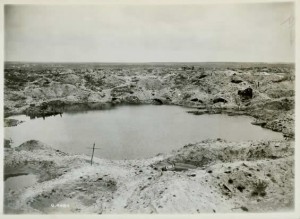
For the CEF in the trenches, April 1916 was a cruel month.  Following the German offensive at Verdun, there was great emphasis on offensive action to relive the pressure on the French Army.  Just south of Ypres, Canadian troops were committed to a battle that became known as the St. Eloi Craters (27 March – 16 April 1916).  Four large mines were detonated under the German lines, but instead of the hoped-for breach, vast craters were created in the soggy landscape, complicating maneuver and navigation in the dismal landscape.   While some ground was won, the battlefield was “under constant enemy shelling, and men had been forced to crouch in mud-filled ditches and shell-holes, or stand all day in water nearly to their waists with no possibility of rest”.   During a relief in place under these appalling conditions, the Canadian 6th Brigade was caught in a German counterattack while badly strung out and not in defensive positions.   The Canadians were thrown back with heavy casualties, and the ground was retaken by the Germans.   The battle dragged on for days as an artillery duel before it ended, leaving 1,373 Canadians killed or wounded.  The Canadian official history describes St. Eloi as a “fiasco”, and its costly lessons were taken to heart in future trench offensives.


One of the St. Eloi Craters, Canadian War Museum


 One of the regiments hard pressed in the St. Eloi battle was the 6th Brigade’s 29th (Vancouver) Battalion.   Its chaplain was an Anglican, the Rev. Cecil Caldbeck Owen, a graduate of Wycliffe College and the Rector of Christ Church, Vancouver (today’s Christ Church Cathedral).  Owen, a vigorous man in his middle age, and widely popular in Vancouver, had long been a militia chaplain, and he went overseas with the newly formed 29th BN in May of 1915.  His 22 year old son Harold was by then already in France as an infantry officer.  


Padre Owen (right) with his son, Harold, in front of the Christ Church rectory, Vancouver, 1915, from Living Stones: A History of Christ Church Cathedral


 Christ Church granted Owen leave to serve in the CEF, and despite worries about his parish’s finances and attendance, he gained a reputation as a dedicated front-line chaplain.  He would have gone into action at St. Eloi still coping with grief, for his son Harold had been killed in action on 1 February, 1916.  Owen made a three hour journey on horseback to be present at Harold’s funeral, and like his colleague Canon Scott, continued in his ministry after losing his son to the war.    After the war, Owen served as a hospital chaplain in Vancouver, and was present at the dedication of the Vimy Monument, where he spoke of how “We must educate our children in the finer aspects of courage and sacrifice which emerged during the war so that they will remember the heroism and the deeper lessons which should have resulted from it”.  Sadly, war would ask another sacrifice of him.  Owen’s adopted son Luder Keshisian, an Armenian refugee, was an RCAF pilot in the Second World War, and was killed over Germany in June, 1944.   Padre Owen died in Vancouver on Christmas Eve, 1954, 


For those troops not in the line, Easter Sunday 1916 (24 April) happened to coincide with St. George’s Day, which was not lost on troops of English heritage.  Canon Scott, in the Ypres Salient with the First Division, describes how the engineers “built me a church, and a big sign over the door was first used on Easter Day … and we had very hearty services”.  For those Canadians in the nearby town of Poperinghe, like the Queen’s Own Rifles  which observed Easter Sunday with a church parade, there was the possibility of a visit to Talbot House, an all-ranks refuge created by an enterprising English Anglican, Padre “Tubby” Clayton.  


Talbot House, or “TocH” as it was known, offered soldiers a chance to worship in the chapel upstairs (which rocked alarmingly when packed with men) or to remind themselves of civilian life in the comforts of its drawing room and garden.  Visitors first saw a sign enjoining them to “Abandon rank, all ye who enter here”.  Padre Clayton knew the Canadian chaplains like Canon Scott, and welcomed many Canadian visitors.  He wrote that “Canadian churchmanship impressed me not a little.  For six months in 1916 a Canadian sergeant-major was the Vicar’s warden; and it was he who most appropriately welcomed the Archbishop of Canterbury on his memorable visit to the House early that summer.  Almost the first Canadians I saw were two tunnellers, who on a weekday morning set out from the old French dug-outs beyond Vlamertinghe at 5am and arrived at the Chapel for the celebration (then at 6:30 on weekday), having heard that the service was held daily, and being quite prepared to forgo their chances of breakfast at the end of a ten-mile walk.”  


While TocH was a refuge, it was not a shelter.  Poperinghe lay within the Ypres salient, and as Clayton wrote, shells “crossed and recrossed the roof from three points of the compass”.  The congregations who knelt and prayed in TocH’s small chapel had to return to an even more dangerous front line.  A long war and uncertain survival still lay before them.    For padres like Clayton, all they could do was to try andfind these momentary places and times of grace for the troo, and commend the men to God in the terrible battles to come.


Padre Michael Peterson+

Wednesday, March 23, 2016

Easter 2016 Anglican Military Ordinariate Newsletter

Here is a link to the Easter 2016 edition of the newsletter I edit for my diocese, the Anglican Military Ordinariate of the Canadian Armed Forces.

It includes several articles on an historic event, our first election of our Bishop Ordinary, as well as a book review and a continued look back 100 years at Canadian Anglican chaplains in the Great War.

MP+


Thursday, March 3, 2016

ACC Primate's Charge to Anglican Military Ordinariate Electoral College

This Saturday, March 5th, an Electoral College, representing the fifty Anglican chaplains serving in the Canadian Armed Forces, will select the first Bishop Ordinary to be elected by members of the Military Ordinariate.   Previously this post was appointed by the head of the Anglican Church of Canada, the Primate.  


Primate Fred with our retiring Ordinary, Bishop Peter Coffin
 

Primate Fred Hiltz' charge to the Electoral College may be found here.  In this ten minute video, the Primate offers reflections not only on this election, but on the task of military chaplains, and on the role of the Holy Spirit in the deliberations of the church.   It is a very helpful short meditation on this aspect of Anglican ecclesilogy.

I have always appreciated the Primate's support of me and my fellow Anglican chaplains, and thank him for the way he has guided us through this process.

MP+

Thursday, December 24, 2015

First Christmas In The Trenches: Remembering Anglican Chaplaincy in the Great War

This post copies an article that I wrote for the newsletter of the Anglican Military Ordinariate, the body of Anglican chaplains serving in the Canadian Armed Forces.  It is part of an ongoing centennial retrospective of Anglican military chaplaincy in the First World War.   Last Christmas, I posted here about the Canadian Expeditionary Force’s first Christmas of the war, when they were waiting to go over from England to France.  By Christmas 1915, the Corps had suffered brutal baptisms of fire at places such as Second Ypres, Festubert and Givenchy, and were well on their way to becoming professional soldiers.  


By Padre Michael Peterson


To make the centennial of the First World War, the AMO Newsletter continues a series of vignettes of Canada’s Anglican chaplains and their ministry throughout that conflict.  Each instalment in the series will recall a time one hundred years prior to the date of each Newsletter.


During the second half of 1915, Canada’s Army and its Chaplaincy had both matured.   The Canadian Corps, now with two divisions in the line, had suffered its baptism of fire in the spring at Second Ypres, Festubert and Givenchy.   By the winter the Corps’ strength had reached ninety-five thousand, and it held a line in Belgium south of Ypres and north of Messines, between the villages of St. Eloi and Wulverghem.   While the positions were static, the British high command expected all units to carry out trench raids under cover of darkness in order to improve combat skills, gather prisoners and intelligence, and to maintain the troops’ fighting spirit.


These orders were more easily given than executed.   The historian of the Second Battalion (Eastern Ontario Regiment), described the Flanders rains that winter as “like no other that had ever fallen on earth”.


There was no escape from it. The trenches, which were nothing more than sandbagged breastworks, simply dissolved. The earth within the sandbags liquefied and oozed out. Everything collapsed. Every indentation of the ground filled with water, and, to make things worse, the enemy, being on higher ground, delighted in draining his trenches  across No Man's Land into those occupied by the Canadians.


Those in damp billets and flooded dugouts fared little better, and as there was not sufficient waterproof clothing, particularly rubber waders, troops suffered from influenza and a new ailment known as “trench foot”.


Canadian troops in Flanders, Winter 1915

(Natl. Archives of Canada)


While the Canadian Chaplain Service had been formally established in August 1915, it suffered from the divisive leadership of its first Director, Col. Richard Steacy.  His partiality  towards Anglicans and Orange Lodge factionalism meant that many Catholic and other Protestant chaplains were kept out of the line, and as Corps numbers increased, so did the number of padre vacancies.


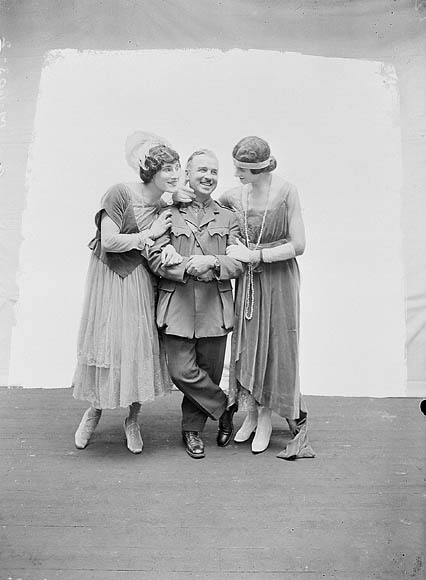
Chaplains in the rear areas found opportunities to enhance morale.  Some set up sports events and libraries, while others worked with the Red Cross and church groups in Canada to distribute comforts to the troops.  Arthur McGreer, an Anglican priest (Trinity College 1910) assigned to Third Field Ambulance, was tasked with setting up a concert troupe which became wildly popular.  By the end of the war there were some thirty such concert troupes entertaining Canadian soldiers in Europe, the most famous being the Dumbells.  


Three of the Dumbells. Their founder, Capt. Merv Plunkett, is in the centre.


Through the second half of 1915, padres had earned greater freedoms to pursue their frontline ministries.  Canon Scott wrote that “Chaplains were being looked upon more as parish priests to their battalions.  They could be visited freely by the men, and could also have meals with the men when they saw fit”.  During the sodden winter of 1915-1916, some found that maintaining morale could be difficult.  Even the diligent Canon Scott discovered this challenge when he met a unit, “wet and muddy”, coming out of the line.


I stood by the bridge watching them pass and, thinking it was the right and conventional thing to do, wished them all a Merry Christmas. My intentions were of the best, but I was afterwards told that it sounded to the men like the voice of one mocking them in their misery.


Christmas 1915 was a varied experience for Canadian troops.  If they were in the front line, it might pass with scant celebration.  The 10th BN (Calgary Rifles) spent Christmas in the trenches, supporting the engineers with working parties day and night.  The 10th’s war diary states tersely: “No notice of Christmas Season other than issue of plum puddings and gifts of cigars and fruit at midday meal”.  However the men of the 7th BN (British Columbia Regiment) found time to publish a Christmas edition of their regimental newspaper, “The Listening Post”, with an image of a stern Father Christmas and wishes “To one and all of our Fellow Countrymen at home in Canada, and to our many friends and relatives where ‘ere they be … a right MERRY CHRISTMAS and a HAPPY NEW YEAR”.


Pte. Alan Manderson with the 49th BN (Edmonton Regiment) wrote to his mother to describe a fine Christmas dinner of chicken, plum pudding and beer served by the sergeants.


We got a Christmas sock from the people of Canada for the Canadians in France.  Mine came from a lady in the east end of Toronto.  I may write and thank her for it.  At seven we had supper - just custard and figs.  Then followed the concert — a pantomime, “The Babes in the Wood”.  It was great.  The actors were all soldiers in camp here, but I’ve seen worse shows in Toronto lots of times.


For those troops in the front lines, however, war and danger were ever present.  Canon Scott was summoned on Christmas Eve by a sergeant “who told me he had some men to be buried”.  After prayers over their graves with the burial party, he set up in a barn “which for some reason or other, although it was in sight of the enemy, had not been demolished and was used as a billet” and celebrated a midnight Eucharist with the men of the 16th BN (Canadian Scottish).  This candlelit barn, with empty biscuit tins as an altar, was a far cry from Scott’s previous Christmas, celebrated in the lovely English parish of St. Mary and Melor, Amesbury.


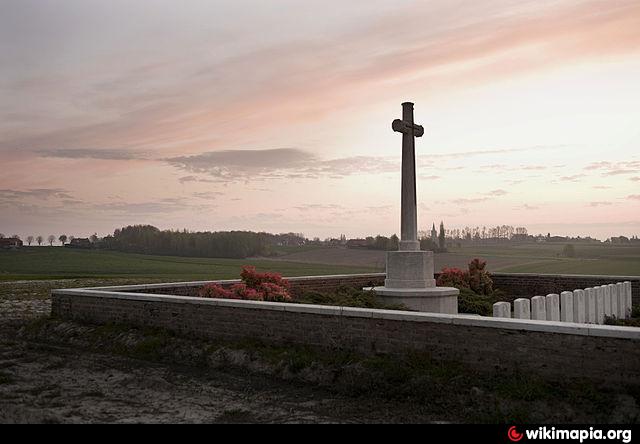
St. Quentin Cabaret Commonwealth Cemetery

Somewhere near here, Canon Scott celebrated the Eucharist on Christmas Eve, 1915


The Highlanders assembled in two rows and I handed out hymn books. There were many candles in the building so the men were able to read. It was wonderful to hear in such a place and on such an occasion, the beautiful old hymns, “While Shepherds Watched their Flocks by Night,” “Hark the Herald Angels Sing,” and “O Come All Ye Faithful.” The men sang them lustily and many and varied were the memories of past Christmases that welled up in their thoughts at that time.   


Christmas 1915 also saw one of the famous informal soldier’s truces.  For some Canadian troops, the memories of the gas attack at Second Ypres left them feeling too uncharitable for such a gesture.  The CEF official history notes that “front-line battalions were instructed that any attempt by the enemy ‘to bring about a temporary cessation of hostilities’ must be met by rifle, and if necessary artillery fire”.  However, in Canon Scott’s part of the line, all was peaceful.  To the Canon’s “astonishment”, German and Canadian soldiers strolled in plain view of one another, and bottles of beer were exchanged as gifts.  Miraculously the rain had stopped.  “Christmas parcels had arrived and the men were making merry with their friends, and enjoying the soft spring-like air, and the warm sunshine”. 


The unofficial soldiers’ truces of Christmas 1915 earned

significant media attention.


Later that day Scott celebrated Eucharist with another battalion, “in the cellar of a ruined building” and “down some broken steps”.  He would later write that “We had two more war Christmases in France, but I always look back upon that first one as something unique in its beauty and simplicity”.  


No Canadian soldier that Christmas could imagine that three more years of war, each more terrible than the last, lay ahead of them.


Blessings to you and yours this Christmas.

MP+

Saturday, December 19, 2015

Anglican Military Ordinariate Advent 2015 Newsletter

The Anglican Military Ordinariate is formed of clergy of the Anglican Church of Canada serving as chaplains in the Canadian Armed Forces.  Our Advent/Christmas 2015 Newsletter may be found here.

Mad Padre

Mad Padre
Opinions expressed within are in no way the responsibility of anyone's employers or facilitating agencies and should by rights be taken as nothing more than one person's notional musings, attempted witticisms, and prayerful posturings.

Followers

Blog Archive

Labels