Showing posts with label Religion In The News. Show all posts

Tuesday, September 27, 2022

King Charles III: Defender of Faith?


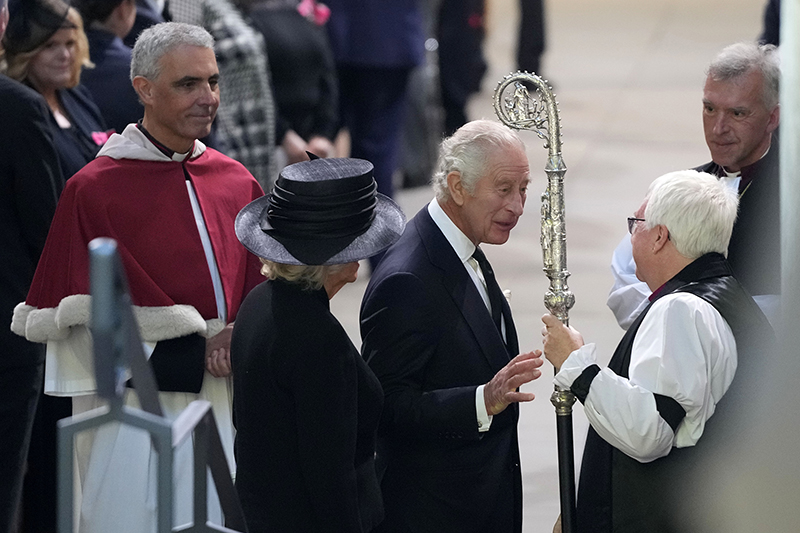
Britain’s King Charles III and Camilla, the queen consort, leave after a Service of Prayer and Reflection for the life of Queen Elizabeth II, at Llandaff Cathedral in Cardiff, Wales, Sept. 16, 2022. (AP Photo/Frank Augstein, Pool)

As we come to terms with what the British monarchy will look like in the post-Elizabethan era (can we recycle that term to speak of recent history?), I was interested in this article posted in Religion News Service on 21 September about the new king’s title Defender of the Faith and how King Charles may be interpreting it.

The term Defensor Fidei was first given to Henry VIII in 1521 by the Pope, when Henry was trying to curry favour with the papacy through a ghost-written tract he had put his name to, denouncing Martin Luther.  As we know, Henry was quite willing later on to jettison Rome’s favour to gain his divorce from his first wife, Catherine.   Readers who want to know more, and are looking for good fiction, are encouraged to read the late and lamented Hilary Mantel's novel Wolf Hall.

The title remained, and while the late Queen and her son have both maintained their membership in the Church of England and their Christian faith, there have been signs that the new King has envisioned the Crown being a guarantor of religions.   As Prince of Wales, he controversially said that he thought the monarch should be “Defender of the Faiths”, and while he recanted that statement, the RNS article notes that there were many different faith/religious leaders present at funeral services for Queen Elizabeth.

An expansive view of religious freedom is probably the only course open to a constitutional monarch with a fragile authority over an increasingly pluralistic and secular nation.   It is, however, the view that the late Queen took, as the RNS article notes:

In a landmark speech in 2012 at Lambeth Palace, the London home of the Archbishop of Canterbury, the queen said of the Church of England that “Its role is not to defend Anglicanism to the exclusion of other religions. Instead, the Church has a duty to protect the free practice of all faiths in this country.”

She credited the established church with having done so already. “Gently and assuredly, the Church of England has created an environment for other faith communities and indeed people of no faith to live freely,” she said.

Watching the funeral service for the Queen, one of my more conservative clergy colleagues jokingly suggested that the Crown on the flag-draped casket was a fitting symbol of Christian nationalism.   I respectfully differ.  When I was a chaplain in the Canadian Forces, as a religious functionary employed by the federal government, I came to the view that my role was to speak politically and socially for all faiths represented in Canada, while speaking pastorally and theologically only for my own.  A chaplain’s role, I thought, was ultimately to guarantee the freedom of people of faith to be themselves.  My sense is that the new King takes a similar view of the Crown’s role.     

Saturday, October 30, 2021

Food Security and God's Community: A Homily on the Book of Ruth


Food Insecurity and God’s Community: A Sermon on The Book of Ruth

Preached on the Twenty-third Sunday after Pentecost, 31 October, All Saints, King City, Anglican Diocese of Toronto.  Readings for Proper 31B: Ru 1:1-18; Ps 146; Heb 9:11-14; Mk 12:28-34


The Book of Ruth is one of those small corners of scripture that I suspect we all wish we knew better.   For my part, I confess that I have never before given a sermon on Ruth, which is a terrible admission for a preacher who has a fondness for the Hebrew Scriptures (Old Testament).   It’s known, at least in part, for Ruth’s famous and moving speech to Naomi – “Where you go, I will go” (Ru 1,16-17) but I’m not sure we know what quite to make of it.   In Christian bibles, Ruth is found tucked between Judges and 1 Samuel, leading us to think that it belongs to the historical books of the bible.  However, whereas these historical books are about great kings and prophets, the characters of Ruth are unremarkable, ordinary people living ordinary lives, which encourages us to think that it has something to speak into our ordinary lives.

Today and next Sunday, I want to explore several of the themes of Ruth.   The first is food, which I’ll mostly focus on today; what does the contrast between the opening scene of famine and the grain-filled threshing floor of Boaz have to tell us about food insecurity and our basic needs?   The second theme is love and family; what does Ruth’s loyalty to Naomi and Boaz’s kindness to Ruth say to us about how we might live our lives in ways that are gracious to one another and aligned with the purposes of God?   The third we might call God’s providence or design; how does the story of Ruth fit into the saving purposes of God, and how might that give us hope and inspiration?

“In the days when the judges ruled, there was a famine in the land” (Ru 1.1).

In just five verses, the Book of Ruth presents a bleak and uncompromising view of life in ancient Israel.   It begins in hunger and migration.   The husband Elimelech takes his family to the neighbouring land of Moab to escape the famine.  For a while Elimilech and Naomi seem to find better lives and also find wives for their two sons, but within ten years the father and his sons are dead, leaving three homeless widows.  Naomi is left without any male family to provide for and to protect her.  The best she can do is send her daughters-in-law back to their families in the hope that they will be taken in and cared for.  

So the story of Ruth starts in hunger.  It’s not just the hunger of empty stomachs, though that is all too real.   It’s also a story about the hunger of empty lives, of Naomi, whose name in Hebrew means Pleasant, changing her name to Mara, meaning bitter, because she thanks she has nothing, no family, no kin, no love, no future.  It’s also a story about the hunger of loneliness, of Boaz, an older unmarried man who has prosperity but no one to share it with, and who finds in Ruth a wife and in her children a future for his name and lineage.

The progression of the story, from hunger and mourning to the harvested grain and barley on the threshing floor to the marriage and child of Ruth and Boaz, is a gradual movement from emptiness to fullness, from sorrow to joy.  It’s a wonderful little story.  In some ways it is like Job, in its narrative movement from tragedy to joy, though unlike Job, Ruth and Naomi are not caught in a cosmic struggle between God and Satan as Job is, and their restoration to happiness seems quietly deserving compared to the cornucopia of abundance that Job is finally blessed with.

There’s metaphorical hunger here, but there’s real, earthly, deadly hunger in this story.   Elimelech’s taking his family to Moab is one of several examples of hunger-related migration in the Hebrew Scriptures (see the stories of Abraham and Jacob in Genesis), and indeed today hunger and food insecurity lead many millions today to leave their homes in the hopes of finding UN administered relief food refugee camps.   The problem is not unique to overseas.  

Recently I was stunned to read an opinion piece in The Globe and Mail (Oct. 11, 2021) byLori Nikkel, who is CEO of the food rescue organization Second Harvest.  Nikkel opened her essay with the shocking statistic that Canada’s charitable sector (churches, mosques, schools and social problems) gave out $33 billion dollars worth of food to 6.7 million Canadians, which is 18 per cent of our population. 

In 2019, Statistics Canada reported that 1.9 million Canadian households are food insecure, meaning that their diets are inadequate and unhealthy.  Many Canadians are one paycheque away from hunger, while half of the food produced in Canada ends up in landfills.    It’s hard not to conclude from these numbers that there is something systemically and sinfully wrong with food supply in Canada.

What does an ancient bible story about hunger have to say to our context?  Ruth is a story about loyalty, or in Hebrew, hesed.  It’s about bonds of connection and affection, some of which are familial (Boaz is Naomi’s kinsman, Naomi is Ruth’s mother-in-law) but which are also deeply rooted in heart and soul.   Ruth persists in staying with Naomi, even unto death, when the other daughter in law Orpah obeys Naomi and leaves her.    Boaz shows kindness to a nobody, a foreign widow, who has no claim on him except that he has heard of her faithfulness to his kinswoman Naomi.

This kindness is rooted in the hearts of ordinary people in an ordinary story, but it is also rooted in the purposes of God that is firmly opposed to hunger and human indifference.    Even when Naomi (quite understandably) says bitterly that “the Lord has turned against me” (Ru 1.13), Ruth declares that “your God [shall be] my God” (1.16).  Her faith in this God that she does not yet know is rewarded when Boaz agrees to help Ruth.  As he says to her, “may you have a full reward from the Lord, the God of Israel, under whose wings you have come for refuge” (Ru 2.12).  Boaz is certainly not immune to the charms of a younger woman, but this wealthy farmer seems to understand God’s purpose for him means to be an agent of refuge, and so his faith extends to concrete acts of assistance to others.

The Book of Ruth, then, speaks across the long centuries to a church in twenty-first century Canada and asks us how we will be God’s wings of refuge?   Who are the Ruth’s, the refugees from foreign lands, those of no account and no status, who are hungry and friendless?   I said in my homily last Sunday that the data shows that are immediate neighbourhood as a church is wealthy, but we know that there is hunger in our wider community.    We have an existing relationship with a local food bank that manifests itself in sporadic efforts.  We could certainly do more there.  There are other churches and agencies running food programs in poorer neighbourhoods not far from us that we could reach out to.   How will hunger and food security be part of our mission going forward?

One final thought about why we do this.  At the end of the Book of Ruth we are back in Bethlehem, and we are told that the child born to Boaz and Ruth is Obed, who will be the father of Jesse, who will be the father of David.   From this ancestry a descendent of David will also be born in Bethlehem, and it is that person who will call us to mission as he reveals God’s purposes.  More on that next Sunday.


Wednesday, July 17, 2019

New Findings On The Relevance Of Clergy Are Not Inspiring


A new poll suggesting the waning influence of clergy doesn't really surprise me.  Perhaps the only thing that is at all newsworthy is that the poll describes religions opinions in the United States, which reinforces ongoing findings that even the US is becoming increasingly secular.

That the clergy are less respected than other professions (financial, medical, etc) seems to me a wholly expected result of secularization and the general decline of participation in churches.  As someone who wears a cross on a military uniform and, occasionally, a civilian clergy shirt and dog collar, I don't expect deference from strangers.  Usually I hope for a sort of forbearance or polite tolerance, and hope to build on that.

What I find most interesting, and most hopeful, from this article is this part:

“There are people who are smarter, more competent, more equipped in certain fields, and that’s where we go for those sorts of answers,” said Kurt N. Fredrickson, associate professor of pastoral ministry at Fuller Theological Seminary.
Clergy, Fredrickson said, must recognize that churches today are often seen as fire stations — places to go when all else falls apart.
“I help younger pastors, pre-service, flip the power structure upside down; rather than seeing pastors as the top of the triangle I want to help pastors become servant leaders.”
My advice for practicing and aspiring clergy who wish to be relevant would be that, in lieu of seeking or expecting a mostly vanished social respect and prestige, seek instead to cultivate character, empathy, and compassion.

MP


Thursday, October 13, 2016

Trump And The Christians


It's time for Christians to get off the Trump Train.   It is certainly time now, and it was time a long while ago. 


I get why some still want to stay on, even as it hurtles towards a scene that will eclipse the big final moments of either The Cassandra Crossing or Breakheart Pass (something about Trump seems to invite metaphors based on 1970s disaster films - or is that just me?).

Their argument is that even though Trump has said (and apparently done, according to his growing legion of accusers) the sorts of things as an old man that would have had a youth pastor fired in a heartbeat, he is nevertheless the last best hope for Christian America, because after Hilary comes the Deluge, apparently.

Here is an example of how this argument works.   Ralph Reed and Jerry Fallwell Jr., lay out a case for Trump as the candidate most likely to advance a pro-Christian agenda by appointing suitable judges to the Supreme Court and to further curtail access to abortion, which Reed has called the “defining moral issue of our time.”

This argument appeals to an overarching theological claim of American Exceptionalism, meaning that God has created America as a second Israel, and has entered into a covenantal relationship with American Christians by which he gives special blessings and rewards in return for America's faithfulness.   This theology was central to Ted Cruz's Republican nomination bid this year and now Reed and others are willing to give this standard to Trump, who must win lest America suffer ''a moral and spiritual and a cultural death from within that starts at the heart and soul of a country.”

According to Reed and Falwell, Trump must win to champion the causes that “matter most to the Christian community'', even though the events of this past week have confirmed that Trump is a morally deficient standard bearer.  One senses that for Reed, the stakes are too high to wait for a more suitable champion.  As Reed said on 10 October to Liberty University's convocation gathering,  “I think retreating to the stained-glass ghetto from whence we came and refusing to muddy our boots with the mud and mire of politics is simply not an option for a follower of Christ
Leaving aside for a moment the idea that the Christian faith is worth dragging into ''the mud and mire' of politics'' in order to, supposedly, save it, is the idea of Christian America theologically and historically defensible?

While it is tempting to think of modern America's founding in New England by devout Puritan exiles as the basis of a national identity based on Protestant Christian values (Chesterton's quip of a nation with the soul of a church), the reality is far too complicated and pluralistic for that idea to hold water.  The founding fathers were primarily 18th century Deists, whose view of a distant, uninvolved God was far removed from contemporary evangelicals.  The Christianity of slaves become African-Americans, Hispanics, and Irish immigrants from the Old World was far removed from, and almost unintelligible to, white Protestants through much of the 19th and early 20th centuries

Jewish, Catholic and Protestant Americans forged new alliances in the mid 20th century (see Kevin M. Schultz's excellent book Tri-Faith America).  Then came immigration from Asia and the globalization of religion and now Jews and Christians are finding that mosques and temples are now also part of the religious landscape.   Sikh soldiers in the US Army want their distinctive beards and turbans to be authorized as part of their service dress.   Buddhism, once an exotic counter-cultural option in the 1960s, is increasingly familiar.  A Mormon won the Republican presidential nomination.  'Spiritual but not religious' and 'nones' are now recognized categories in religious polling as the proportion of Americans who do not identify with Christianity increases year by year. 

American religion and society is pluralistic.  This seems to me to be a fact on the ground that is as much historical as it is contemporary and demographic.   The author of the excellent religious blog Bensonian made this point when he wrote, back in February, that he could not accept Ted Cruz as a presidential candidate because Cruz was running to be the Christian president of Christian America.  In his post, Bensonian quotes the scholar Paul D. Miller on why the idea of Christian America so dear to Cruz, Reed and Falwell, Jr. is so problematic. 

America is exceptional, but not because of any special access she enjoys to God. The United States had a highly unique origin in the acts of the Continental Congress and Constitutional Convention, and its national identity is uniquely rooted in ideas of equality and liberty, rather than race, class, or language, as had been the case for most European countries at the time.

But America is not the special vehicle of God’s purposes in the world. Some conservatives love to quote Psalm 33:12, “Blessed is the nation whose God is the Lord.” The nation whose God is the Lord is the Christian Church, not the United States. The church, not the United States, is the vehicle of God’s purposes in the world. To believe otherwise is to confuse the nation with the church, the spiritual with the temporal. That sort of confusion can justify all sorts of dangerous messianic political movements.

As a Christian, I believe that I am called to follow a moral and ethical code based on the law of God and the imitation of Christ.  I hope that in so doing, however imperfectly, that I am a good influence (salt and light to use biblical terms) on those around me.  However, I can't ignore the fact that I live n a pluralistic democracy where Christian faith is widely perceived as a lifestyle choice.   For me to believe that I have a right to impose Christian-based laws and governance on those who do not subscribe to them would be at best hubristic, and at worst theocratic.  In any case, how could I do when Christians can't agree amongst themselves on key issues like pacifism, abortion, and sexuality? To impose a Christian view on those who don't share it could only be a coercive act, and coercion, as I read the gospel, is antithetical to the nature and invitation of Christ to follow him willingly.


The history of Christianity in the west has long been composed of some groups buttressing the power of the day in throne and altar alliances (e.g. Catholics, Lutherans, Anglicans), and dissenters (e.g. Mennonites) retreating into self-isolating communities.   Starting in the late 20th century, once dominant religious groups were slowly disenfranchised by secularization and political change.  American evangelism, like British Anglicanism and French/Quebecois Catholicism before it), now seems to find itself on the way into exile which is why the stakes in this US election seem so high.  Lose the Supreme Court to Clinton and the last chance of legislating a Christian agenda for at least the next few generations vanishes. 


I think, though I can't prove, that this is why the authoritarian aspects of Trump's character have attracted American evangelicals even when his morality has been exposed as a sordid mess.   If it takes a tribune to make America Great again, in Trump's phrase, as 'one people, under one God, saluting one flag', and if the popular vote threatens to elect Clinton, then democracy be damned. 


Second to their betrayal of Christ's gospel of love, the betrayal of a republic that so many non-Christians have fought and died for, and that so many across the world still see as our best hope, is the great treason of the religious right in America.   Their desire to impose a Christian agenda on America, even if well-meaning, has blinded them to the terrible danger that Trump poses to democracy.   The political scholar Jill Lepore laid out this danger eloquently in a recent post for The New Yorker.

Donald J. Trump ... leads the Republican Party the way the head of a rebel army holds a capital city. This isn’t an ambush or an act of treason or a kidnapping. This is a siege. He plans to build walls; he promises to put his opponents in prison. He enjoys harems. He admires tyrants. He erects monuments to himself in major cities. He holds entertainments in America’s stadiums, where he toys with his political enemies, delighting his band of followers while terrorizing other citizens. Over the weekend, he insisted that he will neither retreat nor surrender.

Meanwhile, he invokes the people: they, he says, have chosen him, and will elect him; the people love him. Do they? Joe McGinniss once observed that the American voter “defends passionately the illusion that the men he chooses to lead him are of a finer nature than he” and that “it has been traditional that the successful politician honor this illusion.” That tradition has ended. No one in the Republican Party can possibly believe that Trump is a better person, a man of finer nature, than the ordinary American voter. The problem for the Party is that no one, including House Speaker Paul Ryan, can even pretend to believe that anymore. No one can believe that in daylight, or in the darkest hour of night, while Trump, restless, tweets about the conspiracies that he believes are being hatched by his enemies—men and, especially, women—to fell him.

In the last few weeks, theologians like Miroslav Volf and Russell Moore have also made the case for disavowing Trump.   Yesterday it was heartening to see students at Liberty University follow suit, despite the urgings of their elders.  For those Christian leaders like Falwell Jr. who want to stay on the Trump Train, well, see my comments on The Cassandra Crossing.  It will not end well for you and it will bring shame and disrepute on the gospel you profess to preach.

For other Christian Americans, assuming (as is likely) that Hillary Clinton is the next president, the question is, can you go forward without proclaiming her as the AntiChrist, delegitimizing the election and government, and so like Samson bringing down the temple on your heads?   Robert Franklin, who teaches at Emory University, offers some suggestions for how a post-Trump civics could be achieved.   It will involve dialogue and listening on both sides, and a letting go of words like 'deplorables' and 'irredeemable', because no one and nothing is irredeemable.    Christians and non-Christians will have to find a way to live together, because the alternative is too grim and too terrible to contemplate.


Wednesday, April 6, 2016

For Jews of Scottish Ancestry, An Official (And Kosher) Tartan

Today in Canada, and elsewhere in the world for all I know, we are observing National Tartan Day.   It seems a fitting occasion to pass on this story, via US National Public Radio, which certainly qualifies as one of the cheerier religious news items of the day.  In this link, NPR's Mary Louise Kelly speaks with a Glasgow Rabbi, Mendel Jacobs, who has designed the fist official Jewish Scottish tartan.


Rabbi Mendel Jacobs with his tartan prayer shawl.
 
 
The interview references a Sikh tartan, which may be seen here.  There are also mysterious references to a Christian clergy tartan, but, being a bit of a liturgical purist, I don`t have the courage to really pursue that.

Thursday, January 7, 2016

What`s Religious? What`s Political? Religious Literacy And Current Events


There has been some shop in my office this week about an interview in the Ottawa Citizen with Andrew Bennett, Canada`s Ambassador for Religious Freedom.  

In the interview, Bennett argues that diplomats and foreign service officers need to be more aware of the role that religion plays in politics and international affairs.  Bennett is quoted as saying: “We need to ensure that if we want to be really nuanced and winsome in how we engage countries that are deeply religious, that we can actually employ language that enables us to have a deeper engagement,” he said. “If we can’t do that, then we risk developing or having a serious diplomatic blind spot.”

One could argue that the same can be said of Canadian Armed Forces personnel operating in environments where religion has a prominence that is far greater than one would find in secular, pluralistic Canada.

Since Saudi Arabia and Iran broke relations last year following the Kingdom`s execution of a dissident Shia cleric, I`ve heard and read several media explanations of the differences between Shia and Sunni Islam, dating back to events following the death of the Prophet Mohammed, and how this split in Islam maps over the contemporary Middle East.

I am sure that this sort of background is useful, particularly in North America where most people have only the haziest of understandings of Islam.  But is it true, as Mr. Bennett suggests, that we can`t understand the world unless we understand the religious factors at work in societies and conflicts?

The answer is probably a qualified yes.   A round table of scholars assembled by the US Council on Foreign Relations discussed the Saudi-Iran split yesterday, 6 January, and focused mostly on the geopolitical rivalry between the two regional powers. 

One of the participants, Philip H. Gordon (a CFR Senior Fellow)  noted that this conflict does break along sectarian lines, but was reluctant to dwell on it.  He said ``... this notion of sectarianism and eternal hatred, you know, it has not been an all-out war between Sunni and Shia for 1,400 years.  There have been times when they have been able to cooperate.  And those times end when there are political reasons for them to end, you know, after the Iranian revolution, when whether within a country or between countries there`s some change in the regional order.  So in the `79 revolution in Iran, after the US 2003 invasion of Iraq.  If you change the balance between Sunni and Shia, again either between countries or within countries, you get the rise in tension.''

Writing in The Nation yesterday, Juan Cole, a history professor at the University of Michigan, described sectiarianism as ''a recruiting tool'' used by regional rivals, and pointed to the complexity of the religious landscape.

''Just as the political collapse in Yemen and the takeover of Sana by the Houthis over a year ago pushed Saudi Arabia to intervene there, the prospect of the Baath regime of Bashar al-Assad being overthrown pushed Iran to send aid and troops to Damascus. Tehran also convinced Lebanon’s Hezbollah to enter the fray on the side of Assad, preserving the Syrian land bridge for Iranian resupply of munitions to its Lebanese client. The Iranian investment in Syria has nothing to do with Syrian Shiism. Iran’s allies in Syria are an assortment of Christians and Sunni secularists and New Age Shiites (the Alawites) with a gnostic and mythological approach to religion that bears about as much resemblance to clerical Iranian Shiism as Theosophy does to Episcopalianism. Besides, the Alawites who run the Baath regime in Syria are atheists.''

On the other hand, for those who suspect that all conflict in the Middle East is driven by oil, Jon Schwarz in The Intercept analyzes a fascinating map of oil deposits overlaid with sectarian divides and suggests that it`s not a coincidence that most of Saudi Arabia`s oil weath lies in the part of the country dominated by its Shia minority.https://theintercept.com/2016/01/06/one-map-that-explains-the-dangerous-saudi-iranian-conflict/.

Closer to home, one can ask if religion helps to understand the armed ranchers currently occupying a federal wildlife centre in Oregon.   Writing in the New Yorker, Benjamin Wallace-Wells analyzes the political motivations of the occupiers, and suggests that they arise from frustation arising from rural poverty in the so-called ''flyover states'' and the rule of far-off elites.   In that respect, the white protesters in Oregon may have more in common with the Black Lives Matter activities in US cities than either group would care to admit.

However, a religious studies scholar, Mark Silk, looks at the role of Mormonism in the Oregon event.  Silk notes the ties between some of the protestors' thinking seems indebted to the ''Skousenite''offshoot of Mormonism, which combines libertarian thought with apocalyptic expectation, and believes that Mormon warriors will cleanse the US and reclaim if for God. One can only hope that the law enforcement officials tracking the Malheur occupation are talking to Silk and people like him to better understand what is going on here.

These two contemporary examples suggest that religion is complex and can often underlay political conflicts.   To dismiss it in the way that some liberal commentators do (I`m thinking of Bill Maher, who I otherwise enjoy), assuming that religion is a vestigial remnant of our prehistoric superstitions, is to grossly over-simplify.  At the same time, religion does not by itself explain the essence or persistence of some conflicts, and we should not allow our conflict analysis to reinforce notions that religion is a negative, destabilising force in the world.   Religion is an aspect of human behaviour that plays a role from the simplest of everyday rituals to large-scale conflict.  Diplomats and military personnel are well-advised to keep this in mind.

Tuesday, July 22, 2014

"Even Genghis Khan Didn't Do This": Mosul Empties Of Christians


Several Christian news sites are reporting that jihadists in ISIS-controlled Iraq are marking the homes of Christians with a graffiti tag, the Arabic sign “nun”, the first letter of the word “nasara” meaning “Nazarene” or Christian.   The meaning of the tag is a warning that the Christians must flee or be killed.  Today one of my friends, Gene Packwood, has started using the “nun” sign as his Facebook avatar as a sign of witness.  

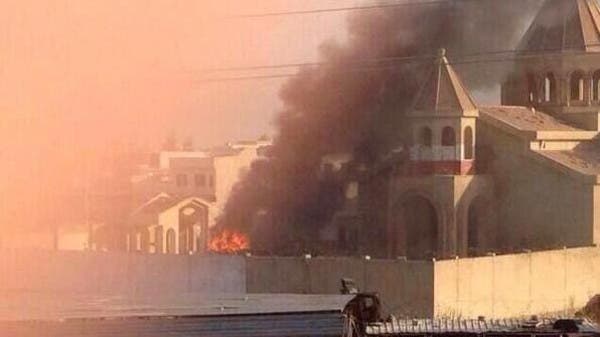
While I don’t know how widespread the use of this symbol is in Iraq, BBC News is reporting that a significant expulsion of Christians from parts of Iraq is underway.   The monastic community of Mar Behnam, southeast of Mosul, was given short notice by ISIS fighters to leave, and were forced to abandon the monastery’s relics.   Mar Behnam was founded in the 4th century AD, and has been a pilgrimage site and part of the Syriac Catholic Church.   The BCC also reports that Mosul’s Christian population has largely fled, after being given an ultimatum to leave, convert, or pay an ancient Islamic tribute tax known as the jizya.  A similar ultimatum was given to the Christian community in the Syrian city of Raqqa earlier this year.  The English branch of Al Arabiya reports that an 1800 year old church in Mosul and its library have been burned, and a tomb thought to be that of the prophet Jonah has been destroyed.

Christians mourning this persecution of our brothers and sisters in iraq should also remember that ISIS is doing much the same or worse to Shiite Muslims and destroying their shrines and holy places.   We need to pray for them as well as for our fellow Christians.

it’s tempting to see this mayhem as proof of the irrationality and dangerous nature of religion, but for a broader view, for those who have the time, I recommend a piece by Gregory Gause of the Brookings Institute on how sectarianism is being used as a weapon in a larger Middle East cold war.  Here’s an excerpt.

"The current confrontation has an important sectarian element, but it cannot be accurately understood simply as a 'Sunni versus Shia' fight. Applying such a framework can distort analytical focus, oversimplify regional dynamics, and cause Iran and Saudi Arabia's motives to be misunderstood. Riyadh and Tehran are playing a balance of power game. They are using sectarianism in that game, but both have crossed the sectarian fault line in seeking regional allies. The regional cold war can only be understood by appreciating the links between domestic conflicts, transnational affinities, and regional state ambitions. It is the weakening of Arab states, more than sectarianism or the rise of Islamist ideologies, that has created the battlefields of the new Middle East cold war. Indeed, it is the arc of state weakness and state failure running from Lebanon through Syria to Iraq that explains the current salience of sectarianism. Given how difficult it will be to reconstruct stable political orders in these and other weak states, the likelihood is that the new cold war will be as protracted as the Arab cold war was."


Tuesday, May 13, 2014

The Media and Muslim Scares: A UK Perspective


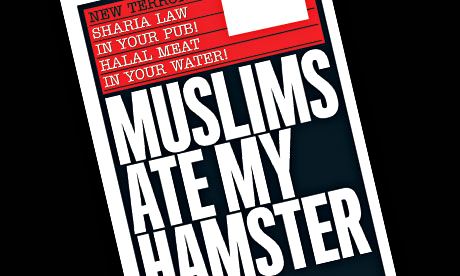
Today’s online Guardian from the UK features a piece by Nesrine Malik about how the British media routinely recycles certain stories about Muslims which, she argues, “create a fear of stealthy, incremental Islamicisation”.  
 
Looking at this story from a Canadian view, it’s hard to put this story into context.   No mainstream voices in Canada have argued that our multicultural policy has failed, whereas British Prime Minister David Cameron said in 2011 that Britain’s multicultural policy has failed.

The  British Office of National Statistics put the Muslim population of England and Wales at 2,706,066 according to the 2011 Census, about 4.8% of the total population.    Statistics Canada put the Muslim population of Canada at about 3.2% as of 2013.  In both cases we are talking about small fractions of the total population.

While Canada has has several prominent court cases involving Islamist terrorism, we haven’t had an incident comparable to the killing of a British soldier, Lee Rigby, in by two Nigerian converts to Islam in May 2013.  There has not been a controversy regarding sharia law in Canada comparable to that which erupted after Rowan Williams as Archbishop of Canterbury made a speech about sharia law in Britain in 2008.
 
Given these different contexts, it is not surprising that the British press would cover issues around Islam differently than their tamer Canadian colleagues.   However, Ms. Malik’s article is a useful reminder that numbers and perspective matter.   The number of Muslim women in Britain who wear the niqab, for example, may be as low as .001% of the total population, or, at the very least, statistically slight.   That seems like a helpful number to keep in mind when trying to decide whether Muslim dress poses a cultural threat to society.
 
I consider myself moderately informed about Islam.  I’ve served with several Muslims in the Canadian Forces and found them little different than anyone else, other than a few distinctions.  For example, I’ve learned that when yo go to the movies with a Muslim friend during Ramadan, your offer of popcorn may be politely turned town.   That said, if you asked me to explain the difference between Shia and Sunni, it would be embarrassing.     I’m reminded of these things as I began a grad class on Religion and Globalization this term, and have several readings (Noah Feldman, The Fall and Rise of the Islamic State; Peter Mandaville, Global Political Islam, and Nafissi Mohammad, Shiism and Politics”) that I hope will amend my ignorance somewhat.  
 
Given how little most of non-Muslims know about Islam, we should be better served by journalism.
 
MP+

Friday, February 7, 2014

This Just In From Tehran

So the brother of Iran’s president walks into a Jewish hospital.   No, it’s not the start of a joke.  Call this story from Teheran political gesture or call it encouraging.   Me, I’m calling it encouraging.   One of the great obstacles facing Muslim states in this century is whether they can find some way to accept religious pluralism (including Shia/Shiite tolerance as well as interfaith pluralism).   

Thomas Friedman wrote about this issue in a recent column.  Here’s a quote from that column, the speaker being Marwan Muasher, a former Jordanian foreign minister now with the Carnegie Endowment in the US:

"No sustainable progress will be possible without the ethic of pluralism permeating all aspects of Arab society – pluralism of thought, pluralism in gender opportunities, pluralism in respect to other religions, pluralism in education, pluralism toward minorities, pluralism of political parties rotating in power and pluralism in the sense of everyone’s right to think differently from the collective."

This is harder said than done.  It hasn’t been achieved very well in the West, where aggressive secularism still fights culture wars with conservative and fundamentalist Christianity.   The theological work necessary to sustain pluralism isn’t easy and most of it remains to be done, but it’s necessary in Tehran, and everywhere else, I would argue.


Read more here: http://www.kansas.com/2014/01/10/3219563/thomas-l-friedman-ethic-of-pluralism.html#storylink=cpy

Wednesday, November 13, 2013

A Shrine For Illegal Immigrants

In one of my classes this fall, we've been reading Thomas Tweed's book Our Lady Of The Exile, a study of the shrine to the Virgin in Miami, Florida, that has been venerated by the Cuban exile community there for decades.  Tweed's book is a modern classic of the anthropological side of Religious Studies, a synthesis of interviews with clergy and visitors to the shrine conducted over several years and situated in a a detailed study of how this place of workshop fits into orthodox and syncretistic faith practices of the Cuban-American community.  Like many of the readings we've done in this class, it has served as a case study of how religion has a seemingly infinite ability to work at and reinvent itself at the local level.

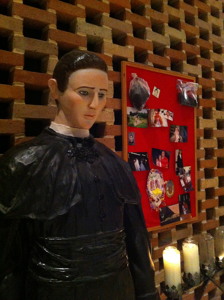
Today on NPR I heard a story about another shrine, in Tulsa, Oklahoma, set up in 2010 in honour of St. Toribio, who is considered to be the patron saint of immigrants.  You can hear the 10 minute segment at the first part of segment C at this page.  Father Toribio Romo Gonsalez was a Mexican Roman Catholic priest who was murdered in 1928 and has since been venerated by Mexican immigrants to the United States who credit him with miraculous appearances to those crossing the desert.  In 2007 the Oklahoma State Legislature passed Bill 1804, which made it a crime to hire, give rides to, or even shelter illegal immigrants.  The shrine was created by parishioners at St. Peter and St. Paul parish in Tulsa as a response to this law.  A statue of Fr. Toribio was brought from Guadalupe, Mexico, in a manner very similar to how Tweed describes the transport of the image of Our Lady from Cuba to Miami.  Drug smugglers have been known to hide narcotics in statues to bring them across the border, but Santo Toribio made it across the border without any problems.

Many people now come to the shrine to pray and talk to Santo Toribio, pray for help with family members seeking their papers or hoping to avoid deportation, and in 2010, two years after the shrine came to Tulsa, two provisions in Bill 1804 were struck down by a court of appeal.

Whether you interested in how religion works and adapts to local conditions and needs, or are a person of faith, it's a lovely example of how faith and hope can gently work against the grain of a harsh legal and political culture.


Wednesday, April 24, 2013

What's With Burma's Violent Buddhists?

Christian Caryl has a good and readable piece on the Foreign Policy website today on the ongoing (and apparently state-sanctioned) violence in Myanmar (Burma) between the majority Buddhist and minority Muslim populations. He notes that this violence, which appears to be state sanctioned, shows that "some of our [Western] idealized notions about the purity of Buddhism don't live up to real-world scrutiny". The reality, he notes, is that Buddhism as it is practised in Myanmar and elsewhere, is subject to the same dynamics that cause other faiths to react in certain ways when under stress.

"All religions -- Buddhism included -- tend to create a powerful sense of collective identity among their followers. All of the great world religions emphasize the sanctity of human life, and strive to limit the use of violence to what's admissible in certain cases. But those careful distinctions tend to go out the window when a group of believers feels that its values are under threat."

As I noted here earlier, what is happening in Burma shows yet again the necessity for inter-religious understanding and dialogue among believers as our best hope for firebreaks against violence between between believers of different faiths.


Location:What's With Burma's Violent Buddhists?

Thursday, September 20, 2012

Newly Found Papyrus Talks Of Jesus' Wife

We don't usually talk religion in the mess but I am so expecting to get asked about this story over a beer at happy hour tomorrow.

Mad Padre

Mad Padre
Opinions expressed within are in no way the responsibility of anyone's employers or facilitating agencies and should by rights be taken as nothing more than one person's notional musings, attempted witticisms, and prayerful posturings.

Followers

Blog Archive

Labels