Showing posts with label Over There. Show all posts

Monday, May 8, 2017

War And Remembrance: Notes Towards A Taxonomy Of Contemporary War Literature


For a long time it was TGWOT - The Global War on Terror, the term for the US led conflict that officially began on September 11, 2001, though one could argue that it began with the USS Cole attack in 2000, the US embassy bombings in Kenya and Tanzania in 1998, or the Khobar towers bombing in Saudi Arabia in 1996, or maybe even the Marine barracks bombing in Beirut in 1983 or ... well, you get the picture.

At some point, the operations fought in Afghanistan, Iraq, Yemen, Iraq (again) and now apparently Syria, began to be lumped into a single term, one that conjures up the titles of classic science fiction novels by the likes of Harlan Ellison:  The Forever War.  That term may have been coined by the US journalist Dexter Filkins, who used it for the title of his indispensable 2008 book based on his assignments in Iraq and Afghanistan. 

The Forever War is primarily an American war, though at different times and places it has also caught up America's friends and allies, including Canada in Kandahar, Great Britain in Basra and Helmand, Germany in Kundiz, and the Kurds in Raqqa.   However, the Forever War is now part of the American experience, longer than any single conflict in US history, and it is not surprising that after a generation of conflict, American writers and poets of note, most of them military or recent veterans, are now emerging.  However, one could argue that these writers have less of a shared context with their civilian readers than at any other time in US history.   America's all volunteer military, its power augmented formidably by technology, has fought and still fights a war that scarcely touches the home front.

The challenge of communicating across this civil-military disconnect unites many of the authors discussed by Adin Dobkin in his recent essay in the Los Angeles Review of Books, "The Never-Ending Book of War".   Some of these writers - Phil Klay, Brian Castner, and Eric Fair, have been previously reviewed on this blog.  

In thinking through Dobkin's review of recent war writing,  the EngLit student in me got to wondering how I would survey the disparate voices of the Forever War.  What literary modes do they work in?  What traditions, genres, and literary predecessors do they draw on?  Dobkin rightly notes the starting point, memory, in his opening paragraph.

"The necessity of a long memory runs throughout our conception of war.  Just consider the phrase,"never forget". 

The phrase "never forget" points to a powerful moral imperative in this mode of history, a dual belief that this history should not be forgotten, and that it not be repeated.  Writers like Castner would rightly have their fallen and wounded comrades remembered, while writers like Fair would not have their country fall back into the moral shame of the Abu Ghraib prison scandal.

As Dobkin notes, since modern wars do not cause "societal shocks" on the homefront, the writers and publishers of these wars have to fight headwinds of incomprehension, alienation, and indifference, as Klay's characters do upon their return home in the short stories of his book Redeployment.  Other writers, as Dobkin notes, fight the moral obfuscation of language as political change in the Trump era resurrects ideas such as enhanced interrogation/torture.  For some of the current military writers, as they admit to Dobkin, it is discouraging to see that the "Never Again" moral and protest function of war literature, a tradition going back at least far as Eric Remarque and Robert Graves, has little apparent efficacy.  As Eric Fair tells Dobkin, "we're right back to where we started, and in fact, might be headed somewhere far worse".

In the rest of this essay, I propose a few gradations of analysis, or pigeonholes, to enhance Dobkin's summary.   Perhaps its the EngLit student in me who finds taxonomies helpful in refining Dobkin's core idea of remembrance by proposing the following categories, and if nothing else it allows me to locate contemporary war writers more easily in my mental landscape.

Remembrance as Epic -  this classification would be writers working in what we might call the encomiastic tradition, in which heroism and pride win out over anti-heroism and irony within a narrative that follows a relatively uncomplicated moral trajectory, what Dobkin calls "clear-cut good versus evil".  While we see this mode in history used in accounts of recent wars, most notably in Tom Brokaw's The Greatest Generation (1998) or Rick Atkinson's Liberation Trilogy (2002-2013), today's writers live and work under the shadow of post-modernity, with its scepticism and suspicious, mordant humour.  Thus The Greatest Generation gives way to Generation Kill, in which careerist officers and petty NCOs are almost as much of an adversary to the protagonists as are the enemy.   Some works of military journalism fall at times into the epic mode, such as Fifteen Days, Christie Blatchford's account of the Canadian Army in Kandahar or Where Men Win Glory, Jon Krakauer's account of the life and death of NFLer turned Army Ranger Pat Tillman, though the later part of Krakauer's book falls into irony as he dissects the tragic circumstances of Tillman's death.  Surely the reluctance of many authors to identify with the Epic mode has to do with the moral ambiguity ad even moral taint of wars like the 2003 invasion of Iraq.  As Tom McDermott, an Australian army officer and scholar has noted, that war, fought without a clear causus belli or UN Declaration has a morally "malignant" quality, so that the participants look back with, "if not a sense of shame, at least an absence of pride".

Remembrance as Mimesis - this classification could also be described as the documentary mode of remembrance, in which the writer works to capture a sense of "this is what it was like" for the reader, who is often a civilian to whom the military ethos and war are compelling but foreign.   To borrow two terms from the literary scholar Northrop Frye, we can subdivide this mode into the High Mimetic and Low Mimetic modes.  The High Mimetic mode is something akin to Shakespearean tragedy, in that it shows us admirable but flawed figures struggling against an often inescapable feat.  The EOD operatives in Brian Castner's works, or journalist David Finkel's portrayal of the doomed soldiers climbing into their fragile Humvees for another patrol in bomb-infested Baghdad.  In this mode of memory, the writer can both offer tribute to comrades for their heroism, while also fully acknowledging their ordinary and flawed natures, as well as the terrible ambiguity of the wars to which they offer themselves.   In contrast, the Low Mimetic mode is marked both by graphic realism and a sense of pathos, of a profound sympathy.  In this mode, the subjects are more victims than heroes, and memory is tempered by sorrow and outrage.  In war literature, the templates for this mode include well-known First World War figures such as Wilfrid Owen, particularly his poems "Anthem for Dead Youth" and "Dulce et Decorum Est".   The two perplexed heroes of Kevin Powers' The Yellow Birds (2012) are good examples of the low mimetic, as are their real-world counterparts, struggling with injury, suicide, and reintegration to civilian life in David Finkel's sequel, Thank You For Your Service.

Remembrance as Comedy and Satire - in this category the primary mode is irony.  Unlike Shakespearean comedies which include strong characters and some positive new social order being established at the conclusion, the voice of this mode of remembrance in war literature is one of mocking laughter.   Well known examples of military comedy and satire include Robert Grave's Goodbye to All That, Joseph Heller's Catch 22, and Evelyn Waugh's Sword of Honour trilogy.   The antiheroes of military comedy and satire are often junior in rank, profoundly alienated from military culture, fully aware of the incompetence of their peers and superiors, but generally helpless to do anything about it.   A classic contemporary example would be David Abram's Fobbit (2012).   Examples of military parody, or snark, abound in social media circles frequented by military types, as is seen in this well known blog.  Satire is directed more outwards, towards the society which largely ignores its complicity in wars and its responsibility to those who fight in them, while uttering banalities such as "thank you for your service".   A classic example of contemporary military satire is Ben Fountain's Billy Lynn's Long Halftime Walk (2012), recently made as a film directed by Ang Lee (2016).

Remembrance As Soul Work - there is something therapeutic about the act of writing.  The literary critic Andrew Brink once described literature as "symbolic repair", a kind of healing by which the act of literary creation helps balance or ease a loss or grief.  A rich PhD thesis or book of interviews with the Forever War generation of writers still needs to be written, perhaps noting how many of them took advantage of MFA programs or other kinds of educational opportunities as ways of easing their transition back into civilian life while processing their wartime experience in a healthy manner.  The work of Phil Klay and Brian Castner would certainly bear examination from this point of view.  in some cases, literature and memoir works in a penitential mode, as the author works through both the effects of moral injury and their complicity in the immoral or shadow side of these wars.  A particularly good example of the penitential mode would be Eric Fair's Consequence, describing how he ended up as an interrogator at the Abu Ghraib prison in Iraq.  One senses that atonement in Fair's writing does not depend upon a transaction with the reader.  Rather, the reader, implicated in acts done in the national cause, must uneasily reflect on his or her own complicity.

Remembrance as Art - this is perhaps the most challenging aspect to war literature of any generation.  What distinguishes a soldier's memoir or a journalist's account of war from that of a poet or novelist?   What are the standards by which we can assess the craft of war literature from the content?   This has always been a contentious subject in literary criticism.  The great poet W.B. Yeats, a master of poetry, wrote in 1936 that "passive suffering is not a theme for poetry", yet he was surely wrong when he dismissed Wilfrid Owen's war poetry as "blood and dirt and sucked sugar stick".  What gives Owen his power and his claim on memory is surely that the power and even sweetness of his verse conveys the horror of the subject.  Consider Owen's "Anthem for Doomed Youth", which captures the sound of battle in its first stanza, but then gives way to this graceful couplet which evokes the grief of a whole society:

The pallor of girls' brows shall be their pall;
Their flowers the tenderness of patient minds,
And each slow dusk a drawing-down of blinds.

Prose writers like Klay, Power and Castner offer many examples of well worked prose, the result of long hours and revisions.   Some memoirs have a highly poetic quality to their prose; Benjamin Busch`s Dust to Dust (2012) is a particularly strong example.  However, poetry per se invites our attention both for the quality of the craft and whatever hard-earned truths the poet has brought back from war.   Randy Brown's 2015 collection, Welcome to FOB Haiku, is a series of near-virtuoso uses of the haiku form, but also draws on classical English forms such as the sonnet, as well as free verse.   Brown moves easily between modes, from low-mimetic comedy

You'd think the poo pond
would attract more mortar rounds,
but they can't hit sh...

to an Owenesque closing couplet that evokes the gulf of experience between civilian and veteran:

they do not grasp our names our found
on medals and on stones
and on the lips of friends who've seen
what sacrifice has been

Brian Turner's 2005 collection of poems, Here Bullet, based on his experience in Iraq, has a different quality than Brown's often colloquial tone, more formal and perhaps more introspective.   Turner's work is beautiful and haunting, and shows, as Dobkin notes in his essay, how war literature can create strains of empathy which complicate and even overcome the enemy's Otherness.   In Turner's ''In the Leuopold Scope'', a rifleman is suddenly connected with an Iraqi woman on a distant rooftop, hanging laundry.  In the soldier poet's mind, that woman becomes a muse channeling the countless war dead through her billowing clothing, creating a powerful sense that the soldier is an interloper, complicit in an eternal tragedy.

She waits for them to lean forward
into the breeze, for the wind's breath
to return the bodies they once had,
women with breasts swollen by milk,
men with shepherd-thin bodies, children
running hard into the horizon's curving lens.

Conclusion
This survey has been partial at best.   I confess that I am woefully ignorant of war literature written by women veterans, whose experience of the Forever War included many combat and support roles.   Likewise there are no voices of African-American or Hispanic war writers.   There is a whole realm of literature from veterans of NATO armed forces that also played their part in the Forever War.  The UK's Patrick Hennessey (Junior Officer's Reading Club, 2009) is one example.  I would love to discover soldier writers and poets from Canada, Germany, and Denmark, to name just three of many allied countries.

Adin Dobkin has done us a great service by guiding us through an emerging and important body of work.  I hope that my own modest refinements make a further contribution in understanding the shape, variety and importance of contemporary war literature.

MP+


Monday, October 19, 2015

Book Review, Redeployment by Phil Klay


Redeployment by Phil Klay (Penguin 2014)

 Redeployment may be the strongest and most literary work of fiction to have emerged from America’s recent wars, deserving comparison with Kevin Powers' The Yellow Birds .  It is a collection of short stories, presenting different voices of soldiers, all back from war and all trying to process their various experiences.  Together the voices have the quality of a person directly after an accident, still trying to ascertain the extent of their injuries.
The author, Phil Klay, served from 2007-2008 as a Public Affairs Officer in the US Marine Corps in Iraq.  While he describes his own experience as “a very mild deployment”, it is clear that he was a skilled observer of military experience.  His characters seem highly believable as they go through the many stages of returning home, including emotional numbness, anger, heightened alertness, and disillusion.
Klay is clearly writing for a civilian audience, to whom the minds and experiences of new veterans are largely inaccessible.   In some stories, he shows readers how an experience at home can trigger memories and re-traumatize them.  In the first story, a Marine, a dog lover who had to shoot feral dogs in Iraq, finds that his girlfriend has kept his ancient and sick dog alive for his return. He refuses the services of a veterinary, and decides to put his dog down himself.  “That’s how it should be done, each shot coming quick after the last so you can’t even try to recover, which is when it hurts”.  In other stories, characters struggle to make themselves understood to civilians, sometimes using their “war stories” as weapons to wound and alienate their listeners.
Redeployment is a distinctively American book and the experiences of US Marines in places like Fallujah do not closely match (thankfully) those of CAF personnel in Afghanistan.   However, as a starting point in learning to understand the many ways in which contemporary war both wounds and stays with its survivors, it is a useful book.   Two stories will be of particular interest as they both feature chaplains.  In one, “Prayer in the Furnace”, a Catholic chaplain finds few words of comfort for a Marine who wonders how “somebody can live and fight for months in that shit and not go insane”.   As a Catholic himself, Klay imagines the priest’s pastoral and theological struggle with great sympathy and integrity.
While a work of fiction, Redeployment offers some understanding of the traumatic effects of war and the post-traumatic effects of survival and return from war.   For chaplain readers of this blog, since we who are called to walk with soldiers, and seek to understand their often concealed interior worlds, it is a useful book to have on our shelves.  Using war fiction as a means to explore issues of moral injury, spiritual resilience, and ethics may also be a useful way for chaplains to connect with other CAF members through one-on-one conversations, study groups, or talks.  Other recent fiction which chaplains should know about include Kevin Powers’ Iraq war novel The Yellow Birds and two classics of the Vietnam War, Tim O’Brien’s The Things They Carried and Karl Marlantes’ Matterhorn.
MP+

Friday, October 9, 2015

Was Kunduz A War Crime?

A week after US warplanes bombed a hospital run by Doctors Without Borders (MSF) in Kunduz, Afghanistan on 3 October,  killing over twenty staff and patients, Afghanistan, there is some debate as to whether the bombing was a war crime.

On 8 October, Dr. Joanne Liu, the President of MSF issued a statement that included these words.

"It is precisely because attacking hospitals in war zones is prohibited that we expected to be protected. And yet, ten patients, including three children and twelve MSF staff, were killed in the aerial raids.
The facts and circumstances of this attack must be investigated independently and impartially, particularly given the inconsistencies in the US and Afghan accounts of what happened over recent days. We cannot rely on only internal military investigations by the US, NATO, and Afghan forces.
Today we announce that we are seeking an investigation into the Kunduz attack by the International Humanitarian Fact-Finding Commission (IHFFC). This Commission was established in the Additional Protocols of the Geneva Conventions and is the only permanent body set up specifically to investigate violations of international humanitarian law. We ask signatory States to activate the Commission to establish the truth and to reassert the protected status of hospitals in conflict.  MSF has called the event a war crime and has demanded an international investigation."

Whether these attacks constitute a war crime, a deliberate breach of the Geneva Convention protections on hospitals in war zones, will be up to the IHFFC, which BBC News describe as a "never-used body" to determine.

A week after the event, some facts are apparent.  The hospital, seen here in this photo from an MSF factsheet on the bombing, was clearly marked as such, and its location was known to NATO and Afghan authorities.


The MSF has denied claims from the Afghan government that enemy forces were operating on the hospital grounds. 

This week the New York Times reported that the US forces involved were apparently not in a position to confirm what was happening at the hospital when they ordered the strike.

The Special Operations Forces also apparently did not have “eyes on” — that is, were unable to positively identify — the area to be attacked to confirm it was a legitimate target before calling in the strike, the officials said.
 
Regardless of what mistake may have been made, General Campbell told a Senate committee on Tuesday that the strike was ultimately the result of “a U.S. decision made within the U.S. chain of command.” He took responsibility for the sustained bombardment of the medical facility, which he said took place in response to an Afghan call for help.

“Obviously, the investigation is still underway, but Campbell’s thinking now is that the Americans on the ground did not follow the rules of engagement fully,” said one of three American officials, all of whom emphasized that no final conclusions had been reached and that the inquiry could yield different reasons for what transpired.

Under Article 18 of the Geneva Convention, hospitals enjoy protected status in war zones provided that they are being used as hospitals, as this UN commentary on the Article notes.

A civilian hospital must have the staff (including administrative staff) and the equipment required to fulfil its purpose. It must be organized to give hospital care. That is the essential point. It is not necessary for the hospital to function permanently as a hospital. The Diplomatic Conference considered that establishments converted into auxiliary hospitals as an emergency measure consequent upon the events of war, should not be excluded from the protection of the Convention (5), as such hospitals are very often established in the combat area itself, and their need for protection is thus all the greater. The deciding factor is, as has just been mentioned, that it must be effectively possible to give hospital treatment and care, and that necessarily implies a modicum of organization.

Clearly the hospital in Kunduz was organized to provide care, and was entitled to the protection of the Geneva Convention.

In an interview with NPR, an American law professor noted that to convince a court or tribunal that this a war crime, as something more than an accident, would be difficult.

Still, it is a high bar to call the Kunduz attack a war crime, says Robert Goldman, who teaches international law at American University.
"Are we going to have to make some kinds of reparation and so forth? Well, I think, you bet," he says. But, he cautions, it will be difficult to make a case that this was an intentional attack on a protected place — rather than just a case of poor intelligence or negligence.
"The burden would be on the prosecution to establish beyond a reasonable doubt that this was an attack willfully undertaken in the knowledge that it was an object entitled to protection," Goldman says. "That is a very, very high hurdle."

At the very least, the bombing of the hospital in Kunduz was the result of haste, the "fog of war", chaos, and poor communications.   It should not have happened.   It seems unlikely that those who bear responsibility will face international justice, but the doubtless will face internal investigation, and possibly reprimand and dismissal.  Beyond those consequences, those who called the mission, authorized it, flew it, and fired the weapons will face the moral consequences and injury for the rest of their lives.

Sunday, May 10, 2015

Military Picture of the Week

Starting back at this slowly. Amazing photo of the aftermath of contemporary war in Afghanistan from a NYT photographer. Haunting image. MP+

Tuesday, January 27, 2015

Advise and Assist In Iraq, Not Combat, Says Canadian Commander

Image released by Canada’s Department of National Defence, shows Canadian advisors working with Iraqi military personnel.

A few days ago the Military Times noted that “American troops in Iraq appear to be more cautious than Canadians”.  The article noted that while US advisors to the Iraqi military are working at the headquarters level, Canadian Special Forces advisors are working on the front lines, and have exchanged fire with ISIS militants.

Since then, a Canadian Armed Forces spokesman has confirmed that there have been two more firefights between Canadian military personnel and ISIS militants.  The spokesman said that the Canadians, among some 69 Special Forces personnel in Iraq, were “acting in self-defence [and] effectively returned fire, neutralizing the threat”.

On 20 January, General Mike Rouleau, commander of Canada’s Special Forces Command (CANSOFCOM) confirmed that while his personnel, including snipers, had “neutralized” ISIS machine gun and mortar positions, their work was “very much in the advise and assist role”.

At present there are 69 confirmed CANSOFCOM personnel in Iraq, besides a larger number of Royal Canadian Air Force personnel who are also involved in the mission, known as OPERATION IMPACT.

Saturday, April 5, 2014

Violence Inseparable From Pity: George Packer On The New War Fiction

What’s going on under that hat?

It seems for now that the face of the returning veteran, as far as the media is concerned, is the late Fort Hood shooter Ivan Lopez,  Yesterday on the Foreign Policy website, Gordon Lubbold noted that the media were connecting the wrong dots about Lopez.  " It remains unclear what caused Lopez to do what he did. But his four-month tour in Iraq - in 2011, clearly not the darkest days there, and at a time when few Americans were even seeing combat - was not enough to draw the conclusion that Lopez' mental illness was combat-related.”   This tragic episode may have more to do with the largely civilian trope of the disgruntled employee’s workplace shooting spree and suicide than it does with a soldier processing the experience of combat.   Since Lopez took his own life, we will never know for sure.

The story about Lopez broke last week just as I was digesting a very fine essay by George Packer in The New Yorker magazine on the emerging literature of war, as told by veterans, in the 21st century.   Readers of this highly intermittent blog will know that this is a subject I’ve been interested in for a while.  I’ve reviewed several books, some by veterans, on their experience of the Iraq war as told through the lens of literature and fiction.  Kevin Powers’ The Yellow Birds, which I reviewed here in September 2012.  

Packer is much better equipped as a critic to comment on this latest generation of war writing than I am.  His essay launches from an important critical touchstone, Paul Fussell’s influential study The Great War and Modern Memory, but notes the many differences between the young soldier writers of the trenches and the ones who came home in the last decade.  Here’s an excerpt.

The wars in Iraq and Afghanistan fully meet Fussell’s description of the ironic: they were worse than expected. Both began with hubris and false victories, turned into prolonged stalemates, and finally deserved the bitter name of defeat. The shorthand for Iraq, from “Mission Accomplished” to Falluja, Abu Ghraib, civil war, the surge, U.S. withdrawal, and the ongoing sectarian killing, is a story of exploded illusions. The first wave of literature by American combatants in these long, inconclusive wars has begun to appear—poems, memoirs, short stories, novels. Their concerns are the same as in all war writing: bravery and fear, the thin line between survival and brutality, the maddening unknowability of the enemy, tenderness, brotherhood, alienation from a former self, the ghosts of the past, the misfit of home.

But Iraq was also different from other American wars. (So far, almost all the new war literature comes from Iraq, perhaps because there weren’t many troops in Afghanistan until 2009, and the minimum lag time between deployment and publication seems to be around five years.) Without a draft, without the slightest sacrifice asked of a disengaged public, Iraq put more mental distance between soldiers and civilians than any war of its duration that I can think of. The war in Iraq, like the one in Vietnam, wasn’t popular; but the troops, at least nominally, were—wildly so. (Just watch the crowd at a sports event if someone in uniform is asked to stand and be acknowledged.) Both sides of the relationship, if they were being honest, felt its essential falseness. A tiny number of volunteers went off to fight, often two or three times, in a war and a country that seemed incomprehensible. They returned to heroes’ welcomes and a flickering curiosity. Because hardly anyone back home really wanted to know, the combatant’s status turned into a mark of otherness, a blessing and a curse. The title of David Finkel’s recent book about the struggles of soldiers returned from Iraq, “Thank You for Your Service,” captures all the bad faith of a civilian population that views itself as undeserving, and the equivocal position of celebrated warriors who don’t much feel like saying, “You’re welcome.”

Packer mentions a number of other writers that I wasn’t aware of until now, so for that reason alone his article is wroth reading.  As a chaplain, I am grateful to Packer for telling me about Iraq veteran Phil Klay’s book of short stories, particularly “A Prayer In The Furnace” which tells of a chaplain trying, and largely failing, to preach to a group of Marines.  "The story can end only in irony: the chaplain alludes to Christ’s Passion, and Rodriguez spits in the grass. Some of the men will remain alone for years, perhaps their whole lives. But some will begin to recognize their own suffering in the stories of others. That’s what literature does."

The story of Ivan Lopez may have nothing to do with PTSD, but the way his story is being reported may say more about our trying to understand this handful of veterans in misunderstood wars, the disempowered 1% who served, than it ever will with him.  As one of Klay’s characters puts it after returning home from Iraq and meeting a girl who misunderstands him, “I don’t have PTSD, but I guess her thinking that I did is part of the weird pedestal vets are on now."

Tuesday, April 23, 2013

With Sergeant Camopatch In Afghanistan

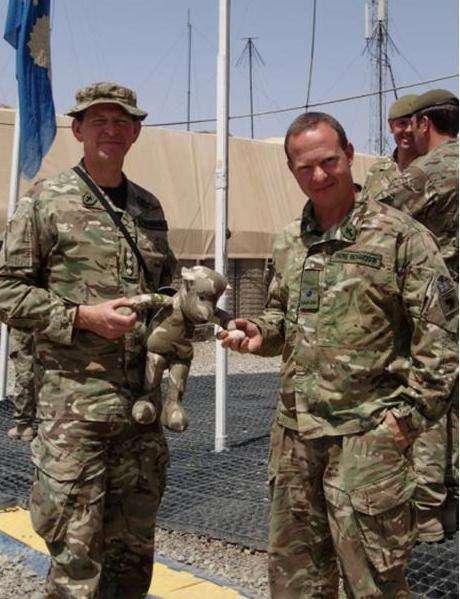
My friend Phil Burrows, an Anglican priest and British Army Padre with the Second Duke of Lancaster's Regiment, writes from Helmand Province in Afghanistan to tell me about a colleague in his ministry: "The children of Weeton Primary School named a bear, ‘Sgt Camopatch’ who is out on tour with me. The soldiers have taken to him like an old friend and he has already been photographed on the ranges and falling asleep during Power Point lectures. I think he will be up before the Commanding Officer on a disciplinary charge."

Here Padre Phil (left), and Sgt. Camopatch (centre) pose with Padre Robin Richardson (right), the chaplain to the First Battalion, The Mercian Regiment, prior to his returning to the UK.

Phil reports that his soldiers are in good spirits and "just get on with" whatever adversities they face. He is asking others of faith and prayer to join with him in praying for the people of Afghanistan and for the safe return of his soldiers.

"On our first Sunday Evening Communion service we prayed that God would have mercy on us and keep us safe. That he would confuse and confound all those who plot evil and who would seek to do us harm and that his guardian angels would build a hedge of protection around our bases and all who travel. We remembered our families and loved ones and we prayed for peace."

"Perhaps you would join us in doing the same."

Tuesday, April 9, 2013

"No Two Days Are Ever The Same": An RAF Padre's Work In Afghanistan

A nice little piece in today's UK MOD blog) on the work of Reverend (Flight Lieutenant) Matt Buchan, a reservist chaplain with the Royal Air Force currently serving Royal Air Force personnel at Camp Bastion in Afghanistan. Nothing especially profound or exciting here, just a real and honest account of what chaplains try to do to serve military personnel and why they do it. Buchan is the first RAF reservist padre to deploy.

The Canadian Forces Chaplain Branch, which is triservice, has deployed a number of reservist chaplains during our time in Afghanistan. Reservist chaplains, like any military reservists, have their own jobs at home. Not every parish or congregation would be willing to let their priest or pastor go overseas for six or more months, and not every priest or pastor is good at managing competing priorities as a reserve chaplain - I know I wasn't. Hopefully the MOD blog entry has already been printed and proudly displayed in Buchan's parish back in Leybourne, Kent.

Tuesday, March 20, 2012

Thoughts on Staff Sgt. Bales, PTSD, and the Way Ahead


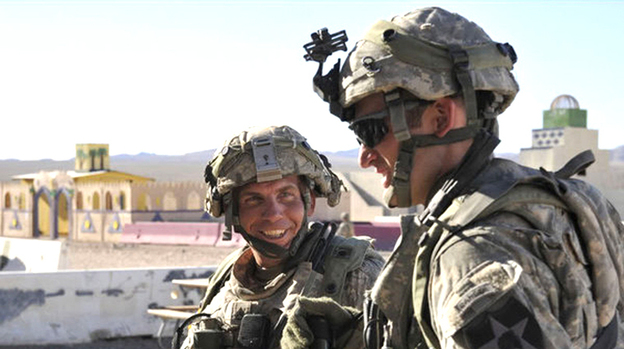
Staff Sgt. Robert Bales (left), the U.S. soldier who allegedly shot and killed 16 civilians in Afghanistan, at the National Training Center in Fort Irwin, Calif., on Aug. 23.
Defense Video and Imagery Distribution System/AFP/Getty Images


Like many others in the military community, I've been following the unfolding of the alleged shooting by Staff Sgt. Robert Bales of 16 Afghan civilians. I say "alleged" because while the evidence so far looks pretty damning, the case is still under investigation.

I have no expertise as a political or military pundit, but since this blog is interested in the spiritual and mental health of soldiers, and since Bales' lawyer has already indicated that Bales' mental health and deployment history will be prominent in his defence, I think it's worth noting this story.

One of the go-to people in the press this week has been retired US Army general Peter Chiarelli, who is now working in the area of brain disorder research. In this interview with NPR's Weekend Edition, Chiarelli makes two important points. First, there are simply not adequate diagnostics to screen for "behavioural health issues". Second, he notes that the decision to send Bales to Afghanistan, despite his medical history and previous tours, "is not uncommon for a force that has been fighting in two separate theaters for over 10 years." What Chiarelli implies but does not elaborate on is that Bales may be the presenting symptom of a small, all-volunteer force, pushed to the limit and beyond for a decade and now beginning to come apart.

Chiarelli also puts in an appearance on this piece from yesterday's PBS News Hour. Dr. Jeffrey Johns, the ex-Air Force psychiatrist on the panel with Chiarelli, has some pretty scathing things to say about the US military's screening processes and demands. As Johns says, "the military is not taking care of its own". Several of the callers to last Friday's edition of NPR's Diane Rehm show make the same point.

It's early days yet, but to my mind, here are some things to watch as this story develops.

1) How far will Bales' defence, which seems to be a PTSD variant on "temporary insanity", go given that the US military has tried 43 other soldiers for crimes against civilians in Iraq and Afghanistan?

2) Will this case shed any new light on links between post traumatic stress and violent behaviour, or lead to improvements in screening procedures? Will the problem be linked to an army that is too small, doing a job that is too large, and lead us to revisit conscription for future wars?

3) To go beyond my arcs a bit, will this case accelerate NATO and US withdrawals from Afghanistan? I find it worrisome that military affairs bloggers like Tom Ricks seem to calling for the West to "pop smoke" and get out.

Thursday, March 1, 2012

"A Place Which Provides Peace, Quiet and Privacy": A Military Chapel in Afghanistan

In garrison and on bases, military chapels tend to be quiet, infrequently used places. I once heard them described as being like the formal sitting parlour in a house, a place reserved for formal occasions rather than for everyday use. On deployment, however, chapels can be the one place in a FOB or a base where troops can be alone with their thoughts, find counsel, or seek God's presence.

Today the British MOD profiles St. Martin of Tours, a chapel built by members of 2nd Battalion, the Mercian Regiment, for their RC padre, at a British FOB in Helmand Province.


Father David Smith stands in front of a mural of St Martin with its artist, Staff Sergeant Jones Lee of the United States Marine Corps
[Picture: Crown Copyright/MOD 2012]


Do you have a story about the role a chapel played in your tour or deployment? If so, please consider leaving it in the comments section below. MP+

Monday, February 27, 2012

A Soldier Artist Remembers the Fallen


Almost a year ago I put a clipping outside my office door, a story from the Globe and Mail profiling Poto Leifi, a commercial artist who enlisted in the US Army in 2005 and put his talents to work commemorating his fallen comrades. I took the clipping down today, and suddenly realized that I had never blogged it.

A fan of vintage posters and artwork, Leifi composes tributes to fallen US soldiers in the style of old World War Two posters. Leifi noticed that when he started experimenting with putting fallen soldiers' faces into his work, "the posters came to life in a very profound way". I would certainly agree with that.

The Globe and Mail article can be found here. Sadly, there are only a few of Leifi's commemorative pieces on the web to my knowledge.

Saturday, February 25, 2012

Tactical Ministry in Kabul


Captain the Reverend Howard Rittenhouse, Padre of the 3rd Battalion, Princess Patricia’s Canadian Light Infantry, and Task Force Chaplain of the Canadian Contribution to the Training Mission in Afghanistan, adds a black liturgical scarf to his normal dress of arid-pattern CADPAT in preparation to conduct a service.
Photo : MCpl Rory Wilson


My padre buddy Howard is featured in a piece in the CF Land Forces Western Area newspaper, Western Sentinel, profiling his ministry in Kabul. The story is carried on the CEFCOM website here. The work described in this article is typical of what a good chaplain does and what a chaplain can offer to deployed troops. Howard is just finishing a rotation with the Afghan training mission. Hard times over there for NATO troops right now. Spare a prayer and a thought for the folks there and for the next batch to go over, including another padre friend of mine.

Monday, February 20, 2012

Using Light to Unlock the PTSD Trap

I've been hearing bits and pieces about EMDR (Eye Movement Desensitisation and Reprocessing), a relatively new approach to treating people with severe PTSD. This story from the Telegraph, about how EMDR has helped a UK army nurse, is interesting. The account of how Hilary Horton got her PTSD is also a reminder that pscyhological wounds can be inflicted on support trades as well as on front line personnel. Worth reading. MP+


No-nonsense nurse: Hilary Horton at Al Amarah base in Iraq, where she dealt with the bodies of six military poilcemen Photo: GABRIEL SZABO/GUZELIAN


By Clare Goldwin
7:20AM GMT 20 Feb 2012
Hilary Horton has the no-nonsense attitude you’d expect from someone who was an intensive care nurse for 20 years, has worked in women’s prisons and is a former Air Force reservist. So it is a surprise to learn that five years of her life were virtually destroyed by constantly reliving one of the Iraq war’s grimmest episodes.

The former Air Force nurse was responsible for the bodies of six Royal Military Policemen who were murdered as they manned a police station in southern Iraq in June 2003, a killing spree that became notorious. Hilary was badly affected by her experience, and in 2009 she was diagnosed with severe post-traumatic stress disorder (PTSD), suffering regular flashbacks, fits of weeping and loss of confidence.

Read the whole piece here.

Thursday, February 9, 2012

We Are Not the Dead: Soldiers' Faces Before, During and After Afghanistan

The UK's The Telegraph has published a series of pictures and interviews of members of the 1st Battalion The Royal Regiment of Scotland, before, during, and after their deployment to Afghanistan. In these powerful photos you can see the physical and psychological toll that the war has taken on these young men. Especially moving is this comment from one young private, who survived an IED explosion, of how he coped after going home: "I walked for miles and miles not caring where I stepped.”

Thursday, November 3, 2011

Military Picture of the Week


Got this courtesy of Dana Rittenhouse. This was taken last week in Kabul, during the ramp ceremony for Master Corporal Byron Greff. The padre leading the bearing party is Dana's husband, Captain Howard Rittenhouse, chaplain to the Third Battalion, Prince Patricias' Canadian Light Infantry, and a dear colleague of mine.

Dana wrote that "The ramp ceremony went without a hitch - they actually practice it (and Howard had to lead the procession in a slow march - the hardest one to do, drag foot, hesitate, put down, start again) and Howard maintained his composure until he was all done - he was wearing a preaching scarf (that is the tradition) so did not have headgear which means he could not salute the casket as everyone else did. He was bothered by that so he walked over to face the casket and stood at attention for a minute as his gesture of respect - he said he started to lose it after that, and then watching the man's closest friends go into the herc to salute goodbye."

Monday, October 31, 2011

Canadian Soldier Killed in Afghanistan

Among the sixteen killed in an attack on an armoured NATO bus in Kabul, Afghanistan on Saturday, 29 October. Master Corporal Byron Greff, of the 3rd Battalion, PPCLI, was the first Canadian soldier to be killed since the end of the combat mission, centered in Kandahar, this July.


For more on this incident and on MCpl Greff, Globe and Mail coverage here. The G&M article also mentions the deaths of three Australians, killed in a separate incident by an Afghan soldier they were training. Clearly Canada's mission in Afghanistan continues to have risks.

Rest eternal grant to him, O Lord, and may light perpetual shine upon him.

Tuesday, October 11, 2011

Book Review: The Junior Officers' Reading Club


Patrick Hennessey. The Junior Officers' Reading Club: Killing Time and Fighting Wars. New York: Riverhead Books (Penguin), 2009.

During the British Army's training season here at CFB Suffield you can spot them in the officer's mess - young Brit officers with big hair, a certain languid grace and a devil-may-care attitude. They fall into two groups, the young subbies (lieutenants) here with their battlegroups, training to go over to Helmand province in Afghanistan, and slightly older captains who have already been over there and are now here as trainers, imparting their hard-won lessons to the first group. Reading Patrick Hennessy's book gives me a sense of what their lives and their army is like.

Patrick Hennessy is a bright young man (born 1982) from a family of soldiers who did well at Sandhurst, was assigned to the Grenadier Guards, and went from Iraq to Afghanistan, where he mentored a piratical group of Afghan National Army soldiers. In the process he did very well, saw an insane amount of combat, got badly burned out, and came to realize that he and his peers had followed the trajectory of each generation before them, learning lessons the hard way, by personal experience and coming of age. As he writes in the introduction, his cohort could only learn so much from their seniors, not because the seniors couldn't teach, but because the juniors had to walk that road themselves.

"Too Cool for School" was what we'd been called by the smarmy gunner colonel on a course down in Warminster, congratulating through gritted teeth the boys who'd picked up gallantry awards, too old now to win the spurs he never got the chance to while he was getting drunk on the Rhine and flying his desk.
But in a way he was right: what did we know just because we'd had a few scraps in the desert? The bitter, loggy major who sat next to him had probably been to the Gulf back in '91, when we were still learning to read; probably had been patronized himself when he was a crow by returning Falklands vets who in turn had been instructed by grizzly old-timers sporting proud racks of World War Two medals, chests weighed down by Northwest Europe and Northern Desert Stars, which told of something greater than we could comprehend, the stuff of history imagined in black and white when no one was anyone without a Military Cross. Our grandfathers were heroes, whatever that meant, and they had taught the legends who charged up Mount Tumbledown in the Falklands and had returned to teach us.
We who didn't believe them."


I suppose that excerpt repeats a cliche as old as Achilles, that each generation in turn must go to war to prove itself as their elders did, and in turn must experience war and its many disillusionments first hand. Hennessey is a bright young man, and he tells this old story in the language and context of his generation: ferociously skeptical, media astute, cynical but wanting meaning. There are times when, as a chaplain and a person of faith, I find myself wincing at his honesty, as when he writes that he "was overcome by a surge of revulsion at the hypocrisy of the thing, the crap being peddled by the padres that somehow makes it all right for a nineteen-year-old to die if he's going to heaven. That surely can't have been the same heaven the suicide bombers who blew up the UN workers were off to. After the Old Testament trials of the week I'm done with the religious bullshit dimension of what is going on" (24-25). Brutally honest, but I'm grateful for it. It's good to know your audience.

Despite its title, this book is more about combat than about literature. The Book Club in the title was the author's initial peer group, but they are only briefly sketched characters and we soon lose sight of them. However, Hennessey was himself an avid and eclectic reader in theatre, and his choices are interesting. Some of his reading connects him with a long tradition of adventurous British soldier-scholars, such Wilfred Thesiger's The Marsh Arabs. As something of a satirist himself, it's easy to see why Hennessey enjoyed military send-ups such as Evelyn Waugh's Vile Bodies and Joseph Heller's Catch 22. More contemporary choices included Brett Easton Ellis (himself once a bright young man). And of course there are the 21st touches, ipod playlists, DVD series, email and videos.

I won't spoil the ending. Along the way, one admire's Hennessey's love for the Afghan soldiers he served with, and shares his unease as to the West's longterm commitment to the Afghan people. As an addition to the genre of military memoirs, it's a useful update, even if the tropes (alienation from former civilial friends, resentment at rear-echelon types, disillusionment with the experience once so eagerly sought out) are familiar. If war is indeed a cliche, then each generation it seems must discover that truth for itself, and Hennessey is an apt spokesman for those who came of age in the War on Terror. My hope is that somewhere out there, a similarly articulate young Canadian soldier is working on his or her own account of Afghanistan.

A quick final note on the cover art shown above. The choice of a pile of dog-eared paperbacks, some suspiciously resembling the old Penguin Classics, is inspired. It reminded me of the chapters in Paul Fussell's chapters in his book Wartime: Understanding and Behavior in the Second World War (1989), on how paperbacks, miraculously suited to the pockets of battledress, helped soldiers pass the time and stay sane. Regretfully, Penguin has seen fit to adorn the pile of books on the cover with little soldiers who, from their weapons and helmets, are conspicuously US. Could they not have used images of British soldiers? Surely the North American market could stomached that.

Military Picture of the Week

I continue to love the work of the British military photographers! This photo is the MOD's Image of the Day for 10 Oct 2011. MP


Lightning strikes in the distance behind Camp Bastion, Afghanistan, as troops wait for the first rainfall on Operation HERRICK 15, which officially began yesterday when 20th Armoured Brigade took over command of Task Force Helmand in Lashkar Gah from 3 Commando Brigade Royal Marines. Click here to read more. [Picture: Sergeant Steve Blake RLC, Crown Copyright/MOD 2011]

Wednesday, September 28, 2011

"They Are the Beginnings of a Nation": Major Fernando Lujan on How the War in Afghanistan Can Still be Won


Wise and encouraging words in today's NYT from a US Special Forces Major who believes that the Afghan people have the will to prevail against the Taliban even when many in the West have pronounced the conflict unwinnable.

Here's an excerpt: "... optimism in Afghanistan should not be mistaken for naïveté. We’ve paid a terrible price for the gains we’ve made, and Afghans know we’re leaving. Insurgents still control many areas and are certain to attempt a counteroffensive as foreign troops withdraw. My optimism is rooted instead in an intangible metric, gleaned from the thousand cups of tea we drank and the hundreds of patrols we walked: the Afghans have the will to win, with or without us."

Read the whole piece here.

Tuesday, August 9, 2011

Children's Artwork Brightens Chapel in Afghanistan

Lovely story and image. Text below from the UK MOD. MP+


[Picture: Sergeant Alison Baskerville RLC, Crown Copyright/MOD 2011]


Children from two primary schools in Plymouth have created plastic mosaic windows for the tent which houses padre Ian Wheatley's church in Lashkar Gah. As a number of the schoolchildren have family members serving in Afghanistan, they wanted to give the church some colour and remind personnel of home. Click here to read more.

Mad Padre

Mad Padre
Opinions expressed within are in no way the responsibility of anyone's employers or facilitating agencies and should by rights be taken as nothing more than one person's notional musings, attempted witticisms, and prayerful posturings.

Followers

Blog Archive

Labels