Showing posts with label Christianity and Society. Show all posts

Saturday, March 1, 2025

Background On This Year’s Vestry Social Justice Motion and Supervised Consumption of Drugs in Ontario

Preached at All Saints, Collingwood, Anglican Diocese of Toronto, for the parish vestry meeting, The Last Sunday of Epiphany, 2 March, 2025.

Every year, as part of the vestry meeting process, our Diocesan Social Justice Committee asks parishes to vote on a motion concerning some social cause or issue that is in the news.  Each year the Social Justice Committee gives these motions careful thought and research.   


The 2025 Social Justice Motion gives all churches in our Diocese the chance to call on our provincial government to reverse its opposition to and closer of Supervised Consumption Sites across the province.    When our vestry meets tomorrow, on March 2nd, the motion we will consider reads as follows:


We, the parish of All Saints, Collingwood, in the Diocese of Toronto, urge the Province of Ontario to reverse the planned closure of safe consumption sites in Ontario, and to lift the ban on the creation of new sites, in order to expand life-saving harm reduction services to Ontarians.


A fact sheet on the motion, and a video explaining it,  can be found here.


Before I talk about the motion, let me offer a short explanation of what I think we as church mean when we talk about Social Justice.  Social Justice should not be confused with supporting any one political party.   Social justice is about how we live the values of the Kingdom of God in our daily lives.  It’s about how our social values uphold the value of each life made in the image of God and loved by Jesus.


Our province does not value lives as it should.  Between November 2024 and January 2025, an average of seven people a day died in Ontario from drug overdoses.  Each of those people mattered: they were someone’s child, brother, sister, partner, parent.  So for me, the basic question boils down to this:  we as Christians and as Ontarians are not okay with people dying if their deaths are preventable.  If we don’t want them dying of hunger and exposure on the street or in homeless encampments, then we don’t want them dying of overdoses. 


The premise of the Supervised Consumption Site program has always been to offer spaces that provide a wide spectrum of health and medical attention.  For some users, they function as community clinics, offering a path away from addiction and back to wellness.  They bring drug users and care professionals together and offer hope for healing, and they make neighbourhoods safer.  


Here are some comments that the Social Justice Committee has gathered:


Rebecca is another parent whose child attends school near a supervised consumption site, the Kensington Market Overdose Prevention Site. She says, “As a parent, I value safe consumption sites.  Amidst the opioid crisis that has claimed thousands of lives in Ontario, safe consumption sites are saving lives, and making our communities safer. I am sympathetic to people who are concerned for their safety; however, as research points out, overdose prevention centres do not increase local crime, but instead help reduce drug use in public spaces and reduce the disposal of syringes in public spaces, such as parks and school yards.” 


Zach, who lives in a homeless encampment in Toronto, goes to a nearby SCS for harm reduction supplies. He says, “I don’t use these as much myself, but other people come here [to my tent] and get this stuff. I often go three times a day to refresh the supplies.” He adds that people who are

addicted “gotta do it somewhere. It’s better people know what you’re doing and how you are doing it, so you don’t do it in the bathroom. That’s how people die.”


We might decide that Safe Consumption Sites are a Toronto problem, but we’d be wrong.  Health advocates in Barrie and Orillia have been trying in vain to establish sites in their communities, and we know that drug use happens in small communities, where there are even fewer places to turn for help.   I hope that you will look at the materials that our Diocese has made available on this subject and that you will decide to support this year’s motion.


The clergy team hopes that when all four parishes in our region have voted to support the motion, we can write a joint letter to Brian Saunderson, our newly re-elected MLA for Grey Simcoe, calling on him to consider the concerns that we have raised as Christians and as citizens.  Better yet if we could present the letter in person and have a discussion.  Please support the motion so we can do that.


Blessings,


Fr. Michael


https://odprn.ca/occ-opioid-and-suspect-drug-related-death-data/

Sunday, June 9, 2024

Jesus the Strongman: A Homily for the Third Sunday After Pentecost


We are determined to have a king over us, 20so that we also may be like other nations, and that our king may govern us and go out before us and fight our battles.” (1 Sam 8.19-20)

Preached at All Saints, Collingwood, Anglican Diocese of Toronto, Sunday, June 9, 2024, the Third Sunday after Pentecost.

Readings for this Sunday (Proper 10 Year B):  1 Samuel 8:4-11 (12-15), 16-20 (11:14-15); Psalm 138; 2 Corinthians 4:13-5:1; Mark 3:20-35


It’s an unsettled time, full of insecurity and fear.  The old ways of doing things don’t seem to work any more.  The leaders are distrusted, and few people have much faith in religion or even in God.   Instead the people want a strongman to rule them, someone who will crush their enemies and make them feel good about themselves.


I won’t blame you if thought I was talking about today’s headlines, but really this is a a description of where we come in to our first lesson today, from the First Book of Samuel.   Since Sharon talked about the call of the boy Samuel in her homily last Sunday, I thought I’d pick up the story from where she left off.   You’d think the story about the adorable little Samuel in his pyjamas, twice going to Eli and saying “did you call me?”, would have a happy ending, but not so much.


So to recap the story (and just to prove that the Hebrew scriptures are chiock full of good stories), Samuel was called by God because the priest Eli’s sons were absolute rotters, corrupt and abusive.   At the time, Israel is at war with the Philistines, and the war isn’t going that well because the Israelites have started worshipping the gods of neighbouring countries.   


There’s a big battle, and the sons of Eli take the Ark of the Covenant to the battle as a sign of God’s presence and protection.  But, God is angry with Israel’s faithlessness, so God lets the Philistines win, the sons of Eli are killed, and the Ark of the Covenant is captured.   Eli dies of shame when he hears the news, thus fulfilling God’s prophecy that his house and line will end. The Philistines take the Ark home but they suffer terribly because they never watched the Indiana Jones movie, so they send it back.   


By this time Samuel is the chief priest of Israel.  He calls his people to repent, they get rid of their false godsend God helps them to defeat the Philistines.   So you’re thinking, that must be the real happy ending, right?  Well, no, this film isn’t over, because as someone once said, history may not repeat but it does rhyme.  Turns out the sons of Samuel are also rotters, and the people don’t want another priest.  Instead they ask Samuel to find them a king, so they can be like other nations.


So this is point where things really go off the rails. Since Joshua took over from Moses and led the people of God across the Jordan, Israel had never had a king.   Instead they had judges, men and women who mostly acted as a priest and prophet.  The judges had a connection to God who was the true founder and king of Israel.  As God tells Samuel, the people “have not rejected you, but they have rejected me from being king over them” (1 Sam 8.7).   So, God tells Samuel to give the people what they want, with a few caveats.


I read recently about politics that the people who help put  strongmen in power think that they can control the strongmen, when in fact the strongman only looks after himself.   This is exactly what God warns the people will happen to them.   A king will take their wealth.  He will take their daughters as servants, and their sons as soldiers to fight his wars.   A king will be cruel and domineering, like Pharaoh.  It’s a sobering thought that Pharaoh’s soldiers who drowned when God parted the Red Sea were the sons of ordinary people, and Samuel is saying to his people that their sons may likewise never come home.


At this point in the larger story of Samuel we start to notice a trend that may seem discouraging, namely that over and over again, humans pull away from God and go their own way.   Eli was replaced as a priest because his sons were scoundrels.   Samuel was a faithful priest but his sons were scoundrels and no one wanted them.  God wanted the people of Israel to be unique among the nations, but they asked for a king so they could be like other nations.  


And just as good priests are followed by bad ones, so it goes with kings.   Some, like David and Solomon are good, well, mostly, but others are scoundrels and so, by the time we think that First Samuel was written, the kings are gone and the Israelites are slaves in Babylon and the story is back where it started in Egypt.  But that’s not the end of the story, because through all this, God remains faithful.


When the angel Gabriel appears to Mary, he says of the son she will have that “the Lord God will give to him the throne of his ancestor David” (Lk 1.32).  But in all his time on earth, Jesus doesn’t want like any earthly king.   Likewise, Jesus tells his disciples not to want power and honour as they understand it.   He tells them “You know that the rulers of the Gentiles lord it over them, and their great ones are tyrants over them. 26It will not be so among you” (Mt 20.26-28).   


What Jesus is saying here is a complete reversal of what the people told Samuel.  They wanted a powerful king to be like other nations.  Jesus is calling God’s people back to the role that was always intended for them, to be a unique people who will be a blessing for the world.  The kings that Samuel warns of will always want to be served.  Jesus will be a king that serves others.  As he says in Matthew’s gospel, “the Son of Man came not to be served but to serve, and to give his life a ransom for many” (Mt 20:28).


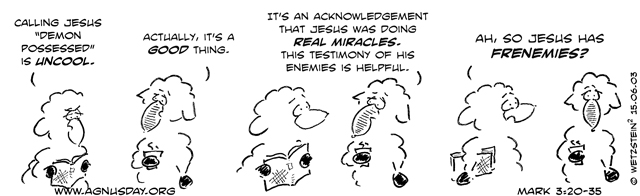
Now don’t get Jesus wrong, his talk about serving others doesn’t mean that he is some milquetoast hero.  Jesus comes to smack down evil.    The first miracle that Jesus performs in Mark’s gospel is to free a man of an unclean spirit, a demon, and the witnesses recognize this as an act of power and authority (exousia) (Mk 1.27).  So in today’s gospel reading, Jesus’ authority is never questioned by his religious opponents.  Rather, they suggest that Jesus is somehow demonic himself - “by the ruler of the demons he casts out demons” (Mk 3.23).


Let’s pay attention to the parable by which Jesus rebuts this accusation:  “no one can enter a strong man’s house and plunder his property without first tying up the strong man” (Mk 3.27).   So the strong man in the parable would be Beelzebul, the prince of devils (whose name, by the way, means “Lord of the Flies / Dung Heap”).   The strong man’s house is the world that is captive to sin and evil.  The strong man’s plundered property are those who are held captive by sin evil, as seen in those in the gospels whom Jesus frees from evil spirits.  And the thief who can bind the strong man must be even stronger, and the thief is clearly Jesus.


So in a surprising conclusion to this homily, the strong man that we long for is not some earthly king or leader who will defeat our enemies and make us great, but rather, the strong man is Jesus, the King of Heaven and Earth, who will set free us from the evil, free us from the evil of the world and from ourselves.  The strong king that the people asked Samuel for could never come from among them.  That king could only come from God, but he would be no king they could even recognize, because his crown would be thorns, his throne a cross, and his sword would be love.  But his power over evil is very real.


We need Jesus our king because now is just as uncertain a time as it was in Samuel’s day.  It’s still an unsettled time, full of insecurity, and full of fear.  Social media has filled many people with outrage and grievance, and it’s made our politics vicious, so that we’re less likely to compromise and to find solutions to complicated issues.  Half the world seems to be run by dictators, and the other half is losing faith in democracy.   So now, as in Samuel’s day, many want strongmen to rule over them and to crush their enemies


I didn’t mean for this to be a political homily.   As followers of Jesus, I would say that our politics should resemble our Sunday prayers of the people in that they should want what is best for our communities and for the wider world.   I would also that whatever our politics, whatever our insecurities, we should never give in to the desire for a strongman, because we have Jesus and because we live in his kingdom.


Jesus is our strongman and king, but he’s a curious kind of strongman because in return for conquering our enemies, sin and death, he only asks three things of us:  to repent, to love God, and to love our neighbour as ourselves.   If we can obey him in these three things, then we might well find our way to a politics that offers community, dignity, and security for all.


Thursday, October 13, 2016

Trump And The Christians


It's time for Christians to get off the Trump Train.   It is certainly time now, and it was time a long while ago. 


I get why some still want to stay on, even as it hurtles towards a scene that will eclipse the big final moments of either The Cassandra Crossing or Breakheart Pass (something about Trump seems to invite metaphors based on 1970s disaster films - or is that just me?).

Their argument is that even though Trump has said (and apparently done, according to his growing legion of accusers) the sorts of things as an old man that would have had a youth pastor fired in a heartbeat, he is nevertheless the last best hope for Christian America, because after Hilary comes the Deluge, apparently.

Here is an example of how this argument works.   Ralph Reed and Jerry Fallwell Jr., lay out a case for Trump as the candidate most likely to advance a pro-Christian agenda by appointing suitable judges to the Supreme Court and to further curtail access to abortion, which Reed has called the “defining moral issue of our time.”

This argument appeals to an overarching theological claim of American Exceptionalism, meaning that God has created America as a second Israel, and has entered into a covenantal relationship with American Christians by which he gives special blessings and rewards in return for America's faithfulness.   This theology was central to Ted Cruz's Republican nomination bid this year and now Reed and others are willing to give this standard to Trump, who must win lest America suffer ''a moral and spiritual and a cultural death from within that starts at the heart and soul of a country.”

According to Reed and Falwell, Trump must win to champion the causes that “matter most to the Christian community'', even though the events of this past week have confirmed that Trump is a morally deficient standard bearer.  One senses that for Reed, the stakes are too high to wait for a more suitable champion.  As Reed said on 10 October to Liberty University's convocation gathering,  “I think retreating to the stained-glass ghetto from whence we came and refusing to muddy our boots with the mud and mire of politics is simply not an option for a follower of Christ
Leaving aside for a moment the idea that the Christian faith is worth dragging into ''the mud and mire' of politics'' in order to, supposedly, save it, is the idea of Christian America theologically and historically defensible?

While it is tempting to think of modern America's founding in New England by devout Puritan exiles as the basis of a national identity based on Protestant Christian values (Chesterton's quip of a nation with the soul of a church), the reality is far too complicated and pluralistic for that idea to hold water.  The founding fathers were primarily 18th century Deists, whose view of a distant, uninvolved God was far removed from contemporary evangelicals.  The Christianity of slaves become African-Americans, Hispanics, and Irish immigrants from the Old World was far removed from, and almost unintelligible to, white Protestants through much of the 19th and early 20th centuries

Jewish, Catholic and Protestant Americans forged new alliances in the mid 20th century (see Kevin M. Schultz's excellent book Tri-Faith America).  Then came immigration from Asia and the globalization of religion and now Jews and Christians are finding that mosques and temples are now also part of the religious landscape.   Sikh soldiers in the US Army want their distinctive beards and turbans to be authorized as part of their service dress.   Buddhism, once an exotic counter-cultural option in the 1960s, is increasingly familiar.  A Mormon won the Republican presidential nomination.  'Spiritual but not religious' and 'nones' are now recognized categories in religious polling as the proportion of Americans who do not identify with Christianity increases year by year. 

American religion and society is pluralistic.  This seems to me to be a fact on the ground that is as much historical as it is contemporary and demographic.   The author of the excellent religious blog Bensonian made this point when he wrote, back in February, that he could not accept Ted Cruz as a presidential candidate because Cruz was running to be the Christian president of Christian America.  In his post, Bensonian quotes the scholar Paul D. Miller on why the idea of Christian America so dear to Cruz, Reed and Falwell, Jr. is so problematic. 

America is exceptional, but not because of any special access she enjoys to God. The United States had a highly unique origin in the acts of the Continental Congress and Constitutional Convention, and its national identity is uniquely rooted in ideas of equality and liberty, rather than race, class, or language, as had been the case for most European countries at the time.

But America is not the special vehicle of God’s purposes in the world. Some conservatives love to quote Psalm 33:12, “Blessed is the nation whose God is the Lord.” The nation whose God is the Lord is the Christian Church, not the United States. The church, not the United States, is the vehicle of God’s purposes in the world. To believe otherwise is to confuse the nation with the church, the spiritual with the temporal. That sort of confusion can justify all sorts of dangerous messianic political movements.

As a Christian, I believe that I am called to follow a moral and ethical code based on the law of God and the imitation of Christ.  I hope that in so doing, however imperfectly, that I am a good influence (salt and light to use biblical terms) on those around me.  However, I can't ignore the fact that I live n a pluralistic democracy where Christian faith is widely perceived as a lifestyle choice.   For me to believe that I have a right to impose Christian-based laws and governance on those who do not subscribe to them would be at best hubristic, and at worst theocratic.  In any case, how could I do when Christians can't agree amongst themselves on key issues like pacifism, abortion, and sexuality? To impose a Christian view on those who don't share it could only be a coercive act, and coercion, as I read the gospel, is antithetical to the nature and invitation of Christ to follow him willingly.


The history of Christianity in the west has long been composed of some groups buttressing the power of the day in throne and altar alliances (e.g. Catholics, Lutherans, Anglicans), and dissenters (e.g. Mennonites) retreating into self-isolating communities.   Starting in the late 20th century, once dominant religious groups were slowly disenfranchised by secularization and political change.  American evangelism, like British Anglicanism and French/Quebecois Catholicism before it), now seems to find itself on the way into exile which is why the stakes in this US election seem so high.  Lose the Supreme Court to Clinton and the last chance of legislating a Christian agenda for at least the next few generations vanishes. 


I think, though I can't prove, that this is why the authoritarian aspects of Trump's character have attracted American evangelicals even when his morality has been exposed as a sordid mess.   If it takes a tribune to make America Great again, in Trump's phrase, as 'one people, under one God, saluting one flag', and if the popular vote threatens to elect Clinton, then democracy be damned. 


Second to their betrayal of Christ's gospel of love, the betrayal of a republic that so many non-Christians have fought and died for, and that so many across the world still see as our best hope, is the great treason of the religious right in America.   Their desire to impose a Christian agenda on America, even if well-meaning, has blinded them to the terrible danger that Trump poses to democracy.   The political scholar Jill Lepore laid out this danger eloquently in a recent post for The New Yorker.

Donald J. Trump ... leads the Republican Party the way the head of a rebel army holds a capital city. This isn’t an ambush or an act of treason or a kidnapping. This is a siege. He plans to build walls; he promises to put his opponents in prison. He enjoys harems. He admires tyrants. He erects monuments to himself in major cities. He holds entertainments in America’s stadiums, where he toys with his political enemies, delighting his band of followers while terrorizing other citizens. Over the weekend, he insisted that he will neither retreat nor surrender.

Meanwhile, he invokes the people: they, he says, have chosen him, and will elect him; the people love him. Do they? Joe McGinniss once observed that the American voter “defends passionately the illusion that the men he chooses to lead him are of a finer nature than he” and that “it has been traditional that the successful politician honor this illusion.” That tradition has ended. No one in the Republican Party can possibly believe that Trump is a better person, a man of finer nature, than the ordinary American voter. The problem for the Party is that no one, including House Speaker Paul Ryan, can even pretend to believe that anymore. No one can believe that in daylight, or in the darkest hour of night, while Trump, restless, tweets about the conspiracies that he believes are being hatched by his enemies—men and, especially, women—to fell him.

In the last few weeks, theologians like Miroslav Volf and Russell Moore have also made the case for disavowing Trump.   Yesterday it was heartening to see students at Liberty University follow suit, despite the urgings of their elders.  For those Christian leaders like Falwell Jr. who want to stay on the Trump Train, well, see my comments on The Cassandra Crossing.  It will not end well for you and it will bring shame and disrepute on the gospel you profess to preach.

For other Christian Americans, assuming (as is likely) that Hillary Clinton is the next president, the question is, can you go forward without proclaiming her as the AntiChrist, delegitimizing the election and government, and so like Samson bringing down the temple on your heads?   Robert Franklin, who teaches at Emory University, offers some suggestions for how a post-Trump civics could be achieved.   It will involve dialogue and listening on both sides, and a letting go of words like 'deplorables' and 'irredeemable', because no one and nothing is irredeemable.    Christians and non-Christians will have to find a way to live together, because the alternative is too grim and too terrible to contemplate.


Thursday, March 17, 2016

David Gushee On The Church Losing Its Stickiness


Baptist pastor and theologican David Gushee offers an interesting analysis of how Donald Trump's supporters who self-identify as Christian evangelicals attend church less frequently than other evangelicals, particularly those with a college degree who tend not to be Trump supporters.

The point here is not why some Christians are drawn to Trump, though that is a fascinating subject and has been covered well elsewhere.

Rather, Gushee's point is that these people embody changing conceptions of how Christian identity is lived out in a way that has less and less contact with church membership and worship.  When regular church attendence is now defined as once or twice a month on Sunday, he argues, then Christian identity is attenuated as formation, discipleship, and the influence of the pastorate become hollowed out.

 It becomes very hard to pastor a flock when the flock always changes. It is hard to feel deeply spiritually connected, hard to want to become vulnerable, to a group that is not stable in its membership. The mere whiff of conflict can terrify church leaders because it can accelerate the churn and potential loss of membership that is always a possibility anyway.

Perhaps most germane to the politics of the moment, it is hard for church leaders to teach anybody anything in a sustained manner if hardly anyone is present in a sustained manner. The more technical way to say it is that Christian spiritual and moral formation weakens because fewer congregants commit to that formation in any particular place. And pastors have reason to fear that just as soon as they say anything challenging — like about racial prejudice, greed, or violence — congregants who don’t like that message can drift out just as easily as they drifted in.

So, America has a whole bunch of half-churched Christians, some of whom would answer “evangelical” on a survey. This, I think, explains a lot about what is happening in our churches, and in society.

It is worth noting that Gushee is writing s a US Baptist, so he is describing a phenomenon that is not confined to mainstream Protestant denominations.  The basic point is that wherever the denomination,  when the church loses its stickiness, its capacity to attract and form the faithful through the weekly discipline of word and sacrament, then the integrity and depth of Christian identity suffers.

This is not necessarily to say that evangelicals who align politically with Trump are necessarily deficient in their Christianity (though others, including Pope Francis, have suggested this), but it does suggest that termscasually invoked by pollsters and pundits, such as evangelical, are far more complex than many think. 

Having just returned from a three day retreat at the Society of St. John the Evangelist in Cambridge, MA, a community shaped by prayer, a shared identity in Christ and a rule of life, I am reminded of why the faithful need the church to shape and sustain our lives.

Wednesday, September 16, 2015

Jeffrey Toobin on ''Cafeteria Government''


Whatever one thinks of Ms. Davis, Jeffrey Toobin's short essay on the New Yorker website  raises some interesting points about whether religious accomodation amounts to "cafeteria citizenship" and even to "cafeteria government". 

If citizens (and now in the US, small business and family-owned corporations thanks to the SCOTUS Hobby Lobby ruling) are free to decline some obligations (eg, to serve customers, to provide certain kinds of health care) on the basis of their religious beliefs, what degree of accomodation should be allowed to government employees?  Is it acceptable for a govrernment to accomodate the beliefs of its employees by allowing them to decline to perform certain tasks, such as issue marriage licenses to same-sex peole, provided that there are other government employees that are willing to perform those same tasks?  What are the limits to such accomodation?  Voluntary military service comes to mind as one government sector where all employees must be willing to perform, enable or at least sanction certain actions, specifically acts of violence at the behest of a lawful authority.  Are there comparable cases where accomodation is not possible in government service?

Monday, October 7, 2013

Deliver Us From … Hypocrisy: The US Senate Chaplain Speaks Truth To Power

He's a clergyman who looks sharp in a bow tie.  He's a retired Rear Admiral US Navy chaplain with an impressive CV.   He's a Seventh Day Adventist preacher who describes himself as being "liberal on some [issues] and conservative on others".  Each morning, recently, he berates 100 lawmakers in the US Senate for being a bunch of doofuses.

If that makes you curious about Barry C. Black, the US Senate chaplain, you can read a NYT profile of him and his work here and video excerpts of his prayers during the current US government shutdown here.

Given what I'm reading about the intransigence and foolishness going on in Washington DC, I'm thinking that Chaplain Black may be the last best hope of the USA.

Monday, February 18, 2013

"Sourness And Shrugs": Ross Douthat On The Waning Of Catholic Influence In America

In a Feb 16th essay in The New York Times, Ross Douthat writes on how the "Catholic moment", but which he means a time when Roman Catholic thought still had traction in American politics and society, is passing with the incumbency of the current pontiff. Whereas his predecessor was widely revered and mourned, even by secular news media, Benedict's passing will be marked by "sourness and shrugs". This waning of influence is unfortunate, Douthat writes, since Catholic thought has an egalitarian idea of the common good at its heart, but it is not surprising.

"The collapse in the church’s reputation has coincided with a substantial loss of Catholic influence in American political debates. Whereas eight years ago, a Catholic view of economics and culture represented a center that both parties hoped to claim, today’s Republicans are more likely to channel Ayn Rand than Thomas Aquinas, and a strident social liberalism holds the whip hand in the Democratic Party.

Indeed, between Mitt Romney’s comments about the mooching 47 percent and the White House’s cynical decision to energize its base by picking fights over abortion and contraception, both parties spent 2012 effectively running against Catholic ideas about the common good."

Douthat concludes that this decline, while understandable, is also the result of the rejection of ideas of the comon good by the elites themselves:

"The recent turn away from Catholic ideas has also been furthered by a political class that never particularly cared for them in the first place. Even in a more unchurched America, a synthesis of social conservatism and more egalitarian-minded economic policies could have a great deal of mass appeal. But our elites seem mostly relieved to stop paying lip service to the Catholic synthesis: professional Republicans are more libertarian than their constituents, professional Democrats are more secular than their party’s rank-and-file, and professional centrists get their encyclicals from Michael Bloomberg rather than the Vatican.

Canadian and European readers of this blog will find it odd that anyone could yearn for the domination of a modern society by church fostered ideas, but there is a difference between theocracy and a reasonable consensus on ideas of human value, dignity, and mutual obligation. I think Douthat is right to note the moral and intellectual vacuum that Catholicism's demise is creating. The decades ahead will be challenging ones for Christians, both capital C and, like me, small c Catholics, who wish to advocate something other than the pious individualism that passes for much of contemporary Protestantism.

Tuesday, January 22, 2013

Rick Warren On The Most Countercultural Thing You Can Say

If you move in Christian circles today or have done so in the past ten years, you will be familiar with Rick Warren and his book, The Purpose Driven Life. A copy of that book sits to hand on my bookshelf as I type this. I confess I've struggled to read it from cover to cover, but it is there and it a useful introduction to faith, as the Alpha course was in its day. I ran across Warren on Newsweek's Beast TV today, and in a short interview he has some interesting things to say about social media (he's kidding about going to hell if you don't follow him on Twitter ... I think), the top two mistakes young people make, and the most countercultural thing you can say today.

Monday, January 21, 2013

Notable Quotable: "You Christians Eat Your Own"

I came across this piece on Christopher Benson's excellent blog, Bensonian, , in which a Christian pastor has occasion, thanks to a non-believing friend, to rethink grace and forgiveness. The subject of their conversation is disgraced televangelist Ted Haggard, and the friend's comment, "You Christians Eat Your Own", forces the pastor to reconsider his own hardness of heart. Here's an excerpt:

"He was running late for a meeting and had to take off. I, however, could barely move. I studied the TV and read the caption as a well-known religious leader kept shoveling dirt on a man who had admitted he was unclean. And at that moment, my heart started to change. I began to distance myself from my previously harsh statements and tried to understand what Ted and his family must have been through. When I brought up the topic to other men and women I love and respect, the very mention of Haggard’s name made our conversations toxic. Their reactions were visceral.

Please understand, this isn’t just my experience. Just Google his name and read what is said about him in Christian circles. Most Christians would say God can forgive him, but almost universally people agree that God will never use him again. When I pressed the question, “Why can’t God still use Ted?” I was dismissed as foolish or silly. Most of these people got mad and demanded I drop the subject. Perhaps they saw something I was missing, but this response seemed strange. After all, I reasoned, Jesus restored Peter after he denied Christ. That’s a pretty big deal. And what about the Scripture that teaches us that the gifts and callings of God are irrevocable? So I felt I needed to meet Ted for myself."

Read the whole piece here. I found it personally quite challenging. Highly recommended.

Wednesday, February 1, 2012

Notable Quotable: David Gushee on Being Faithful in Times of Election

I am a huge news junkie, and since I have (God help me) discovered Twitter (@madpadre1 if you care to follow me) I have more hot breaking news, especially election news and opinion from the Excited States of America to the south, than I can fully digest.

It was with a sense of gratitude, then, that I came across this quote from ethicist and theologian David P. Gushee, which appeared in Christianity Today in 2007.

To affirm that Jesus Christ is Lord is to acknowledge that no political leader, party, flag, nation, or ideology can share lordship over my life. The one who confesses Christ alone as Lord cannot simultaneously affirm utmost loyalty of another idea or person.

This realization has constricted my understanding of politics. I’ve learned to fear the seductive power of political ideologies, the temptation to idealize political leaders, and the amoral bloodlust of partisan politics. Perhaps I have overreacted.

My study of German churches under Nazism has certainly formed my understanding of how disastrous the confusion of loyalties to God and country can become. But especially around election time, I feel my blood run hot for politics once again – so a reminder that Jesus Christ is Lord is very timely.

Monday, November 7, 2011

"They Facilitated the Horror": A New Study Of German Chaplains in Hitler's Army


In the National Post today, Canadian professor Doris Bergen talks about her research on the paradoxical place of German chaplains in Hitler's army, and how their presence did not stop and may even have facilitated the atrocities committed in places such as the Eastern Front. Here's an excerpt:

"For all her work she had done on the Holocaust, she had never given much thought to the role of Christian chaplains who served the cause of the Nazi Germany.

The chaplains were always in a strange position, she explained. Pure Nazi ideology was at its core pagan. The SS, for example, never allowed chaplains in their midst. Hitler probably would have thought Nazism was enough for the troops, she said. At the same time, 95% of Germans were baptized Christians who continued to belong to the mainstream churches. German soldiers had the words Gott mit uns (God with us) on their belt buckles.

“What I tried to show that the chaplaincy was in an uncomfortable position, that they were also in a position of suspicion.” In the field, the chaplains had to keep adjusting themselves. While there were many who wanted their services there were fanatical Nazis among the troops who hated the chaplains and would taunt them.

“That pushed the chaplains into a position that wouldn’t offend some of the troops. It pushed them in a direction to make their lives easier.”

I'm currently in the process of reading Michael Burleigh's book Moral Combat: A History of World War Two, which proves from documentary sources that rank and file German soldiers (including chaplains) could not have been present in invaded Soviet Russia without witnessing the massacres of Jewish and Slavic civilians by specialized Nazi formations. The presence of chaplains, and their vain attempts to intervene in these massacres, is indeed the starting point for Prof. Bergen's study. It doesn't surprise me that most of these German chaplains shared the mindset of many Germans - that Hitler was good for Germany, that Nazism was a bulwark against Communism and atheism, that Jews were enemies, etc. Not every Christian had the clarity and the courage of those who followed Barth, Bonhoeffer and the confessing church. I wouldn't want to have made those choices myself.

I will look for Bergen's study in print. Her subject is a cautionary tale that all military chaplains and people of faith should study.

Monday, July 11, 2011

This IHOP Serves 24/7 Prayer, Not Pancakes

This article rom the New York Times, 9 July, 2011, describes a US church that combines a 24/7 cycle of continuous prayer with an eschatological focus on preparing for the end times and the second coming of Christ. A daily round of prayer (even if not "24/7")has been a strong part of Christian devotional practice and feature of monastic life for many centuries so in that respect there is a devotional intensity here that is attractive. In terms of relating to the culture, which is a huge goal of contemporary culture, the appropriation of the IHOP name is brilliant, even if it is being contested in court. However, as the NYT article notes, some evangelical theologians have raised concerns about the teaching of the International House of Prayer's teachings. Andrew Jackson's (Gordon Conwell Theological Seminary) concerns as found here are thoughtful and worth reading, both on essential vs nonessential eschatological teachings and on the ecclesiological dangers of a church using private insider language. MP+
Where Worship Never Pauses
By ERIK ECKHOLM
KANSAS CITY, Mo. — The worship music, throbbing soft-rock appeals performed by live bands, has continued here without pause, day and night, since May 1999. Voices calling to Jesus or pleading with God to help tornado victims or make Congress ban abortion resound in an auditorium that is the physical and spiritual heart of the International House of Prayer, a Christian ministry rapidly blossoming into a movement.

Founded 12 years ago by Mike Bickle, a self-trained evangelical pastor, with a group of 20, the International House of Prayer, in a former strip mall, now draws tens of thousands of worshipers to its revival meetings. A wholly devoted cadre of 1,000 staff members, labeled missionaries, have given up careers to move here, living off donations and spending several hours a day in the prayer hall to revel in what they describe as direct communication with God. Another thousand students attend the adjacent Bible college, preparing to spread this fervent brand of Christianity.

The well-populated prayer room and the devout community growing up around it are at the epicenter of a little known but expanding national network: dozens of groups that are stressing perpetual prayer in a way seldom seen in modern America, said Marcus Yoars, the editor of Charisma, an evangelical magazine. Many of them were inspired by the operation here, though none have maintained such an elaborate 24-hour system of worship, seen around the world on a live webcast.

Mr. Bickle has won praise from many evangelicals, but he has also been criticized by some pastors for what they describe as unorthodox theology and a cultish atmosphere, charges that Mr. Bickle rejects. Some former students said they had been expelled for questioning the fascination with mystical healings, prophesies, angels and demons.

The ministry has also drawn fire for helping Gov. Rick Perry of Texas plan a day of prayer in Houston, which is scheduled for August and will be dominated by ardent opponents of abortion and gay rights. Mr. Bickle said he avoided direct involvement in partisan politics himself, but a member of his leadership group, Lou Engle, has a side group, The Call, that organized stadium revivals to promote California’s Proposition 8, which banned same-sex marriage.

But many young followers here said they were drawn by their sense of visceral communion with God and had given little thought to such issues.

Read the whole article here.

Wednesday, January 20, 2010

Will No One Rid Us of This Troublesome Evangelist?

In my last post I mentioned Pat Robertson's stupid comment about how the Haitian earthquake can be explained because the Haitians made a pact with the devil to free themselves of French colonial rule (I'm not making this up - C.L.R. James is spinning in his grave - I'm pretty sure the deal with the devil isn't in his The Black Jacobins but it's been a while). We all know that the Haitians have this voodoo/devil thing going, despite the fact that there was a Roman Catholic cathedral in Port au Prince and there was a Bishop who died in the earthquake, and despite the fact that the Diocese of Montreal in the Anglican Church of Canada has strong ties to Haiti and its seminary and forty something Anglican parishes, but we'll let that pass.

Since this got a lot of comment on this blog's Facebook feed viz my last post, here's the Robertson quote as repeated in the Globe and Mail:

‘They were under the heel of the French, you know, Napoleon III and whatever. And they got together and swore a pact to the devil. They said, ‘We will serve you if you will get us free from the prince.' True story. And so the devil said, ‘Okay, it's a deal.' And they kicked the French out. The Haitians revolted and got themselves free. But ever since, they have been cursed …”

I'm with fellow CF blogger Flit, who called PR "a miserable ignorant moron". However, I give full marks for sarcasm to the ethereal Tabatha Southey, who had a lovely piece in last Friday's G&M. Here's a big chunk of Southey's column:

"Also by Mr. Robertson's understanding of history, the Haitians were “under the heel of Napoleon III” even though Napoleon III hadn't even been born when the Haitians revolted in 1791. That kind of pre-fetal domination could be humiliating for any people, I imagine.

Perhaps, as the death toll in Haiti mounts, a few more questions about Mr. Robertson's story need to be asked.

First of all, didn't just about everyone kick out the French at one point or another? Didn't we pretty much kick out the French? Aren't the French basically the most kicked-out nation in the world, having been kicked out of nearly every country but France? Did all of those countries deal directly with the devil, and if so why did the devil insist that the Haitians alone pay this ghastly price?

When Hurricane Katrina came along, Mr. Robertson and others on the Christian right speculated that God had sent it to punish New Orleans for decadent ways. But Louisiana also effectively kicked out the French, so why curse them for decadence instead? God's being arbitrary about the French thing.

(Also, I'm hardly a biblical scholar, but I'm pretty sure the devil went down to Georgia, not Louisiana.) When you go to a country and the bread's good, you know the French were there. And yet there are parts of the world that have both great bread and very few French people, but are not cursed for having made the French leave. Again, it seems unlikely to me that the devil would have driven such a hard bargain only with Haiti.

Possibly, the devil, eternal as he is, shuffling through history, brokering all these deals, was just bored at the time. He had no “forbear to trifle longer with thy grief” rhetoric left in him when it came to ridding another country of the French. Hence the “okay, it's a deal” that Mr. Robertson insists is in the historical record.

Maybe in Haiti the devil just shrugged and said, “Oh yeah, right, you want the French gone. Okay, it's a deal. I'll have my people send over the standard contract. Now I gotta fly, kids. I'm wanted in Vietnam.”

In which case, I hardly think the deal would have involved Haitians cursing themselves in the crushing-poverty-major-fault-line way that Mr. Robertson insists they collectively signed off on.

I imagine that where the French were concerned, the devil sighed and said, “Really, are you sure you want them gone? Have you tried the pastries? The pastries are good. The little round cookies with the filling? Really? Not interested? Freedom, right?

“Well, okay, the French will be gone. But you're going to have to rake the leaves for me. That's the deal. And bag them,” he might have added as he was leaving, but only if no one was arguing with him about the raking part.

Mr. Robertson, who also called the Haitian earthquake “a blessing in disguise,” might want to check his sources on this “true story.” That's pretty heavily disguised.

Besides, everyone knows that the devil mostly makes deals over music lessons."

Thanks, Tabatha, we needed that.

Mad Padre

Mad Padre
Opinions expressed within are in no way the responsibility of anyone's employers or facilitating agencies and should by rights be taken as nothing more than one person's notional musings, attempted witticisms, and prayerful posturings.

Followers

Blog Archive

Labels