Tuesday, March 29, 2016

Book Review: Annie Jacobsen's The Pentagon's Brain: An Uncensored History of DARPA


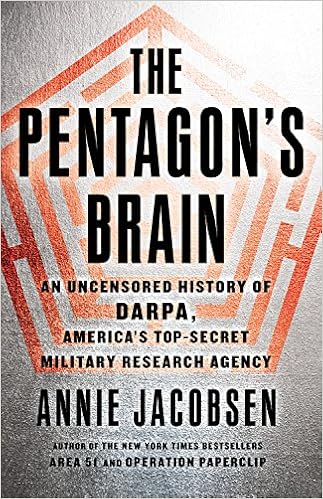
The Pentagon’s Brain:  An Uncensored History of DARPA, America’s Top Secret Military Research Agency (New York: Little, Brown and Company, 2015).

Annie Jacobsen


Since 1958, DARPA, the Defense Advanced Research Projects Agency, has connected the US military with the academic and scientific expertise that it relies upon to maintain its technological advantage over present and likely future adversaries.    Journalist Annie Jacobsen has done a competent job of telling the story of this cooperation, within the limits of what information is unclassified and thus accessible.   A book with a subtitle that includes “Top Secret Military Research Agency” warns the reader that there are limits to what it is likely to tell them.   Jacobsen admits in her conclusion that “DARPA’s highest-risk, highest-payoff programs remain secret until they are unveiled on the battlefield” (451).  Given the limits of what she does not know, she tells a fascinating story of ingenuity and hubris, which ends with troubling ethical and moral implications.

Jacobsen begins her story with Castle Bravo, the codename of an operation in 1954 to test a new thermonuclear or hydrogen bomb on the remote Bikini Atoll, 2650 miles west of Hawaii.   The test was part of an effort to stay ahead of the Soviet Union in the nuclear arms race.  The Castle Bravo bomb took advantage of new technology to miniaturize warheads, so that the weapon detonated on Bilini was vastly more powerful than the Hiroshima bomb a decade before, and yet was not much larger.   The explosion was far more powerful than anticipated, to the point where the observers in a concrete and sand-covered bunker nineteen miles away wondered if they would survive the massive shockwave.    

Jacobsen uses Castle Bravo to set up her main theme, that scientific and technological progress threatens to outstrip our ability to manage it, not to mention our ethical preconceptions of how war is supposed to work.   Another example, similar to the scale of the Castle Bravo explosion, was the first test in 1960 of a massive radar in Greenland, which would allow NORAD (North American Defence Command) to detect Soviet missile launches.   The radar system was so powerful that its signals were detecting the rising moon, a quarter of a million miles away, and the primitive software was interpreting the signals as an attack.  It took human ingenuity and judgement to cancel a response and recalibrate the radar.   Similar wise judgements, Jacobsen recounts, prevailed in the eventual ending of above ground nuclear tests, by the superpowers, and the cancellation of bomb projects so vast that they would destroy continents.   Politicians, scientist, and military leaders could all agree that nuclear technology could never be used in war because there was no way to guarantee that it would not escalate, and no defence if it did.  In her final chapters, Jacobsen warns that we may not be so lucky with the technologies, including autonomous fighting systems (killer robots) and artificial intelligence, that DARPA is currently researching.

If human foresight and wisdom saved us from nuclear war thus far, that same wisdom is conspicuously absent in other chapters.   Jacobsen describes two episodes, one in Vietnam and the other in Iraq and Afghanistan, where military success depended on understanding the culture and motivation of human opponents.  In both cases, DARPA was tapped to recruit anthropologists and social scientists to help the US military understand why guerrilla insurgencies (the Vietcong in Vietnam and various insurgencies - Sunni, Shia and Taliban -in Afghanistan and Iraq) were motivating and recruiting their fighters.  These were questions that military leaders and technology could not answer.  The results, especially in the case of Vietnam, were not encouraging and provide a depressing spectacle of human folly.  When the civilian scientists concluded that the corrupt South Vietnamese regime and policies of forcible resettlement of peasants into fortified villages were creating insurgents, their findings were ignored, because they did not support the dominant paradigm that Communism was to blame.  Today, as Robert Kaplan points out in his recent book Asia’s Cauldron, we know that the Vietnamese have a long history of fighting invaders, and that Communism had far less to do with the struggle against the US than was supposed at the time.  Fears of falling dominos throughout Asia blinded the US to the role of simple, robust nationalism as a motivator.  

In Iraq and Afghanistan, social scientists were recruited into so-called Human Terrain Teams (HTTs), to help US commanders understand the tribal societies they were confronting, as counterinsurgency tactics forgotten post-Vietnam had to be relearned.  In so cases, HTTs were successful in helping troops to understand the human dimension of a complex and messy battlefield.  However, some in the civilian academic community felt that mapping the human terrain of what the military calls the “battlespace” could enable other groups within the military to identify high-value targets for capture or elimination, and that the work of civilian social scientists within the HTTs was not furthering the goal if impartial academic research.   One of the things one learns from Jaoobsen’s book is that when a DARPA program is green lighted, enormous sums of money flow.   Since the growing HTT program was farmed out to civilian defence contractors like BAE systems, unqualified people may have been hired, as this article suggests.  Eventually the Human Terrain program became a target for politicians crusading against waste, and the programs were scaled back, rebranded, or discontinued.

Because Jacobsen’s narrative is chronological, her book reads as a long series of projects that seemingly have little to do with one another, other than that their funding and research went through DARPA.   As a sequence, nuclear bombs, anthropologists in Vietnam, drones and IED jammers in Iraq and Afghanistan, and research on neurological enhancements and robots in the present day, all suggest a series of frenzied and trendy research programs, driven by the exigencies of the large wars America feared, and the small wars it found itself in.   I would suggest looking elsewhere for a military / historical perspective on why the US needs research agencies like DARPA.  Max Boot’s 2006 book, War Made New: Weapons, Warriors and the Making of the Modern World, would be one example of such a perspective.  Boot’s analysis of military technology’s evolution since 1500 shows a series of revolutions in weapons, tactics, and technology, each more remarkable and more compressed than the last, but each fatal for those powers that make poor choices.  Jacobsen’s book falls partially within what Boot calls the Information Revolution (c. 1970-2000), when America gained a decisive advantage in computer technology for weapons and command and control systems.  However, as Boot notes, having chosen to ride that tiger, the stakes involved have gotten higher and higher as the edge becomes less and less decisive.  Boot writes that:

"America’s early lead in the Information Revolution can easily be lost - it may be being lost already - if it does not stay at the forefront of military developments.  Other countries and even subnational entities such as al Qaeda have an opportunity to exert power that would have been unthinkable before the spread of personal computers, cell phones, satellite navigation devices, and other Information Age technologies” (p. 16). "

Jacobsen is write to end her book on a cautionary note as she worries about the implications of applying AI and robotics research to military uses.   She does not, however, note that other powers are undoubtedly working on the same systems.  The ease with which Russia could destroy Ukrainian field units in 2014-15 was through their own use of battlefield drones and computer controlled weapons systems.   If Jacobsen’s book is about technology as a Pandora’s box opened by soldiers and scientists, then that box was opened long ago, and, now opened, will take more than one world power to close.

Sunday, March 27, 2016

Easter 1916 In The Trenches - Remembering Anglican Chaplaincy In The Great War

 This article is part of a series I am contributing to the newsletter of the Anglican Military Ordinariate, the clergy of the Anglican Church of Canada serving in the Canadian Armed Forces, as part of an ongoing celebration of the centenary of the Great War.   The complete edition of the newsletter for Easter 1916, as well as past versions, may be found here.  MP+


By Easter 1916, the Canadian Army in France had finished its apprenticeship of war and was starting to gain its reputation as an aggressive, modern force of shock troops.  With 36 combat battalions in three divisions in the line in France, and a Fourth Division soon to join them, Canada was hitting its stride of near full mobilization.   Its armed forces had doubled since the Canadian Expeditionary Force had first formed in 1914.   The CEF now included within its ranks specialists in tunnelling for the cat and mouse game of laying and detecting vast subterranean explosives planted under enemy trenches, while aggressive Canadian raiding tactics, first by night and later by day, had been approvingly noticed by the British Commander in Chief, Sir Douglas Haig.


France was not the only theatre of operations.   Canadian medical personnel operated in the Middle East, and two hospitals had been established at Mudros, a barren section of the Greek island of Lemnos (modern Limnos), to support the failed operation at Gallipoli.  Personnel and patients there suffered cruelly from inadequate water and rations, weather and disease, including scurvy.  The war diary of one of these hospitals conveys a sense of hardship in this one entry:  “Sickness among Officers, Nursing Sisters and men becoming prevalent.  Admission to Hospital of dysentery cases increasing daily.  The fly menace is very great, also the dust, and poor food supply very trying”.   It was at Mudros that Mary Frances Munro died,  the first of 47 Canadian nursing sisters to die in the Great War.  A native of Ontario and a graduate of Bishop Strachan School in Toronto, she died of illness and is among the Canadians buried at the Portianos Commonwealth Cemetery on Limnos.


Canadian military medical staff on Lemnos, ca 1916, from a Globe and Mail article, 2015.


Even in England, far removed from the hardships of Mudros, chaplaincy was challenging.  George Wells, the Anglican padre assigned to Shornecliffe military district, worried about how the Canadian soldier was “getting a very bad name” because of the temptations to “immoral behaviour” in “objectionable houses” and from those “soliciting in the streets”.  Wells worked hard to protect his soldiers, “those who were the pawns of war”.  His attempts to have such establishments put off limits were not sympathetically received by senior officers, who tended to blame the troops’ bad behaviour on the inadequate moral influences of their chaplains.  As Duff Crerar notes, the padres working in training camps faced an uphill battle.  Alcohol was easily obtainable, leadership was heavy handed, routines were tedious, and mandatory church parades were widely hated.  Social work in such conditions was especially challenging, but Wells had some success in championing unwed English mothers and getting Canadian soldiers to take responsibility for them.  In the near-Victorian morality of the period, one has to see this as an especially fearless and prophetic ministry.


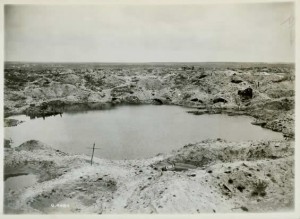
For the CEF in the trenches, April 1916 was a cruel month.  Following the German offensive at Verdun, there was great emphasis on offensive action to relive the pressure on the French Army.  Just south of Ypres, Canadian troops were committed to a battle that became known as the St. Eloi Craters (27 March – 16 April 1916).  Four large mines were detonated under the German lines, but instead of the hoped-for breach, vast craters were created in the soggy landscape, complicating maneuver and navigation in the dismal landscape.   While some ground was won, the battlefield was “under constant enemy shelling, and men had been forced to crouch in mud-filled ditches and shell-holes, or stand all day in water nearly to their waists with no possibility of rest”.   During a relief in place under these appalling conditions, the Canadian 6th Brigade was caught in a German counterattack while badly strung out and not in defensive positions.   The Canadians were thrown back with heavy casualties, and the ground was retaken by the Germans.   The battle dragged on for days as an artillery duel before it ended, leaving 1,373 Canadians killed or wounded.  The Canadian official history describes St. Eloi as a “fiasco”, and its costly lessons were taken to heart in future trench offensives.


One of the St. Eloi Craters, Canadian War Museum


 One of the regiments hard pressed in the St. Eloi battle was the 6th Brigade’s 29th (Vancouver) Battalion.   Its chaplain was an Anglican, the Rev. Cecil Caldbeck Owen, a graduate of Wycliffe College and the Rector of Christ Church, Vancouver (today’s Christ Church Cathedral).  Owen, a vigorous man in his middle age, and widely popular in Vancouver, had long been a militia chaplain, and he went overseas with the newly formed 29th BN in May of 1915.  His 22 year old son Harold was by then already in France as an infantry officer.  


Padre Owen (right) with his son, Harold, in front of the Christ Church rectory, Vancouver, 1915, from Living Stones: A History of Christ Church Cathedral


 Christ Church granted Owen leave to serve in the CEF, and despite worries about his parish’s finances and attendance, he gained a reputation as a dedicated front-line chaplain.  He would have gone into action at St. Eloi still coping with grief, for his son Harold had been killed in action on 1 February, 1916.  Owen made a three hour journey on horseback to be present at Harold’s funeral, and like his colleague Canon Scott, continued in his ministry after losing his son to the war.    After the war, Owen served as a hospital chaplain in Vancouver, and was present at the dedication of the Vimy Monument, where he spoke of how “We must educate our children in the finer aspects of courage and sacrifice which emerged during the war so that they will remember the heroism and the deeper lessons which should have resulted from it”.  Sadly, war would ask another sacrifice of him.  Owen’s adopted son Luder Keshisian, an Armenian refugee, was an RCAF pilot in the Second World War, and was killed over Germany in June, 1944.   Padre Owen died in Vancouver on Christmas Eve, 1954, 


For those troops not in the line, Easter Sunday 1916 (24 April) happened to coincide with St. George’s Day, which was not lost on troops of English heritage.  Canon Scott, in the Ypres Salient with the First Division, describes how the engineers “built me a church, and a big sign over the door was first used on Easter Day … and we had very hearty services”.  For those Canadians in the nearby town of Poperinghe, like the Queen’s Own Rifles  which observed Easter Sunday with a church parade, there was the possibility of a visit to Talbot House, an all-ranks refuge created by an enterprising English Anglican, Padre “Tubby” Clayton.  


Talbot House, or “TocH” as it was known, offered soldiers a chance to worship in the chapel upstairs (which rocked alarmingly when packed with men) or to remind themselves of civilian life in the comforts of its drawing room and garden.  Visitors first saw a sign enjoining them to “Abandon rank, all ye who enter here”.  Padre Clayton knew the Canadian chaplains like Canon Scott, and welcomed many Canadian visitors.  He wrote that “Canadian churchmanship impressed me not a little.  For six months in 1916 a Canadian sergeant-major was the Vicar’s warden; and it was he who most appropriately welcomed the Archbishop of Canterbury on his memorable visit to the House early that summer.  Almost the first Canadians I saw were two tunnellers, who on a weekday morning set out from the old French dug-outs beyond Vlamertinghe at 5am and arrived at the Chapel for the celebration (then at 6:30 on weekday), having heard that the service was held daily, and being quite prepared to forgo their chances of breakfast at the end of a ten-mile walk.”  


While TocH was a refuge, it was not a shelter.  Poperinghe lay within the Ypres salient, and as Clayton wrote, shells “crossed and recrossed the roof from three points of the compass”.  The congregations who knelt and prayed in TocH’s small chapel had to return to an even more dangerous front line.  A long war and uncertain survival still lay before them.    For padres like Clayton, all they could do was to try andfind these momentary places and times of grace for the troo, and commend the men to God in the terrible battles to come.


Padre Michael Peterson+

Wednesday, March 23, 2016

Easter 2016 Anglican Military Ordinariate Newsletter

Here is a link to the Easter 2016 edition of the newsletter I edit for my diocese, the Anglican Military Ordinariate of the Canadian Armed Forces.

It includes several articles on an historic event, our first election of our Bishop Ordinary, as well as a book review and a continued look back 100 years at Canadian Anglican chaplains in the Great War.

MP+


Mad Padre

Mad Padre
Opinions expressed within are in no way the responsibility of anyone's employers or facilitating agencies and should by rights be taken as nothing more than one person's notional musings, attempted witticisms, and prayerful posturings.

Followers

Blog Archive

Labels