The Difficult Art of Gratitude: A Sermon for Thanksgiving Sunday
Preached at Christ the King Chapel, CFB Suffield, Ralston, AB, 10 October, 2010
Deuteronomy 26:1-11, Psalm 100, Philippians 4:4-9. John 6:25-35
Then you, together with the Levites and the aliens who reside among you, shall celebrate with all the bounty that the LORD your God has given to you and to your house. (Deuteronomy 26:11)
Gratitude is a difficult art to practice. Take the thank you card, for example. My father always preached the value of the thank you note or, if I had been a guest somewhere, then he called it the “bread and butter letter” . Dad believed that a thank you note was an appropriate response to an act of kindness or hospitality. As he liked to say, gratitude was a sign of civilization, and being civilized was always better than being a savage. Last week Kay and I had a houseguest over for a very pleasant evening, and the next day we received a warm and thoughtful handwritten thank you card. It wasn’t strictly necessary of him to write and send the card, because we’d shaken hands and as he said goodbye he had thanked us warmly. The card said more than thank you. It was, I suppose, a way of saying “I’m glad we spent time together, let’s continue this relationship and let’s grow this friendship.” The card was especially meaningful because even though our friend was getting ready to fly home, he had taken time out of a busy day to buy a card, write some thoughtful words, and get it to us. I know there have been times were I’ve received kindness and hospitality, and yet have found the art of gratitude too difficult to practice. I got busy, I was lazy, I forgot, and the opportunity was lost. Gratitude is a difficult art to practice. Like anything else of value, it takes intentionality and effort.
If gratitude is social art, gratitude can also be a spiritual art, and like the social art of gratitude, spiritual gratitude can also be difficult art to practice. Sure, we know how to be spiritually grateful. As someone once said, all prayers can be boiled down to two types. The first type of prayer is “please, please, please”, and the second type is “thank you, thank you, thank you”. We’re quite good at saying these kind of things when adrenaline is involved. It might be a few seconds of bad driving in winter, or some very long hours waiting for the doctor to return with the test results. When we need something badly, or when we feel that we’ve received some incredible moment of grace, prayers of please, please, please or thank you, thank you, thank you come easily enough, even to people who aren’t really sure who they’re praying to. As my father also liked to say, “there are no atheists in foxholes”. It’s the moments when the adrenaline fades away and life goes back to normal that many people lose the need to pray. It’s not that they’re bad people, but rather that the need to pray recedes into the background, and so the idea of prayer as a practice or a discipline, as something that we have to persist at to get good, becomes so difficult for most people, even for most Christians.
Thanksgiving Sunday reminds us of the importance of gratitude as a spiritual art. Also known as Harvest Thanksgiving Sunday, it is a holdover of a time when most people’s lives were closely tied to the earth. In Christian history, the Sixth Sunday after Easter was known as Rogation Sunday, the time of planting. That was the “please, please, please” prayer, when churches would ask God to bless the crops and the weather so that people would not go hungry. Harvest Thanksgiving was the “thank you, thank you, thank you” time, when as the old hymn puts it, “all is safely gathered in, ‘ere the winter storms begin”. Because prayers of please and thank you can be selfish because they tend to be about us and about our needs, the church chooses scripture readings for Thanksgiving that remind us to think about others and about our relationship to them. In our first lesson, from Deuteronomy, God’s chosen people are reminded that they have more to be thankful for than just a good harvest. Israel is reminded that it is a chosen people, a nation created by God out of the family of Abraham, “a wandering Aramean”, protected by God when slaves in Egypt and “few in number”, and then brought out of slavery into a promised land. As it does over and over again, the Old Testament reminds God’s people that God has been faithful to them step by step, generation by generation, and this year’s harvest is just another sign of that faithfulness. To remind them of that faithfulness, the people are to give some of that harvest back to God through the priests (the “Levites”) and they are to share it with the non-Jews (the”resident aliens”) living with them. The “resident aliens” are important because God intended his chosen people to be a blessing to the world and not just a tiny, holier than thou, minority. As St. Paul reminds us in Romans and elsewhere, we are all God’s chosen people by adoption through God’s son Jesus Christ. Just as Israel was meant to share God’s blessing with the people around it, so are we called to be God’s partners in sharing the grace given to us.
Often in Anglican churches you will find a poster or a bulletin insert which says something like “Giving begets Grace begets Gratitude begets Giving begets ...”. Sometimes the words are arranged in a circle which suggests the idea of a cycle that feeds and grows off of itself. I’m not sure where this slogan comes from (it may be an echo of a saying by St. Basil --“gratitude begets reward” ) but it doesn’t really matter. What matters is the idea that the “thank yous”, the moments of gratitude which follow our “please please please” requests for grace, should not be selfish. Instead, by cultivating an attitude of gratitude and sharing it with others, we can create a climate which promotes favourable conditions for more grace. The Christian writer Nancy Leigh Moss calls this “going gratitudinal”, which means finding ways to express our gratitude in ways which grace those around us and, in doing so, give witness to God as the author of all grace.
What might “going gratitudinal” mean for you this Thanksgiving? If you’ve been graced with a talent, will your gratitude help nurture talents in others? If you’ve been blessed with an act of kindness, will your gratitude express itself in kindness to others? Here’s a hard one. If it doesn’t seem to you that your “please please please” moment has yet been answered, can you still find gratitude for the faithfulness and promise of God’s son? In our Gospel reading from St. John today, we heard Jesus challenge his followers to believe even in those times when they do not see miracles like gifts of bread. “For the bread of God is that which comes down from heaven and gives life to the world” (John 6:33). This Sunday isn’t just about giving thanks for tables covered with good things like turkey and stuffing. This Sunday, like every Sunday and every day of our baptized lives, is about our giving thanks for the good news that God has chosen us, has called us, has loved us, loves us, and will love us, has forgiven us, forgives us, and will forgive us, and will receive us as his own. That is a gift worthy of our “thank yous”, and a grace worth sharing with others.

Monday, October 11, 2010


Saturday, October 2, 2010
Life in Suffield 2: With the British on the Prairie
Two months into my posting at CFB Suffield, I'm convinced that I have the coolest job in the Canadian Forces Chaplaincy. One of the reasons for that conviction is that last month I had the opportunity to visit the training area as the guest of Padre Stewart Young, the British Battlegroup (BG) Chaplain for EX PRAIRIE THUNDER 5.
As I write this on a sunny October morning, fall has come gloriously to Alberta, but this September just past was horrible, rainy, overcast, and cold. In mid September I caught a ride out to the BG's location with two British soldiers from BATUS (British Army Training Unit Suffield), one of whom, a signaller Warrant Officer, rejoiced in the title of Yeoman of Signals. Our truck struggled along the slimy mud roads, up and down hills, at one point watching a heavy lorry (truck) fishtailing alarmingly ahead of us. "He's got those naff sand tires on" said the driver. Asking what a naff tire was, it was kindly explained to me that "naff" was slang for rubbish, no good, useless. It can also be used to describe someone you don't like or who is rather pathetic.
The drive took about an hour. The training area is that big and the roads were that bad. Under the grey sky and rain the prairie looked especially dispiriting, an endless expanse of rolling, grassy hills as far as the eye could see. During the hour trip I saw exactly one tree. The BATUS staff speak of "prairie sickness", a reaction to the monotony and isolation of this vast area.
I was delivered in the position, or "leaguer", of the BG, which comprised roughly a thousand troops drawn from the British Army's 20th Brigade, an armoured force whose home station is Paderborn, Germany. Warrior armoured personnel carriers, mighty Challenger tanks, agile looking Scorpion recce tanks, recovery vehicles, trucks, and Land Rovers were laid out in long rows. Today was a Maintenance Day, a chance for troops to service their vehicles, resupply, and perhaps catch some rest before the next day's exercise. Tent flies were attached to the sides of vehicles, sheltering sleeping forms next to another vehicles were troops hammered track back into place or shaved in the side mirrors.
I managed to take some rather naff photos with my iphone before the battery failed me.
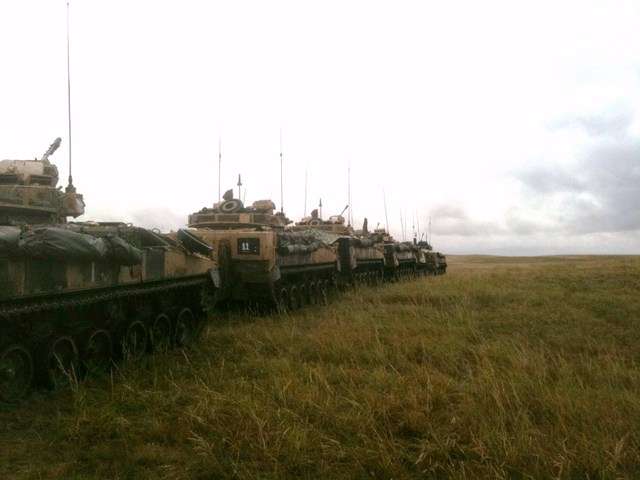
Warrior APCs on the barren prairie. These vehicles are roughly equivalent to Canada's LAVs.
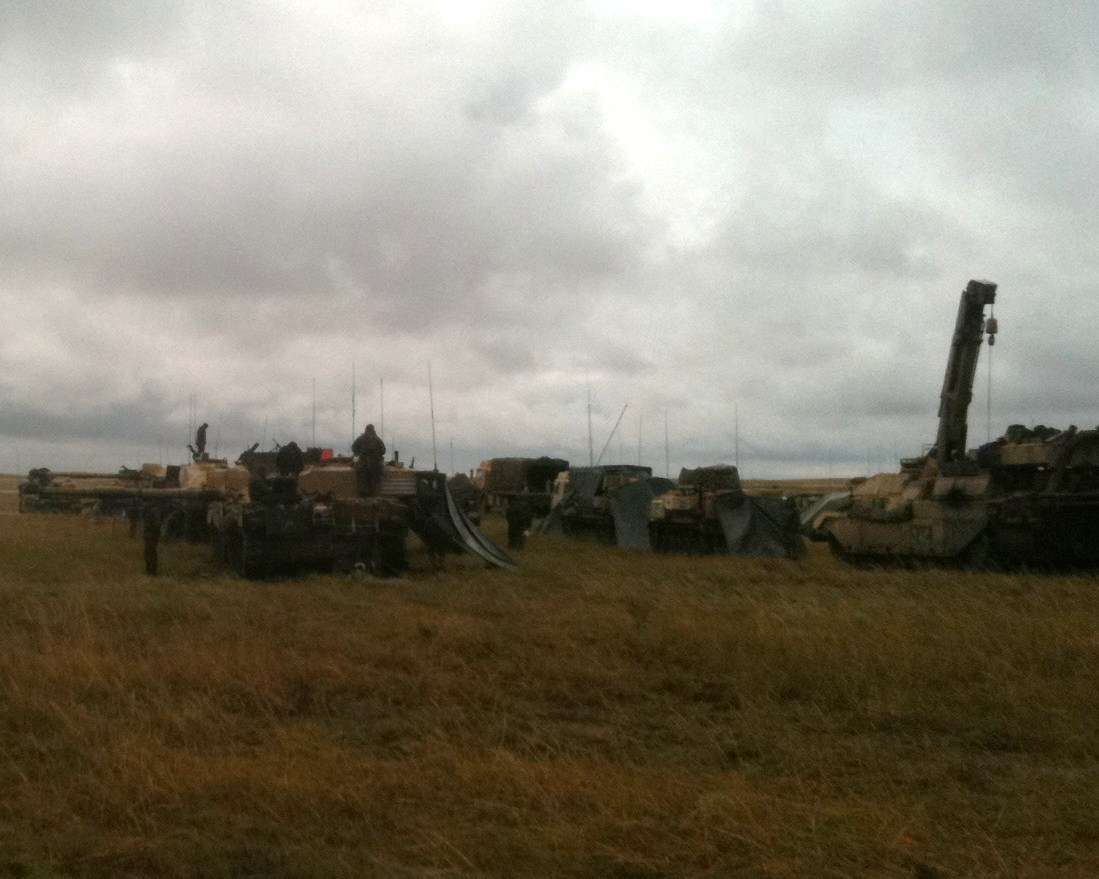
Maintenance on some Challenger tanks (left). On the right is a massive Challenger recovery vehicle. In the center troops rest under flies attached to their Warriors.
When I arrived Padre Young was busy assisting a soldier with an issue back home, so I stowed my gear with his driver, a likable Yorkshireman with a thick and at times incomprehensible accent. As his mates wandered by they kept saying "Hiya John Boy" and on asking why he was called John Boy, he told me his last name was Walton. Of course.
I then wandered among the lines, a happy military tourist, and when troops had time to notice me, they were unfailingly polite. A short, sturdy and bearded tank sergeant, who looked remarkably like one of one of Tolkien's dwarves, connected me with one of his men, a Cpl Perkins, who allowed me to sit in the turret of his massive Challenger tank. Cpl Perkins kindly explained the layout and function of the various crew stations, a marvel of engineering and compactness, until his duties called him away.
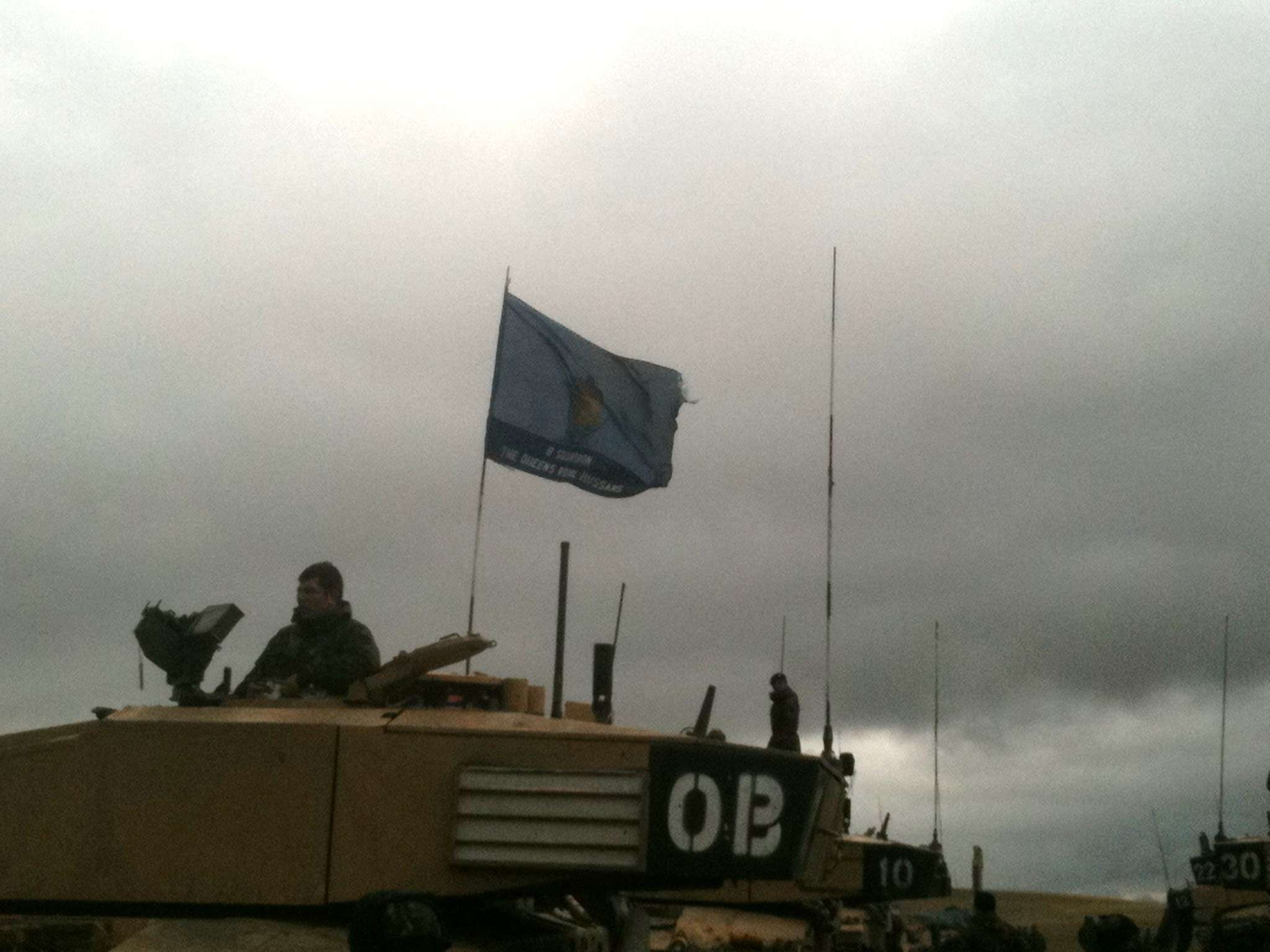
A proud heritage. A Challenger tank commander under the pennant of his regiment, the Queen's Own Hussars.

Another armoured heritage, the naming of vehicles.
Standing in the mess line with John Boy, I was struck by the remarkable ethnic diversity of the British army. Fijians and Africans from Ghana and Kenya mixed with lads from all over the UK. Until quite recently the Army has recruited FOC (Foreign of Commonwealth) troops from across the former British Empire, but I gather has ceased this practice since the Army is now considered fully manned. By and large they seemed to get along with one another.
My host, Padre Young, showed up towards dinner, or "scoff" as they call it. Stewart is a British Army chaplain, which means that unlike my Branch, which is triservice (my next posting could be to a ship), Stewart and his colleagues only serve with army units. He is currently padre to 5 RIFLES, an infantry regiment of ancient lineage (their cap badge would be familiar to fans of the TV series Sharpe's Rifles) based in Paderborn. Stewart is the embodiment of the army chaplain, an energetic, cheerful man, unafraid of the discomforts of the field (he served briefly as a Royal Marine in his youth), with a huge heart for his troops and for God. Despite our denominational differences (he's a Methodist, I'm Anglican) I felt in the company of a kindred spirit.
Just before sunset, the BG turned to the coming day. The BATUS staff had called for the BG to attempt an unopposed river crossing, meaning that the various components would have to move towards a large terrain obstacle, do their nightime reconnaisance, organize a scheme of maneuvre for all the various BG components, make a difficult crossing on muddy and narrow roads, and be prepared for action afterwards. Despite the absence of the enemy, it was a complex process for units that were not always accustomed to workingn with one another. Stewart led me over to a model of the terrain, laid out with tarps, rocks and bits of mine tape by a likable sergeant major whose foxy face made me think of a poacher from a Thomas Hardy novel. The BG commander, a charismatic and expressive Lt Col with a double barrelled name and the quality of someone from a long line of soldiers, led a long and to my mind surprisingly informal briefing in the last moments of daylight. His officers were an interesting bunch. Scruffy, long haired (compared to the shaved or short high and tight styles favoured by Americans and some Canadians), dressed in a variety of military and some civilian kit, they were nevertheless professional and intelligent.
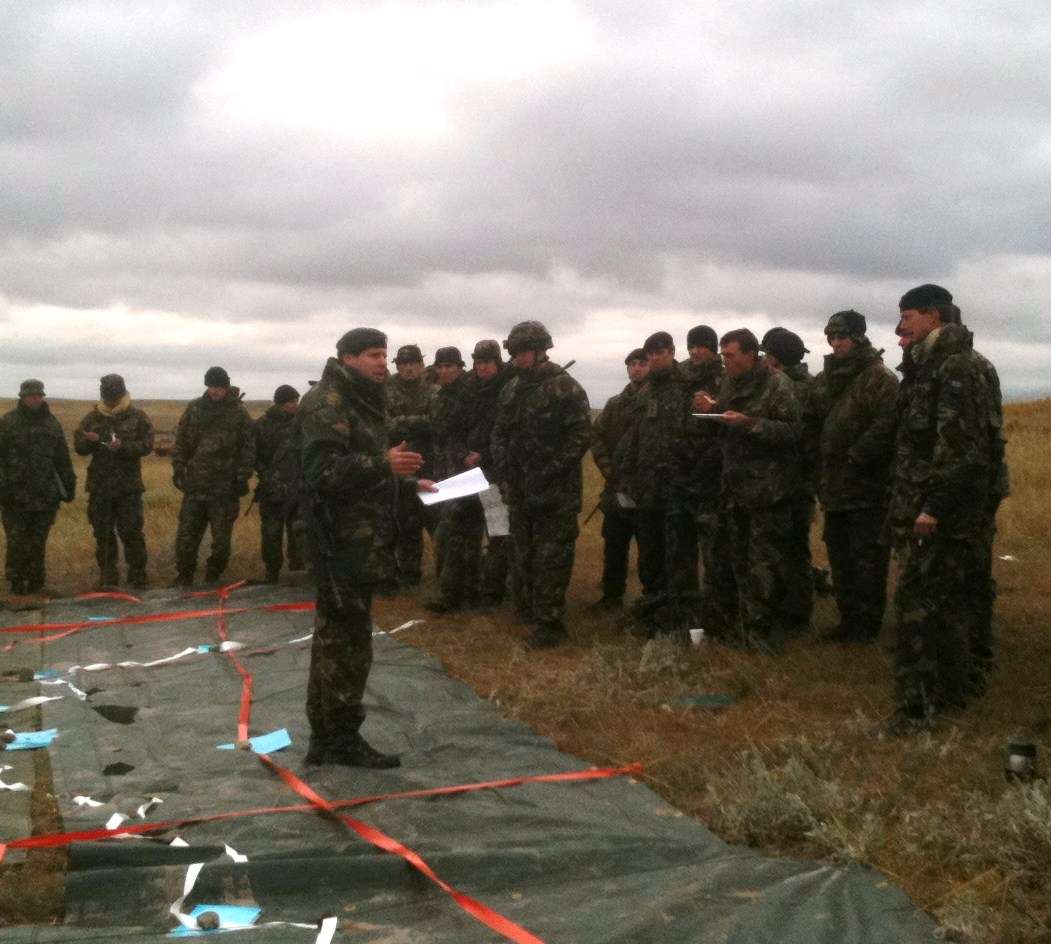
BG CO briefs his officers before the river crossing to come in the morning.
The night to come was busy, and I doubt that the BG got much sleep. I managed four hours in a small tent kindly lent to me by Stewart, and woke shivering in the dark at reveille, 04:00hrs. the British followed their "Morning Routine", which consisted of stowing kit, checking that vehicles were functioning, and then having "a brew" (tea) and a shave if time permitted. A gorgeous sunrise promised a warmer day.
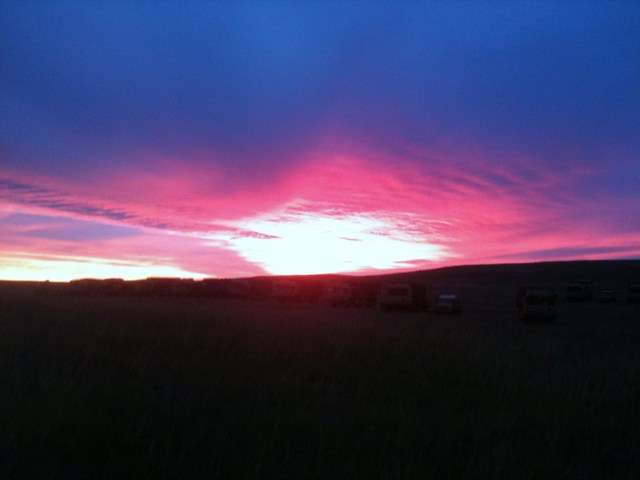
Sunrise on the prairie, illuminating a row of transport and supply vehicles.
Watching the obstacle crossing would be a problem, because Stewart's Land Rover could only seat two and it would be restricted to the logistical tail of vehicles that would be kept in the rear echelon. Stewart solved that problem by finding us seats in two of the BATUS vehicles that would be observing and critiquing the day's exercise. I spend the morning with a young captain, Will Locke, who had seconded to BATUS from his unit, the 9/12th Lancers, an armoured recce unit driving fast tanks and with all of the dash and elan of their heritage, as can be seen in this video they made. Will had a tour in Iraq under his belt, and knew his trade. He would be observing the reconnaisance work of the BG and indeed had been out most of the night watching the recce elements surveying the river for the required crossing points. When his duties permitted, he was a charming and informative host. He endeared himself to me by smoking a pipe, something rare in young men and something I used to do.

Seen from Will's truck, elements of the BG move towards the river crossing,
Riding in Will's truck, I was able to hear the BG communicating amongst itself on one radio net, while on another I could hear the BATUS staff observing and talking amongst themselves, noting both good and bad points for the debrief afterwards. It was a fascinating experience, rather like listening to the play by play of a sporting event while listening at the same time to the athletes themselves. It all underscored the point that training is meant to save lives by giving troops the chance to test themselves and work out the bugs before they go into combat, which the BG will be doing sometime in the future.
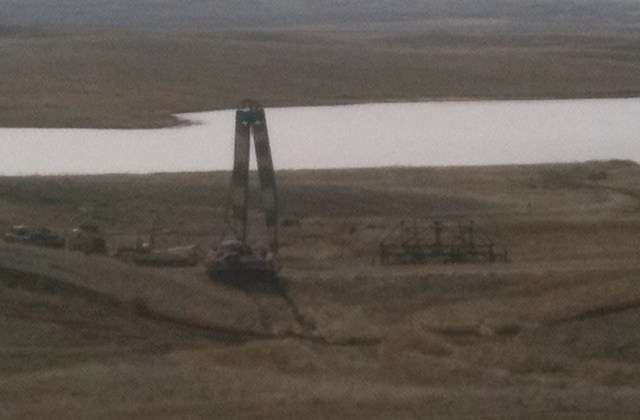
Heavy metal. Once the river was crossed and secure, the BG could bring up its bridgelaying equipment to make a more permanent crossing. This gear, seen about 1 k away, was huge.
A comical moment: I was outside Will's truck, attending to nature's call, when over the crest of the hill behind me came the vehicle of CO BATUS, a full colonel who was overseeing the exercise as well as the work of his control staff. I hastily zipped up and beat a retreat to the truck, but Will was called over and told by CO BATUS that he didn't want to see visitors in temperate clothing (my green Canadian combats) mixed in with his control staff, who all wear arid (desert pattern) uniforms to distinguish themselves as non-players from the exercising troops. I have yet to have any face time with Col Carver, CO BATUS, and if I do, I wonder if this incident will come out. Technically I am Padre to his organization as well as to the CF staff at Suffield, and hopefully he will at least be pleased that his padre is out on the prairie with his people.
The day's exercise went well. The BATUS staff were impressed overall with the BG's performance and with their planning. For the next two weeks the BG practiced increasingly more difficuly drills and challenges, encountering real opposition from the BATUS troops brought in as the opposing force (OPFOR). These combats are a lot like lasertag on an epic scale, with troops and vehicles wearing electronic vests that determine who is killed or wounded. The EX also includes live fire exercises, though not at other troops of course. The night live fire ranges are apparently quite epic, and I hope to see them in due course. With all the exploding things out their on the ranges, the CF range control and fire suppression teams can be quite busy.
After a few days debauchery in Medicine Hat and Calgary, the BG is on its way home now, and another group will come in from Germany next week to spend its time on the ranges before winter sets in. Kay and I had Padre Young over for a more genteel debauch, complete with home cooking, some Alberta ale (Warthog from Big Rock) and some single malt scotch (Bruichladdich) in honour of Stewart's Scots heritage. He's on his way home tomorrow.
I wish I had a photo of Stewart to share, but I did go online and find this grace which he wrote in Afghanistan when he was the chaplain of the Queen's Dragoon Guards, a reminder that a sense of humour and a way with words are often useful to a padre.
Grace for the QDG 50th
Anniversary Dinner
by Padre Stewart Young
(With apologies to all serious poets!)
We gather here in celebration
of 50 years since amalgamation.
The Queen’s Bays and King’s Dragoon
Guards were joined as one,
1st The Queen’s Dragoon Guards to become.
And looking back, since fifty-nine,
with pride in our hearts, we trace our line,
from Wolfenbuttel to Musaymir;
from Sennelager to Garmsir.
First and foremost, we’ve always been,
proud Dragoons who serve our Queen.
And on this day, in this foreign land,
where we’ve been before, we take our stand,
to serve once more, under the eagle,
our badge of honour, which has no equal.
And one more time, we take our pause,
to bring our thanks before our God,
for all he’s done o’er 50 years
to bless our efforts and quell our fears
as we’ve faced great odds and many a
challenge;
as we’ve fought with stealth and used our
skill, to find and fix,
any who’ve dared to pit their wits
against The First, The QDG
the one, the only, Welsh Cavalry.
As I write this on a sunny October morning, fall has come gloriously to Alberta, but this September just past was horrible, rainy, overcast, and cold. In mid September I caught a ride out to the BG's location with two British soldiers from BATUS (British Army Training Unit Suffield), one of whom, a signaller Warrant Officer, rejoiced in the title of Yeoman of Signals. Our truck struggled along the slimy mud roads, up and down hills, at one point watching a heavy lorry (truck) fishtailing alarmingly ahead of us. "He's got those naff sand tires on" said the driver. Asking what a naff tire was, it was kindly explained to me that "naff" was slang for rubbish, no good, useless. It can also be used to describe someone you don't like or who is rather pathetic.
The drive took about an hour. The training area is that big and the roads were that bad. Under the grey sky and rain the prairie looked especially dispiriting, an endless expanse of rolling, grassy hills as far as the eye could see. During the hour trip I saw exactly one tree. The BATUS staff speak of "prairie sickness", a reaction to the monotony and isolation of this vast area.
I was delivered in the position, or "leaguer", of the BG, which comprised roughly a thousand troops drawn from the British Army's 20th Brigade, an armoured force whose home station is Paderborn, Germany. Warrior armoured personnel carriers, mighty Challenger tanks, agile looking Scorpion recce tanks, recovery vehicles, trucks, and Land Rovers were laid out in long rows. Today was a Maintenance Day, a chance for troops to service their vehicles, resupply, and perhaps catch some rest before the next day's exercise. Tent flies were attached to the sides of vehicles, sheltering sleeping forms next to another vehicles were troops hammered track back into place or shaved in the side mirrors.
I managed to take some rather naff photos with my iphone before the battery failed me.
Warrior APCs on the barren prairie. These vehicles are roughly equivalent to Canada's LAVs.
Maintenance on some Challenger tanks (left). On the right is a massive Challenger recovery vehicle. In the center troops rest under flies attached to their Warriors.
When I arrived Padre Young was busy assisting a soldier with an issue back home, so I stowed my gear with his driver, a likable Yorkshireman with a thick and at times incomprehensible accent. As his mates wandered by they kept saying "Hiya John Boy" and on asking why he was called John Boy, he told me his last name was Walton. Of course.
I then wandered among the lines, a happy military tourist, and when troops had time to notice me, they were unfailingly polite. A short, sturdy and bearded tank sergeant, who looked remarkably like one of one of Tolkien's dwarves, connected me with one of his men, a Cpl Perkins, who allowed me to sit in the turret of his massive Challenger tank. Cpl Perkins kindly explained the layout and function of the various crew stations, a marvel of engineering and compactness, until his duties called him away.
A proud heritage. A Challenger tank commander under the pennant of his regiment, the Queen's Own Hussars.
Another armoured heritage, the naming of vehicles.
Standing in the mess line with John Boy, I was struck by the remarkable ethnic diversity of the British army. Fijians and Africans from Ghana and Kenya mixed with lads from all over the UK. Until quite recently the Army has recruited FOC (Foreign of Commonwealth) troops from across the former British Empire, but I gather has ceased this practice since the Army is now considered fully manned. By and large they seemed to get along with one another.
My host, Padre Young, showed up towards dinner, or "scoff" as they call it. Stewart is a British Army chaplain, which means that unlike my Branch, which is triservice (my next posting could be to a ship), Stewart and his colleagues only serve with army units. He is currently padre to 5 RIFLES, an infantry regiment of ancient lineage (their cap badge would be familiar to fans of the TV series Sharpe's Rifles) based in Paderborn. Stewart is the embodiment of the army chaplain, an energetic, cheerful man, unafraid of the discomforts of the field (he served briefly as a Royal Marine in his youth), with a huge heart for his troops and for God. Despite our denominational differences (he's a Methodist, I'm Anglican) I felt in the company of a kindred spirit.
Just before sunset, the BG turned to the coming day. The BATUS staff had called for the BG to attempt an unopposed river crossing, meaning that the various components would have to move towards a large terrain obstacle, do their nightime reconnaisance, organize a scheme of maneuvre for all the various BG components, make a difficult crossing on muddy and narrow roads, and be prepared for action afterwards. Despite the absence of the enemy, it was a complex process for units that were not always accustomed to workingn with one another. Stewart led me over to a model of the terrain, laid out with tarps, rocks and bits of mine tape by a likable sergeant major whose foxy face made me think of a poacher from a Thomas Hardy novel. The BG commander, a charismatic and expressive Lt Col with a double barrelled name and the quality of someone from a long line of soldiers, led a long and to my mind surprisingly informal briefing in the last moments of daylight. His officers were an interesting bunch. Scruffy, long haired (compared to the shaved or short high and tight styles favoured by Americans and some Canadians), dressed in a variety of military and some civilian kit, they were nevertheless professional and intelligent.
BG CO briefs his officers before the river crossing to come in the morning.
The night to come was busy, and I doubt that the BG got much sleep. I managed four hours in a small tent kindly lent to me by Stewart, and woke shivering in the dark at reveille, 04:00hrs. the British followed their "Morning Routine", which consisted of stowing kit, checking that vehicles were functioning, and then having "a brew" (tea) and a shave if time permitted. A gorgeous sunrise promised a warmer day.
Sunrise on the prairie, illuminating a row of transport and supply vehicles.
Watching the obstacle crossing would be a problem, because Stewart's Land Rover could only seat two and it would be restricted to the logistical tail of vehicles that would be kept in the rear echelon. Stewart solved that problem by finding us seats in two of the BATUS vehicles that would be observing and critiquing the day's exercise. I spend the morning with a young captain, Will Locke, who had seconded to BATUS from his unit, the 9/12th Lancers, an armoured recce unit driving fast tanks and with all of the dash and elan of their heritage, as can be seen in this video they made. Will had a tour in Iraq under his belt, and knew his trade. He would be observing the reconnaisance work of the BG and indeed had been out most of the night watching the recce elements surveying the river for the required crossing points. When his duties permitted, he was a charming and informative host. He endeared himself to me by smoking a pipe, something rare in young men and something I used to do.
Seen from Will's truck, elements of the BG move towards the river crossing,
Riding in Will's truck, I was able to hear the BG communicating amongst itself on one radio net, while on another I could hear the BATUS staff observing and talking amongst themselves, noting both good and bad points for the debrief afterwards. It was a fascinating experience, rather like listening to the play by play of a sporting event while listening at the same time to the athletes themselves. It all underscored the point that training is meant to save lives by giving troops the chance to test themselves and work out the bugs before they go into combat, which the BG will be doing sometime in the future.
Heavy metal. Once the river was crossed and secure, the BG could bring up its bridgelaying equipment to make a more permanent crossing. This gear, seen about 1 k away, was huge.
A comical moment: I was outside Will's truck, attending to nature's call, when over the crest of the hill behind me came the vehicle of CO BATUS, a full colonel who was overseeing the exercise as well as the work of his control staff. I hastily zipped up and beat a retreat to the truck, but Will was called over and told by CO BATUS that he didn't want to see visitors in temperate clothing (my green Canadian combats) mixed in with his control staff, who all wear arid (desert pattern) uniforms to distinguish themselves as non-players from the exercising troops. I have yet to have any face time with Col Carver, CO BATUS, and if I do, I wonder if this incident will come out. Technically I am Padre to his organization as well as to the CF staff at Suffield, and hopefully he will at least be pleased that his padre is out on the prairie with his people.
The day's exercise went well. The BATUS staff were impressed overall with the BG's performance and with their planning. For the next two weeks the BG practiced increasingly more difficuly drills and challenges, encountering real opposition from the BATUS troops brought in as the opposing force (OPFOR). These combats are a lot like lasertag on an epic scale, with troops and vehicles wearing electronic vests that determine who is killed or wounded. The EX also includes live fire exercises, though not at other troops of course. The night live fire ranges are apparently quite epic, and I hope to see them in due course. With all the exploding things out their on the ranges, the CF range control and fire suppression teams can be quite busy.
After a few days debauchery in Medicine Hat and Calgary, the BG is on its way home now, and another group will come in from Germany next week to spend its time on the ranges before winter sets in. Kay and I had Padre Young over for a more genteel debauch, complete with home cooking, some Alberta ale (Warthog from Big Rock) and some single malt scotch (Bruichladdich) in honour of Stewart's Scots heritage. He's on his way home tomorrow.
I wish I had a photo of Stewart to share, but I did go online and find this grace which he wrote in Afghanistan when he was the chaplain of the Queen's Dragoon Guards, a reminder that a sense of humour and a way with words are often useful to a padre.
Grace for the QDG 50th
Anniversary Dinner
by Padre Stewart Young
(With apologies to all serious poets!)
We gather here in celebration
of 50 years since amalgamation.
The Queen’s Bays and King’s Dragoon
Guards were joined as one,
1st The Queen’s Dragoon Guards to become.
And looking back, since fifty-nine,
with pride in our hearts, we trace our line,
from Wolfenbuttel to Musaymir;
from Sennelager to Garmsir.
First and foremost, we’ve always been,
proud Dragoons who serve our Queen.
And on this day, in this foreign land,
where we’ve been before, we take our stand,
to serve once more, under the eagle,
our badge of honour, which has no equal.
And one more time, we take our pause,
to bring our thanks before our God,
for all he’s done o’er 50 years
to bless our efforts and quell our fears
as we’ve faced great odds and many a
challenge;
as we’ve fought with stealth and used our
skill, to find and fix,
any who’ve dared to pit their wits
against The First, The QDG
the one, the only, Welsh Cavalry.
RAF Pilots Honoured by Battle of Britain Tea
With Sept 19th's Battle of Britain Sunday service still fresh in my memory, I was pleased to see this story in the UK MOD press service about how a British tea party has released a special blend to remember the 70th anniversary of the BOB. The story of Terry Clark, seen on the label below and today at age 91, is a good read. Wonder if I can get some here in Canada? MP+

A wartime picture of Terry Clark appears on the label inside tins of the tea blended to commemorate the 70th anniversary of the Battle of Britain
[Picture: Newsquest/The Press, York, 2010]

Terry Clark drinks a cup of the tea blended to commemorate the 70th anniversary of the Battle of Britain
[Picture: Newsquest/The Press, York, 2010]
Battle of Britain veteran inspires special blend of charity tea
A History and Honour news article
1 Oct 10
A Battle of Britain veteran has been the inspiration for a special blend of tea brewed to honour 'The Few', with some of the proceeds going to the RAF Association Wings Appeal.
Terry Clark, aged 91, was an air gunner in a Blenheim light bomber aircraft, used as a night fighter, during the Battle of Britain. His initial job was to defend York and the surrounding airfields from German attacks.
He joined the Auxiliary Air Force at the age of 19, training in Surrey and on the Isle of Man. He said:
"The station commander signed my log book but nobody said whether I'd passed the course. I assume I must have done because they sent me off to join 219 Squadron, a Blenheim fighter unit based at Catterick."
Mr Clark and his squadron mates spent much of the Battle of Britain quietly playing pontoon as they waited for a call to arms. But the silence was shattered when the phone rang - it was the signal to scramble. A couple of flicked switches fired up the Blenheims and within minutes crews were airborne:
"Spitfire pilots couldn't see in the dark, but we could," he said. "Blenheims carried an early form of radar which at the time was unknown to the Germans. We also had ground control radar which was used to get us to the main body of the bombers. But while it could see the big picture, it was down to us to identify the individual aircraft with our radar before opening fire."
Read the whole story here.
A wartime picture of Terry Clark appears on the label inside tins of the tea blended to commemorate the 70th anniversary of the Battle of Britain
[Picture: Newsquest/The Press, York, 2010]
Terry Clark drinks a cup of the tea blended to commemorate the 70th anniversary of the Battle of Britain
[Picture: Newsquest/The Press, York, 2010]
Battle of Britain veteran inspires special blend of charity tea
A History and Honour news article
1 Oct 10
A Battle of Britain veteran has been the inspiration for a special blend of tea brewed to honour 'The Few', with some of the proceeds going to the RAF Association Wings Appeal.
Terry Clark, aged 91, was an air gunner in a Blenheim light bomber aircraft, used as a night fighter, during the Battle of Britain. His initial job was to defend York and the surrounding airfields from German attacks.
He joined the Auxiliary Air Force at the age of 19, training in Surrey and on the Isle of Man. He said:
"The station commander signed my log book but nobody said whether I'd passed the course. I assume I must have done because they sent me off to join 219 Squadron, a Blenheim fighter unit based at Catterick."
Mr Clark and his squadron mates spent much of the Battle of Britain quietly playing pontoon as they waited for a call to arms. But the silence was shattered when the phone rang - it was the signal to scramble. A couple of flicked switches fired up the Blenheims and within minutes crews were airborne:
"Spitfire pilots couldn't see in the dark, but we could," he said. "Blenheims carried an early form of radar which at the time was unknown to the Germans. We also had ground control radar which was used to get us to the main body of the bombers. But while it could see the big picture, it was down to us to identify the individual aircraft with our radar before opening fire."
Read the whole story here.
Subscribe to:
Posts (Atom)
Mad Padre

Opinions expressed within are in no way the responsibility of anyone's employers or facilitating agencies and should by rights be taken as nothing more than one person's notional musings, attempted witticisms, and prayerful posturings.