
Preached at All Saints, Collingwood, and Good Shepherd, Stayner, Anglican Diocese of Toronto, on 8 March, 2026, the Third Sunday In Lent. Readings for this Sunday: Exodus 17:1-7; Psalm 95; Romans 5:1-11; John 4:5-42
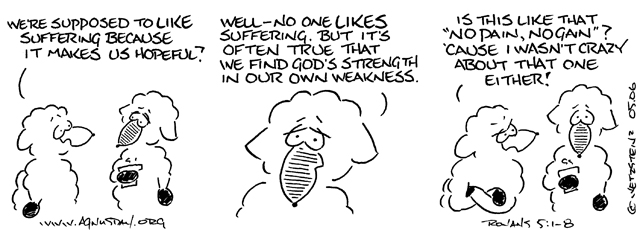
“…we also boast in our afflictions, knowing that affliction produces endurance, 4 and endurance produces character, and character produces hope,” (Romans 5:4-5)
One of the modern virtues, it seems to me, is resilience. When people speak of someone’s resilience, they usually mean it as a compliment. To be resilient means things like being unflappable, quickly bouncing back from a crisis, or, as Shakespeare put it, suffering “the slings and arrows of outrageous fortune”. Resilience is sometimes equated with the lyrics from that Kelly Clarkson song, “what doesn’t kill you makes you stronger”.
The problem with resilience is duration. For how long can a person be resilient? If we’re talking about a load-bearing wall, say, then we expect that wall to be resilient 24/7, every day. But people aren’t designed to be reslient for ever. We need a break. If you think of that old David Bowie/Queen song, “Under Pressure”, there’s only so much pressure we can take. And the problem with the “what doesn’t kill you makes you stronger” mentality is that it only works if you’re not killed, but the odds are against you. You won’t grow infinitely stronger. At some point you’ll be killed.
St Paul didn’t know the word “reslience” but he did understand the idea of pressure. Indeed. the Greek word he uses in Romans for “afflictions” (“we also boast in our afflictions”) is thipsis, which literally means “pressure” or “pressing together” though he also uses it in the sense of “affliction” or “suffering”.
The idea of anyone “boasting in their afflictions or suffering”, as Paul puts it, seems on the face of it absurd. There are monsters, like Pete Hegseth and his master, who boast in the sufferings of others, thus revealing their morally deficient character. But the many people suffering under bombs and missiles as I write this, whose homes have been leveled and who are living under tents or tarps, what can good can they say about their stuation? What can they boast of?
Paul goes on to say that “endurance produces character”, which is true, in that there are always some brave and good souls who run towards the explosions so they can dig out and help the trapped and injured. Such people surely display good character. And while Paul goes on to say that “character produces hope”, hope can seem illusive in the face of great suffering. When there are more explosions than there are helpers, it’s hard to see hope lasting for long. So again, resilience only gets us so far, and after would lie cynicism and nihilism if it wasn’t for our faith.
Here’s something that a Christian and a cynic/nihilist would agree on, that suffering is meaningless. The Christian writer and monk Thomas Merton once write that “Suffering has no value and no power of its own”, which means that there is no reason to be proud of our resilience. Suffering, Merton wrote, only has value accidentally, because it brings us to the mercy of God in Christ.
On the cross, Jesus accepted suffering and death because of love for us. As Paul says in our second lesson, “God proves his love for us in that while we still were sinners Christ died for us” (Rom 5.8). Lent brings us closer week by week to the cross, the place where we know that we are saved because Christ takes all suffering, ours and his and gives them into the infinite love of God, which destroys all evil and all death.
This brings us back to what Paul says about how “character produces hope”. The lesson of the cross, therefore, is hope. The character or trait of the Christian is to put one’s hope and faith and love in the love of God shown in the cross. If we resist God’s love, and only love ourselves, then suffering will always seem evil because it only threatens to destroy us, and so there no resilience, no hope. But if we love God and love others as God leads us to love them, then our suffering ultimately does not matter. But as Merton says, the Christian knows that suffering will only destroy that which in us does not matter, because what truly matters is the love of God which saves us.
Last Sunday in John’s gospel we heard John’s famous line, “for God so loved the world”. Let this be our hope, then, that only the love of God in Christ and in us can save a world that seems so full of suffering.


No comments:
Post a Comment