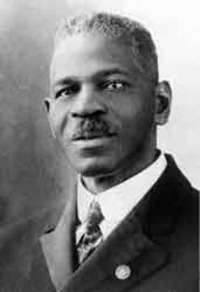
A colleague here at the Canadian Forces Chaplain School and Centre was reviewing our new chaplain history curriculum and asked me why our first African-Canadian chaplain was not included. Because I didn't know the story, I said, and now I can share it with you.
The Rev. William Andrew White was the Baptist pastor of a black congregation in Truro, Nova Scotia when the Great War began. American by birth and the son of former slaves, White came to Canada through the network of the African Baptist Association and attended seminary at Acadia University in Wolfville.
African Canadians were not allowed to enlist in the Army until 1916, when the government authorized No. 2 Construction Battalion, consisting of black soldiers led by white officers. Rev. White actively recruited for this unit, and half of its strength came from Nova Scotia. White was appointed as the Battalion chaplain was the only African Canadian to be commissioned as an officer during World War One.
The Dictionary of Canadian Biography gives this account:
Some members of the battalion trained in Windsor, Ont., and the rest in Pictou, N.S., and later Truro. In March 1917 the unit embarked for England. They were attached to the Canadian Forestry Corps (Jura Group) and relegated to the status of “company” because they were about 300 men under strength. In May they were sent to eastern France, where they worked alongside white troops during logging and milling operations but were segregated the rest of the time. Their chaplain had a hard row to hoe: white soldiers would not accept his ministrations, even when they otherwise lacked the services of a clergyman. Nevertheless he was an unmitigated force for good across racial lines. Such were his courage, moral authority, and physical stature that he once interposed himself between his unit and a group of white men to avert a riot.
Given the racial prejudices of the day, it was a significant step for the Chaplain Service, thanks to its director, John Almond, who was progressive for his time. Almond had tried to send an Anglican Metis chaplain to serve Canadian Indigenous detachments scattered through France, but his request was turned down by CEF Headquarters which disapproved of "roving commissions". Almond had also wanted to send a Jewish chaplain to France, but HQ likewise objected, claiming that "there were no concentrations of Jewish troops large enough to merit [their own chaplain]" (Duff Crerar, Padres in No Man's Land, 2nd ed, p. 68).
Padre White survived the war and died in 1936. His CEF record may be found here. He deserves to be better remembered as a significant figure in the history of the Royal Canadian Chaplain Service.
Showing posts with label Great War. Show all posts
Sunday, November 4, 2018
Thursday, September 13, 2018
Remembering Canadian Great War Chaplains in the Hundred Days
The text below is from an email sent by my friend and colleague, Dr. Duff Crerar, author of Padres in No Man's Land (McGill Queen's 1995, 2nd ed 2014). Duff regularly sends Canadian chaplains these emails to tell us what our predecessors did on certain notable dates, and thus to remind us of our legacy. MP+
Canadian Chaplains and breaking the Drocourt-Queant line.
German Wire - Part of the Drocourt-Queant Line Fortifications
By 17 August, the Canadian Corps had clawed deeply into German lines at Amiens. As the push ground down in the maze of old 1916 trenches, General Currie and Third Army Commander Rawlinson pushed for a relocation of the Canadians to where the Germans would not expect an attack. British Commander Douglas Haig concurred and persuaded the Supreme Allied Commander Ferdinand Foch to agree. Currie’s force was transferred to General Horne at Arras. Here the Germans had fortified a strong belt of defences, thirty kilometers deep, as far back as the partially-drained Canal du Nord. Behind it lay Cambrai. If the Canadians could break in here, the German defences southwards would be turned and the whole front opened for exploitation.
The Canadians had to work fast: Currie had two divisions in the line by August 23. They would jump off three days later, backed by the other two divisions and the 51st Highland Division. Twenty-six Brigades of Artillery and one British Tank Brigade joined in the attack. The first skirmishes at Neuville-Vitasse were over in minutes: hearing the Canadians were in the line, the German defenders were already evacuating the objective when the attack began at 3.am. After great initial gains the offensive ground down in heavy rain, bogged tanks and accidental attack by friendly air forces. When the Canadians finally outran the range of their guns, it was time to pause.
On 30 August the First Division carried out a textbook breakthrough and capture of the critical launching points for the new attack and held them against heavy counter-attacks. Currie planned a renewed attack for 2 September while his guns blasted fields of uncut wire. Altogether, over 101,000 Canadians and 47,000 British troops were under his command.
The breakthrough, once again, was sudden and decisive, and
the advancing Canadians again outran their artillery coverage. German flank
attacks hit the 15th and 16th Battalions hard, leading to
hand to hand combat in the wire until tanks arrived. Heavy resistance occurred
in the central area, though by the end of the attack the critical Mont Dury was
taken and held. The D-Q line was cut, but Currie would plan a separate and
final assault to cross the Canal du Nord. The Germans left in between the
Canadians and the Canal banks were already streaming back to dig in on the
other side.
Throughout these operations, the Canadian padres worked as
they had at Amiens. Father F.L. French, Senior Chaplain, Canadian Corps, was
able to have up to twenty of his priests flow between medical posts and
stretcher parties. About twenty padres “jumped off” with attacking waves, while
the artillery chaplains visited guns, wagon lines and manned burial parties.
George Taylor accompanied his Seventh Brigade battalion on
the 28 August attack, which ended in Jig-Saw Wood. Snipers re-wounded men even
as he was dressing them. Thirsty men greatly appreciated the coffee he had in
two thermos bottles stuffed in his haversack. He rounded up about sixty German
prisoners to carry stretchers, but heavy shelling made it so hazardous that he
held off making a second trip until after dark. Then, assisted by the Medical
Officer, he brought out the rest by moonlight.
German prisoners, possibly waiting to carry the Canadian on the stretcher to the rear.
G.A. MacDonald, taking over as Senior Chaplain, 4 Division
from the wounded A.M. Gordon, reported that his padres were busy across the
field meeting reinforcements with encouragement, writing letters to next of
kin, assisting at RAPs. He had acquired a certain notoriety at Amiens by
accompanying the 54th Battalion onto the final objective. G.H. Sparks visited all the batteries in his
care, and then reported to a Dressing Station, from 3:30 am to almost noon. In
that time he wrote seventy-one letters while offering prayer for patients and
with staff.
The Van Doos had lost their padre, Father Desjardins, to gas
on 28 August, so Father Fortier took over, encountering a wounded Georges
Vanier, who would lose his leg in the event. The Medical Officer offered
alcohol to Vanier, but Fortier advised against it, to keep his head clear.
Vanier took the padre’s advice. Fortier gave the future Governor General
absolution before he was carried to the rear.
One of the most extraordinary deeds of courage was carried
out by E.E. Graham, on behalf of the French Canadian unit, when in broad
daylight he made repeated trips under fire to pluck half a dozen Van Doos off
the barbed wire. Although recommended for a Victoria Cross, the Army chose to
award the Distinguished Service Order instead. On 2 September he spent the day
with the battalion as it attacked the D-Q “Switch”. Although in hospital at
this time, Father Ambrose Madden, M.A., also was awarded the D.S.O. for his
service at Amiens, where he received his third wound of the war.
Frank Buck’s work with the 46th Battalion in the
opening days of September included several days at the RAP under heavy
shelling. He led stretcher parties and went forward for a second day under fire
as the Battalion advanced. For his work at Drury and St. Quentin he was awarded
a Military Cross, one of several awarded to padres after the fight. Military Crosses also went to S.E. McKegney
(58th Battalion), Fathers C.A. Fallon (102 Battalion) and Thomas
O’Sullivan (Engineers). They had exposed themselves to heavy fire locating
wounded in open country, offering first aid, and seeing to their evacuation.
Coffee stall operated by the Canadian Chaplain Service during the Hundred Days fighting. Note the hasty sign beneath the "Art Mun Depot Harcourt" sign. Photo courtesy of Dr. Duff Crerar.
There were casualties, as well. E.E. Graham’s charmed life
was interrupted on 30 September, by leg wounds which forced him to the rear.
Chaplains who were exhausted or winged by enemy fire had to be replaced in a
hurry. Senior Chaplain Louis Moffit found one, an ordained Lieutenant in the 42nd
Battalion who was recuperating from minor wounds after Amiens. He was taken on
Chaplain Service Strength in October. W.G. Clarke, a Baptist, was given speedy ordination
in England and taken on strength, as was J.G. Gibson, a Methodist minister in
the ranks.
Father James Nicholson almost became a casualty when he and
the Medical Officer plunged into a dugout full of armed Germans at Monchy Le
Preux. The startled Germans surrendered to him instead. Cyrl D’Easum also
turned up, after burying 78th Battalion casualties in the open, with
another eight Germans who had insisted on surrendering to him. His reckless
work with the wounded and dying while under machine gun fire was recognized by
the award of a Military Cross.
Friday, July 27, 2018
Remembering a Canadian Great War Chaplain: Donald MacPhail
I owe this chaplain story to my friend Dr. Duff Crerar. I had never heard of Padre MacPhail or of the Llandovery Castle until he told me the story. The text and photo are his. MP
Not every chaplain who lost their lives in Canada’s First World War died as a result of enemy action in the field. Some died from illness, such as Chaplain H. Ingles, who contracted meningitis in the wards at Shorncliffe Camp in 1914. Many Canadians were appalled at the 27 June, 1918 torpedoing of the Canadian-manned (and clearly marked) Hospital Ship Llandovery Castle, in which many nurses and other medical staff lost their lives. It was the worst Canadian naval disaster of the Great War, claiming the lives of 234 medical personnel, soldiers and sailors, including fourteen nursing sisters.
Among those lost was Presbyterian Chaplain
and Honorary Captain Donald G. MacPhail, a graduate of Queen’s University
Theological School and minister at Knox Church, Cayuga, when he volunteered for
overseas service.
As the ship was going down, MacPhail, who had
seen action as chaplain to the 6th and 12th Brigades at
the Somme and Vimy, was last seen assisting the nurses into a lifeboat which
was later sucked under the stern as the ship sank. Just one nurse survived from
that boat. Eventually a notice was received in London that MacPhail’s body had
been recovered on the French coast, and he had been buried in Lamphaul, France.
His widow sponsored a memorial window in the Cayuga church after the war. On
the inscription she had placed: “He that believeth in Me hast everlasting
life”. He is commemorated at Queen’s University in the John Deutsch centre
Memorial Room
Subscribe to:
Posts (Atom)
Mad Padre
Opinions expressed within are in no way the responsibility of anyone's employers or facilitating agencies and should by rights be taken as nothing more than one person's notional musings, attempted witticisms, and prayerful posturings.
Followers
Blog Archive
Labels
- Advent (7)
- Adventures in Alberta (11)
- Adventures in Atlantic Canada (17)
- Adventures in Ontario (2)
- All (1)
- All Saints Collingwood (166)
- All Saints King City (128)
- American Civil War (2)
- Angl (1)
- Anglican (1)
- Anglican Church (373)
- Anglican Military Ordinariate (6)
- archaeology (1)
- Beer (2)
- Blogs and Blogging (13)
- Book Reviews (58)
- C.S. Lewis (1)
- C.S. Lewis and Narnia (2)
- Canada At War (18)
- Canadian Armed Forces (25)
- Canadian Forces Chaplain School (2)
- Canadian Military History (1)
- Chaplain Stories (23)
- Chaplaincy Issues (7)
- Children's Ministry (10)
- Christianity and Islam (4)
- Christianity and Society (14)
- Christmas (4)
- Church and Society (8)
- Church History (11)
- Climate (1)
- Climate and Environment (1)
- Conversations (1)
- Cool Stuff (11)
- CS Lewis (1)
- Cultural Studies (1)
- Daily Devotional (37)
- Daily Office (2)
- Death and Dying (5)
- Depression and Suicide in the Military (10)
- Diocese of Toronto (2)
- Drones (3)
- Easter (3)
- ebooks (7)
- Ecumenism (1)
- Epiphany (6)
- Ethics and Society (31)
- Eucharist (1)
- Evangelism (1)
- Family News (5)
- Films (4)
- Firearms (1)
- First World War (2)
- Flowers (1)
- Food Insecurity (1)
- Friday Theology (19)
- Funerals (6)
- Funny Stuff (36)
- Gaming and Ethics (7)
- Good Friday (2)
- Great War (3)
- Grief and Loss (1)
- Hebrew Scriptures (3)
- Holy Week (9)
- Homiletics and Preaching (6)
- Interfaith Dialogue (3)
- J.R.R. Tolkien (1)
- Jordan Peterson (2)
- Judaism (2)
- Language Play of the Week (9)
- Lent (46)
- Lent Madness (1)
- Lent Madness 2023 (20)
- Lent Madness 2024 (20)
- Lent Madness 2025 (1)
- Literacy and Literature (12)
- Literature and War (2)
- Liturgy (3)
- Living History (1)
- Marriage and Relationships (7)
- Marriage and Society (3)
- Me and My iphone (12)
- Mental Health (9)
- Military and Literature (2)
- Military and Society (59)
- Military and Spirituality (40)
- Military and Suicide (13)
- Military Chaplaincy (109)
- Military Culture (7)
- Military Ethics (68)
- Military Families (10)
- Military Goats (11)
- Military History (67)
- Military History American Civil War (5)
- Military Humour (32)
- Military News (220)
- Military Picture of the Week (36)
- Military Rantings (10)
- Military Reading (3)
- Military Service (42)
- Minature Wargames - My Figures (18)
- Miniature Wargames - Battle Reports (11)
- Miniature Wargames - Miscellaneous (2)
- Music (2)
- Oh Canada (10)
- Over There (122)
- Pandemic (1)
- Physical Fitness (1)
- Pluralism (1)
- Poetry (1)
- Prayer (3)
- Psalms (1)
- PTSD Issues (45)
- Random Stuff (1)
- Reconciliation (2)
- Regional Ministry (1)
- Religion and Conflict (5)
- Religion and Society (77)
- Religion In The News (12)
- Remembrance Day (2)
- Royal Canadian Regiment (4)
- Running (37)
- Sacraments (1)
- Saints (18)
- Saints Days (3)
- Seen on the Run (16)
- Self Care (1)
- ser (1)
- Sermon (3)
- Sermons (405)
- sermons Anglican church all saints collingwood (1)
- Social Justice (1)
- Society of St. John the Evangelist (SSJE) (1)
- Spirituality (23)
- Synod (1)
- Technology and Humanity (1)
- Terrorism (1)
- The Bible and Society (4)
- The Great War (1)
- The Secular (1)
- Theology (35)
- Tolkien (1)
- Tom Holland (1)
- Travel Stories (3)
- Trinity Barrie (1)
- Truth and Reconciliation Canada (2)
- Video Gamex (1)
- Volkswagen Westfalia (8)
- Wanderings (8)
- War and Literature (3)
- Worship (4)