Showing posts with label Chaplaincy Issues. Show all posts

Friday, August 19, 2016

Turning Chaplains Into Military Ethicists

The Canadian Forces Chaplain School and Centre (CFChSC) at Canadian Forces Base Borden, where I work, started its annual Intermediate Ethics Course this week. 


The course is a career course for CAF military chaplains to take early in their careers to prepare them for one of their roles as ethical advisors to command teams and to military and civilian personnel generally.   Building on the theological and religiously informed ethical systems that chaplains learned in their formation as clergy, we train them in a variety of ethical systems, including the CAF's Defence Ethics Program .  The training is practical, and uses concrete scenarios and case studies to prepare chaplains for the kind of real-world problems that they will face in the military context.


Chaplain candidates in fierce ethical debate.


One of the problems we face in our training in military ethics is that you need a foothold on both sides of this compound subject.    Most chaplains know something about ethical traditions through their theological formation, though they may know more about Christian ethics than they do about the classical philosophical traditions.    What they lack, sometimes, is a sufficient knowledge of the military environment to do apply the ethical traditions well.

To that end, I offered the class a short reading list of online resources to help them shore up their military knowledge, and to show them how some smart folks in the military community are tinking hard about ethics, particularly in light of new technologies and the changing battlespace.

This list may interest readers of this blog, either chaplain colleagues or folks who are generally interested in the subject.

1)
A privately published military blog – most articles authored by US defence community people including some serving military.   Lots on foreign policy, military news, leadership, strategy, and technology.
Articles like this one on killer robots make it worth the read for military ethicists.

2)
This online journal describes itself as “an international journal focused on strategy, national security, & military affairs”. 
Contributors are mostly US military, serving and retired, with some allied military contributors.
A quick use of the search feature for articles on “ethics”yields some impressive results:


3)
This military news blog is anything but boring.   Its masthead says:  “From drones to AKs, high technology to low politics, exploring how and why we fight above, on and below an angry world”.
 The articles on politics and culture offer food for thought for ethicists.
4)

A very funny and thoughtful blog by a serving US Army officer.   Star Wars fans will find things to like.
 
5) 
By a professor of philosophy whose research and publication interest is in military ethics. 
 
6)
Mostly US military – a group of active duty officers writing about the military and the military ethos.  Many of the contributors here are worth your knowing.  Many of them are also active on Twitter, which is a whole other thing to follow.
 
Enjoy these links and chime in on any others that you would recommend.
MP+


Friday, August 5, 2016

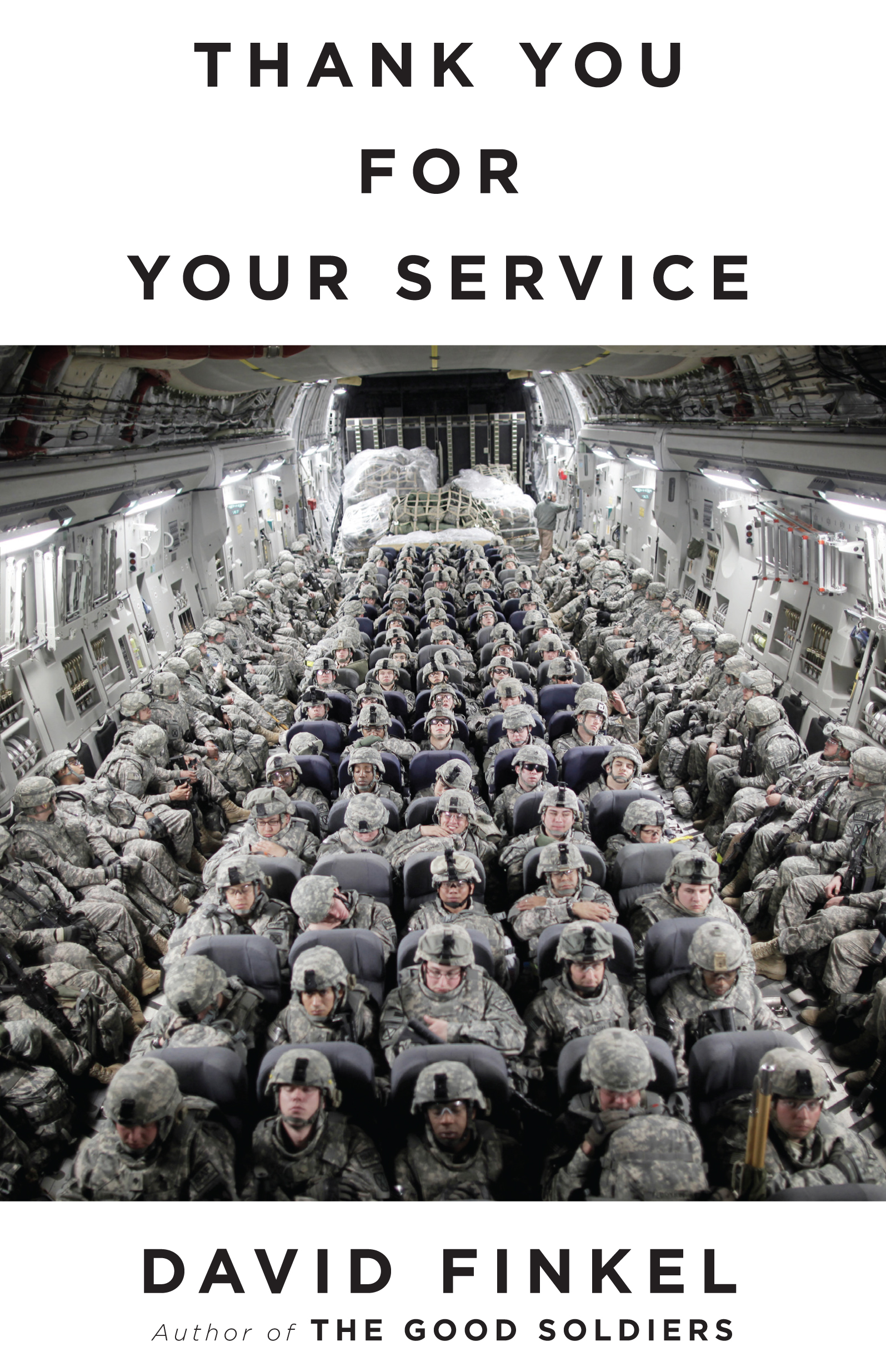
Book Review: David Finkel, Thank You For Your Service


David Finkel, Thank You For Your Service.  Toronto: Bond Street Books, 2013. 

I am slowly working my way through a stack of books about the wars in Iraq and Afghanistan that have been published in the last few years.   My hope is that these books will be useful in the ongoing work of my unit, the Canadian Armed Forces Chaplain School and Centre, and that they will better prepare my colleagues to support those, soldiers and their families, who have been touched by war.

Most of these books are about the US experience in the so-called War on Terror, or as journalist Dexter Filkins called it presciently, almost a decade ago, The Forever War.  However, today's title, while by a US author about US soldiers, seems highly relevant.  As Romeo Dallaire and Carol Off. write in their forwards,  “it could just as easily have been written about Canadians in Afghanistan”. 

“(T)he after-war continues, as eternally as war itself” is how David Finkel ends his book, Thank You For Your Service.  For years now, Finkel has dedicated his work as a journalist to documenting the reality behind the words, “thank you for your service”, too often uttered by those who know nothing to those who can say nothing about the horrible things they have seen and done.  In his honest and unsparing account of ordinary people trying to repair their lives, Finkel reminds us that the terror continues in what he calls the after-war.  Young men return broken and ashamed, afraid to tell their partners “stuff” for fear that they will be seen as monsters.  Young women try to find the patience to raise frightened children and protect them from fathers who have changed.  “As soon as he got home”, one wife says, “he really wasn’t the same no more at all”.

In an earlier book, The Good Soldiers, Finkel embedded with a US Army unit tasked with patrolling one of the most violent parts of Baghdad, “a sorry bomb-filled neighbourhood ... (where) the war felt eventually like the wrong everything”.  These soldiers would armour up, go through their good-luck rituals, and load into convoys of lightly armoured Humvees,   never knowing when they would be blown up.   I reviewed The Good Soldiers here in 2009.  Towards the end of his earlier book, Finkel focused on difficulties of soldiers coming home to the US on leave during their tours. 

He quoted a mental health care specialist who described home as a  "a place of disaster" for most soldiers, whose trips home to the US on leave midway through their tour were not what they expected.   "There's an anger in guys when they go back. They want to go home and be normal, and they're not quite normal," he said, and added, "Coming back from leave is the worst part of the deployment".  Now, years after the war, home is more than ever a place of disaster.

In Thank You For Your Service, Finkel follows some of these same men after their return to the US.  Some came home broken by too many deployments, having seen too much and feeling too much guilt for comrades shot or burned to death inside their vehicles.   The same bonds which held them together would eventually work against them, for as Finkel writes, “To be a soldier in combat was to full love constantly”, only to have the loved one killed or shattered or burned before one’s eyes.


For some of these returning soldiers, these lost comrades haunt them waking and sleeping, like one soldier whose friend appears regularly and says “You let me burn”.  For others, the effects of loss, guilt, and post-traumatic stress are compounded by the physical effects of violence on the body and especially on the brain.  Cognitive loss and dementia are just as real to these soldiers as they are to some professional athletes.   In this harrowing passage, Finkel describes the long-term effects of such an injury on a soldier who, years later, cannot remember how to buy flowers for his wife.

 "Before he got blown up, he could have figured it out.  How hard is it to buy roses?  There’s a flower shop on Fort Riley.  They sell them at Walmart.  But such are the effects of being in a Humvee that rolls over three buried 130-millimeter artillery shells, which explode at the perfect moment.  Up he went, and down he came, and once his brain was done rattling around from a blast wave that passed through him faster than the speed of sound, here came the rest of it.  Memory, fucked.  The ability to pay attention, fucked.  Balance.  Hearing.  Impulse control.  Perception.  Dreams.  All of it, fucked.  “The signature would of the war” is what the military calls traumatic brain injury …  (198)

 Thank You For Your Service takes the reader through a labyrinth of damaged bodies and psyches, and of broken relationships and domestic abuse, that plays out in bleak neighbourhoods around a military base, or in the offices and clinics of a bureaucracy hastily-assembled by a military scrambling to understand and cope with these many unexpected casualties.    While Finkel is sympathetic to the many military and civilian personnel struggling to assist these injured veterans and their families, his conclusion, again and again, is that it is not enough.  Ordered by the chain of command to analyze each suicide, unit and brigade leaders struggle to find out if the member has taken mandated suicide prevention training, as much to cover themselves as to develop lessons learned.  Well-meaning generals cooperate with medical researchers to assess risk factors for suicide, but find that explanations are elusive.  Soldiers are medicated but cannot find adequate long-term treatment programs.   Wives feel alone and cut off from help.  Families struggle to pay the bills as unemployable and wounded veterans run through their benefits.   All of these ongoing struggles are what Finkel calls the “after-war”, as if getting blown up in Baghdad is just the start.

 This is one of the most difficult and demanding books I have ever read about contemporary warfare.   Finkel’s honesty, and the incredible degree of access he has gained to ordinary and damaged people gives this book a brutal and stark truth that a hundred war novels and films could never hope to capture.   It is a book that demands far more of society than empty slogans and cheap celebration of its “warriors”.  While Finkel is not prescriptive in his solutions, he seems to suggest that these veterans demand, and are owed, far more time, attention and care than they currently receive.  However, a society that would pay its debt to these men and women would first have to acknowledge what it asked them to do, and that admission might prove too difficult.

 We should all read this book if only to gain a better understanding of how the ongoing physical, mental and moral injuries of the “after-war” can isolate and oppress those who have returned to an uncomprehending country that no longer feels like home.   A person of faith will note that there is next to nothing said here about how faith or spirituality can be resources for such veterans, a notable absence that should be noted by those chaplains working in the area of spiritual resilience. 

One sees glimpses of hope and endurance here and there, in the care and love that these broken soldiers show one another, or in the determination of a few to walk with them and help them.   As the book ends we see one family seem to start a new life together, somehow still together after countless quarrels and fights, but by then we have learned of  many others who never survived the after-war, having chosen to end their own pain and struggle through suicide.   As a chaplain you will find no easy answers for ministering to veterans like the ones described here, but you will better appreciate the reality of the pain and the immensity of the need.

MP+

Wednesday, April 30, 2014

US Military To Recognize Humanism

The US Army announced recently that it would formally recognize humanism as a religious preference if soldiers elect to self-identify as humanists.   For some time a US military member, Major Bradley, has been seeking to have his religious self-identification recognized as Humanist, and his request has been supported by the American Civil Liberties Union.  While some might use the term humanist and atheist interchangeably, Major Bradley is clear that while he does not believe in a god, the term atheist is an insufficient description of his beliefs.

 The Religion News Service explains the significance of this decision by the military:  In practical terms, the change means that humanists could face fewer hurdles in trying to organize within the ranks; military brass would have better information to aid in planning a deceased soldier’s funeral; and it could lay the groundwork for eventually adding humanist chaplains."

While there are advocates of humanist chaplains in the US military, I would not expect to see them anytime soon, but I do know of at least one advocacy group, the Forum on Military Chaplaincy, that supports the move.  The recognition of humanism by the Army probably means that we will see a humanist chaplain at some pony.

Religious Studies scholar Elizabeth Drescher has some interesting thoughts on why this move is significant.

For the record, there are no humanist chaplains in the Canadian Forces, and I am not aware of whether the CF allows members to self-identify this way.   At least one other NATO militaries (the Dutch, I believe), have humanist chaplains.


Monday, October 7, 2013

Deliver Us From … Hypocrisy: The US Senate Chaplain Speaks Truth To Power

He's a clergyman who looks sharp in a bow tie.  He's a retired Rear Admiral US Navy chaplain with an impressive CV.   He's a Seventh Day Adventist preacher who describes himself as being "liberal on some [issues] and conservative on others".  Each morning, recently, he berates 100 lawmakers in the US Senate for being a bunch of doofuses.

If that makes you curious about Barry C. Black, the US Senate chaplain, you can read a NYT profile of him and his work here and video excerpts of his prayers during the current US government shutdown here.

Given what I'm reading about the intransigence and foolishness going on in Washington DC, I'm thinking that Chaplain Black may be the last best hope of the USA.

Friday, October 12, 2012

No More Non Christian Prison Chaplains Says Canadian Government

A friend of mine put me on to this story tweeted by the Canadian church's Anglican Journal, reporting that the Canadian government will not renew contracts for non-Christian chaplains employed in Canadian federal prisons.

Vic Toews, the minister responsible, has apparently decided that non-Christian prison chaplains are not a good use of taxpayers' money and that Chris stian chaplains can take up the slack in ministering to Wiccans, First Nations believers, Moslems, etc. A spokeswomen for the minister is reported as saying that the government "is not in the business of picking and choosing which religions will be given preferential status through government funding. The minister has concluded … [Christian] chaplains employed by Corrections Canada must provide services to inmates of all faiths."

In today's Globe and Mail, journalist Lorna Dueck pushes back against the notion that Christian chaplains can adequately serve the needs of inmates of other faiths. She argues that the move not only promotes the impression at the government is giving Christianity preemince over other faiths, but also rests on the strange belief that all spiritual needs can be met by one faith. It would be like asking me as a Christian chaplain in the Canadian Forces to minister to a Moslem or First Nations soldier.

Dueck also argues that effective prison chaplaincy can serve the goals of rehabilitation and recidivism, which should also support the good use of taxpayer's dollars argument so beloved of Mr. Toews. I was pleased to see Ms. Dueck quote my fellow Wycliffe College alumnus, the Rev. Eleanor Clitheroe, CEO of Prison Fellowship Canada,who makes this argument:

“There are three parts we’re talking about here: spiritual issues, ethical issues and religious or faith issues. Faith is more than ethics. Ethical issues are around behaviour, and that’s important, but it has to be rooted in something for behaviour to change,” said Rev. Clitheroe. “When it is rooted in faith, we see the real transformation in people’s lives. It’s our view that Christian chaplains are not equipped to deal with languages, sacred writings and traditions of other religions. Because religious support is so effective, we would hope [Mr. Toews] could consider the distinction between ethical and spiritual support and faith-based transformation.”

Wednesday, November 23, 2011

A University Chaplain Brings Some Peace To Tense Campus

The tense campus is University of California at Davis, site of the now-viral images of a university peace officer casually pepper-spraying a row of sitting and apparently peaceful demonstrators on 18 November. The chaplain is the Rev. Kristin Stoneking, who was called in to campus the following day to defuse a tense situation outside the administration building. A group of students, feeling excluded from a press conference being held by the university chancellor, had gathered and the administration staff were feeling threatened and excluded.

Chaplain Stoneking was able to act as an interlocutor between the two groups, escorted the chancellor from the building, and descalated a potentially tense situation.

UC Davis Chancellor Linda Katehi walks with Rev. Stoneking past silent protesters as she leaves her office at the campus in Davis, California November 19, 2011. (BRIAN NGUYEN - REUTERS)

On her blog, Chaplain Stoneking wrote this:

What was clear to me was that once again, the students’ willingness to show restraint kept us from spiraling into a cycle of violence upon violence. There was no credible threat to the Chancellor, only a perceived one. The situation was not hostile. And what was also clear to me is that whether they admit it or not, the administrators that were inside the building are afraid. And exhausted. And human. And the suffering that has been inflicted is real. The pain present as the three of us watched the video of students being pepper sprayed was palpable. A society is only truly free when all persons take responsibility for their actions; it is only upon taking responsibility that healing can come.

Why did I walk the Chancellor to her car? Because I believe in the humanity of all persons. Because I believe that people should be assisted when they are afraid. Because I believe that in showing compassion we embrace a nonviolent way of life that emanates to those whom we refuse to see as enemies and in turn leads to the change that we all seek. I am well aware that my actions were looked on with suspicion by some tonight, but I trust that those seeking a nonviolent solution will know that “just means lead to just ends” and my actions offered dignity not harm.

I like this story because I believe it points to a function that all chaplains have the potential to fulfil, namely witnessing to our common humanity and values. As the Occupy movement becomes taken up in ideological talk of class warfare by both sides (note the perception of militarization in the linked articles), we need voices to pull us back from dehumanizing and demonizing one another. MP+

Monday, June 28, 2010

For One US College, Chaplaincy is an Unnecessary Luxury

I noticed this story in the NYT last week. Smith College may be an obscure place, but the issues involved in the story, namely how to quantify the value that chaplains can bring to an institution, are of note and are equally relevant in the contxt of military chaplaincy. Likewise the story's comments on how difficult it can be to offer meaningful yet generic Protestant worship would be well understood by CF protestant chaplains. MP+

June 18, 2010
A College Fires Its Chaplains to Save Money, and Students Move On
By MARK OPPENHEIMER
NORTHAMPTON, Mass.

When a chaplaincy dies, there is nobody to preside over the funeral. But if there were a funeral, would anyone show up?

In May 2009, Jennifer Walters, dean of religious life at Smith College, closed a budget gap by laying off her only three practicing chaplains, representatives of the American trinity of religious tradition: Protestant, Catholic and Jew.

The Rev. Leon T. Burrows, a Baptist minister; Elizabeth Carr, a Catholic laywoman; and Rabbi Bruce Bromberg Seltzer were allowed a final year, but by June 30, all will have vacated their Smith offices, spiritual and physical. Rabbi Seltzer and Dr. Carr will continue as chaplains at nearby Amherst College, which paid a third of the three chaplains’ salaries. But for the first time since 1935, there will be no chaplains at Smith.

According to Dr. Walters, the end of the chaplaincy was not just a matter of money.

On a weekly basis, “less than 100 students were actually participating in regular religious services provided by the college,” Dr. Walters said. “Maybe close to 50 total, to be honest.”

It is hard to tell who cares, or how much.

Read the whole story here.

Mad Padre

Mad Padre
Opinions expressed within are in no way the responsibility of anyone's employers or facilitating agencies and should by rights be taken as nothing more than one person's notional musings, attempted witticisms, and prayerful posturings.

Followers

Blog Archive

Labels