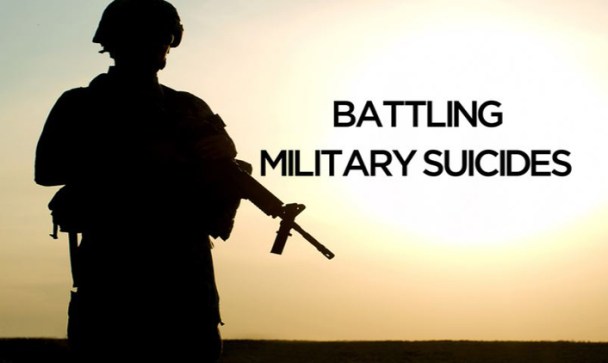
Showing posts with label Depression and Suicide in the Military. Show all posts

Wednesday, May 30, 2018

Book Review: Adam Montgomery, The Invisible Injured: Psychological Trauma in the Canadian Military From the First World War to Afghanistan

Here is a link to my review of the subject book, which appeared on The Strategy Bridge (TSB) this week.   For those of you who aren’t familiar with it, TSB is an excellent online journal for anyone interested in military history, contemporary military issues from doctrine to ethics, and foreign policy.  

https://thestrategybridge.org/the-bridge/2018/5/28/reviewing-the-invisible-injured

Disclaimer: while I am an associate editor for TSB, I had nothing to do with the selection of this piece.


MP


Monday, March 7, 2016

What Is The Good Death? Two Authors' Answers

With the Supreme Court of Canada grudgingly giving the federal government a little more time to prepare legislation on physician- assisted dying, and Canada's largest Roman Catholic Archdiocese joinining the debate, saying that it seeks to "protect vulnerable groups under Canada’s new law, and ensure that medical professionals who object to doctor-assisted dying on moral and religious grounds are exempt from providing those services", I suspect that this issue is on the minds of many.

Several times this winter, my neighbour B. and I have met in our driveays, leaned on our snowshovels and chatted.  B., a retired man somewhere in his seventies, is caring for his wife, who is dying of cancer and is struggling to manage her bodily functions and pain levels.  She has told B. that she would gladly die now if she could find someone to help her, which I can tell is distressing to him.  How many households across Canada have similar situations, I wonder.

Today I learned about  Anne Neumann, who is a visiting scholar at the Center for Religion and Media at New York University.  Neuman has just published a book called “The Good Death: An Exploration of Dying in America”. 


In this brief review published by the Religion New Service, Kimberly Winston notes that according to Neumann, religion is never greatest in our social life than at the time of dying, and religion influences laws and health care practices that work against assisted dying.

"Religion is most prevalent around the deathbed in our country,” Neumann, 47, said in a phone interview from her home in Brooklyn, N.Y. “That is where it is resoundingly proven that we are not a secular nation.”

“The laws, medical practices and corporate regulations that surround death and dying continue to be strongly influenced by religion, whether it is in the delivery of health care through Catholic hospitals, whether it is in the rituals that medical practice is infused with, or whether it is simply in the language that we find acceptable around the dying.”

At the end of the day, Neumann argues, the dying should be the ones who decide how they die.

“A good death is whatever a patient wants,” Neumann said. “It is not up to me, to their legislators, to their priests, to their families. That is true informed consent. A good enough death is as close as we can get because humans are not perfect. We can get so much closer, but we will never have a perfect death.”

Another person who seems likely to agree with Neuman, and who has also just written on the subject, is the incomparable Diane Rehm, a broadcaster on US public radio whose husband of 54 years recently died of Parkinsons.  Here is an excerpt of her interview with Jeffrey Brown ot the PBS NewsHour:

Now in a new book titled “On My Own,” she’s addressing a more personal an raw topic, the death of her husband John after 54 years of marriage. John was dying owed with Parkinson’s disease in 2005 and moved into an assisted living facility in 2012.

Two years later, in steady decline, he decided to end his life. But with doctors legally barred from assisting, his only option was to refuse food, liquids and medication. His death came 10 days later. Diane Rehm lives alone now with her dog Maxie and with lingering grief and anger over her husband’s last days.

DIANE REHM: I so resented that John was having to go through this long 10-day process to die. He had said 10 days earlier he was ready to die, and it took him that long. It shouldn’t have, I don’t believe, taken him that long.
JEFFREY BROWN: You write: “I rage at a system that wouldn’t allow John to be helped toward his own death.”
He knew what he was going through. You two had talked this through, and he just wanted to let it happen.
DIANE REHM: He wanted to relinquish life. He didn’t commit suicide. He wanted to let go of life and be on to the next journey.

Diane Rehm's book would be a good companion to Neumann's, I think.  Both are on my list.

MP+

Thursday, January 21, 2016

One American Soldier's Proposal To Address Military Suicides


This guest piece in Tom Ricks' Best Defence Blog caught my attention today. The author`s proposal, that the Department of Defence actively monitor its members' social media activity and intervene when there are posts, comments, or google searches suggesting suicidal ideation, may dismay some.

I`m not sure how that would even work in other countries' militaries such as my own. In one sense I agree with the author. Whatever the reasons for military suicide, be it prior deployments, the young adult demographic, or pre-existing mental health concerns, watching our comrades, whether in garrison or online as their FB friends, is the key. If you see something, you need to intervene, whether as a friend, as an NCO, or as an officer. That`s your responsibility.

MP+

Monday, July 9, 2012

Dr. Rich Mahogany Takes Men's Questions On Mental Health

Another h/t to the New York Times today for this great piece on a fictional doctor, Dr. Ron Mahogany, who you can find on the website ManTherapy.org. Mantherapy is a joint effort by several US agencies, including the State of Colorado Office of Suicide Prevention.

I heartily recommend this site to my chaplain colleagues dealing with men and looking for a humourous and non-threatening mental health resource for them. I think militaries, whose mental health campaigns tend to be distressingly earnest, could learn a lot from this website.

Thursday, October 28, 2010

Another Take on Video Shooter Games


Character from US Army recruiting video game, America's Army

My last post reminded me that I've beaked off on the subject of video games and ethics myself. Here's a link to an article of mine that appeared in the online journal of chaplaincy, Curtana: Sword of Mercy (Spring/Summer 2010). The link takes you to one big .PDF file but scroll down to find my article. Curtana is edited by former chaplain Robert Stroud and is an interesting venture - long may it prosper.

Friday, September 24, 2010

US Soldier's Near Death Experience Becomes Source of Hope for Comrades

An inspiring story of resilience from the AFPS, worth repeating. Sometimes it's all about hope. MP+

Soldier Turns Brush With Death Into Message of Hope
By Elaine Wilson
American Forces Press Service


Army Capt. Joshua Mantz speaks with Iraqi children while on patrol near Sadr City, Iraq, about an hour before an enemy sniper attacked his unit and nearly killed Mantz, April 21, 2007. A military medical team brought him back to life. Courtesy photo


WASHINGTON, Sept. 20, 2010 – Army Capt. Joshua Mantz was dying on a hospital bed in Iraq.

Just moments earlier, a sniper’s bullet had severed a femoral artery in his right thigh, causing massive blood loss. As the medical team strove to save him, Mantz struggled to take each breath. He felt the blood creep from his legs to his stomach to his chest -- a telltale sign of a catastrophic injury -- and knew the end was near.

He began repeating the names of his mother and two sisters in his head, over and over, and then had his last thought -- a prayer: “Please take care of them.”

He felt a deep peace and took one last breath. Everything faded to black, and he died.

Read the whole story here.

Monday, September 13, 2010

US Military's "Restoring Hope" Project Targets Military Suicides

Military suicides, especially since frequent stress and deployments in Iraq and Afghanistan, has been a huge issue for the US military. I was very impressed by the number of resources and stories put together on the Restoring Hope website and refer it to my colleagues, to soldiers and their families, and to everyone who cares about the people in uniform. MP+

Wednesday, June 23, 2010

US Military Pursues Link Between Suicides and Brain Ailments

Noting this piece below in today's US Defence Dept news feed. What's interesting about the figures in this piece is that suicides in the Marines and Army are increasing year by year since 2007, though that increase may be an increase in the actual number reported following investigations, due to militaries focusing more and more attention and resources on this problem. This report comes in the wake of a recent report carried June 17th on National Public Radio that US military suicides now equal combat deaths in Afghanistan. I learned about this NPR report while listening to a discussion of military suicides and their link to stress and strain on overdeployed personnel on the Diane Rehm show last week. The discussion is worth a listen, especially some of the comments by Nancy Yousseff, Pentagon correspondent with McClatchy News who has embedded with US troops in theatre and has noted the increase in attempts to try to make soldiers aware of depression and suicide.

Anyway, here's the Pentagon story:


Services Work to Learn More About Brain Ailments, Suicides
By Lisa Daniel
American Forces Press Service

WASHINGTON, June 22, 2010 – Post-traumatic stress, traumatic brain injury and suicides among servicemembers are interrelated problems requiring holistic prevention methods and more scientific study, military leaders told a Senate panel today. Video

“The reality is, the study of the brain is an emerging science, and there still is much to be learned,” Gen. Peter W. Chiarelli, Army vice chief of staff, told the Senate Armed Services Committee during a hearing about how the services are dealing with brain injuries and mental health problems.

The vice chiefs of the Navy and Air Force, the Marine Corps’ assistant commandant and a Veterans Affairs Department health official also spoke before the committee. All agreed with Chiarelli that the Defense and Veterans Affairs departments are coordinating better than ever to diagnose and treat brain injuries and mental disorders, and that much more is known about such conditions today than when combat operations began after Sept. 11, 2001.

Read the whole piece here.

Thursday, May 20, 2010

''Sometimes you just can't get away from the things you have seen.''


Lance Corporal Johnson Beharry is a Grenadan-born soldier in the British Army who won the fabled Victoria Cross, the Commonwealth's highest decoration for valour in combat, in Iraq in 2004. He recently told the British media of how, in December 2008, he attempted to kill himself by driving his sports car into a street light. The UK's The Sun ran a piece today describing some of the therapies used to treat soldiers such as Beharry (1 in 20 in the British Army) who suffer from PTSD.

How Soldiers Can Save Their Buddies From Suicide

As part of our mental health programs, the Canadian Forces we run a suicide intervention program called ASIST (Applied Suicide Intervention Skills Training), which teaches soldiers what signs to watch for and gives them strategies to come alongside and assist a friend or comrade who may be acting suicidal. This story from the US Department of Defence News Service offers a great example of what that sort of friendship and intervention looks like in real life. MP+

Face of Defense: Buddy’s Concern Saves Soldier’s Life


By Zach Morgan
Fort Polk Guardian

FORT POLK, La., May 18, 2010 - Aug. 7, 2008, was a hot day in Iraq, and it seemed as if the walls were closing in on Army Spc. Joe Sanders.


Army Cpl. Joe Sanders and Spc. Albert Godding pose April 27, 2010, after Godding received a Meritorious Service Medal for preventing Sanders' suicide in Iraq in 2008U.S. Army photo by Zach Morgan

Sanders had deployed to Iraq with the 10th Mountain Division's 5th Battalion, 25th Artillery Regiment, 4th Brigade Combat Team. Sander's wife was leaving him, and he had several months left to serve in Iraq when he attempted suicide by turning his weapon on himself.

His battle buddy, Army Spc. Albert Godding, had seen the signs of Sanders' stress, and removed the firing pin from his friend's rifle earlier that day. The weapon misfired and Godding confronted his friend about the attempt. Sanders sought counseling and made it home alive.

On April 27 here, Godding received the Meritorious Service Medal for his actions. He is now with the 4th Infantry Division's 1st Brigade Combat Team at Fort Carson, Colo., and was at Fort Polk for a pre-deployment rotation with his unit when he received the award.

Sanders is thankful his friend had intervened in Iraq.

"Every day I wake up, I have to thank Godding," he said. "If it wasn't for him, I wouldn't have gotten to experience my fiancée. I wouldn't have gotten to lead troops, or attend schools and learn. Those are things I love to do."

Read the whole piece here.

Mad Padre

Mad Padre
Opinions expressed within are in no way the responsibility of anyone's employers or facilitating agencies and should by rights be taken as nothing more than one person's notional musings, attempted witticisms, and prayerful posturings.

Followers

Blog Archive

Labels