I just noticed this slightly dated (14 Feb 2017) on the Modern War Institute of West Point website about a panel of writers speaking on the value of writing fiction.
The panel included one writer I have reviewed on this blog, Phil Klay, author of Redeployment, a book of short stories, as well as Matt Gallagher, author of Youngblood, a book on his experience with the US Army in Iraq, and August Cole, author of Ghost Fleet, a speculative look at a near-future war between the US and China.
The panelists spoke to an audience of West Point cadets about the value of fiction as a way of processing experience and even developing a "radical empathy" for others and other points of view.
I remain hopeful that we will see a similar event with Canadian soldiers turned writers, perhaps at Royal Military College, in the not too distant future, but these writers have yet to emerge.
MP+

Showing posts with label Military News. Show all posts
Showing posts with label Military News. Show all posts
Wednesday, April 26, 2017


Monday, January 25, 2016
Three Journalists Reflect On Covering Today's Wars

This interview between War on the Rocks' editor Ryan Evans and three working journalists - Nancy Yousseff, David Wood and Paul Shinkman is well worth listening to.
The three discuss the difficulties journalists face in covering wars today, their profound admiraton and even love of military personnel and the need to be objective, and the increasing lack of news organizations in covering defense issues. Those in uniform tasked with working with the media and civilians interested in healthy deomcracy will all get something from this conversation.
It's all good stuff, but about half way through the discussion, when they discuss moral and physical injury and the human cost of war, it gets riveting. You realize that these are three people who care deeply about their work and its importance.
Some of David Wood's other work on severely wounded veterans, a subject he obviously cares for deeply, can be found here.
Friday, October 9, 2015
Was Kunduz A War Crime?
A week after US warplanes bombed a hospital run by Doctors Without Borders (MSF) in Kunduz, Afghanistan on 3 October, killing over twenty staff and patients, Afghanistan, there is some debate as to whether the bombing was a war crime.
On 8 October, Dr. Joanne Liu, the President of MSF issued a statement that included these words.
"It is precisely because attacking hospitals in war zones is prohibited that we expected to be protected. And yet, ten patients, including three children and twelve MSF staff, were killed in the aerial raids.
The facts and circumstances of this attack must be investigated independently and impartially, particularly given the inconsistencies in the US and Afghan accounts of what happened over recent days. We cannot rely on only internal military investigations by the US, NATO, and Afghan forces.
Today we announce that we are seeking an investigation into the Kunduz attack by the International Humanitarian Fact-Finding Commission (IHFFC). This Commission was established in the Additional Protocols of the Geneva Conventions and is the only permanent body set up specifically to investigate violations of international humanitarian law. We ask signatory States to activate the Commission to establish the truth and to reassert the protected status of hospitals in conflict. MSF has called the event a war crime and has demanded an international investigation."
Whether these attacks constitute a war crime, a deliberate breach of the Geneva Convention protections on hospitals in war zones, will be up to the IHFFC, which BBC News describe as a "never-used body" to determine.
A week after the event, some facts are apparent. The hospital, seen here in this photo from an MSF factsheet on the bombing, was clearly marked as such, and its location was known to NATO and Afghan authorities.

The MSF has denied claims from the Afghan government that enemy forces were operating on the hospital grounds.
This week the New York Times reported that the US forces involved were apparently not in a position to confirm what was happening at the hospital when they ordered the strike.
“Obviously, the investigation is still underway, but Campbell’s thinking now is that the Americans on the ground did not follow the rules of engagement fully,” said one of three American officials, all of whom emphasized that no final conclusions had been reached and that the inquiry could yield different reasons for what transpired.
Under Article 18 of the Geneva Convention, hospitals enjoy protected status in war zones provided that they are being used as hospitals, as this UN commentary on the Article notes.
A civilian hospital must have the staff (including administrative staff) and the equipment required to fulfil its purpose. It must be organized to give hospital care. That is the essential point. It is not necessary for the hospital to function permanently as a hospital. The Diplomatic Conference considered that establishments converted into auxiliary hospitals as an emergency measure consequent upon the events of war, should not be excluded from the protection of the Convention (5), as such hospitals are very often established in the combat area itself, and their need for protection is thus all the greater. The deciding factor is, as has just been mentioned, that it must be effectively possible to give hospital treatment and care, and that necessarily implies a modicum of organization.
Clearly the hospital in Kunduz was organized to provide care, and was entitled to the protection of the Geneva Convention.
In an interview with NPR, an American law professor noted that to convince a court or tribunal that this a war crime, as something more than an accident, would be difficult.
Still, it is a high bar to call the Kunduz attack a war crime, says Robert Goldman, who teaches international law at American University.
"Are we going to have to make some kinds of reparation and so forth? Well, I think, you bet," he says. But, he cautions, it will be difficult to make a case that this was an intentional attack on a protected place — rather than just a case of poor intelligence or negligence.
"The burden would be on the prosecution to establish beyond a reasonable doubt that this was an attack willfully undertaken in the knowledge that it was an object entitled to protection," Goldman says. "That is a very, very high hurdle."
At the very least, the bombing of the hospital in Kunduz was the result of haste, the "fog of war", chaos, and poor communications. It should not have happened. It seems unlikely that those who bear responsibility will face international justice, but the doubtless will face internal investigation, and possibly reprimand and dismissal. Beyond those consequences, those who called the mission, authorized it, flew it, and fired the weapons will face the moral consequences and injury for the rest of their lives.
On 8 October, Dr. Joanne Liu, the President of MSF issued a statement that included these words.
"It is precisely because attacking hospitals in war zones is prohibited that we expected to be protected. And yet, ten patients, including three children and twelve MSF staff, were killed in the aerial raids.
The facts and circumstances of this attack must be investigated independently and impartially, particularly given the inconsistencies in the US and Afghan accounts of what happened over recent days. We cannot rely on only internal military investigations by the US, NATO, and Afghan forces.
Today we announce that we are seeking an investigation into the Kunduz attack by the International Humanitarian Fact-Finding Commission (IHFFC). This Commission was established in the Additional Protocols of the Geneva Conventions and is the only permanent body set up specifically to investigate violations of international humanitarian law. We ask signatory States to activate the Commission to establish the truth and to reassert the protected status of hospitals in conflict. MSF has called the event a war crime and has demanded an international investigation."
Whether these attacks constitute a war crime, a deliberate breach of the Geneva Convention protections on hospitals in war zones, will be up to the IHFFC, which BBC News describe as a "never-used body" to determine.
A week after the event, some facts are apparent. The hospital, seen here in this photo from an MSF factsheet on the bombing, was clearly marked as such, and its location was known to NATO and Afghan authorities.

The MSF has denied claims from the Afghan government that enemy forces were operating on the hospital grounds.
This week the New York Times reported that the US forces involved were apparently not in a position to confirm what was happening at the hospital when they ordered the strike.
The Special Operations Forces also apparently did not have “eyes on” — that is, were unable to positively identify — the area to be attacked to confirm it was a legitimate target before calling in the strike, the officials said.
Regardless of what mistake may have been made, General Campbell told a Senate committee on Tuesday that the strike was ultimately the result of “a U.S. decision made within the U.S. chain of command.” He took responsibility for the sustained bombardment of the medical facility, which he said took place in response to an Afghan call for help.
“Obviously, the investigation is still underway, but Campbell’s thinking now is that the Americans on the ground did not follow the rules of engagement fully,” said one of three American officials, all of whom emphasized that no final conclusions had been reached and that the inquiry could yield different reasons for what transpired.
Under Article 18 of the Geneva Convention, hospitals enjoy protected status in war zones provided that they are being used as hospitals, as this UN commentary on the Article notes.
A civilian hospital must have the staff (including administrative staff) and the equipment required to fulfil its purpose. It must be organized to give hospital care. That is the essential point. It is not necessary for the hospital to function permanently as a hospital. The Diplomatic Conference considered that establishments converted into auxiliary hospitals as an emergency measure consequent upon the events of war, should not be excluded from the protection of the Convention (5), as such hospitals are very often established in the combat area itself, and their need for protection is thus all the greater. The deciding factor is, as has just been mentioned, that it must be effectively possible to give hospital treatment and care, and that necessarily implies a modicum of organization.
Clearly the hospital in Kunduz was organized to provide care, and was entitled to the protection of the Geneva Convention.
In an interview with NPR, an American law professor noted that to convince a court or tribunal that this a war crime, as something more than an accident, would be difficult.
Still, it is a high bar to call the Kunduz attack a war crime, says Robert Goldman, who teaches international law at American University.
"Are we going to have to make some kinds of reparation and so forth? Well, I think, you bet," he says. But, he cautions, it will be difficult to make a case that this was an intentional attack on a protected place — rather than just a case of poor intelligence or negligence.
"The burden would be on the prosecution to establish beyond a reasonable doubt that this was an attack willfully undertaken in the knowledge that it was an object entitled to protection," Goldman says. "That is a very, very high hurdle."
At the very least, the bombing of the hospital in Kunduz was the result of haste, the "fog of war", chaos, and poor communications. It should not have happened. It seems unlikely that those who bear responsibility will face international justice, but the doubtless will face internal investigation, and possibly reprimand and dismissal. Beyond those consequences, those who called the mission, authorized it, flew it, and fired the weapons will face the moral consequences and injury for the rest of their lives.
Monday, September 28, 2015
Whither Canada's Military, and Who Will Pay For It?

Last week I offered some thoughts here about the burdensome costs that first world countries must contemplate to put soldiers in the field.
On the CBC website today, Brian Stewart offers some thoughtful comments on relationship between the cost of a standing military and the need to have a rationale for that cause. Stewart notes some startling numbers as to what it will take to bring the Canadian Armed Forces to reequip the Canadian Armed Forces with ships, aircraft and ground equipment such as tricks.
"We're going to need to add on much more — between $33 billion and $42 billion across the coming decade — just to adequately modernize and maintain our military, warns Parliamentary Budget Officer Jean-Denis Frechette.
And even that wouldn't satisfy our allies. Leaders of the NATO alliance, especially the U.S. and U.K., nag that we should be spending twice what we're now doing, up from one per cent of GDP to the two per cent that NATO members have set as the common goal.
The last time Canada hit that two per cent mark was (surprise) under Pierre Trudeau over 40 years ago, and we're not about to get even remotely close in the foreseeable future.
So we remain slumped near the bottom of NATO, 22 out of 28 in the percentage of GDP that we spend on a common defence."
The essential problem is that since the Cold War, no party has been able to articulate a coherent rationale for why Canada needs a military or what sort of military it should be. Even during the height of the Cold War, there were disagreements within the military and civilian leadership as to whether Canada needed more than a trip-wire force in Europe when World War Three was likely to end in nuclear suicide. Peter Kasurak’s book A National Force: The Evolution of Canada`s Army, 1950-2000 (UBC 2013) tells this story in detail, noting that Canadian Army planners were allowed to fantasize about building a standing army of corps strength, along the lines of the army of 1940-1945, while their political masters had no intention of ever authorizing such expenditures when the uses of such an army were unclear and difficult to justify.
History shows that we build up our military only once the shooting starts, which is why Canadians went to Afghanistan riding in obsolete Iltis jeeps and ended up in Chinook helicopters. That was ad hoc, not planned, spending. The reality is that other than Search and Rescue capabilities, and some vague conception of peacekeeping, the Canadian public can not agree on what sort of military it wants. If you read the comments on the CBC website in response to the Stewart article, you will see that readers are all over the map, from build the army to cut the army to bring the troops home. Taxpayers almost certainly won't pay for a large standing military until we get into a major war, in which case, taxpayers won't have a choice.
Tonight I’m listening to the federal leaders’ debate on foreign policy, and I have yet to hear anything thoughtful on what Canada’s foreign policy should be and how that might drive our military commitments.
MP
Wednesday, September 23, 2015
Military Taxdollars At Work
From today's New York Times, "David Petraeus Urges Stronger U.S. Military Effort in Syria":
"A Pentagon effort to train rebel forces to take on the Islamic State has produced only a handful of fighters. Officials with United States Central Command, which oversees American military operations in the Middle East, said Monday that only about 70 individuals who had been trained under a $500 million program to take on the extremists were currently in the field."
Leaving aside the fact that David Petaeus has apparently finished his moral timeout, and is now qualified to be a foreign policy advisor, I couldn't resist doing the math on this one. Assuming that all $500 million was actually spent on 70 Syrian fighters, which is probably not the case, that works out to $7,142,857 per moderate Syrian rebel.
While it's tempting to think that it would be cheaper, or at least only slightly more expensive, to develop sentient autonomous killer robots, it's worth noting that putting a soldier in the field in the contemporary battlespace, according to Western standards of warfighting, is expensive.
In 2012, CNN reported that it cost between $800,000 and $1.4 million to deploy a US soldier. I haven't found any figures on what it costs to deploy a Canadian Forces member per year, in 2010 the Vancouver Sun reported that if you divided the 2010 cost of the Afghanistan mission by the number of soldiers deployed, that worked out to about $550,000 per military member in theatre. That figure did not take into account the cost of the member's salaries, or the differences in equipping and training, say, a combat infantry soldier from a helicopter pilot.
These estimates don't take into account the long-term costs of pensions, post war retraining (e.g. GI Bills) and medical support and rehabilitation for seriously wounded soldiers, who are much more likely to survive than than were in previous wars. These costs are not likely to be born by the US for proxy Syrian fighters, but they should be considered in the cost that a first-world country will bear in fielding a combat force.
As politicans talk about what sort of standing militaries their countries should have to protect national interests and project power abroad, and whether highly paid volunteer militaries are still viable (as opposed, say, to some form of national service), constituents need to reflect on what they are willing to pay for. Furthermore, when a politican includes expensive military commitments among his or her campaign language (viz. Ms. Fiorina at the most recent Republican candidates' debate), it's worth asking what the actual cost of militar force in the 21st century actually might be.
MP+
"A Pentagon effort to train rebel forces to take on the Islamic State has produced only a handful of fighters. Officials with United States Central Command, which oversees American military operations in the Middle East, said Monday that only about 70 individuals who had been trained under a $500 million program to take on the extremists were currently in the field."
Leaving aside the fact that David Petaeus has apparently finished his moral timeout, and is now qualified to be a foreign policy advisor, I couldn't resist doing the math on this one. Assuming that all $500 million was actually spent on 70 Syrian fighters, which is probably not the case, that works out to $7,142,857 per moderate Syrian rebel.
While it's tempting to think that it would be cheaper, or at least only slightly more expensive, to develop sentient autonomous killer robots, it's worth noting that putting a soldier in the field in the contemporary battlespace, according to Western standards of warfighting, is expensive.
In 2012, CNN reported that it cost between $800,000 and $1.4 million to deploy a US soldier. I haven't found any figures on what it costs to deploy a Canadian Forces member per year, in 2010 the Vancouver Sun reported that if you divided the 2010 cost of the Afghanistan mission by the number of soldiers deployed, that worked out to about $550,000 per military member in theatre. That figure did not take into account the cost of the member's salaries, or the differences in equipping and training, say, a combat infantry soldier from a helicopter pilot.
These estimates don't take into account the long-term costs of pensions, post war retraining (e.g. GI Bills) and medical support and rehabilitation for seriously wounded soldiers, who are much more likely to survive than than were in previous wars. These costs are not likely to be born by the US for proxy Syrian fighters, but they should be considered in the cost that a first-world country will bear in fielding a combat force.
As politicans talk about what sort of standing militaries their countries should have to protect national interests and project power abroad, and whether highly paid volunteer militaries are still viable (as opposed, say, to some form of national service), constituents need to reflect on what they are willing to pay for. Furthermore, when a politican includes expensive military commitments among his or her campaign language (viz. Ms. Fiorina at the most recent Republican candidates' debate), it's worth asking what the actual cost of militar force in the 21st century actually might be.
MP+
Wednesday, October 29, 2014
Military Picture of the Week: Odd Man Out
One of those three Grenadier Guardsmen is actually a cake, which may be the strangest thing I’ve ever written on this blog.

The cake is to celebrate the start of the British Legion’s annual Poppy Campaign. More info here.
Wednesday, July 23, 2014
Medal Charges May Seem A Small Thing, But They Say Much About Military Culture

This is a soldier’s resume, if you know how to read it.
Two days ago the Globe and Mail reported that an officer in the Royal Canadian Air Force, Lt. Col. Debbie Miller, has been charged following an investigation to determine if she wore medals on her uniform that she was not authorized to wear. It’s not clear from the article what the medals are. In an earlier version of this post, I incorrectly inferred from the article that the medals might have been the Order of Military Merit, awarded for “exceptional” performance of one’s duty, and the Canadian Forces Decoration Medal, or CD, awarded to all ranks who have completed twelve years of service of good conduct. Thanks in part to blog reader Edwin King, I learned that Lt. Col. Miller was in fact awarded the OMM and has certainly earned the CD and clasp, since she was first commissioned in 1981. In 2012, a court martial found Lt. Col. Miller guilty of twice presenting a document saying she had passed a Physical Fitness test which she had in fact failed, but the investigation mentioned in the G&M article appears to be about medals.
Napoleon once said of medals that “A soldier will fight long and hard for a scrap of ribbon”, which may explain why, in military culture, wearing medals (also known as decorations) that one has not earned is significant offence. Google “Stolen Valor” and you will find websites dedicated to exposing or “outing" individuals, many of them civilians, wearing medals and/or military uniforms that they have no right to wear.
To those outside military culture, it may seem odd that a person would want to risk the humiliation of being caught in such a masquerade. However, as Dr. Johnson once observed, “Every man thinks meanly of himself for not having been a soldier, or not having been at sea”. In a culture, particularly US culture, where the military may be the only public institution that still commands respect, one could see why some might want the counterfeit respect of being taken for a member of the military. But even within military culture, the wearing of medals is rather like walking about with one’s curriculum vitae pinned to one’s chest. In general there are three types of medals, given for good service (like the Order of Military Merit), given for particular tours or deployments (such as to Afghanistan), or medals indicating length of service (such as the CD). There are also uniform items that connote particular qualifications and elite status, such as the Ranger tab indicating special forces training with the US military, an especially coveted and respected item in the Canadian Army. Some militaries are more lavish with medals than others. Our American friends, for example, tend to wear more decorations than do their Canadian and British colleagues.
To go on parade with one’s decorations, earned through sweat, danger, and hard service, is an act of pride. In military slang, a large collection of medals is known as a “rack”, and a “big rack” is looked on with favour. I can attest that going on parade with few, or in my case, despite nine years of service, no medals, requires some humility, and I can therefore understand why a soldier, even a senior officer who should have known better, might give into the temptation of wanting to appear more seasoned than he or she really is. I suppose it could be seen as the military equivalent of burnishing or falsifying one’s resume. The temptation to exaggerate ons accomplishments has often proved irresistible for the high as well as the low, as is seen in this week’s New Yorker profile of US Vice President Joe Biden, who has been known to exaggerate his credentials during his career. As Evan Osnos says of Biden in that article, “Looking over the record of his exaggerations and plagiarism, I came to see them as the excesses of a man who wants every story to sing, even at the risk of embarrassment”.
The four principle virtues of the Canadian Armed Forces are Courage, Integrity, Loyalty and Duty. A soldier, particularly an officer, should understand that these virtues do not permit one to embellish one’s rack or resume, no matter how much they might want their story to ‘sing”. Perhaps the best antidote to this counterfeit glory is the humility often seen in those who wear their medals lightly, as in the soldier who says that his or her award for valour was really earned by their unit, or in the saying, often heard by Canadian soldiers with the CD, that it was given for 12 (or more) years of “undetected crime”.
Wednesday, February 19, 2014
More Weird And Scary
On the heels of yesterday’s post on the strangeness of the Cold War, here’s an image from today’s Foreign Policy website that is replete with weirdness and scariness.

This image, from a July 2013 parade, shows North Korean special forces troops wearing chest packs with garish radiation symbols. This may just be Nork posturing - the packs could just be dummies stuffed with old newspaper, as one commentator has suggested. Or they may be man-carried dirty bombs, a resurfacing of old Cold War research on radiological warfare. If I was one of these guys, and I was actually wearing a dirty bomb on my chest, I’m not sure I’d be grinning and waving inanely.
Thursday, July 18, 2013
The Canadian Army Goes Back To The Future

This photograph of a group of junior officers relaxing was taken sometime around 1960. You can tell they belong to the Canadian Army because of the cap badges, if you know what you're looking for. The fellow in beret second from right, who just happens to be my father, wears the cap badge of the Royal Canadian Regiment, while the fellow seated far left is a Royal Canadian Dragoon (I can't make out the other cap badges). You can tell they are junior officers because four of them visibly wear three pips on their shoulders showing that they are captains, reflecting the evolution of our military from the British Army.
Today Canadian Army officers wear the American-style bars that we adopted in 1968, but earlier this month it was announced that we are going back to the future. As my brother the Mad Colonel put it, it's "Not quite back to brown uniforms, boots and puttees but getting there". These changes were announced by the Rt. Hon. Peter McKay in early July before he finished his tenure as Minister of National Defence. The commander of the Canadian Army, General Devlin, has said this:
“The restoration of these features is a significant step in the restoration of the Canadian Army’s traditions,” said Lieutenant-General Peter Devlin, Commander of the Canadian Army. “Symbols and traditions establish links to soldiers’ heritage, and are important. It is very significant that our non-commissioned members have the prospect of being able to bear the same ranks as their forbearers, and our officers will proudly wear the same insignia worn by Canadians who fought in the First and Second World Wars and Korea.”
This somewhat oversized graphic shows the rank insignia that Army officers will adopt. Non-commissioned members will keep their rank but in some cases will return to old rank titles such as Sapper, Bombardier, Fusilier or Guardsman rather than Private, depending on their regiment.

Since I have spent the last three years working with British Army personnel at CFB Suffield, I am familiar with British army insignia and know things like how a Major's crown is smaller than a Warrant Officer's crown. My colleagues without this experience will struggle at first. While I respect General Devlin's desire to honour our heritage, I do find it slightly ironic that no one currently wearing officer's rank in the Canadian Army is old enough to wearing the British-style rank of my father's day. That generation has either passed on or is in retirement. It's also curious that, as Colonel Ian Hope wrote of his time leading Task Force Orion in Afghanistan in 2006, our interoperability in theatre in the last decade has been with the US Army, so that culturally we are more like them now than we are like the Brits. American and Canadian soldiers can currently look at each other and understand the rank insignia, but there will be some Yanks scratching their heads in future theatres until they figure out our "new" ranks.
Fortunately for me, this is all above my pay grade and it won't matter in the short term as I am shortly taking off the uniform for two years while a soldier-student, so it's back to school before it's back to the future. In two years from now, I'll be putting on a new-style army combat uniform with (possibly, depending on the time it takes to phase this in), three captain's pips and maybe a major's crown to look forward to one day. For army chaplains, though, a vexing question presents itself. The combat uniform slip-on (the piece of fabric worn on the chest of the combat or everyday uniform to show rank and trade) only has room for three captain's pips, which is why British army padres of captain's rank wear crosses on their collars and the word "Padre" as part of their name tag. With the current Canadian slip-on for army padres, there is enough room for both the rank bars and the cross (or crescent or torah scroll). What will Canadian army padres of captain's rank wear when we go back to the future? Black puttees, perhaps?
Wednesday, May 22, 2013
Men In Uniform Behaving Badly - The Sad Parade Continues

This sad looking fellow is a face that should live in military infamy. It belongs to a Lt. Col. Jeff Krusinski, who was in charge of the US Air Force's program to prevent sexual assault until he, well,ummm, oh dear, this is awkward, until he sexually assaulted a woman in a Virginia parking lot. Judging from the mug shot, he got the worst of it, which is in itself not a bad thing. When news of this story broke recently, the US Secretary of Defence announced that he would take a personal interest in seeing Krusinski was properly punished, which pretty much guarantees the acme of military career flameouts.
Unfortunately, it gets worse. Following revelations that the number of reported sexual assaults in the US military had risen six percent from 2012, going from 3,192 to 3,374, several other military men charged with the safety of their female peers and subordinates in uniform have also been accused of the very offences they were charged with preventing. Last Friday, Tom Ricks mordantly proposed a new competition, asking "Has your base's sexual assault czar been arrested yet?", in response to stories that two other US servicemen with duties similar to Krusinksi's had been relieved of duties and charged. One was accused of stalking his ex-wife, the other was accused of "pandering, abusive sexual contact, assault and maltreatment of subordinates." The issue has become sufficiently prominent that NPR's Tom Ashbrook recently dedicated an hour to it.
Lest I come across as being smug at the expense of the US military, I should note that a Canadian Forces base commander was recently relieved of his command and "faces a charge of sexual assault and two charges under the National Defence Act — disgraceful conduct and drunkenness". It is not the first time in this officer's career that he has been in trouble for sexual misconduct. While I don't have any current data for the prevalence of sexual assault in the Canadian Forces, the Ottawa Citzen reported in 2011 that the number of sexual assault complaints made in the CF in 2010 was 176, slightly up from the 166 complaints made in 2009.
I think we are seeing several trends happening here. The first is that as western militaries cease to be exclusively male preserves, and as lawmakers and elected officials charged with military oversight now include prominent and outraged women, we will see fewer excuses for male soldiers to behave badly. The second is that the current approach to fighting sexual misconduct in the ranks is now revealed as being badly flawed. It will no longer be enough to create a program aimed at preventing misconduct and giving it to an underperformer to administer. In my own experience in the military, I've seen examples of posts and programs aimed at making people virtuous, such as the Unit Ethics Officer, given as secondary duties to nonentities because no one else wants them. Making ethics or sexual assault prevention the responsibility of one person, especially someone whose career has stalled, is pretty much a guarantee that the idea behind that program won't be taken seriously.
Another trend, and I'm surprised that no one has mentioned it in this context, is pornography. Perhaps its the elephant in the room, but I think it needs to be discussed in relation to the issue of how women are mistreated in the military. Not to put too fine a point on it, but the military culture tolerates, and even encourages, the consumption of porn. In the case of the Canadian officer I mentioned above, his earlier misconduct seems to have been linked to porn. Feminists have been saying for decades that the consumption of pornography encourages men to objectify and dehumanize women, and I agree with this basic argument because I see it in my military peers. I don't see a way to make pornography magically disappear, but I don't see any way forward for militaries composed of men and women until we can start talking about it.
Thursday, February 21, 2013
Thinking Ethically About The New Cool War
On the Foreign Policy website today, David Rothkopf uses the term "Cool War" (new to me) to describe so called "cyberwar", the use of computer hacking and digital attacks by state actors on one another. A very current example of cyberwar was in the headlines this Tuesday with the Mandiant report on Chinese Army hacking of US computer networks. Here's Rothkopf explaining why the "Cool War" is different from the "Cold War" that those of us over the age of thirty remember.
"This new war is "cool" rather than "cold" for two reasons. On the one hand, it is a little warmer than cold because it seems likely to involve almost constant offensive measures that, while falling short of actual warfare, regularly seek to damage or weaken rivals or gain an edge through violations of sovereignty and penetration of defenses. And on the other, it takes on the other definition of "cool," in that it involves the latest cutting-edge technologies in ways that are changing the paradigm of conflict to a much greater degree than any of those employed during the Cold War -- which was, after all, about old-fashioned geopolitical jockeying for advantage in anticipation of potential old-school total warfare.
The Cool War is largely different not only because of the participants or the nature of the conflict, but also because it can be conducted indefinitely -- permanently, even -- without triggering a shooting war. At least that is the theory."
I hope that someone in the legal and military comunity who thinks about Laws of Armed Conflict (LOAC) is tracking this. LOAC is geared to kinetic conflict, where bullets and bombs are employed to cause physical harm, and is designed to protect the innocent (civilians, non-combatants) from violence and ill treatment. The sanctions exercised by the world community (eg, the International Criminal Tribunal for the former Yugoslavia in the Hague, NL) are designed to deter the leaders of states or sub-state actors (militias, guerrilla armies, etc) from war crimes committed in a kinetic conflict through fear of arrest, prosecution and imprisonment.
What fear, other than the fear of escalation to a kinetic, military conflict, deters those who order cyberattacks on other countries and, by extension, on their people? It's one thing to steal plans from a major defense manufacturer, but what happens when Cool Warriors start touching the lives of populations? In an increasingly fragile and technologically dependent world, this future is not hard to imagine. What if banking were to crash for an extended period, causing economic crisis and even hunger? What if the power grid were brought down in the depths of winter, or air transport was halted by the hacking of navigation aids, satellites, etc? What if civilian populations are displaced, harmed, or even killed by these actions? Could those responsible be charged with war crimes? Could these crimes even be defined?
One thing is for certain. We are, as Rothkopf writes, "in the midst of a sea change in the way nations project force". It would be helpful for the international community to discuss how we might limit the uses of this new force, while we still can.
Thursday, January 24, 2013
US Militay To Lift Ban On Women In Combat Roles
Discussion of this story on last night's PBS News Hour:
Watch Secretary Panetta Lifts Military Ban on Women in Combat on PBS. See more from PBS NewsHour.
Thursday, January 17, 2013
Sadly, No Death Star Anytime Soon
It's astonishing to me that over 30,000 people signed a petition calling on the White House to "build the "Star Wars" inspired super-weapon to spur job growth and bolster national defense". I shouldn't be surprised at what people will sign. When I was on a whale watching tour in Nova Scotia I was entranced to learn that Greenpeace had called for names for a humpack whale it was following on its South Atlantic migration, and the winning name, with 119,367 votes, was Mr. Splashy Pants.
I still want to know, what were these people thinking? Does anyone really, seriously think that a Death Star, a moon-sized, galaxy roaming, planet-killing vessel, is either feasible or desirable? And how would it protect US security, seeing as US security problems, such as North Korea and Iran, are, well, on the same planet as the US? That would rather invalidate the planet-killing capability of the Death Star.
Fortunately, cooler heads are prevailing in Washington. On Friday last, "Paul Shawcross, an administration adviser on science and space, said a Death Star would cost too much to build — an estimated $850 quadrillion — at a time the White House is working to reduce the federal budget. Besides, Shawcross says, the Obama administration "does not support blowing up planets."
So it being a slow day in the mess, a bunch of us were thinking that it would be cool to be part of Death Star Command, assuming that such a thing was ever stood up. Just the shoulder badge alone would be awesome.

On the way home, I got to thinking about the merits of Canada stepping in, since the US is not interested in the project. I decided it would be unlikely, and here's why.
Top Ten Reasons Why Canada Probably Won't Build a Death Star
1) Language issues: would it be called "The Death Star" for English Canada, "L'Etoille de la Mort?" for French Canada, or "Dat Big Shiny 'Ting Dat Blows Stuff Up" in Newfoundland?
2) Provincial issues: Ottawa would have to parcel out construction projects to the provinces, requiring extensive drydock to spacedock upgrades in Halifax, Vancouver, and Montreal. A large Death Star maintenance contract to Winnipeg would be cancelled at the last minute and given to Quebec, thus creating a new generation's worth of East-West hostility.
3) Interservice issues: Fighting between the Navy and the Air Force over ownership of the Death Star project would take at least a generation to sort out. The Army would settle for a modest role as the Death Star Security Force, but this would mean long delays while white plastic stormtrooper uniforms were procured.
4) Cost issues: the Minister of Defence would lowball the cost at $600 quadrillion, and then revelation of cost overruns running the total to $850 quadrillion would paralyze Parliament for years. This delay would not include the costly F35 to TIE Fighter conversion project, which would have its own set of cost overruns and its own parliamentry debate. Expect a Crown Commission to be appointed to look into the costing issues.
5) Procurement issues: the Department of Defence would be castigated for considering European and US bids for design and construction of the Death Star. Demand would increase for a "made in Canada" Death Star, and at some point, someone would write to the Globe and Mail demanding that the Avro Arrow be built instead of a Death Star.
6) International law issues: Canadian Military police would be tasked to run the Death Star detention facilities, which, as Star Wars fans will recall, seems to be the second raison d'etre of having a Death Star other than blowing planets up. Post-Afghanistan concerns about potential mistreatment of Death Star detainees under international law would add yet another paralyzing debate to Parliament, especially when plans for the floating black globe with hypodermic needles were leaked. Situation is further complicated when Parliamentry subcommittee examines possible intergalactic law as it applies to alien detainees and their rights, such as Bothans and fur combs. Many long Supreme Court appeals ensue.
7)Security issues: Speaking of leaks, all the plans for Canada's Death Star would be sold by an RCN intel sub-lieutenant to a potentially hostile power for $200 and a pack of smokes. Luke and Han will not rescue the sub-lieutenant.
8)Manning issues: Crewing Canada's Death Star will require everyone currently serving in the Canadian Forces and then some. Civilian DND staff will be required to make up the Death Star's complement. Unfortunately, federal hiring freezes will make this impossible.
9)Environmental issues: Concerns about the habitat of the giant squid monsters in the Death Star trash compactors, and the need to protect them, will require that large sections of Canada's Death Star be declared as Environmentally Protected Areas, thus significantly degrading its operational effectiveness.
10) Cultural issues: Canadian public has a massive freak out when it learns that the federal government is building a Death Star. Massive debate in CBC and other media ensues as to whether a "Death Star" is in keeping with Canadian values and image in the world. Canadian neocons say "damn skippy it is", everyone else says no. Finally the government compromises on a Canadian Peacekeeping Star, but due to budget constraints what is finally built is a Canadian Peacekeeping Asteroid whose primary armament is a slightly larger Canadarm. A prototype is built, the project is cancelled, and the prototype is mysteriously destroyed, thus giving Canadian nationalists and conspiracy theorists new grist for their mill (see Avro, Arrow).
Saturday, October 13, 2012
The Church Militant And Air Mobile
A tip of the beret to Mad Padre's Man In Dublin for spotting this wonderful story about the Russian Army's introduction of a new piece of kit, something it claims is it "the only flying chapel on Earth".

This airmobile chapel is designed to accompany Orthodox priests assigned as chaplains to Russia's airborne forces. The chapel is apparently slung on the sort of pallet used to transport equipment or armoured vehicles. Besides the icons (including, one presumes, one of St. Michael. the patron saint of airborne soldiers) and the cool steeple at the top, the chapel is also equipped with a diesel generator and other comforts.
Russian chaplains are shown in training for their airborne duties. I must say I am quite jealous.

More can be found at an intriguing blog called Subtopia: A Field Guide To Military Urbanism.
Wednesday, September 26, 2012
US Army To Down Tools Tomorrow And Focus On Suicide Prevention
I noticed via Twitter that the US Army has announced that it will set aside normal business tomorrow, operations permitting, and deal with suicide awareness and prevention.
That is a pretty huge deal for the largest service in the US military to suspend normal duties for a day, and an indication of how seriously they are taking the issue. I visited the US DOD website today and you can see from this page that the Army is putting a lot of resources into this problem, which seems to be getting worse. One day can't turn the problem around, but I hope it helps.
Again With The Drones: NYU/Stanford Study Addresses Social/Cultural Impact Of Drone Warfare In Pakistan
I've posted on several items in the military/political news regarding the West's increasing reliance on Unmanned Aerial Vehicles (commonly called drones) to conduct military actions and extra-judicial killings as part what we have come to call the War on Terror. These articles have focused on the usefulness or counter-productiveness of these weapons on foreign policy aims and on their implications for military ethics and the laws of armed conflict.
Living Under Drones, a joint study by academics and Stanford and New York universities is the first, to my knowledge, to focus on the impact of drone warfare on a population and culture. The researches conducted numerous interviews in Pakistan, the main theatre of US UAV/drone operations. Their findings challenge the prevalent idea that drones are a surgical and precise weapons system, and suggests that a very small percentage of the thousands believed killed by drone strikes in Pakistan were actually key terrorist leaders.
This paragraph from the report (p. 11) is worth quoting in full, as it speaks to what the report claims is the impact of sustained drone warfare on the culture and lives of the people living beneath them: Drones hover twenty-four hours a day over communities in northwest Pakistan, striking homes, vehicles, and public spaces without warning. Their presence terrorizes men, women, and children, giving rise to anxiety and psychological trauma among civilian communities. Those living under drones have to face the constant worry that a deadly strike may be fired at any moment, and the knowledge that they are powerless to protect themselves. These fears have affected behavior. The US practice of striking one area multiple times, and evidence that it has killed rescuers, makes both community members and humanitarian workers afraid or unwilling to assist injured victims. Some community members shy away from gathering in groups, including important tribal dispute-resolution bodies, out of fear that they may attract the attention of drone operators. Some parents choose to keep their children home, and children injured or traumatized by strikes have dropped out of school. Waziris told our researchers that the strikes have undermined cultural and religious practices related to burial, and made family members afraid to attend funerals. In addition, families who lost loved ones or their homes in drone strikes now struggle to support themselves.Besides rekindling the ethical debate on whether drone technology gives the executive branch an illegal, or at least an extrajudical, power of lethal sanction, to my mind it also raises other questions. The whole policy of COIN (counterinsurgency warfare), widely touted as the only viable means of ending the wars of the last decade, and especially Afghanistan, rests on the idea of winning the hearts and minds of the people while isolating and fighting the insurgents. But if, as the report requests, drones make whole populations fearful and then hostile to the US and to the West, then is this technology working for us or against us?
Saturday, September 22, 2012
Grenadier Guards Band Visits Suffield
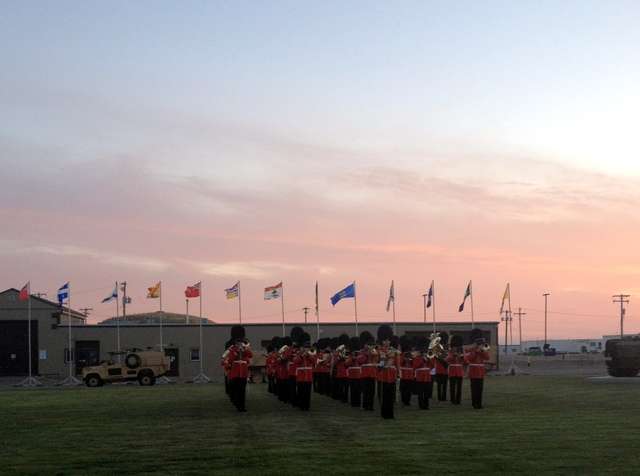
CFB Suffield was treated to some pomp and circumstance last Wednesday evening as only the premier band of the British Army can deliver it. The Band of the Grenadier Guards performed the Beating the Retreat ceremony, a sunset concert and an annual tradiiton at Suffield. The band had a busy schedule touring Southern Alberta, and was in Suffield to complete a year of celebrations marking the 40th anniversary of British Army Training Unit Suffield.
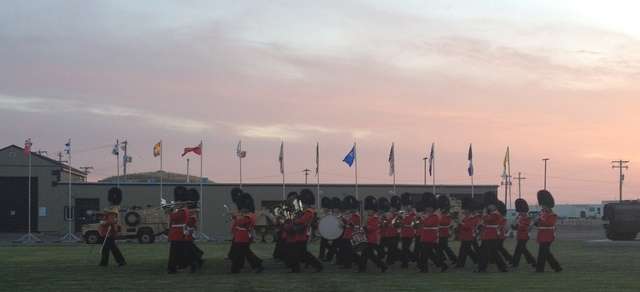
This makes three British military bands that I've had the privilege to see and hear during my posting at Suffield, and this band was far and away the best. The quality of their footdrill, as well as their musical ability, was amazing and showed the Brigade of Guards traditions to good effect.
The Guards are no strangers to Suffield. A Grenadier Guards battle group came through Suffield last year, all business, to train for Afghanistan and went over early this year. It was good to see the ceremonial face of the regiment this time. And there they go, off into the sunset.

Wednesday, August 22, 2012
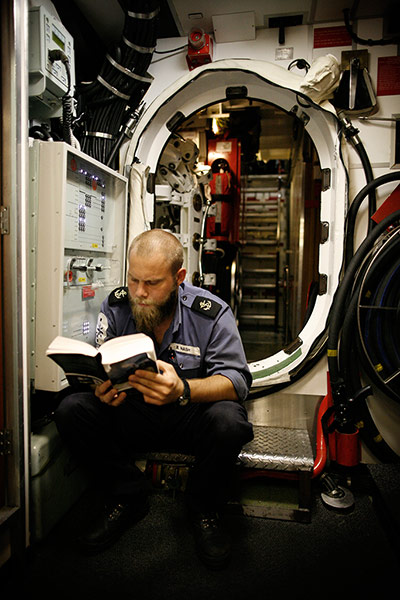
Hugging Missiles And Not Going Wibble
Stephen Moss of the UK's The Guardian spent a month aboard a Royal Navy submarine recently, and offers an engaging and well-written portrait of life on a modern submarine.
Monday, August 13, 2012
For The US Army, A Milestone

With the posthumous revelation of the late Dr. Sally Ride's sexual orientation, a lot of media commentators suggested, rightly I think, that the time may have come for us to start talking about prominent people simply because they may be gay. However, today's mention in the NYT of the US military promoting its first openly gay general is noteworthy because it shows a military (always by necessity a conservative organization) adapting to changes and cultural shifts in society, and that, I would argue, is a good thing.
Tuesday, July 10, 2012
Notable Quotable On Women In The Infantry
H/t to Mad Padre reader Dan for pointing me to this interview with a USMC Engineer, Capt, Katie Petronio, who offers these comments, based on her experience in Iraq and Afghanistan, on why the Marine Corps is wrong to consider taking women into the infantry.
Note from her written comments that she is only speaking for the Marines. She deliberately refrains from commenting on similar experiments in the US Army. Readers from other services and other countries can draw their own conclusions, but as Dan noted in his comment, Petronio has written a brave article.
Subscribe to:
Posts (Atom)
Mad Padre

Opinions expressed within are in no way the responsibility of anyone's employers or facilitating agencies and should by rights be taken as nothing more than one person's notional musings, attempted witticisms, and prayerful posturings.