Showing posts with label Religion and Society. Show all posts

Saturday, May 9, 2026

Gods Seen and Unseen: A Homily for the Sixth Sunday of Easter


Preached at Prince of Peace, Wasaga Beach, and Good Shepherd, Stayner, Anglican Diocese of Toronto, on the Sixth Sunday of Easter, 10 May, 2026.

Text for this Sunday: Acts 17:22-31; Psalm 66:7-18; 1 Peter 3:13-22; John 14:15-21

Paul stood in front of the Areopagus and said, "Athenians, I see how extremely religious you are in every way. For as I went through the city and looked carefully at the objects of your worship, I found among them an altar with the inscription, 'To an unknown God.’  (Acts 17:22-23)



Last Monday was May 4, and I’m wondering, on that day did anyone say “May the Fourth” be with you?   Or, did you notice that people on social media were talking a lot about Star Wars?

May the Fourth in popular culture has now become known by those in the know as Star Wars Day, because when you say the date, it sounds a lot like the famous phrase from the Star Wars movies, “May the Force be with you”.  In the imaginary universe of Star Wars, the Force is a kind of living energy that animates the galaxy.  

The Force can be used for good, especially by practitioners called The Jedi who vaguely resemble Buddhist monks, who say “May the Force be with you” as a kind of blessing.   (Fun fact, when an Anglican Jedi says this, everyone else has to say “And also with you”.   But the power of the force can also be used for evil purposes, most famously by the arch-villain of the Star Wars films, Darth Vader.   So even though the Star Wars franchise seems to be about spaceships, cute aliens, and selling toys, it’s also a spiritual story about the battle between good and evil, and it asks questions about morality.   Seemingly good characters can be corrupted, but can also be redeemed.

Star Wars as a cultural phenomenon shows how people are willing to believe all sorts of things. As people in North America and the West become less Christian, they still find ways to form and practice spiritual beliefs.   

For decades some people have indicated their belief on census forms as Jedi and have sought, perhaps not always seriously, to have Jediism recognized as an official religion.   And they’re not alone.  Some people, mostly in the millenial and post-millenial cohorts, find deep meaning and morality in online computer games such as Mass Effect.  What these beliefs and spiritualites have in common is that they are not linked to ancient religious traditions.   They are what social scientists call New Religions.

Scientology as a belief system and even as a religion has existed for decades.  More recently, some advocates of Artificial Intelligence  have started expressing their faith in the promise of AI in deeply spiritual ways.  Transhumanism, for example, is the hope that human consciousness can exist and evolve in digital form, free from the limits of the human body, and thus attain a kind of immortality.   Other AI super-believers imagine a future where humans live in a kind of technological paradise.   Either way, say scholars, there is a religious dimension to many attitudes about AI.

For those of us who are baby boomers, we’ve seen amazing changes in religion and spirituality in our lifetimes.   When we were growing up, Canada was a Christian country.   Over the decades, as we became a multicultural country, we became more familiar with Islam, Hinduism, and other world religions because they were our neighbours and coworkers.   Then, as our adult children fell away from church, we became a more secular country.   And now we’re in a strange, pluralistic kind of landscape where people are more likely to say they are spiritual than they are to say that they’re religious.

In some ways, if you took St Paul out of our first reading from Acts and dropped him down in 21st century Ontario, I think he would find himself at home.  Our world, at least spiritually, has similarities to the ancient world, and the way that Paul speaks to the Greeks in Athens gives us some clues as to how we as Christians can dialogue with people today who don’t share our beliefs but who do have beliefs of their own.   Let’s dive into Acts and see how it might help us today.

By this point in the book of Acts, Paul has travelled to the Greek city of Athens, which was famous as a place of learning and philosophy, but was also a place of spirituality.  Besides the Greek gods that we might all remember from mythology books, Paul finds an altar dedicated to “an unknown God”.  Perhaps the Athenians were hedging their bets.  We can imagine the Athenians thinking,  “if there are gods out there who haven’t introduced themselves, it’s a good idea to worship them, just so we don’t miss out on any blessings or benefits”.

Paul’s attitude is respectul but perhaps there’s a little humour when he says, basically, “Wow, you guys are super religious”.  But he doesn’t condemn the Greeks for being pagans.  He finds some common ground between their beliefs and his, specifically the shared belief that God/gods created the earth and “gives to all mortals life and breath and all things” (Acts .   He also points out that there is a common impulse among people to “search for God and perhaps grope for him and find him” (Acts 17:  

But there is a key difference that Paul wants to make, and that is the difference between unknown and known.  Paul knows God personally.  He encountered Jesus when he was still Saul, persecuting Jesus’ followers, and he became Paul, a messenger of Jesus.   As a Jew and a Pharisee, Paul also knows that Jesus’ father has always wanted to be known, and has revealed over and over again: to Abraham, to Moses, to the prophets. and finally God sent his son, “a man whom he has appointed, and of this he has given assurance to all by raising him from the dead” (Acts 17:31).

Paul could have started with Jesus, and condemned the Greeks right off the bat, but he respectfully looked for common ground, got to know the Greeks by looking around their city, and refused to condemn them.   But Paul knows Jesus and he knows what he believes, and he isn’t ashamed of his message.    And, we are told, he doesn’t convince all the Greeks (some “scoffed”), but others are curious and want to learn more.

Last Sunday, in the Gospel reading from John, we heard Jesus say that "I am the way, and the truth, and the life. No one comes to the Father except through me” (Jn 14:  ).  In our bible study at All Saints, we had a lively discussion about this verse and how it is often used by some Christians in a very exclusivist way, to invalidate all other forms of belief as being false and untrue.  We agreed that for us as followers of Jesus, we do believe that he speaks truth, that he is the way that we know God, and he is worth following.    So how do we communicate our belief to others in a respectful and non-judgemental way?

In my own experience as a military chaplain, working with believers from other world religions, like Jews and Muslims, it was clear to me that they respected the truth of my beliefs, but they were equally committed to their truths and beliefs.   Recognizing that we both held a truth was enough.  We didn’t try to convert one another.

But what if you are talking to a friend or neighbour who believes that certain crystals or sounds have healing powers, or who puts statues of angels in their garden for protection?  What if the person believes that trees are sacred, or that Mother Earth is a goddess?   What if  the other person finds their spirituality through yoga, or through cheering for the Leafs (now that would be a person of faith!).  

Again, the story of Paul in Acts is I think helpful.  It shows us that most people are searching and groping for something, some higher meaning.  It teaches us to be respectful and to learn about others’ beliefs.  And it teaches us  for our part to be true to what we believe, that Jesus is our truth, our life, and our way to God.  We believe in Jesus, because we know Jesus and we know that Jesus has always believed in us.


Friday, April 11, 2025

Aliens or Nationalists? What First Peter says to Christians in An Idolatrous Time

A Homily Preached at Trinity Church, Barrie, Anglican Diocese of Toronto, Friday 11 April as Part of Their Lenten Series on Faith Informing Politics


Honour everyone. Love the family of believers. Fear God. Honour the emperor. 1 Peter 2.17


Let me begin by thanking you for asking me back there to come back to Trinity as a preacher for the Lenten series.  As I hope you know, Trinity holds a special place in my heart and that of my wife Joy, your former canonical administrator, and who is very sorry that she can’t be here today because of a funeral.


The topic for these services, “Faith Informing Politics”, could not be any more relevant to our time, and I can only imagine what a rich feast of thoughts you’ve enjoyed from the previous preachers in this series.   The times we find ourselves in feel unmoored and chaotic.   As Canadians, our nationalistic emotions are stirred by talk of the “Fifty First State” and phrases like “Elbows Up”.   We are buffeted by ever-changing news about tariffs, we worry about our savings evaporating, and we are perplexed by the sorry, indeed, idolatrous state of much of Christianity in the United States.


In the past few months we’ve seen US evangelicals continue to proclaim that their president has a divine mission to make America great again, while we’ve seen an Anglican Bishop, Mariann Budde, who dared to preach about mercy and compassion at the Inaugural service in Washington in January, hounded as a “Radical Left hard line Trump hater”. As the new president wrote on social media,  the Bishop “brought her church into the World of politics in a very ungracious way”.


If for the American right there is a “gracious way” for politics and church to mix, then it seems to be in the heady brew called “Christian Nationalism”.  Drew Strait, an Mennonite scholar, defines Christian Nationalism as “a form of political idolatry that distorts our knowledge of God and neighbor through a xenophobic, racialized and militarized gospel that is at odds with the life and teachings of Jesus”.   Many who hold this view see Donald Trump as a chosen agent of God, despite all evidence to the contrary, and see his democratic opponents as evil and even demonic.    Tellingly, Christian Nationalism actually has little to say about Jesus or his teachings, such as the Beatitudes, which cannot in any way be reconciled with an authoritarian political project.


Its worth noting that two days ago, the church remembered the German theologian and martyr, Dietrich Bonhoeffer, who was murdered by the Nazis on April 9th, 1945.   Bonhoeffer and many of his Christian clergy colleagues saw a similar attempt by many of their contemporaries to give religious approval to the rise of fascism in Germany.    In 1934 Bonhoeffer and many other German Christians signed the Barmen Declaration, a manifesto critiquing any attempt by the Nazis to co-opt the church.     They wrote that “We repudiate the false teaching that the church can turn over the form her her message … according to some dominant ideological and political convictions”.


Perversely, Bonhoeffer has himself become a contested symbol.  Because he was associated with some Germans  involved in the plot to assassinate Hitler, some have made tried to make Bonhoeffer a hero of the right.  One of his biographers, Eric Metaxas, has argued that because Bonhoeffer resisted an unjust authority, he should therefore be a patron saint for those who resisted the Biden administration, including the January 6th rioters.  Bonhoeffer scholars have protested against such attempts to link his memory to Christian nationalism, calling it “a dangerous and grievous misuse of his theology and life.”


The Bonhoeffer controversy brings us squarely to the question of how Christians should live and conduct themselves under political authority.  The New Testament seems to be on the side of the rulers.   The criminal crucified beside Jesus in Luke’s gospel says that he and the other criminal have “been condemned justly, for we are getting what we deserve for our deeds”, although he admits that there has been a miscarriage of justice in Jesus’ case (Lk 23.40-51).  Paul in Romans, as you heard last week, says that that “every person [should] be subject to the governing authorities” (Rom 13.1).  And today we hear from the letter known as First Peter that  “For the Lord’s sake [we should] accept the authority of every human institution, whether of the emperor as supreme, or of governors, as sent by him to punish those who do wrong and to praise those who do right. (1 Pe 13-14).


Now we might surely wonder, how could Paul and the author of First Peter counsel obedience to pagan rulers who were at best suspicious of Christians, and at worst hostile to them?   The answer might be as simple as this, that the early church was keeping its head down, trying to be good citizens and trying not to attract attention or suspicion.   The Roman authorities had a limited understanding of Christianity, and were generally suspicious of any cult or belief that had the potential to disturb social norms and social order.   Here’s an example.


First Peter was written in the late 80s as a letter circulated among the churches in Asia Minor, modern day Turkey.   A few decades later, a Roman governor in that part of the world named Pliny, reported to the emperor Trajan that he had investigated cases of people, women and men, accused of being Christians.   He described them as being superstitious, with an “inflexible obstinacy”, but not criminals in the usual sense.  In fact, he told Trajan, when they gathered to worship Christ, “they [bound] themselves by an oath …to abstain from theft robbery, adultery, and breach of faith”.    Generally, he found them harmless people whose only crime was that their belief was undermining the official religion of Rome.


Pliny’s description of Christians as generally law-abiding closely follows the instructions given in First Peter to “do right” and “not use your freedom as a pretext for evil” (1 Pe 2.17).   First Peter consistently preaches a message of morality, urging Christians to shun the vices that it associates with pagan (gentile) society such as “licentiousness, passions, drunkenness”.  It offers the interesting idea that all have a freedom that they have found in Christ, but urges them not to use that freedom in a disruptive way, so that slaves should obey their masters and wives their husbands (suggesting that many Christians were in fact women and slaves).   


The letter is clear that Christians should not rock the social boat; they should “honour” the emperor but they should also “honour” everyone.  Here the Greek word for honour, timaō, seems to mean give appropriate and due respect.   “Honour the emperor” in First Peter may thus mean something as simple as 'respect that the emperor is the boss for now, but Jesus is the boss for all time”.  It probably wasn’t the same sense of honour that Pliny had in mind when he tried to force Christians to curse Christ and say prayers to the emperor and to the Roman Gods.


There is clearly in First Peter a sense that Christians under Roman authority are living in a temporary situation.  Believers are repeatedly described as “aliens and exiles” who owe their true obedience to Christ.   The letter does imagine the possibility that Christians may be questioned about their beliefs, perhaps questioned by someone like Pliny, in which case, the letter states, “Always be ready to make your defence to anyone who demands an accounting for the hope that is in you; yet do it with gentleness and reverence” (3.15-16).   In other words, when you have to, be clear that you are a Christian, in the religious sense of confessing , of stating belief, knowing that you might have to suffer the consequences.  First Peter is clear that Christians may be called to a [share] in Christ’s sufferings (1 Pe 4.12-19) but through these ordeals you are “receiving the outcome of your faith, the salvation of your souls” (1.9).


Its fair to say that First Peter is in some ways a subversive document.   It places Christ at the centre of the universe, and only admits a temporary authority for the emperor, whose power will not last.  The letter shares a common belief of the early church, that Christ will return soon,  and the “The end of all things is near”(4.7-11).  There is also a subtle reference to Rome itself at the end, when the letter offers greetings from “Your sister church in Babylon” (1 Pe 5.13).  The Book of Revelation, written about a decade later, paints a scathing portrait of Rome as a sinful, whorish New Babylon, suggesting that the early Christians had a sort of code.  It’s unlikely that someone like Pliny would have understood this reference had he see a copy of the letter of First Peter.


If First Peter tells us anything as we navigate these strange and perilous  political times, it is that we as Christians should lead wholesome lives while paying appropriate respects to rulers whose reign and power are temporary.   Living as a Christian in a time of empire is to always be aware that our allegiance is ultimately to another kingdom, the kingdom of God whose power is not expressed in golden images or in slavish demands for obedience, but rather exists at the edge of our perceptions, only becoming real through acts of worship, love, gentleness, and self sacrifice.  


I’m thinking here of this coming Sunday and the Passion narrative from Luke, when Jesus is confronted by Herod and Pilate, who demand to know what sort of king he is.    Pilate’s mocking inscription, “King of the Jews”, totally misunderstands Jesus.    Previously in Luke Jesus has associated the kingdom of God with the banishing of demons and the gathering of innocent children.    The kingdom of God is a place strong enough to obliterate evil but gentle enough to gather the lost and the weak like a mother hen.   It is humble rather than grandiose, and it is merciful enough to welcome the condemned man whose plea for mercy is simply this, “Jesus, remember me when you come into your kingdom”.


The kingdom of God is where our moral compasses should always point towards, even in the bleakest of times..   The kingdom of God has no politics other than love and mercy.  The kingdom of God has no ethnicity and has no room for nationalism. The kingdom of God has no agenda other than a longing for Christ’s return.   The kingdom of God is where our ultimate loyalty resides.


Source For Pliny and Trajan:  Church and Society in Documents 100 - 600AD, ed Alan L Hayes, Toronto: Canadian Scholars' Press, pp 1-6.

Saturday, March 15, 2025

Citizens of Earth and Heaven: A Homily for the Second Sunday of Lent

 Preached at All Saints, Collingwood, Anglican Diocese of Toronto, on, March 16, 2023, the Second Sunday of Lent. 

Readings for Lent 2 (YrC): Genesis 15:1-12, 17-18; Psalm 27; Philippians 3:17-4:1; Luke 13:31-35

“But our citizenship[a] is in heaven, and it is from there that we are expecting a Savior, the Lord Jesus Christ.” (Phil 3.21) 


I’m sure you’ve had that moment when you land in another country and you’re in a queue at immigration, that moment when you hand over your Canadian passport and you think “I’m so glad you I have one of these”.   Having a Canadian passport when I travel makes me feel a little like having a magical charm, something that says “I’m one of the good guys, I’m harmless and inoffensive, why would you give me any trouble, I’m Canadian”.  

It’s often said of Canadians that we have a quiet sense of pride in our country, that we’re nice, polite folks, but it’s also said that when push comes to shove, we can be fighters.  Yesterday I saw an article in The Atlantic magazine with the title, “The Crimson Face of Canadian Anger” and we can all understand why that is.   

When you hear “Fifty First State”, doesn’t your blood pressure go up a bit?   It says something about us as a country that when we feel threatened we turn to the language of hockey fights and use phrases like “drop the gloves” and “elbows up”.  I’m as guilty of this as anyone else, because I’ve served in uniform, I’ve worn my country’s flag on my shoulder, and I know damn well that my nationalistic buttons are getting pressed.

In times like these, one of the challenges for us as Canadians and as Christians is to remember that we have another identity and another loyalty as citizens of the kingdom of God.   When we were baptized, the priest drew the sign of the cross on our foreheads, and said “I sign you with the cross, and mark you as Christ’s own for ever” (BAS p 161).   As I like to say at confirmation classes, we actually have two passports, one as Canadians and one as citizens of the kingdom of God, and that second passport was issued to us at the font.

Which one of our two passports has precedence?  Which one is ultimately more important?   For Paul, who was a Roman citizen, the answer was simple.   As he wrote to the Christians in Philippi, “our citizenship is in heaven” and elsewhere in the letter he writes that the Philippians are “children of God”.   He was writing these words as a prisoner in Rome, awaiting a trial for preaching the good news, the gospel, of Christ, for which he would ultimately be executed.  Paul knew that being a Roman citizen would not protect him from punishment for putting Jesus first, for saying that Jesus was lord of heaven and earth and putting Jesus ahead of the emperor in Rome who called himself a God.  Many Christians  would learn the same hard lesson in the centuries of persecution that followed.  

Being a Christian in Paul’s day and in the early church was counter-cultural and sometimes dangerous, but as time went on it became comfortable.   If you don’t mind a quick church history lesson, in the fourth century the Emperor Constantine declared Christianity to be the official religion of the Empire.  As Christianity spread, if a king or ruler converted, then his people were considered Christian.  After the Reformation, the rule of thumb was that the religion of the ruler (Protestant or Catholic) was the religion of his citizens (Cuius regio, eius religio).  Church and state gradually grew apart, but some of us can still remember a time when Canada considered itself a Christian nation.   

Today it’s much more complicated.   Christmas and Easter are holidays, but we also acknowledge Ramadan, Passover, and Diwali as important religious dates.   We now see diversity as a positive good, so we see being Canadian as a common, collective identity, whereas being religious or irreligious is a private, voluntary matter.

In some ways we are a lot closer to Christianity as it was in Paul’s time then we are to Christianity as it was when Canada was founded.   While we’re not persecuted, and we get a nice tax receipt for our offerings to the church, we find ourselves, as I said last Sunday, on the margins of a largely secular society.   As Christians we don’t control the national agenda, but we don’t suffer from our irrelevance.   In fact, many Canadian values - civility, tolerance of difference, equality, universal programs - are compatible with and adjacent to Christian values.

So of course when we hear certain neighbours say that we should be the “Fifty First State”, of course we as Christians and as Canadians should get riled.   Our country is worth defending.   But here’s where we need to remember our second passport as baptized followers of Jesus, because we know that there is a dark side to nationalism.   

It can become an irrational force that makes people say “my country right or wrong”.  It can divide neighbours, as we saw just five years ago when people who disagreed with Covid regulations and vaccinations began to wave large flags and call themselves the true Canadians.   Nationalism can be used by politicians to incite hatred and target minorities who aren’t really one of us.  Nationalism makes civil and reasonable conversations difficult if not impossible.   If you doubt that claim, then imagine that you had a neighbour or a family member who genuinely believed that Canada should be fifty-first state.   How would you feel about that person?  Would you even try to talk with them?

It’s hard these days to separate the blather and bluster from reality, and maybe there is no real threat to the country that we love.   But whatever happens, we always need to remember that our identity as Christians matters in the here and now.  When Paul writes that “our citizenship is in heaven”, we might think that he is talking about some future reality, because he goes on to say that it is from heaven that “we are expecting a Saviour, the Lord Jesus Christ”.  But Paul also says elsewhere in this letter that we should live for Jesus on earth while we wait to be with Jesus in heaven.   He tells the Philippian Christians that they should “live your [lives] in a manner worthy of the gospel of Christ” (Ph 1.27) so that they “shine like stars” amidst the people around them (Ph 2.5).

What does it mean for us in this strange and fearful time to live lives worthy of the gospel of Christ?  I would say that it means to live in hope and in kindness.  It means valuing everything good about our country of Canada while wanting Canada to have more ofthe things that God teaches us to strive for - justice, dignity, and compassion for all.  It means praying for our leaders while giving our ultimate allegiance to Jesus as our Lord.  

We give our loyalty to Jesus because we know that he will never lead us to dark places. Jesus calls us to love rather than to hate, he calls us to welcome strangers instead of fearing them, and he calls us to act like brothers and sisters rather than as enemies.  These are good values for citizens of heaven, and they are good values for citizens of Canada.   May God bless us, and may God bless and protect all that is good in our beloved country.

Tuesday, March 26, 2024

Latest Gallup Poll Shows Regular Church Attendance Continues to Decline


The information in this latest Gallup poll on church attendance in the US does not really surprise me and I refuse to let it discourage me at the start of Holy Week.

Of 15,147 Protestants surveyed, 27% say they seldom attend and 16% say they never attend.  Those figures are within a few points of the 6,934 Catholics who answered seldom or never.

The poll also notes that the steady decline in attendance is driven by the increasing number of Americans who do identify as religious. and who are increasingly young adults.    I can only suspect that the percentages of people in these categories is higher in Canada.  

This date explains why the rate of church closings across North America will be in the tens of thousands through the next decade.   

Different denominations will react differently.  Some will harden their theology, appealing to a righteous remnant, and some will choose to die sacrificially, spending their last endowments on community projects and giving their buildings over to secular community purposes.   For the Anglican Church of Canada, it will be a steep decline, which we are already seeing in the diminishing numbers of active clergy and new vocations.     Hopefully we will see some ways to measure our church's places in the community other than in average Sunday attendance.

In the meantime, I'll keep my gaze fixed on the cross and on the hope of the resurrection.

MP+


Saturday, May 27, 2023

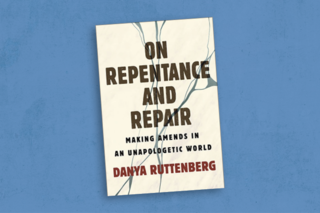
Book Review: Repentance and Repair by Rabbi Danya Ruttenberg


A group of us at All Saints, Collingwood, recently completed a study of this book and I compiled a summary of it for our parish newsletter, passed on in hopes that this post stirs some interest in the book.  Michael+


“In a moral universe, there is work to do whenever harm is inflicted”.  Rabbi Danya Ruttenberg


Through Lent and into the season of Easter, a number of us read a book called On Repentance and Repair: Making Amends In An Unapologetic World.   The author, Danya Ruttenberg, is a young American rabbi and scholar who has thought long and hard about why we as a society have such a hard time truly saying that we are sorry.  For example:


  • Individuals hide behind anonymity to be horrible on social media;
  • Celebrities are caught being abusive and sexist and then complain that they have been cancelled; 
  • Corporations make mealy mouthed statements about their misdeeds, vetted by lawyers and PR departments:

   and

  • Governments struggle to right old wrongs.  


As Ruttenberg carefully and passionately explains it, anyone who has committed harm has work to do to fix it.  She defines harm as “hurt, injury, or damage of some sort, whether mental, emotional, or physical, which may be sustained for a brief amount of time or across generations”.  

The only remedy for harm, she writes, is the hard work of repentance.    Repentance involves the offender recognizing, naming, and owning the harm they’ve done, doing the hard soul work necessary to change their character and behaviour, and making a sincere apology that includes, if necessary, offers of compensation for loss and injury. 


 A true apology, she writes, “is about trying to see the human being in front of you, to connect with them … to make it clear - abundantly, absolutely, profoundly clear - that … their feeling better matters to you”.


As Christians, we found some of the book challenging, as Ruttenberg reports that the Jewish tradition does not place the same emphasis on forgiveness as Jesus did.   Forgiveness, she writes, should never be required of the victim if the offender is not truly penitent, or if the offence is unforgivable.     While nursing a grudge can be harmful, and sometimes forgiveness may be someone saying “I’m going to forget an offence you caused me even if you’ll always be a horrible person”, the decision to forgive is always the victim’s.


Forgiveness is also not required if there is a power imbalance and where forgiveness might simply continue patterns of injustice.  For example, she notes the habit of reporters asking African American families if they forgive the police for unjustified shootings of their loved ones.  Do expectations that families will apologize merely perpetuate cycles of violence and police brutality?


Finally, Canadians may find the book challenging because, even if successive governments have apologized to indigenous communities for longstanding injustices, Ruttenberg challenges the validity of these apologies if these communities still don’t have good drinking water and still languish in poverty.  As she writes, “The [Canadian] government is still committing harm, environmental injustice, colonialist land theft, and more”.   Apologies only matter if there’s change:  “Without transformation, there’s no repentance”.


While most of us found this a hard and challenging read, I think we all felt better for it.   Repentance is part of our vocabulary as Christians, and we can always use a bracing and  honest account what hard work it can be, and how necessary it is.  Thank you, Rabbi Danya, for calling us to the work of being better people.

Tuesday, September 27, 2022

King Charles III: Defender of Faith?


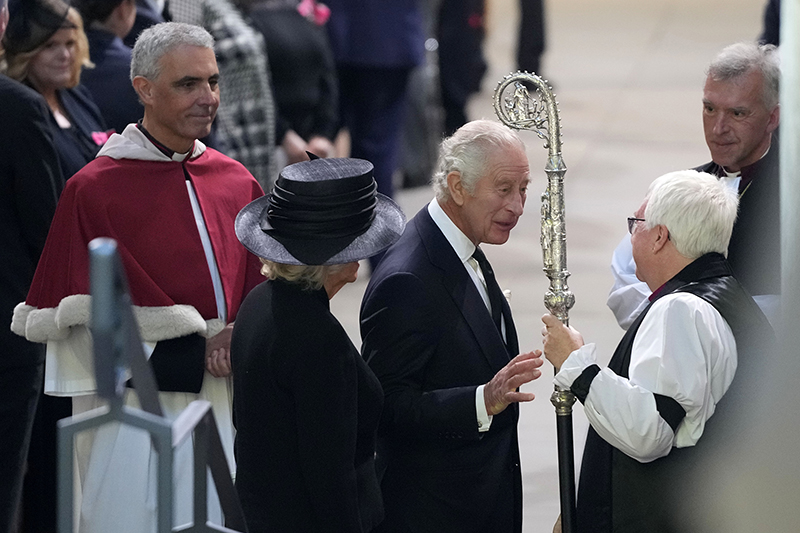
Britain’s King Charles III and Camilla, the queen consort, leave after a Service of Prayer and Reflection for the life of Queen Elizabeth II, at Llandaff Cathedral in Cardiff, Wales, Sept. 16, 2022. (AP Photo/Frank Augstein, Pool)

As we come to terms with what the British monarchy will look like in the post-Elizabethan era (can we recycle that term to speak of recent history?), I was interested in this article posted in Religion News Service on 21 September about the new king’s title Defender of the Faith and how King Charles may be interpreting it.

The term Defensor Fidei was first given to Henry VIII in 1521 by the Pope, when Henry was trying to curry favour with the papacy through a ghost-written tract he had put his name to, denouncing Martin Luther.  As we know, Henry was quite willing later on to jettison Rome’s favour to gain his divorce from his first wife, Catherine.   Readers who want to know more, and are looking for good fiction, are encouraged to read the late and lamented Hilary Mantel's novel Wolf Hall.

The title remained, and while the late Queen and her son have both maintained their membership in the Church of England and their Christian faith, there have been signs that the new King has envisioned the Crown being a guarantor of religions.   As Prince of Wales, he controversially said that he thought the monarch should be “Defender of the Faiths”, and while he recanted that statement, the RNS article notes that there were many different faith/religious leaders present at funeral services for Queen Elizabeth.

An expansive view of religious freedom is probably the only course open to a constitutional monarch with a fragile authority over an increasingly pluralistic and secular nation.   It is, however, the view that the late Queen took, as the RNS article notes:

In a landmark speech in 2012 at Lambeth Palace, the London home of the Archbishop of Canterbury, the queen said of the Church of England that “Its role is not to defend Anglicanism to the exclusion of other religions. Instead, the Church has a duty to protect the free practice of all faiths in this country.”

She credited the established church with having done so already. “Gently and assuredly, the Church of England has created an environment for other faith communities and indeed people of no faith to live freely,” she said.

Watching the funeral service for the Queen, one of my more conservative clergy colleagues jokingly suggested that the Crown on the flag-draped casket was a fitting symbol of Christian nationalism.   I respectfully differ.  When I was a chaplain in the Canadian Forces, as a religious functionary employed by the federal government, I came to the view that my role was to speak politically and socially for all faiths represented in Canada, while speaking pastorally and theologically only for my own.  A chaplain’s role, I thought, was ultimately to guarantee the freedom of people of faith to be themselves.  My sense is that the new King takes a similar view of the Crown’s role.     

Saturday, October 30, 2021

Food Security and God's Community: A Homily on the Book of Ruth


Food Insecurity and God’s Community: A Sermon on The Book of Ruth

Preached on the Twenty-third Sunday after Pentecost, 31 October, All Saints, King City, Anglican Diocese of Toronto.  Readings for Proper 31B: Ru 1:1-18; Ps 146; Heb 9:11-14; Mk 12:28-34


The Book of Ruth is one of those small corners of scripture that I suspect we all wish we knew better.   For my part, I confess that I have never before given a sermon on Ruth, which is a terrible admission for a preacher who has a fondness for the Hebrew Scriptures (Old Testament).   It’s known, at least in part, for Ruth’s famous and moving speech to Naomi – “Where you go, I will go” (Ru 1,16-17) but I’m not sure we know what quite to make of it.   In Christian bibles, Ruth is found tucked between Judges and 1 Samuel, leading us to think that it belongs to the historical books of the bible.  However, whereas these historical books are about great kings and prophets, the characters of Ruth are unremarkable, ordinary people living ordinary lives, which encourages us to think that it has something to speak into our ordinary lives.

Today and next Sunday, I want to explore several of the themes of Ruth.   The first is food, which I’ll mostly focus on today; what does the contrast between the opening scene of famine and the grain-filled threshing floor of Boaz have to tell us about food insecurity and our basic needs?   The second theme is love and family; what does Ruth’s loyalty to Naomi and Boaz’s kindness to Ruth say to us about how we might live our lives in ways that are gracious to one another and aligned with the purposes of God?   The third we might call God’s providence or design; how does the story of Ruth fit into the saving purposes of God, and how might that give us hope and inspiration?

“In the days when the judges ruled, there was a famine in the land” (Ru 1.1).

In just five verses, the Book of Ruth presents a bleak and uncompromising view of life in ancient Israel.   It begins in hunger and migration.   The husband Elimelech takes his family to the neighbouring land of Moab to escape the famine.  For a while Elimilech and Naomi seem to find better lives and also find wives for their two sons, but within ten years the father and his sons are dead, leaving three homeless widows.  Naomi is left without any male family to provide for and to protect her.  The best she can do is send her daughters-in-law back to their families in the hope that they will be taken in and cared for.  

So the story of Ruth starts in hunger.  It’s not just the hunger of empty stomachs, though that is all too real.   It’s also a story about the hunger of empty lives, of Naomi, whose name in Hebrew means Pleasant, changing her name to Mara, meaning bitter, because she thanks she has nothing, no family, no kin, no love, no future.  It’s also a story about the hunger of loneliness, of Boaz, an older unmarried man who has prosperity but no one to share it with, and who finds in Ruth a wife and in her children a future for his name and lineage.

The progression of the story, from hunger and mourning to the harvested grain and barley on the threshing floor to the marriage and child of Ruth and Boaz, is a gradual movement from emptiness to fullness, from sorrow to joy.  It’s a wonderful little story.  In some ways it is like Job, in its narrative movement from tragedy to joy, though unlike Job, Ruth and Naomi are not caught in a cosmic struggle between God and Satan as Job is, and their restoration to happiness seems quietly deserving compared to the cornucopia of abundance that Job is finally blessed with.

There’s metaphorical hunger here, but there’s real, earthly, deadly hunger in this story.   Elimelech’s taking his family to Moab is one of several examples of hunger-related migration in the Hebrew Scriptures (see the stories of Abraham and Jacob in Genesis), and indeed today hunger and food insecurity lead many millions today to leave their homes in the hopes of finding UN administered relief food refugee camps.   The problem is not unique to overseas.  

Recently I was stunned to read an opinion piece in The Globe and Mail (Oct. 11, 2021) byLori Nikkel, who is CEO of the food rescue organization Second Harvest.  Nikkel opened her essay with the shocking statistic that Canada’s charitable sector (churches, mosques, schools and social problems) gave out $33 billion dollars worth of food to 6.7 million Canadians, which is 18 per cent of our population. 

In 2019, Statistics Canada reported that 1.9 million Canadian households are food insecure, meaning that their diets are inadequate and unhealthy.  Many Canadians are one paycheque away from hunger, while half of the food produced in Canada ends up in landfills.    It’s hard not to conclude from these numbers that there is something systemically and sinfully wrong with food supply in Canada.

What does an ancient bible story about hunger have to say to our context?  Ruth is a story about loyalty, or in Hebrew, hesed.  It’s about bonds of connection and affection, some of which are familial (Boaz is Naomi’s kinsman, Naomi is Ruth’s mother-in-law) but which are also deeply rooted in heart and soul.   Ruth persists in staying with Naomi, even unto death, when the other daughter in law Orpah obeys Naomi and leaves her.    Boaz shows kindness to a nobody, a foreign widow, who has no claim on him except that he has heard of her faithfulness to his kinswoman Naomi.

This kindness is rooted in the hearts of ordinary people in an ordinary story, but it is also rooted in the purposes of God that is firmly opposed to hunger and human indifference.    Even when Naomi (quite understandably) says bitterly that “the Lord has turned against me” (Ru 1.13), Ruth declares that “your God [shall be] my God” (1.16).  Her faith in this God that she does not yet know is rewarded when Boaz agrees to help Ruth.  As he says to her, “may you have a full reward from the Lord, the God of Israel, under whose wings you have come for refuge” (Ru 2.12).  Boaz is certainly not immune to the charms of a younger woman, but this wealthy farmer seems to understand God’s purpose for him means to be an agent of refuge, and so his faith extends to concrete acts of assistance to others.

The Book of Ruth, then, speaks across the long centuries to a church in twenty-first century Canada and asks us how we will be God’s wings of refuge?   Who are the Ruth’s, the refugees from foreign lands, those of no account and no status, who are hungry and friendless?   I said in my homily last Sunday that the data shows that are immediate neighbourhood as a church is wealthy, but we know that there is hunger in our wider community.    We have an existing relationship with a local food bank that manifests itself in sporadic efforts.  We could certainly do more there.  There are other churches and agencies running food programs in poorer neighbourhoods not far from us that we could reach out to.   How will hunger and food security be part of our mission going forward?

One final thought about why we do this.  At the end of the Book of Ruth we are back in Bethlehem, and we are told that the child born to Boaz and Ruth is Obed, who will be the father of Jesse, who will be the father of David.   From this ancestry a descendent of David will also be born in Bethlehem, and it is that person who will call us to mission as he reveals God’s purposes.  More on that next Sunday.


Friday, October 29, 2021

Churches and Food Insecurity

 This week I've been working on sermons on the Book of Ruth for this coming Sunday and the next.   Perhaps because I've been thinking also about food insecurity, my attention has been drawn to the book's opening setting in a time of famine, and from there to the church's role in helping those living with food insecurity.

There are two articles that I would commend to your attention.   The first is this piece from Religion News Service which notes that half the religious organizations in the US are helping those who don't have enough to eat.  

The second piece is from the Oct 11 issue of the Globe and Mail, which notes that faith-based and other charities engaging in food insecurity ministries provide food to 18% of Canadians, and outnumber grocery stores four to one.   That's a shocking statistic.  Unfortunately the article is behind the Globe's paywall, but subscribers can access it here.

Thursday, May 20, 2021

Notable Quotable: Living your Neighbour Means Caring About Climate Change

\

From Dianne Randall, a US Quaker church leader, on how living our neighbour means loving our planet, on which all our neighbours:

 "As I wrote in June 2020, the Quaker call to love thy neighbor speaks more broadly to the world than it does to our immediate neighbors. We believe loving our planet first means loving its people. Earth, as Pope Francis wrote, is “our common home.” Therefore, we are all neighbors.

An Earth restored, a Quaker tenet of faith, recognizes that climate change has created global imbalances, resulting in unprecedented climate events. The negative impacts they spawn — from stronger hurricanes and flooding to long-term drought — are most often borne by the people not responsible for them and least able to adapt to climate change.

This inequity cannot be allowed to continue for future generations. We have to look at climate change through the lens of justice to stop the degradation of our planet."

Read the whole piece here.

Mad Padre

Mad Padre
Opinions expressed within are in no way the responsibility of anyone's employers or facilitating agencies and should by rights be taken as nothing more than one person's notional musings, attempted witticisms, and prayerful posturings.

Followers

Blog Archive

Labels