Military members have to walk a line between their own political beliefs and what the State asks of them as members of the profession of arms. In principle, it is fairly simple: do nothing to bring disrepute on the government that you serve, but be ready to disobey an unlawful order and/or resign if your ethics and moral values make it impossible to continue to serve.
Military members owe the same loyalty to the government of the day that civil servants do, but with the extra burden of realizing that unlike workers in, say, Finance or Vital Statistics, they have the unique capability and organization to take power and replace a government that is not to their liking.
Times of social and political polarization make it especially tempting for the military to see itself as a political actor, in the long Bonapartian tradition of the Man on the White Horse. In the especially fraught politics of the US, the number of recently retired senior officers endorsing political candidates rises each year, lending their influence and example to serving members who may feel similarly tempted. In this excellent essay, LCol Cavanaugh, an American Army officer, proposes a Code of Conduct to keep the military apolitical.
While Canada's military is a sliver of the size of its US counterpart, and has always stayed out of active politics, I have personally seen Canadian Armed Forces members, identifiable online as such, criticize policies of the Government of Canada on social media. Non-commissioned members have associated with racist and extremist groups, thus violating the CAF's commitment to diversity and to mirroring the face of Canadian society. I would suggest that LCol Cavanaugh's proposed Code of Conduct works just as well for us, if the words "Canada" and "Canadian" are substituted for United States and American.
There are dark days ahead. Military members have a duty and a responsibility not to make them any darker.
MP+

Showing posts with label Canadian Armed Forces. Show all posts
Showing posts with label Canadian Armed Forces. Show all posts
Tuesday, November 13, 2018


Canadian Armed Forces Chaplain General's Prayer, Remembrance Day, 2018
|
We gather today on this hallowed ground on
which is interred Canada’s Unknown Soldier, to remember all those who made
the ultimate sacrifice. On the Centennial of the signing of the Armistice, we
honour those whose names we know, and those whose names are known to God
alone.
For those of you who wish to
join me in prayer,
in the respect of our freedom
of religion, I invite you to turn your hearts to the God of your
understanding or to take this moment in personal reflection.
Please
join me in prayer or in a moment of personal reflection.
(Choir
starts humming I vow to Thee my country until the end of the prayer)
Loving
God,
We give thanks for those who have given their lives in the
service of justice and peace.
We
know that peace is more than tolerating one another, it is recognizing
ourselves in others, and realizing that we are all on the path of life together.
Lord of peace and justice, enable us to lay
down our own weapons of exclusion, intolerance, hatred, and strife. Make us
instruments of your peace that we may seek reconciliation in our world.
As
we remember those who returned from past wars with injuries, both visible and
invisible, inspire us to care for all military personnel who are wounded in body, mind, and soul.
Help us to have compassion for our brothers and
sisters, who, for reasons known and unknown, have considered or attempted
suicide. May we be compassionate for the
families and friends impacted by these tragedies.
We remember the families,
friends, comrades, and caregivers of those who, in time of war and peace,
have paid the ultimate sacrifice to restore peace. Be their refuge and
strength in moments of grief
We pray for all military
members who are deployed around the world in dedication to the welfare of
humanity, and the preservation of justice and peace. Inspire them to give
their best in the cause of freedom.
We pray for our Sovereign
Lady, Elizabeth II, Queen of Canada, for the Governor General, the Prime
Minister, our Chief of Defence Staff and all in authority: that they may have
the wisdom, and compassion to meet the call of their offices.
On this Centennial year of the Armistice,
we remember and pay respects to our fallen by answering their call to peace.
In sure and certain hope, we
pray.
Amen.
|
Nous sommes réunis
aujourd’hui en ce lieu sacré où repose en paix le soldat canadien inconnu,
pour nous rappeler de tous ceux et celles qui ont fait l’ultime sacrifice. En
ce jour du centenaire de la signature de l’armistice, nous voulons rendre
hommage à ceux et celles dont nous connaissons les noms et ceux et celles
dont les noms sont connus de Dieu seul.
Dans le respect des croyances individuelles, j’invite toutes les personnes qui
veulent se joindre à moi dans la prière à tourner leur cœur vers le dieu de
leur foi ou à prendre un moment de réflexion personnelle.
Je vous invite à vous joindre à moi dans la prière ou prendre un moment de réflexion personnelle.
(La chorale commence à fredonner I vow to Thee my
country jusqu’à la fin de la prière)
Dieu d’amour,
Nous te rendons grâce pour
ceux et celles qui ont donné leur vie au service de la justice et de la paix.
Nous savons que la paix c’est plus que tolérer l’autre; c’est se
reconnaître dans les autres, c’est
réaliser que nous sommes tous ensemble sur le chemin de la vie.
Dieu de justice et de
paix, aide-nous à laisser tomber nos propres armes d’exclusion, d’intolérance,
de haine et de conflits. Fais de nous des instruments de ta paix afin d’apporter
la réconciliation dans le monde.
Alors que nous nous
rappelons ceux et celles qui ont été marqués par des blessures, visibles ou
invisibles, inspire-nous de prendre soin de tous nos militaires qui ont été blessés
dans leur corps, leur esprit et leur âme.
Aide-nous à être plein de
compassion à l’égard de nos frères et sœurs qui, pour des raisons connues ou
inconnues, ont envisagé ou tenté de se suicider. Rends-nous sensible à la souffrance des
familles et des amis touchés par ces tragédies.
Nous nous souvenons des familles, des amis, des
collègues et du personnel soignant de ceux et celles qui, en temps de guerre
et de paix, ont fait le sacrifice de leur vie pour restaurer la paix. Sois leur soutien et leur force dans
les moments de deuil.
Nous prions pour tous les militaires déployés autour
du monde, dévoués au mieux-être de l’humanité et à la promotion de la justice
et de la paix. Inspire-leur de donner le meilleur d’eux-mêmes pour la cause
de la liberté.
Nous prions pour notre souveraine, Sa Majesté Elizabeth
II, Reine du Canada; pour la gouverneure générale, le premier ministre, le
chef d’état-major de la Défense et toutes les personnes en autorité; que la sagesse
et la compassion les accompagnent dans l’exercice de leurs fonctions.
À l’occasion de cette
année du centenaire de l’armistice, nous nous souvenons et rendons hommage à
nos disparus en répondant à leur appel à bâtir la paix.
Dans cette espérance, nous te prions.
Amen.
|
Guy Chapdelaine OMM, CD, QHC
Major-General / Major-général
Chaplain General Canadian Armed Forces / Aumônier général des Forces armées canadiennes
Wednesday, May 30, 2018
Book Review: Adam Montgomery, The Invisible Injured: Psychological Trauma in the Canadian Military From the First World War to Afghanistan
Here is a link to my review of the subject book, which appeared on The Strategy Bridge (TSB) this week. For those of you who aren’t familiar with it, TSB is an excellent online journal for anyone interested in military history, contemporary military issues from doctrine to ethics, and foreign policy.
https://thestrategybridge.org/the-bridge/2018/5/28/reviewing-the-invisible-injured
Disclaimer: while I am an associate editor for TSB, I had nothing to do with the selection of this piece.
MP
Friday, September 29, 2017
Book Review: The Vimy Trap (2016) by Ian McKay and Jamie Swift
Hello! I am trying to get this blog back into service as part of my ongoing professional military development. This is a book review that I submitted to the Canadian Military Journal this week. The authors' left-wing perspective will be quite foreign to most members of the Canadian Armed Forces, but hearing a different voice is often a valuable experience. MP
The Vimy Trap: Or, How We Learned To Stop
Worrying and Love the Great War
By Ian McKay and Jamie
Swift. Toronto: Between the Lines, 2016. 372 pages, $22.93.
The Vimy Trap is an extended critique of the place of the 1917 battle of Vmy Ridge in
Canadian identity. McKay, an academic,
and Swift, a journalist, have spent their careers examining Canadian history
and institutions from a left-wing perspective. As their book’s title snarky title suggests,
they reject the idea that Vimy was a foundational moment when a true Canadian
identity and nation were born. This
provocative book is intended for a general audience, and is clearly intended to
challenge a history that we have gotten very comfortable with.
McKay and Swift are at
their best when describing the process by which Vimy Ridge became an iconic
battle for Canada. While tactically
successful, Vimy Ridge did not have a strategic result. In fact, Vimy was the sole bright spot in the
failed Anglo-French Arras offensive of April 1917. Other Canadian actions, such as the Hundred
Days in 1918, had far more effect on the outcome of the war. However, Vimy was the first time that the
Canadian Corps had fought together, (albeit with significant British support),
a point of pride to Canadians who took part in the fighting.
Immediately after the
war there was disagreement as to whether Vimy should be selected over other
Canadian battlefields (Hill 62 in the Ypres Salient was a candidate) to be the
site of a national memorial. By 1922 Vimy
had been selected, in part because the scenic view, and the contract for the
design of a monument was awarded to Walter Allward, The driving force for the Vimy memorial came
from William Mackenzie King, who first became Prime Minister in 1921. As McKay and Swift note, King was a pacifist,
and saw the Vimy monument as a way to condemn the “futility of war” while
acknowledging the coming together of all Canadians in a great common
cause. Allward, the designer, wanted the
Vimy monument to be a “sermon against the futility of war”.
McKay and Swift’s main thesis is that this ideal of a monument to peace was hijacked by a militaristic, nationalistic view of Canadian history that ignored the horrors of World War One. The authors describe this view as “Vimyism”, meaning a glorification and simplification of war, a desire to see Canada as always being on the side of right, and to see the battle of Vimy Ridge as the birth of a nation that was in fact far from unified. This idea of “Vimyism”, which becomes a long screed against militarism, is where McKay and Swift overplay their hand while pointing at some important truths.
McKay and Swift are
right to remind us that Canada had no common or romanticised understanding of
war in the decades after 1918. There
was a sizeable peace movement, fueled by trade unions, unemployment, social
issues, pacifist clergy, and antiwar soldier writers such as Charles Yale
Harrison, whose novel Generals Die In Bed
(1928) is often hailed as the Canadian version of Remarque’s All Quiet on the Western Front. However, in the late 1930s Canadian pacifism
largely gave way to a grudging belief that a war against Nazi Germany was
necessary. “Vimyism”, claim the
authors, developed in the last fifty years as a whitewashed version of Canada’s
military history, so that Vimy is portrayed by everyone from Pierre Berton to
Prime Minister Justin Trudeau as a glorification of Canada’s military history
and a celebration of a common Canadian resolve to fight tyranny and win.
In a rambling second half,
the authors argue that for Vimyism to succeed as the myth of Canada’s birth in
fire, much has to be forgotten, from the horrors of war as described by
Harrison, to French Canada’s alienation from the war, the segregation of black
Canadian soldiers in construction units, and the poor treatment of indigenous
soldiers who did not receive proper pensions.
Vimyism for Swift and McKay also means forgetting the injustice of
shooting of twenty-two Canadian soldiers, many of them young and
psychologically wounded, for cowardice.
From the sales of war toys in the gift shop of the Canadian War Museum
to Vimy tours for schoolchildren, the authors cast a wide net in looking for evidence of Vimyism as a
false but “uplifting and sacred story of [Canadian] origins” that betrays the
true horror of war. To prosecute their
case, McKay and Swift often use “what about” arguments, like supposedly noble
Canadian soldiers executing prisoners or employing poison gas, or snide
dismissals such as the comment that military intelligence and martial music are
contradictions in terms. All of these arguments
are intended to expose Vimyism as a lie, though one can ask whether it’s fair
to judge the Canada of 1917 by today’s standards.

Members of Joint Task Force Nijmigen participate in a short commemorative ceremony at the Vimy War Memorial at Vimy Ridge on July 15, 2017, prior to the 101st International Four Day Marches Nijmegen, in the Netherlands, 18-21 July, 2017. Photo MCpl Charles A. Stephen, CAF

One of the monuments placed at Vimy after the battle by members of the Canadian Expeditionary Force. Canadian War Museum.
The
Vimy Trap is nevertheless useful as an opportunity to reflect on how the
CAF uses military history to perpetuate its values. Young NCMs are frequently taken on tours of
Vimy Ridge and other First World War battlefields. In my experience, when our members see cemeteries
full of Canadians as young or even younger than themselves, they are not moved
to militaristic zeal. In fact, quite the
reverse. Older members with combat
experience immediately connect the war dead with their own friends and comrades
lost or wounded in Afghanistan.
Militarism for the CAF is not the problem. Perhaps for our leadership, the challenge
is to use places like Vimy Ridge honestly, as historical moments, stripped of myth
and full of pain and horror, yet still capable of teaching the military ethos
of courage, self-sacrifice, tactical skill, and aggressiveness.
Wednesday, May 17, 2017
Generations In Uniform: The Rise Of An Hereditary Military Caste

Lt. Col. Shawn McKinstry of the Canadian Army Reserve shows a picture of his great-grandfather with his regiment from the First World War. Photo credit here.
My father, like his father before him, was a soldier, as were my two older brothers. My earliest memories are of life on an army base in West Germany. Even after dad aged out and fitfully pursued a second career as a high school teacher, there were his army mementoes around the house as well as the books of military history that he pursued voraciously. When my brothers visited, there were stories of army life in the air, which burnished their heroic auras to my young eyes. No surprise, then, that I should want to "go for a soldier" as a young man.
Sociologists use the term "professional inheritance" to describe the influence of parents on their children's career choices. Whether its the law, the clergy, the factory or mine, or the military, there is "an increased probability of a child entering his or her parent's career field". Amy Schafer, a scholar with the Centre for a New American Security (CNAS), makes professional inheritance the focus of her recent study, Generations of War: The Rise of the Warrior Caste and the All-Volunteer Force. Her study of data from a variety of sources notes that having a family member with militarys service, particularly a parent (and thus usually a father) is a strong predictor for a person to join te military. US Army data from the year 2015 shows that 36 percent of recruits had a father who had served (6 percent had a mother who had served) and a stunning 60 percent of general officers surveyed in 2007 had children in service.
The implications of Schafer's survey can be outlined broadly as follows:
1) As the generations of veterans who were conscripted into the military (Korea and Vietnam) fade away, the total number of veterans as a percentage of US society declines correspondingly.
2) With the end of the draft after the Vietnam War, the rise of the All-Volunteer Force (AVF) has meant that fewer and fewer Americans have any contact with the active-duty military.
3) This "familiarity gap" has been exacerbated as the US military was reduced in size after the Cold War, and as military bases were closed. Today only .4 percent of the US population serves in the active duty military, while many of the military bases are concentrated in the US South.
4) As military service becomes more and more multigenerational, it becomes more homogenous. Over half of recruits now come from one region, the south. Multigenerational service, particularly in the primarily white officer corps, limits the growth of diversity in the military.
5) While military children may take better to military life and may be more resilient, multi-generational service has the adverse effect of reducing the overall recruiting pool and limits the growth of diversity in the military.
6) A military that is slowly evolving into a "warrior caste" becomes increasingly isolated from the democratic society that it serves, meaning that fewer and fewer Americans know anyone in uniform, while voters and legislators become increasingly ignorant of issues surrounding the use of military force. Conversely, while the military is revered and largely trusted by the American population, unlike other organs of government, the lack of civic connection to the military poses risks to the stability and endurance of democracy.
As always, I try to translate this article into the Canadian context, though I am far less qualified than Schafer to do that well.
Canada's population in 2016 was in excess of 35 million, while the Canadian Armed Forces numbers approximately 68,000 Regular Force and 28,000 Reserve Force members, for a total of approx. 96,000. The CAF is thus a miniscule percentage of the total national population, even though the CAF and the civilian personnel of the Department of National Defence together make up Canada's largest single public sector employer. The CAF Regular Force is primarily concentrated on a few bases, only a few of which are near or in large population centres, with the Navy being a significant exception (based in Halifax and Victoria). The CAF is primarily white, and recruited from smaller communities, particularly from Atlantic Canada. The Reserve Force is distributed more evenly through urban centres. The CAF has worked hard to recruit a more diverse military, but has had difficulty meetings its goals. Persistent budget cuts, pay freezes, limited training opportunities and many antiquated base facilities all work against the goal of making the CAF a career of choice for many young Canadians.
There is no data that I am aware of to suggest that military service in Canada is as multi-generational as it is in the US, though given the dynamics I have outlined above, I would not be surprised that it is similar. Speaking purely anecdotally, roughly one in four of my colleagues have family members with military service, and some have children in the CAF. Several past Chiefs of the Defence Staff, Canada's ranking military officer, have or have had children in uniform. So one can assume that a Canadian generational dynamic that is roughly equivalent to the US is in play.
Whether there is the same civil-military familiarity gulf in Canada as there is in the US, and whether it matters as much, is debateable. Canada is not a military superpower. Our citizenry feels good about seeing military personnel hauling sandbags to help flood victims, but not so good about seeing them fight, kill, and even die. While there was considerable national pride over the Afghanistan deployment, there was little argument when a casualty-adverse Conservative government ended the combat mission, and then ended the training mission. Afghanistan, and the Global War on Terror, did not fit into a national narrative (however unrealistic) of Canadian soldiers as peacekeepers. The current Liberal government has clearly signalled that defence spending is not a high priority, and there has been little public complaint over the fact that Canada lags in the bottom half of NATO countries in terms of percentage of GDP spent on defence. Not since the end of the Cold War has any Canadian government convincingly argued for a large military or for its role on the world stage.
In summary, the same multigenerational trends in military service that Shafer observes in the US may well apply in Canada, though the data deserves closer examination. The political and social stakes in Canada are less important because our military, frankly, is far less important to the national identity. Nevertheless, Canadian citizens, like their US neighbours, should ask whether they can afford to entrust their military to an hereditary warrior class.
Monday, October 24, 2016
Preparing Chaplains For The Next War
As my current duties include directing a course designed to prepare new Canadian Armed Forces (CAF) chaplains for their first operational deployment, I try to keep an eye on the professional literature. As geopolitical tensions continue to rise, I have been thinking quite often about the possibility of a conflict with a near-parity opponent, meaning, most likely, Russia. This reading has led me to offer some thoughts which are predominantly intended for my chaplain colleagues. Of course, these thoughts are entirely my own and do not reflect the positions of the Royal Canadian Chaplain Service, its School, or the CAF.


Much of the training that these points would require would have to be delivered in the field, either on regularly scheduled exercises or in whatever workup training was possible in the event of or after the start of hostilities. Training at the Chaplain School, which is predominantly academic in nature, would have to be significantly reimagined in a conflict of any significant duration. In focusing on ministry in theatre, I have not discussed what domestic or rear-party ministry would look like. The amount of pastoral work required to notify next of kin in Canada after a significant engagement, with large numbers killed, wounded, missing or taken prisoner, would be a herculean task in itself.
CAF personnel from all three services participate in OPERATION REASSURANCE "in Central and Eastern Europe as part of NATO assurance and deterrence measures." We also have an ongoing assistance and training mission in Ukraine as part of OPERATION UNIFIER.

Glebokie, Poland. 31 July 2015 – Corporal Philippe Lyonnais carries a Carl Gustav recoilless rifle (M2CG) followed by Corporal Emilie Gauthier-Wong carrying the 84mm rounds for the M2CG during a live fire exercise at Mielno range in the Drawsko-Pomorski training area in Glebokie, Poland on July 31, 2015 during Operation REASSURANCE. Photo: Corporal Nathan Moulton, Land Task Force Imagery
The training we are doing in REASSURANCE, not to mention our military posture in Eastern Europe, is significantly different from the stability and counterinsurgency (COIN) operations that the CAF was commonly practicing when I became a chaplain a decade ago. During the Afghanistan era we focused primarily on asymmetric warfare, (a notable exception was Operation Medusa in 2006, which was the Army's largest set-piece engagement since Korea). Our chaplain training assumed a battlespace that featured:
- robust and extensive logistics and secure rear-area base networks made possible in large part because of private contractors and local labour.
- complete air-superiority, including the ability to insert, evacuate, and rotate troops as required.
- significant technological advantages over the enemy, including night-vision and thermal capability. precision guided munitions, long range artillery and armour support, UAVs and aerial surveillance, and close air support (CAS).
- uninterrupted command, control, communications and intelligence (C3I) capabilities.
- a comprehensive commitment to soldier welfare, including regular and dependable home leave allowances mid-tour, and regular communications, including via social media, with loved ones at home.
- the luxury of being able to focus on ministry to a relatively small number of Canadian casualties.
- an emphasis on civil-military cooperation (CIMIC), perhaps more so than on combat operations
- a relatively low-threat environment.
None of these points is intended to minimize the impact of what chaplains experienced in Afghanistan, or to suggest that they did not experience hardship, difficulty or danger in their ministry. I know colleagues who suffer to this day, mentally and physically, because they were exposed to mortal danger or gave to much of themselves in ministering to others. If you are nearly blown up by a rocket attack or by a primitive IED, the trauma is still real, even if it is incurred in an asymmetric conflict. While no CAF chaplains were killed or wounded in action in Afghanistan, the number of those suffering from PTSD, from my own, admittedly anecdotal knowledge, is proportional to rates in the CAF as a whole.
Nevertheless, chaplains enjoyed significant advantages and resources in their ministry that their predecessors did not enjoy in Canada's previous wars. Our padres had a high degree of mobility and movement to allow them to reach troops, even in Forward Operating Bases. They had access to support from bases and rear-party ministry teams in Canada when arranging repatriations or aiding a deployed soldier's family in times of crisis. They worked in interdisciplinary teams with civilian helping professionals such as social workers, and so did not have to bear the load of maintaining soldier welfare by themselves. Finally, and perhaps most importantly, as the Afghan mission evolved from combat to aid and training, padres were ministering to soldiers with a very high probability of coming home alive and in one piece. We cannot expect a future conflict to have these characteristics.
It is a truism that armies train to fight the last war. However, the literature I am reading suggests that strategists, particularly Americans, now believe that the wars in Iraq and Afghanistan were sui generis, one-of-a-kind conflicts, and were even poor preparation for the kind of war fighting that a conflict with a near-peer adversary would require. Should "assurance and deterrence" fail, and
Canada become involved in such a conflict, perhaps through invocation of NATO Article Five after a Russian attack on a Baltic country, our recent military experience may be of little use to us. For the CAF, the transition to a war with a peer opponent might be historically analogous to its participation in the South African war, in which Britain's professional army enjoyed significant advantages over their Boer opponents, and 1915, when our small Expeditionary Force went up against a huge, well equipped, and professionally led conventional Germany army. While images of Canadian gallantry at Second Ypres adorn many a CAF mess today, our first battle of the Great War was a significant shock for an army hitherto only experienced in garrison life and colonial warfare.

Fighting a peer opponent. Richard Jack's painting of Canadian troops holding the line at Second Ypres, courtesy of the Canadian War Museum.
Chaplain training for the next war needs to pay attention to articles like this one, in which strategic leaders like Tom Mahnken, president of the US Center for Strategic and Budgetary Assessments, is quoted as saying that “Like the European powers at the start of World War I, we could find ourselves tremendously unprepared ... surprised, and unpleasantly surprised.” In a speech that has been widely circulated in military social media circles, US Army Chief of Staff General Mark Milley has warned that the battlefield of the near future will be decidedly unpleasant, an environment where being surrounded and constantly on the move will be normal. "There will no clear front line, no secure supply lines, no big bases like Bagram or Camp Victory with chow halls, air-conditioning, and showers. With enemy drones and sensors constantly on the hunt for targets, there won’t even be time for four hours’ unbroken sleep. So, says Milley, “being seriously miserable every single minute of every day will have to become a way of life.”
For chaplains, our training should demand that we think about the demands of doing our ministry in a battlespace with these characteristics:
- no safe bases from which to minister. Tactical and brigade level chaplains, normally attached to service and support, B echelon or HQ elements, will be frequently on the move. Fighting and support units will all be at some degree of risk from from artillery, air attack, or even from tactical nuclear missiles.
- air superiority may be contested or even denied by enemy anti-access /area denial (A2/AD) weapons systems. C3I capabilities may be degraded by enemy Electronic Warfare and jamming operations. Chaplains may find themselves part of a force cut off from Canada for long periods.
- casualty ministry will be the norm. The ornate ramp ceremonies practised in Afghanistan will often be impossible when airspace is heavily contested or even dominated by the enemy. Lost arts from the mobile battlefields of World War Two, including grave registration and hasty casualty collection ministry, will need to be relearned.
- battlefield ministry will be the norm. This task will be complicated by the social impact of secularism and pluralism. The twentieth century padre had the advantage of ministering to soldiers from a culture shaped by Christianity. However, the old axiom of no atheists in foxholes will likely reassert itself and hasty prayers before and after actions, another chaplain skill from twentieth century conflicts, will doubtless be valued by soldiers whom we previously thought of as quite secular.
- self-directed ministry will be the norm. During Afghanistan the CAF chaplaincy developed elaborate command and communications protocols for events like casualty notification, with each step in the process being reported to a host of persons back in Canada. In the event of war with a peer competitor, with communications severely degraded, chaplains will need to function independently for days or weeks at a time. It is doubtful that chaplains will have the assistance of civilian helping professionals such as social workers. Other than their partnerships with CAF medical personnel, chaplains will be working on their own to support morale, welfare and mental health as best they can.
- military skills will be paramount. The highest honour troops can give a chaplain, that he or she is a "soldier's padre", must be the norm and not the exception. Chaplains will be as dirty, unfed, cut off, scared and miserable as anyone else. They will need to know how to use a map and compass, conceal their positions, give first aid and even drive some military vehicles as required. They will need to do all these things while effectively giving spiritual aid and morale comfort to their troops.
- chaplain casualties will be normal. In late World War Two, the British and Canadian armies, chaplain casualties (KIA and WIA) were proportionally as high as that of the combat arms. If the first stages of a future war go badly, as they did in WW2, chaplains will almost certainly become POWs and will need to minister in austere conditions.

Battlefield ministry in 1944. A Canadian Army chaplain aids in the evacuation of the wounded in Normandy.
Finally, we need to consider the enormous spiritual and psychological demands that ministry in this type of conflict would make of chaplains. In garrison ministry, or even on some deployments, our chaplains have not always met the mark. In the battlespace of the near-future, chaplains will be conspicuous in their successes and failures, at a time when they will be needed more than ever. Success will depend on the cultivation of physical fitness, military skills, fieldcraft and, above all, highly intentional and meaningful spiritual preparation.
Friday, August 19, 2016
Turning Chaplains Into Military Ethicists
The Canadian Forces Chaplain School and Centre (CFChSC) at Canadian Forces Base Borden, where I work, started its annual Intermediate Ethics Course this week.
The course is a career course for CAF military chaplains to take early in their careers to prepare them for one of their roles as ethical advisors to command teams and to military and civilian personnel generally. Building on the theological and religiously informed ethical systems that chaplains learned in their formation as clergy, we train them in a variety of ethical systems, including the CAF's Defence Ethics Program . The training is practical, and uses concrete scenarios and case studies to prepare chaplains for the kind of real-world problems that they will face in the military context.

The course is a career course for CAF military chaplains to take early in their careers to prepare them for one of their roles as ethical advisors to command teams and to military and civilian personnel generally. Building on the theological and religiously informed ethical systems that chaplains learned in their formation as clergy, we train them in a variety of ethical systems, including the CAF's Defence Ethics Program . The training is practical, and uses concrete scenarios and case studies to prepare chaplains for the kind of real-world problems that they will face in the military context.

Chaplain candidates in fierce ethical debate.
One of the problems we face in our training in military ethics is that you need a foothold on both sides of this compound subject. Most chaplains know something about ethical traditions through their theological formation, though they may know more about Christian ethics than they do about the classical philosophical traditions. What they lack, sometimes, is a sufficient knowledge of the military environment to do apply the ethical traditions well.
To that end, I offered the class a short reading list of online resources to help them shore up their military knowledge, and to show them how some smart folks in the military community are tinking hard about ethics, particularly in light of new technologies and the changing battlespace.
This list may interest readers of this blog, either chaplain colleagues or folks who are generally interested in the subject.
1)
A privately published military blog – most articles authored
by US defence community people including some serving military.
Lots on foreign policy, military news, leadership, strategy, and technology.
2)
This online journal describes itself as “an international
journal focused on strategy, national security, & military affairs”.
Contributors are mostly US military, serving and retired,
with some allied military contributors.
3)
This military news blog is anything but boring.
Its masthead says: “From drones to AKs, high technology to low politics,
exploring how and why we fight above, on and below an angry world”.
The articles on politics and culture offer food for thought
for ethicists.
4)
A very funny and thoughtful blog by a serving US Army
officer. Star Wars fans will find things to like.
5)
By a professor of philosophy whose research and publication
interest is in military ethics.
6)
Mostly US military – a group of active duty officers writing
about the military and the military ethos. Many of the contributors here
are worth your knowing. Many of them are also active on Twitter, which is
a whole other thing to follow.
Enjoy these links and chime in on any others that you would recommend.
MP+
Wednesday, August 3, 2016
Royal Canadian Navy Chaplain Recognized for Meritorious Service
On February 27, 2014, a major fire broke out in the engine compartment of the Royal Canadian Navy supply ship, HMCS Protecteur. For the next eleven hours, the crew worked without power, in smoke and darkness, amid rough seas, to save the ship. The situation was especially critical given that, as a supply ship, Protecteur was carrying fuel and ammunition. Had the crew lost control of the fire, the result would have been catastrophic. Once the fire was extinguished, Protecteur was dead in the water, 600 kilometres from the nearest port, Pearl Harbor.

I was very pleased to see the United Church of Canada website tell the story of Protecteur's chaplain, Padre Mike Gibbons (a United Church chaplain serving with the Canadian Armed Forces). All of us in the Royal Canadian Chaplain Service are especially proud of Mike's service during the fire and in the days that followed. As Mike told me the story, in the days following the fire, with much personal kit lost and the ship's laundry unusable, the crew worked in ragged, smoke-stained uniforms through many difficult attempts to establish a tow line and get the ship safely to port.
His ability to make connections with the US Navy chaplains at Pearl led to the Protecteur's crew getting much-appreciated bedding and other comforts on their return, a reminder of how the networks between chaplains of allied nations can significantly benefit the mission.

In his sardonic and self-effacing manner, Mike dismissed the commendations and decoration (Meritorious Service Medal), joking that there may be a connection between the fire and his need to get rid of his mess bar bills.
His padre colleagues are very proud of Mike's service and example, which are in the very best traditions of the Chaplain Service. It is also very gratifying to see a Canadian denomination recognizing the work of one of their own clergy in the military.
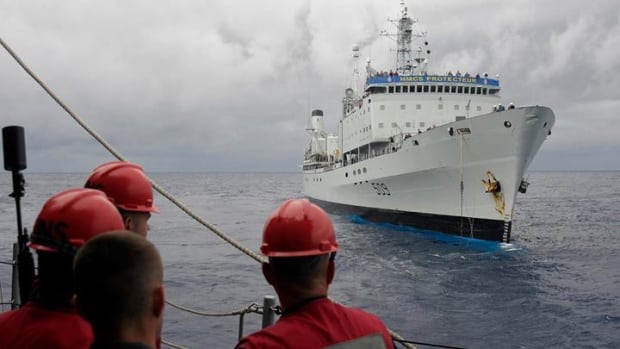
HMCS Protecteur seen from the USS Chosin during towing operations after the fire. This photo gives you a sense of Protecteur's size and the challenge of towing her.
I was very pleased to see the United Church of Canada website tell the story of Protecteur's chaplain, Padre Mike Gibbons (a United Church chaplain serving with the Canadian Armed Forces). All of us in the Royal Canadian Chaplain Service are especially proud of Mike's service during the fire and in the days that followed. As Mike told me the story, in the days following the fire, with much personal kit lost and the ship's laundry unusable, the crew worked in ragged, smoke-stained uniforms through many difficult attempts to establish a tow line and get the ship safely to port.
His ability to make connections with the US Navy chaplains at Pearl led to the Protecteur's crew getting much-appreciated bedding and other comforts on their return, a reminder of how the networks between chaplains of allied nations can significantly benefit the mission.

His padre colleagues are very proud of Mike's service and example, which are in the very best traditions of the Chaplain Service. It is also very gratifying to see a Canadian denomination recognizing the work of one of their own clergy in the military.
Tuesday, August 2, 2016
Military Picture Of The Week

From the DND / RCAF website: Wing Commander John “Moose” Fulton, D.F.C., A.F.C., photographed on June 12, 1942, was the first commanding officer of 419 Squadron. He died on July 29, 1942, at the age of 29, and his name is engraved on the Runnymede Memorial in the United Kingdom, which records the name of airmen who have no known grave. PHOTO: DND Archives, PL-7742
I learned the story of "Moose" Fulton today on the Royal Canadian Air Force website, in a story about a recent reunion of his 419 Squadron in Kamloops, BC. 419 Squadron was part of the British Commonwealth Air Training Plan, and prepared fighter pilots for combat. To this day, it is named after it's first commander.
419 “City of Kamloops” Squadron was named in honour of their beloved first commanding officer, John “Moose” Fulton, who grew up in Kamloops and from whom the squadron personnel received their designation as the “Moosemen”. 419 Squadron, whose unit badge portrays a charging moose, is reputedly the only Canadian squadron named after a person. And to this day, all 419 Squadron commanding officers retire their own call signs for the duration of their command and take the call sign “Moose” in honour of “Moose” Fulton.
A very touching montage of photographs, including the only surviving member of 419 Squadron from World War Two, may be found here.
Sunday, March 27, 2016
Easter 1916 In The Trenches - Remembering Anglican Chaplaincy In The Great War
This article is part of a series I am contributing to the newsletter of the Anglican Military Ordinariate, the clergy of the Anglican Church of Canada serving in the Canadian Armed Forces, as part of an ongoing celebration of the centenary of the Great War. The complete edition of the newsletter for Easter 1916, as well as past versions, may be found here. MP+
By Easter 1916, the Canadian Army in France had finished its apprenticeship of war and was starting to gain its reputation as an aggressive, modern force of shock troops. With 36 combat battalions in three divisions in the line in France, and a Fourth Division soon to join them, Canada was hitting its stride of near full mobilization. Its armed forces had doubled since the Canadian Expeditionary Force had first formed in 1914. The CEF now included within its ranks specialists in tunnelling for the cat and mouse game of laying and detecting vast subterranean explosives planted under enemy trenches, while aggressive Canadian raiding tactics, first by night and later by day, had been approvingly noticed by the British Commander in Chief, Sir Douglas Haig.
France was not the only theatre of operations. Canadian medical personnel operated in the Middle East, and two hospitals had been established at Mudros, a barren section of the Greek island of Lemnos (modern Limnos), to support the failed operation at Gallipoli. Personnel and patients there suffered cruelly from inadequate water and rations, weather and disease, including scurvy. The war diary of one of these hospitals conveys a sense of hardship in this one entry: “Sickness among Officers, Nursing Sisters and men becoming prevalent. Admission to Hospital of dysentery cases increasing daily. The fly menace is very great, also the dust, and poor food supply very trying”. It was at Mudros that Mary Frances Munro died, the first of 47 Canadian nursing sisters to die in the Great War. A native of Ontario and a graduate of Bishop Strachan School in Toronto, she died of illness and is among the Canadians buried at the Portianos Commonwealth Cemetery on Limnos.

Canadian military medical staff on Lemnos, ca 1916, from a Globe and Mail article, 2015.
Even in England, far removed from the hardships of Mudros, chaplaincy was challenging. George Wells, the Anglican padre assigned to Shornecliffe military district, worried about how the Canadian soldier was “getting a very bad name” because of the temptations to “immoral behaviour” in “objectionable houses” and from those “soliciting in the streets”. Wells worked hard to protect his soldiers, “those who were the pawns of war”. His attempts to have such establishments put off limits were not sympathetically received by senior officers, who tended to blame the troops’ bad behaviour on the inadequate moral influences of their chaplains. As Duff Crerar notes, the padres working in training camps faced an uphill battle. Alcohol was easily obtainable, leadership was heavy handed, routines were tedious, and mandatory church parades were widely hated. Social work in such conditions was especially challenging, but Wells had some success in championing unwed English mothers and getting Canadian soldiers to take responsibility for them. In the near-Victorian morality of the period, one has to see this as an especially fearless and prophetic ministry.
For the CEF in the trenches, April 1916 was a cruel month. Following the German offensive at Verdun, there was great emphasis on offensive action to relive the pressure on the French Army. Just south of Ypres, Canadian troops were committed to a battle that became known as the St. Eloi Craters (27 March – 16 April 1916). Four large mines were detonated under the German lines, but instead of the hoped-for breach, vast craters were created in the soggy landscape, complicating maneuver and navigation in the dismal landscape. While some ground was won, the battlefield was “under constant enemy shelling, and men had been forced to crouch in mud-filled ditches and shell-holes, or stand all day in water nearly to their waists with no possibility of rest”. During a relief in place under these appalling conditions, the Canadian 6th Brigade was caught in a German counterattack while badly strung out and not in defensive positions. The Canadians were thrown back with heavy casualties, and the ground was retaken by the Germans. The battle dragged on for days as an artillery duel before it ended, leaving 1,373 Canadians killed or wounded. The Canadian official history describes St. Eloi as a “fiasco”, and its costly lessons were taken to heart in future trench offensives.

One of the St. Eloi Craters, Canadian War Museum
One of the regiments hard pressed in the St. Eloi battle was the 6th Brigade’s 29th (Vancouver) Battalion. Its chaplain was an Anglican, the Rev. Cecil Caldbeck Owen, a graduate of Wycliffe College and the Rector of Christ Church, Vancouver (today’s Christ Church Cathedral). Owen, a vigorous man in his middle age, and widely popular in Vancouver, had long been a militia chaplain, and he went overseas with the newly formed 29th BN in May of 1915. His 22 year old son Harold was by then already in France as an infantry officer.

Padre Owen (right) with his son, Harold, in front of the Christ Church rectory, Vancouver, 1915, from Living Stones: A History of Christ Church Cathedral
Christ Church granted Owen leave to serve in the CEF, and despite worries about his parish’s finances and attendance, he gained a reputation as a dedicated front-line chaplain. He would have gone into action at St. Eloi still coping with grief, for his son Harold had been killed in action on 1 February, 1916. Owen made a three hour journey on horseback to be present at Harold’s funeral, and like his colleague Canon Scott, continued in his ministry after losing his son to the war. After the war, Owen served as a hospital chaplain in Vancouver, and was present at the dedication of the Vimy Monument, where he spoke of how “We must educate our children in the finer aspects of courage and sacrifice which emerged during the war so that they will remember the heroism and the deeper lessons which should have resulted from it”. Sadly, war would ask another sacrifice of him. Owen’s adopted son Luder Keshisian, an Armenian refugee, was an RCAF pilot in the Second World War, and was killed over Germany in June, 1944. Padre Owen died in Vancouver on Christmas Eve, 1954,
For those troops not in the line, Easter Sunday 1916 (24 April) happened to coincide with St. George’s Day, which was not lost on troops of English heritage. Canon Scott, in the Ypres Salient with the First Division, describes how the engineers “built me a church, and a big sign over the door was first used on Easter Day … and we had very hearty services”. For those Canadians in the nearby town of Poperinghe, like the Queen’s Own Rifles which observed Easter Sunday with a church parade, there was the possibility of a visit to Talbot House, an all-ranks refuge created by an enterprising English Anglican, Padre “Tubby” Clayton.
Talbot House, or “TocH” as it was known, offered soldiers a chance to worship in the chapel upstairs (which rocked alarmingly when packed with men) or to remind themselves of civilian life in the comforts of its drawing room and garden. Visitors first saw a sign enjoining them to “Abandon rank, all ye who enter here”. Padre Clayton knew the Canadian chaplains like Canon Scott, and welcomed many Canadian visitors. He wrote that “Canadian churchmanship impressed me not a little. For six months in 1916 a Canadian sergeant-major was the Vicar’s warden; and it was he who most appropriately welcomed the Archbishop of Canterbury on his memorable visit to the House early that summer. Almost the first Canadians I saw were two tunnellers, who on a weekday morning set out from the old French dug-outs beyond Vlamertinghe at 5am and arrived at the Chapel for the celebration (then at 6:30 on weekday), having heard that the service was held daily, and being quite prepared to forgo their chances of breakfast at the end of a ten-mile walk.”
While TocH was a refuge, it was not a shelter. Poperinghe lay within the Ypres salient, and as Clayton wrote, shells “crossed and recrossed the roof from three points of the compass”. The congregations who knelt and prayed in TocH’s small chapel had to return to an even more dangerous front line. A long war and uncertain survival still lay before them. For padres like Clayton, all they could do was to try andfind these momentary places and times of grace for the troo, and commend the men to God in the terrible battles to come.
Padre Michael Peterson+
Subscribe to:
Posts (Atom)
Mad Padre

Opinions expressed within are in no way the responsibility of anyone's employers or facilitating agencies and should by rights be taken as nothing more than one person's notional musings, attempted witticisms, and prayerful posturings.