Preached at All Saints, Collingwood, Anglican Diocese of Toronto, 19 October, 2025. Readings for Proper 29(C): Jeremiah 31:27-34; Psalm 119:97-104; 2 Timothy 3:14-4:5; Luke 18:1-
“And yet, when the Son of Man comes, will he find faith on earth?" (Lk 18.8)
You may have a morning routine where you like to stretch your brain muscles before starting the day. In our house, we have to finish some of the New York Times puzzle games - Wordle and Connections - before we get going. It feels like a useful exercise, a little mental calisthentics to keep the brain sharp, ad there’s always a feeling of reward if I can solve the puzzle quickly.
I don’t know about you, but whenever I hear that the gospel is going to be one of Jesus’ parables, I think it’s a puzzle that needs to be solved. That might seem like an odd reaction, because we’re taught in Sunday school that parables are simple stories using everyday images for ordinary folk, and offering homespun wisdom. But in fact many parables are cryptic and leave us wondering, what is Jesus trying to say? How exactly is heaven like a mustard seed? (and so on).
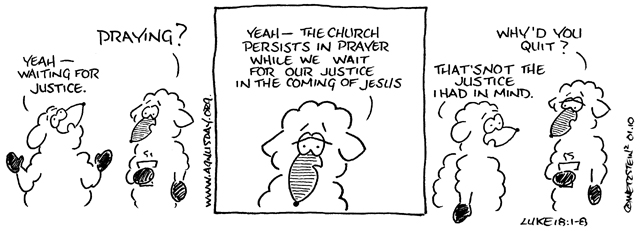
Today’s gospel is different because Jesus gives us the Coles Notes summary at the start - “[he] told them a parable about their need to pray always and not to lose heart” (Lk. 18.1). So right off the bat Jesus is telling us what the parable is about - it’s an encouragement to pray often, persistently, and hopefully.
Jesus also helps us avoid an interpretive error. Sometimes with these sorts of parables we are tempted to say that the most powerful person in the story somehow represents God, but Jesus helpfully tells us that if even the corrupt and wicked judge in the story can be swayed by a pesky widow, how much more will a loving God quickly hear and answer the prayers of his people?
If there’s a character in the parable that we want to identify with, surely it’s the widow. It’s not just that she is persistent, though Jesus does say that we should “pray always”. But if we were to simply say that the moral of the parable is that “the squeaky wheel gets the grease”, then I think we would be missing out on a more important truth. The important point of the parable I think is that the woman wants justice.
In Jesus’ time, a widow asking for justice would have tied in to definite ideas about the kind of society God wants, where even the most helpless have protections and dignity. We see this for example in one of the psalms.
“O Lord, you will hear the desire of the meek, you will strengthen their heart, you will incline your ear to do justice for the meek and for the orphan and the oppressed, so that those from earth may strike terror no more.” (Ps 10:17-18).
Jesus’ parable thus takes up a call for justice for the poor and powerless that runs throughout the Hebrew scriptures. Verse 7 of the gospel reading should be read in this context as a powerful promise that God’s will bring justice to the world: “And will not God grant justice to his chosen ones who cry to him day and night? Will he delay long in helping them?” (Lk 18:7). So that promise is reassuring, and yet the Gospel ends on a question that seems almost foreboding: “And yet, when the Son of Man comes, will he find faith on earth?”
What does Jesus mean by faith on earth? Does he mean faith as a set of abstract beliefs that we have to hold in our heads? I would say no, that’s not a helpfulw way to understand either faith in general or this parable in particular. Faith is more than a set of abstract ideas. Faith is beliefs in action. And here in the parable the action is about the widow’s persistent prayer for justiuce.
And if the parable is about justice, we could say that faith is the extent to which we believe in and strive for God’s justice, in our actions where possible, and in prayer often. In this context, “faith” is understood to include “faith/belief in God’s justice”.
Caring about justice doesn’t necessarily mean that we as Christians and as Canadian Anglicans need to align ourselves with any one political party or cause, though it does mean I think that we care about what happens in the political realm. I think we have pretty good instincts when it comes to looking around us and recognizing injustice. Injustice is simply that which isn’t right.
As a case in point, people going homeless isn’t rigght. Our wonderful deacon, Rev. Lorna, was in the city yesterday at the church of St Stephen in the Fields. You many have heard that this church has been the site of a homeless encampment for the past year or more. In fact, the priest there. the Rev. Maggie Hellwig, recentlty published a book called Encampment, a theological and social reflection on what homelessness is and how we should respond to it.
The CBC described Helwig as “an outspoken social justice activist [who] has spent the last three years getting to know the residents and fighting tooth and nail to allow them to stay, battling various authorities that want to clear the yard and prefer to keep the results of the housing crisis out of sight and out of mind”.
https://www.cbc.ca/books/encampment-by-maggie-helwig-1.7458187
This Thursday, less than 24 hours after Hellwig received the Toronto Book Award, the Toronto Fire Marshall had the encampment cleared on the grounds of safety, and the residents were offered space in the city’s shelter system. As Hellwig noted, many of the encampment residents see shelters as more dangerous than sleeping in tents, and so the problem of urban homelessness will continue. All that people like Rev Hellwig, Deacon Lorna, and their supporters can do is to bear witness to this seemingly insoluble problem and call for justice.
https://torontolife.com/city/a-churchyard-homeless-encampment-was-cleared-less-than-24-hours-after-the-priest-received-the-toronto-book-award-for-writing-about-it/
Even persistent, applied faith can seem to be in vain. Despite the efforts of Revs Lorna and Maggie and others, the encampment was cleared. Their efforts, like our other good causes, may seem like a drop in the ocean compared to the injustice in the world.
However, prayer reminds us of God’s purpose and plan to rescue and redeem the world, to return it to the way he created it. Iy briefy point us ahead a month to the season of Advent and Christmas beyond it, I’m reminded of another widow in Luke’s gospel, the one who is mentioned in the nativity stories, the prophet Anna, who lives long enough to see the Saviour born. Luke tells us that:
“She was of a great age, having lived with her husband for seven years after her marriage, 37then as a widow to the age of eighty-four. She never left the temple but worshipped there with fasting and prayer night and day. 38At that moment she came, and began to praise God and to speak about the child to all who were looking for the redemption of Jerusalem. Luke 2:36-38)”
Anna reminds us that prayer is heard and answered, that God does care for the world enough to send us his son, and that as Christians, are prayers are part of God’s ongoing work in Christ to save and rescue the world.
Until this happens, our job is “to pray always and not to lose heart”.