Showing posts with label Advent. Show all posts

Saturday, December 21, 2024

Elizabeth's Blessing: A Homily for the Fourth Sunday of Advent

Preached at All Saints, Collingwood, Anglican Diocese of Toronto, 22 December, 2024, the Fourth Sunday of Advent.  

Texts for Advent 4C: Micah 5:2-5A; Canticle 18 (Luke 1:47-55) OR Psalm 80:1-7; Hebrews 10:5-10; Luke 1:39-45 (46-55)


And blessed is she who believed that there would be a fulfilment of what was spoken to her by the Lord.  (Lk 1:45)

The first chapter of Luke’s gospel is one packed full of wondrous events - comings and goings, visits and announcements.  Some of these visits and announcements are awe inspiring and momentous - the angel Gabriel coming to Zechariah and Mary with news of unbelievable pregnancies and children that will change the world.    In contrast, the third visit, that of Mary to her kinswoman Elizabeth in today’s gospel, may seem homey and ordinary, a young woman dropping in on an aunt or early cousin, but in their own ways, what these two women say to one another is just as powerful as the angel Gabriel’s words.   

Today I want to focus on Mary and Elizabeth as people of faith who trust that God will deliver on his promises.   Mary and Elizabeth can inspire us to hear with fresh ears the good news we hear every Christmas, that God comes into our human world with love and justice to save the world that God loves.  Mary and Elizabeth can inspire us to show Christ anew to the world through our own lived faith and actions.

First let’s consider the reasons why Mary would want to seek out her relative Elizabeth.   The trip between Mary’s house in Nazareth of Galilee and Elizabeth’s house in the hills near Jerusalem (today known as Ein Karem) was about one hundred kilometres, so not an inconsiderable journey for a young woman, whether  on foot or maybe by donkey.    We can guess at the reasons.    Mary has recently learned from the angel Gabriel that she has miraculously conceived a child who “will be holy, who will be called the Son of God” (Lk 1.35).  Even though she receives this news calmly (“let it be with me according to your word” Lk 1.38), we can imagine that her life has now been thrown into disarray.

We can imagine that one reason she would want to get away is because of what others would perceive as a scandalous pregnancy.    Matthew’s gospel has the account of Gabriel visiting Mary’s betrothed Joseph to allay his fears about the pregnancy (Mt 1:18-25), and presumably this has already happened.    It’s also six months since her relative Elizabeth has miraculously become pregnant, and that news would have travelled, so we can imagine Mary wanting to take refuge with an older relation who would understand her situation.  And what Elizabeth will understand is that God is up to something wonderful, because when she conceived at her old age, Elizabeth said that “This is what the Lord has done for me” (Lk 1.25).   And so Mary goes to be with the one person who will understand what God is doing.

The scene where Mary arrives at Elizabeth’s house is one of the loveliest in all of scripture.    Sometimes in the gospels we get these rare and lovely domestic vignettes of private homes where real people come together in love and friendship, surrounded by God’s grace.   The home of Lazarus and his sisters, a refuge for Jesus and his friends, is one such place.   Elizabeth’s home in the hills above Jerusalem is another.  We can imagine a cozy, domestic scene and a joyous welcome as Mary arrives, but it’s also a scene full of God’s activity, for the child leaping in Elizabeth’s womb will be John the Baptist, who here in utero is already beginning his vocation of announcing the coming of Christ.  And there is Elizabeth, not just an incongruously pregnant old lady but also the wife of a priest, Zechariah, and herself a person of deep faith and belief that God would keep his promises to his people.

I think it’s worth taking a minute to consider the context here and what it is these people want and hope for - the Messiah, the Saviour of Israel who will be sent by God.  Elizabeth and Mary are people who live under occupation.   As faithful Jews, they know the stories about how God freed his people from slavery in Egypt and in Babylon.   The remember their great kings, David and Solomon, and they know it’s been centuries since a Jewish king has sat on David’s throne.  They have faith that God will send another David, some mighty king, to rescue them.  Mary has already leaned into that faith when she said yes to Gabriel.  And now Elizabeth recognizes that faith in her young cousin, for what she says to Mary is significant: “blessed is she who believed that there would be a fulfilment of what was spoken to her by the Lord”  (Lk 1:45).

And what does Mary believe?  We see her faith laid out in what has become known as the Magnificat, perhaps the greatest hymn of longing for deliverance in all of scripture.  In her song, she expresses her faith that God will look kindly on those the world deems to be of no account (“he has looked with favour on the lowliness of his servant”).  She praises the faithfulness of God, who is with us “from generation to generation … according to the promise he made to our ancestors”.  She points to the mighty power of God that will sweep away the Emperor in Rome who will soon decree that all the world will be taxed (Lk 2.1).   And Mary declares that in a world where only a few can feast, God will bring food and wellbeing to the hungry.

It’s remarkable that the Song of Mary has become so spiritualized, so set apart in gorgeous musical settings in liturgy, that we somehow don’t think about it as applying to the real world, but isn’t the real world where God in Christ Jesus is born?  It is the same world where people still chafe under dictatorships and would-be emperors, where we see a handful of mighty oligarchs and tech billionaires feasting while millions go hungry.  Even though faith in God and God’s promises has dwindled, there is still a desire, especially at Christmas, for some better reality to appear, even briefly.   

Last night, a few of us were handing out hot chocolate at the Christmas market, we told folks that it was free but that donations would go towards our food ministry, because our church feeds a lot of people.  That was always well received and made people want to open their wallets.    At some primal level, even in what some call the post-Christian world, people still want the hungry to be filled with good things.  

And you, dear saints, this Christmas, what do you do want?  What do you hope for?  Would Elizabeth say of you that we are blessed for believing that God would make good on God’s promises?   Should the poor and lowly have dignity and value?  Should the hungry be filled with good things?  Should we trust in God’s power rather than worship those who chase earthly power?  Dare we believe that God is faithful to God’s ancient promises?

If you can say yes to these things, and if you can even try to do these things, than surely you are blessed.   And, dear saints, if you feel that you cannot come to believe these things, then ask for the faith to believe, for as Advent has taught us, the Lord is near.  Indeed, the Lord may be closer than you think, for with every act of hospitality, with every word of encouragement, with every kindness to the poor and lonely, and with every beat of a thankful heart and every prayer of praise, you have been faithful to the vision of God's kingdom that Mary described in her great song.  

The Lord is near.  Our Advent journey is nearly over.  Once again we've heard the promises of God, that he would save us.   And now Jesus stirs, waiting to be born in Bethlehem, waiting to be born anew in the hope and life and actions of each faithful believer, for as the poet Rumi once said, each of us has a Christ within.   Just as Mary bore Christ because she believed in God's promises, so we can show Christ to the world by living out our own faith.   My prayer for us this Christmas is that we, like Mary, dare to believe in God's promises, for as old Elizabeth told Mary, blessed are those that dare to believe.

Sunday, December 1, 2024

Keeping Our Heads Up: A Homily for the First Sunday of Advent

Keeping Our Heads Up:  A Homily for the First Sunday of Advent

Preached at All Saints, Collingwood, Anglican Diocese of Toronto, 1 December, 2024.  Readings for Advent 1C: Jeremiah 33:14-16; Psalm 25:1-9; 1 Thessalonians 3:9-13; Luke 21:25-36


Now when these things begin to take place, stand up and raise your heads, because your redemption is drawing near.” (Lk 21.28)

In my first parish, there was an old gentleman named Tom who would often say goodbye with these words: “Keep your stick on the ice and your head up going into the corners”.  It’s good advice for hockey players:  be ready for the puck but also be aware when you’re vulnerable to being checked.  It’s also good advice for Advent.   Hockey and Advent are both about being ready and being alert.  Today I would like to think about how Advent invites us to be spiritually ready for the Savour whose coming we long for and should await with confidence rather than fear.

Readiness, the Advent idea of preparation and getting ready,  I think we can all understand.  There is a satisfaction in hanging lights, wreaths and greenery, even as we sometimes debate the appropriate date to decorate! There’s a joy in seeing the church decorated by faithful hands, and knowing that more - the tree and the creche - is still to come.   As the beloved Advent hymn says, “make your house fair as you are able, trim the hearth and set the table”.    Just as we prepare for friends and family, Advent calls us to prepare our hearts to welcome our beloved, Jesus, for again to quote the hymn, “love the guest is on the way”.

Advent is also a way to understand exactly who it is that we are getting ready for and why that’s important.   Advent is a gentle correction to our cozy and sometimes sentimental ideas about baby Jesus in the manger, who comes predictably in late December.   This season reminds us that that babe is also the king of the universe, the holy one of Israel, the Lord of justice and righteousness that Jeremiah spoke of in our first lesson.   Advent reminds us that just as he came to Bethlehem, so this Lord of righteousness will come again. 

Jesus tells his disciples in today’s gospel that they will see  “the Son of Man coming in a cloud' with power and great glory”, which shouldn’t come as a surprise to us, because Sunday by Sunday we acknowledge Christ’s return.  Likewise our Advent hymns have words like “Lo, he comes, with clouds descending”, to remind us that we do await the coming again of Jesus in glory.     Jesus tells his friends that they may see signs of this final day,  but he warns them to “be on guard” and “be alert at all times”.  This theme of alertness and vigilance is quite common in scripture.   Paul tells the Thessalonians that “the day of the Lord will come like a thief in the night” (1 Th 5.2) and warns them to stay awake spiritually.

What does this mean for us?    How are we supposed to stay awake spiritually?  Should we scan the headlines for signs of the Second Coming, as some Christians do? (No, I don’t think so).  I would say instead that we can be spiritually awake and alert without being fearful or anxious about the end times.   Our faith should not make us nervous wrecks!    Part of being Christian is to wake each day knowing that God is Lord of heaven and earth, that all is in God’s hands, and that nothing can separate us from the love of God in Christ Jesus.  Always hang on to those truths!

I believe that spiritual alertness is actually not so much about waiting for the Second Coming as it is about being open to signs of God’s presence in our lives.   Jesus promises us that he will always be very much with us, here, in the present.  We meet Jesus at the altar during communion.    Through the Holy Spirit we can pray with Jesus, even imagine him in conversation with us as Rev Amy preached here recently.    As individuals and as church, we need to be open to what Jesus through the Spirit is calling us to do, watching for signs of God’s activity in the community, listening for calls to new ministries.    

This kind of spiritual alertness requires that we keep our heads up and our ears and hearts open to the Spirit’s promptings.   This receptiveness to God’s actions is what scripture calls wakefulness, and the opposite is that we are spiritually asleep, switched off and oblivious to God’s presence.  Remember that Jesus told his friends to see that their hearts are not “weighed down with dissipation and drunkenness and the worries of this life”.    In his online Advent teaching last Tuesday, Bishop Andrew talked about the many ways that people can dull their spiritual senses through self-medication, consumerism, and anxiety.  When we’re sleepy, depressed, or when we lose hope, our heads tend to droop. Jesus wants believers whose heads stay up and whose hearts and ears are open to his voice.

As an aside, I think there is another kind of dullness of sleepiness that we can fall prey to, and that is indifference to the world around us.   We have ample signs that the world is corrupt, unjust, inequitable, and cruel.   We can easily numb ourselves to these things or ignore them.  But, as we heard Jeremiah say in our first lesson, our Lord is justice and righteousness.  Part of being spiritually wakeful is caring about and striving for justice and caring about our neighbour, as God surely does.

The final thing I want to talk about is confidence.  Jesus said, “Now when these things begin to take place, stand up and raise your heads, because your redemption is drawing near”.    When we hold our heads up, we display confidence and assurance, it’s a sign that we’re not just alert but we are unafraid, even amidst the kind of troubles that Jesus describes.   Jesus promised that we would live in fearful times, and he was right.   We live amidst wars and natural disasters, climate change and political anxiety, but Jesus says, even so, keep your heads up.

We keep our heads up because Advent reminds us that we wait and hope for God in good company.  Noah waited and hoped for the flood waters to recede until the dove returned with the olive branch.    Simeon and Anna waited and hoped for salvation and finally saw the baby Jesus in the Temple.   John the Baptist waited for the Messiah until they met at the Jordan and the dove came down from heaven.   All these people waited and hoped because they knew God was faithful and would rescue them.   So we keep our heads up because we look to God who is faithful for our rescue and our salvation.

Finally, we keep our heads up because we know that in Jesus we can see God face to face.   Jesus telling his followers to “raise your heads” must have been a remarkable thing at the time.  It must have been dangerous for a Jew to look a Roman in the face, or for a slave not to keep their eyes lowered before the master.   Learning how not to be seen is a survival technique for people at the bottom, But Jesus is saying, even when you see God returning in glory, raise your heads.  Don’t be ashamed of yourselves or of your sins.   Paul prays that the Thessalonians “may be blameless before our God and Father at the coming of our Lord Jesus”, and so can we, because of the love and forgiveness shown to us by God through the babe born in Bethlehem, the Lord of Heaven and Earth.

And so, dear saints, let us remind ourselves this Advent to be spiritually ready, awake, and confident in God’s faithfulness.  Let’s listen to how God is calling us, let’s be attentive to what God is doing around us, and let’s be unafraid despite what might happen around us, for God is faithful, Jesus has come, Jesus is with us now, and Jesus will come again.   Or, as my old friend Tom liked to say, “Keep your stick on the ice and your head up going into the corners”.


Saturday, December 23, 2023

The Play of Heaven and Earth: A Homily for the Fourth Sunday of Adveent


Preached on the Fourth Sunday of Advent, 24 December, at All Saints, Collingwood, Anglican Diocese of Toronto.   

Readings - Isaiah 9:2-7; Psalm 96; Titus 2:11-20; Luke 1:26-38


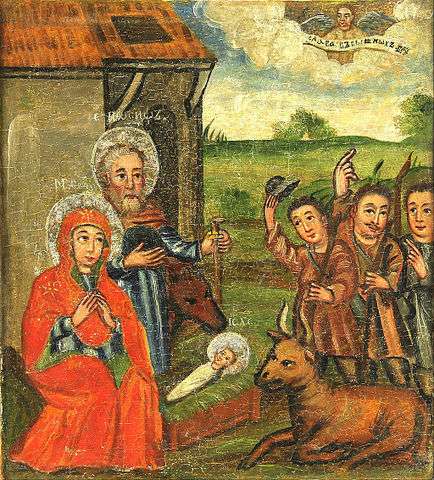
“Adoration of the Shepherds” by an unknown artist a part of the Google Art Project. Wikimedia Commons.


Today I want to offer my thanks to everyone, adult and child, who was a good sport and took part in our Christmas pageant.


The Christmas pageant or nativity play is a curious sort of church ritual, isn’t it?   I wonder sometimes why we put such effort into them when there is so much else to do at Christmas?


Surely the nativity play is an expression of our sheer delight at having children present with us at Christmas time, as families reunite over long distances.   That delight is especially poignant and bittersweet in a church such as ours which remembers crowds of children and now sees them but seldom.


So we want the nativity play out of a sense of nostalgia, a desire for things as they were, but we also do it out of a sense of duty, for the psalmist tells God’s people that we must teach the next generation “so that they should set their hope in God, and not forget the works of God” (Ps 78:6-7).   And what can story is more important to tell our children than that God loved us enough to be part of our human family?


The Christmas story is an ideal lesson for the young because it is full of things that children understand: family, parents, babies, love, gifts, animals.   It’s a solid foundation on which to raise children in the faith, and it’s a place for we adults to return to when our faith is shaken.  


The nativity play is a classroom for all of us, young and old, that teaches us the mystery of the incarnation, and reminds us that God loved us enough to become flesh and dwell us.   We need to be reminded of this truth when God seems distant in our darker moments.


If there is a danger in the nativity pageant, it is that we adults become patronizing and think that this is  merely an activity for children.   But even when it’s just as adults present here on Sunday, what is our worship but big children at play?   Liturgy is when we as adults imagine the glory of heaven and try to recreate it as best we can through songs, vestments, altar hangings, and rituals.   Liturgy is us giving what poor gifts we can find, gifts that in no way match what we have received from God.   Worship is us imagining, as best we can, what the kingdom of heaven might look like, in the same way that CS Lewis created a magic realm called Narnia in order to show us what a divine realm might look like. 


The nativity play invites us to see our world as being open to God’s action and presence, when “heaven and nature” can be unite and sing together.   That angel may be a child with tinfoil wings and a tinsel halo, those shepherds may just be awkward fellows in bathrobes, but seeing them together before us reminds us that the God who sent an angel to a humble peasant girl also delights in and inhabits our ordinary lives.   As I said earlier, the nativity play is a classroom of the incarnation, and we come away learning that we can find mystery in the ordinary.


Others have learned these lessons before us.   In England in the later middle ages, people would reenact biblical stories in dramas that scholars call mystery plays.  One of these plays, about the birth of Jesus, is called The Second Shepherds’ Play, and I confess that this play helped inspire the simple rhymes used in today’s pageant.   This medieval play is about three simple shepherds, country men with thick rural accents, and there’s a comic first half about how they outwit a thief named Mak and his wife.   This villainous couple steal a sheep and try to disguise it as a baby in a cradle, but the three shepherds finally see through this ruse:


(The other SHEPHERDS come back.)

Give me leave him to kiss, and once lift him out. What devil is this? He has a long snout!

1ST SHEPHERD

He is marked amiss. Let's not wait about!

2ND SHEPHERD

The ill-spun weft always comes foully out. Aye, so!

He is like to our sheep.


In the second half, the three shepherds are awakened by an angel, who tells them:

Rise, gentle shepherds, for now is he born

Who shall fetch from the fiend what from Adam was torn. God is made you friend now at this morn,


So the three shepherds go to the manger, apologizing that because they are poor men (“we're rough all three”), they can only offer simple gifts:  a bird, a few cherries, and a ball to play with.   The play ends as the three shepherds leave rejoicing:


2ND SHEPHERD

Lord, well is me.

3RD SHEPHERD

In truth already it seem to be told Full oft.

1ST SHEPHERD

What grace we have found!

3RD SHEPHERD

Let's make a good sound, And sing it not soft.


I’m sure that the medieval audiences appreciated the two-part structure of the Second Shepherd’s Play.  The thief disguising the sheep as a baby in the cradle in the first part is a comic expression, whereas in the second half, the baby in the manger is not only the Lamb of God but also the Lord as shepherd who will protect his flock.  And so, the play tells us, we are saved from the evil one:


1ST SHEPHERD

(They enter stable.)

Hail, comely and clean! Hail, young child!

Hail, maker, as I mean, of a maiden so mild!

Thou has cursed, I believe, the warlock so wild;

That false guiler of vexation has himself been beguiled


Likewise, our nativity plays announce good news, that the babe in the manger was born to save us from ourselves, from evil, and from death.   We could tell this story in so many ways, in soaring music like Handel’s Messiah, in elaborate Renaissance paintings, and in high liturgy amidst chanted psalms and liturgy.    However, we can also all this story as an ordinary church nativity play, with adults and children in their bathrobes and tinsel wings, awkwardly and playfully telling the story about how heaven and earth comes together.   


And maybe a simple nativity play is a more honest gift to our saviour because we’re not trying to impress anyone with our skill and talent.   We’re as artless as children playing dress up.  We offer this simple play to the child in the manger, because like the three medieval shepherds, we give what simple things we have.    Our nativity play is a simple gift, but it’s heartfelt, and it’s joyous, because today is a story that children can understand and mystics can forever ponder, that the God of love and majesty came among us a child, to save us.  What can we give him?  Poor as we are?  What we have we give him, our hearts, our selves.  These are gifts enough.

Saturday, December 9, 2023

The Advent Highway: A Homily for the Second Sunday of Advent

The Advent Highway:  A Homily for the Second Sunday of Advent.  Preached at All Saints, Collingwood, Anglican Diocese of Toronto, Sunday December 10 2023 

Readings - Isaiah 40:1-11; Psalm 85:1-2, 8-13; 2 Peter 3:8-15a; Mark 1:1-8 


A voice cries out: “In the wilderness prepare the way of the Lord, make straight in the desert a highway for our God.  (Isaiah 40:3)

Throughout Advent, the voices we hear from scripture urge us to prepare, to be ready for comings and goings.   

Last Sunday, we heard Jesus say in a parable in Mark’s gospel (Mk 13:24-37) that he would come again like the master of a house, unexpectedly, at any time of the day or night.   We in the parable were the master’s servants, expected to be ready and to the house ready and in good order.    Thus, when the Advent hymn tells us to “trim the hearth and set the table”, it is urging spiritual preparation, and not just home decorating.

So comings and arrivals we can prepare for.   We know the date, we prepare to welcome the babe as God made flesh, and with the Spirit’s help we do what we can to set our souls and lives in order.

But what of Advent goings?  There’s that highway that Isaiah speaks of.  What must we take with us?  When must we leave?  Where will it take us, and what will we find there?

Now as Canadians, we don’t know much about highways in the desert, but we know something of preparing for travel at this time of year.  In the warm months, as we drive about in the highlands and see those signs that say “Road Closed When Lights Flashing Due to Winter Conditions”, we may not think much about them at the time, but we know that in a few months, it will be time to prepare for travel.

We know when it’s time to put on the snow tires.   We fill up with winter window cleaner, stock the car with blankets and, as Rev. Sharon said in her homily last Sunday, a candle or two for warmth.   Mostly we do a good job of getting ready, though there was the guy in the rectory driveway on the first icy day of winter, scraping his windows with a wooden spatula.   The less said about that guy, the better.

While we can try to imagine the dangers of a travel in the desert - getting lost, thirst, wild animals - we know all too well the dangers of winter travel.   Who hasn’t been caught in a snow squall, gripping the steering wheel until the knuckles ache, peering through the whiteout to try and discern the road ahead and the terrifying ditches on either side?  Who hasn’t breathed a sigh of relief to see the blue lights of a plow up ahead, and followed the plow like a gosling follows its mother?  And who hasn’t thanked God when the lights of home or hotel finally come into view and the long scary trip is done?

Our words from Isaiah today are words of promise and freedom to a displaced and captive people.   Israel has served its sentence for disobedience, its time in Babylon has come to an end.   But how will the exiles in Babyon get home to Jerusalem?  The good news that Isaiah holds out is a metaphor that sounds like a miraculous engineering, a highway through the desert, level and smooth, an easy way for God’s people to go home and be free again in their own land.

3A voice cries out: “In the wilderness prepare the way of the Lord, make straight in the desert a highway for our God. 4Every valley shall be lifted up, and every mountain and hill be made low; the uneven ground shall become level, and the rough places a plain.

Perhaps if we wanted to transpose Isaiah’s metaphor to a Canadian context, keeping in mind our earlier thoughts about winter driving, it might go something like this.

A voice cries out:  “In the winter prepare the way of the Lord, plough the highway for our God.   All the black ice will be sanded, every drift shall be cleared, the snow fences shall be fixed firmly in place, and the hills and corners made safe.”

But where will these now safe winter roads bring us?  Will they lead us back home to our old lives and comforts, or will they bring us to some new place where we are willing, even brave enough, to find a God who will make us new?

Isaiah promised a day when the exiles would return home to a new relationship with God.  The people had been taken to Babylon because they had forgotten their covenant with God.   They would return as a changed and redeemed people.  Thus when Isaiah uses the word “comfort”, as he does repeatedly, it means more than just “console” or “cheer”.   As the biblical scholar Anathea Porter-Young notes, the Hebrew word naḥămû has a range of meanings including “change”, “be sorry”, and “repent”.   Thus the road home to Jerusalem will be road to a restored and repaired relationship with God.

 In today’s gospel, the cry of Isaiah is taken up anew.  Now the voice has a name, John the Baptizer. He is dressed like one of the great prophets (Elisha) and he speaks with the words of another.  John tells us that the highway is open, the road is ploughed, and again God’s people can travel, which they do:

And people from the whole Judean countryside and all the people of Jerusalem were going out to him, and were baptized by him in the river Jordan, confessing their sins. (Isa 40:5)

Mark, ever laconic, doesn’t tell us what sins the people want to confess.  Their particularity doesn’t matter.  What matters is that there is need and urgency; tthey desperately want what John promises.  

And what does John promise, but Jesus, the one far greater than himself, the one  whom John isn’t even worthy to stoop before as a servant?   John admits that his baptism is water, a temporary cleansing.

By contrast, Jesus offers a baptism of spirit, an internal cleansing, a remaking, a new beginning, and a making clean of what has gone before.  Confession, baptism, forgiveness, making clean, new beginning - these are all bound up in the first words of Mark’s gospel, “The beginning of the good news of Jesus Christ, the Son of God” (Mk 1.1).    The good news is that we the Advent highway brings to the one who knows us, hears us, judges and forgives us, and makes us new.

Rowan Williams has written of Advent that it is about our need to know that we are not alone.   “We live as human beings, in an enormous hunger to be spoken to, to be touched, to be judged and loved and [forgiven]”.    We cannot judge ourselves.   Who can judge us and forgive us for homelessness and poverty, for war and genocide, for environmental and nuclear destruction?  We cannot forgive ourselves, and yet without the voice of God we are left alone in our flawed humanity.

And so we long for a God who restores our humanity and makes it new.   The Advent highway brings us to this God, whether it leads us through the desert or through the winter storm.   The Advent highway brings us to Jesus, who knows exactly who and what we are, and who, nevertheless, offers us absolution and new life.

Shortly in our worship today, when we get to the Confession and Absolution, I invite you to imagine yourself having driven safely through a winter storm.  The danger’s past.  You’re safe.   You can unclench your hands from the wheel.  Outside the car is light and warmth.  The Advent Highway has brought you home to Jesus.

Friday, December 1, 2023

Advent Badgers and Hedgehogs: A Parish Message for Advent

 This text appeared in the latest issue of our parish newsletter, All Saints Alive.


Every Advent, two tunes compete in my head.  One is the bouncy and uplifting “People Look East”, which uses the language of many parables to encourage us to prepare our souls for the coming of Christ (“Love the guest is on the way”).   This hymn was a favourite of my mother, a cheerful soul who usually began singing it sometime in August.


The other tune competing for my mental real estate is “O Come, O Come, Emmanuel”.   This ancient tune, in a medieval minor tone, is sombre and austere, full of biblical imagery that longs for the promised Saviour whose coming is foretold in scripture.


Both hymns embody the essential Advent themes of preparation and expectation, though neither may satisfy those who come to church in early to mid December hoping to hear Christmas carols!


In a recent essay in the Christian journal Plough, Claire Coffey makes a tongue in cheek distinction between “badger-like stalwarts who point out that Advent is its own season” and “jolly hedgehogs” who want to spread the Christmas spirit as far and wide as they can.


Liturgically speaking, I tend to be a bit badger-ish when it comes to Advent, though I have nothing against jolly hedgehogs and, personally, if you want to keep your Christmas lights lit all year long because they cheer you up, then more power to your elbow!   I myself wait to hang the lights until just before Advent, when the darkness and chill creep in earlier each day.  In doing so, I find myself agreeing with Claire Coffey that “Advent is the final phase of spooky season”.


By spooky season, Coffey means that Advent is in many ways connected with Halloween, when we bid adieu to summer’s glories, when the fields and the trees turn bare and brown, and we walk a little more nervously at night amidst the rustling leaves.    We think of the dead on All Souls, and we think of our sins and guilts and grievances.   In church through November, our gospel readings warn of the return of the lord who will demand an accounting.   We ask ourselves, are we ready for his coming?


Advent is expectation and hope, but it can also be a time for remorse, repentance, and self-examination.   This is a time when we may need to curb our hedgehog enthusiasm for Christmas and tune in to the more disciplined badger side of our personalities.    Remorse, repentance, and self-examination as spiritual disciplines can be demanding, but they lead us out of gloom and into  joy.    One of our most beloved Christmas tales is a ghost story that leads from remorse, repentance, and self-examination to a new life and joy.


 So yes, Advent may indeed be part of the spooky season, but it ends with church bells ringing clear and bright on a frosty morning, ringing to banish the ghosts and to tell us that we need not fear the Lord’s return.   In the words of the ancient hymn,


O come, Thou Dayspring from on high

And cheer us by Your drawing nigh

Disperse the gloomy clouds of night

And death’s dark shadow put to flight


Happy Advent, dear saints.  May this time be one of good preparation for us as we put our homes and hearts in readiness for the coming of the king.


Claire Coffey’s piece may be found at www.plough.com


Saturday, December 12, 2020

Witness to Miracles: A Sermon for the Third Sunday of Advent


John answered them, “I baptize with water. Among you stands one whom you do not know,” (Jn 1.26) 


Preached at All Saints, King City, ON, the Anglican Diocese of Toronto, on December 13, 2020, the Third Sunday of Advent.


Readings for this Sunday:  Isaiah 61.1-4,8-11; Psalm 126, 1 Thessalonians 5.16-24, John 1.6-8, 19-28


My first parish included a few of those legendary bachelor farmers that Garrison Keillor loved to write about.   These men were soft spoken and gentle, in their eighties and still hard-muscled and lean from lifetimes of work.   I wasn’t expecting one of them to turn into John the Baptist.


One Sunday in summertime, Bill wasn’t in church, which was unheard of, so his nephew drove to his farm and noticed uncle Bill’s truck by the woodlot out back.   There he found his uncle, lying on the ground, barely alive.   The Friday before, Bill had taken his ladder and his chainsaw to go limb some trees.  Of course, the ladder slipped and thankfully, he and the chainsaw went their separate ways as they fell quite a distance.


Bill broke his hip and some ribs in the fall, and lay on the ground for three days.   A few times it showered, which saved him from dehydration.    Sunday afternoon his nephew called me and I met them at the hospital.   Bill was well medicated by then and dreamily spoke of seeing guardian angels in the sky above him.  His nephew looked at my sideways.  “Those were buzzards”.


Uncle Bill fully recovered, and the taciturn farmer was transformed into a loud and enthusiastic evangelist.  Bill had prayed constantly lying in that wood, and he firmly believed that Jesus had saved him.   Bill’s story became his testimony, and he testified in churches, in the community, and in his family.    After a while, many hoped that he would settle down and lose his enthusiasm.  Why was that?


In many churches, especially African-American ones, giving testimony is a common part of worship.  As Prof. Courtney Buggs writes, in these churches, “congregants can’t keep it to themselves just how good God has been”.  I saw the same thing with the young Christians I taught in Ethiopia earlier this year.  They would joyfully speak, sing, and clap, saying how good and powerful Jesus is, and how much they loved him.  They believed that Jesus was the most powerful, most wonderful thing in they lives, and they weren’t afraid to say so.  These are Christians who fully identify with John the Baptist.


We think of John as “the Baptist” or “the Baptizer”, but he should really be thought of as “John the Witness”.   His job in the gospels to tell people about Jesus, the Messiah, the one promised by prophets like Isaiah.   In today’s gospel reading, John denies being anything but a witness, a herald, the voice crying in the wilderness.   Hence the tradition in medieval and Renaissance art of depicting John as literally pointing to Jesus, as in the famous Eisenheim altarpiece.   The theologian Karl Barth kept a reproduction of this work on his desk, and said that John and the church shared the same role - both exist only to point to Jesus and see “he is the one, the Saviour”.


Why were my parishioners reluctant to witness to Jesus like Bill? Why did they seem to find it awkward to listen to his testimony and why didn’t they want  to share their own stories? As I think about it years later, I think there was also another reason for their discomfort.  I think they were held back by a lack of confidence in  the idea of God being active among us.  Did God answer Bill’s prayer?  Did Jesus save Bill in that wood, or was that going too far?  After all, there were other non-religious explanations - an atheist might well say that Bill survived because he had a strong constitution for an older man, he was lucky it rained, and lucky that his nephew arrived in the nick of time. 


As Christians in the 21st century, Anglicans who value reason and critical thinking, we kind of straddle a fence between faith and science.  We may well be more comfortable speaking about coincidence than providence.   We may be reluctant to say that God answers prayer because how can you find evidence for that claim?   We may be reluctant to be thought of as credulous or superstitious in a society that prizes education and rationality.  We’re reluctant to say that Jesus saves people, because our age is pretty secular and we don’t want to sound too crazy and whacky Christian.  It might seem nervy to say “God saved Uncle Bill” without being able to prove it.


In C.S. Lewis’ book Miracles, he writes that that there are two ways of seeing the world, which he calls Naturalism and Supernaturalism.  Naturalists see the world as a closed system, where every action and every thought can be explained as a process using disciplines such  as physics, chemistry, or biology.  If we accept that Naturalism is everything, then as Lewis says, there are no doors into this world because none are needed.  There is no reason for the Supernatural, in our case God, to get in and nothing for God to do even should God exist (and naturalists would say God doesn’t exist).  


To believe in miracles is to believe that there are doors into the natural world, that there is a transcendent or supernatural reality that can get into our natural world and work there.   I actually believe that many do believe this, which is why we have a category of persons who are “spiritual but not religious”.   I see lots of people on social media who say things like “I’m having a rough time, please send kind thoughts and good vibes”.  What do they believe when they say things like this?  How is this different from Uncle Bill lying broken on the ground?  The only difference, it seems to me, is that Bill knew who he was praying to.


John the Baptist tells the Pharisees that “Among you stands one whom you do not know” (Jn 1.26).   The same is true today.   We live in an age when many people are dissatisfied, even despairing, of a world that is just mechanical process or even worse, just meaningless chaos.    They want something more, they want hope and meaningful life, but can’t see or can’t make the connection with Jesus.    The church’s job as always is to point to Jesus and say “He is the one, the Messiah, who brings life and light and hope and meaning”.  


Last Friday night, a bunch of parishioners and a few neighbours stood outside the church and sang carols through our masks.  We didn’t sing well, it wasn’t pretty, but we were there as a witness.   We weren’t just trying to keep some old carols alive, though it was fun to sing them, fun to sing anything together.    In fact we were witnessing, we were pointing with our bodes and our voices to the Messiah who comes.   


Witness is not just about miracles or answered prayers.  I’ve seen Christians with terminal illnesses witness about God’s love and faithfulness.  Witness for them was a kind of steady and visible faith that God was with them, that Jesus loved them, and that they would get to a good place on Jesus’ love and care.   In the Christmas season our witness is of the presence of God, Emmanuel, God with us.


Christmas to be sure is also about miracle.  We are two weeks from Christmas Eve, the time when the doors between world open, when Jesus comes, when the Word of God takes flesh and lives in the world.   Jesus comes, as he always does, to save us, just as he saved Uncle Bill in that wood.    My prayer and hope for All Saints is that, like Bill, we never lose our faith and hope in miracles, for what greater miracle is there but the coming into the world of the God who loves and save us?  May we witnesses to this God of Christmas and God of miracle.

Sunday, December 6, 2020

Jesus Won't Cancel You: A Sermon for the Second Sunday of Advent


Preached at All Saints, King City, Ontario, Anglican Diocese of Toronto, 6 December, 2020.

Readings for the Second Sunday of Advent:  Isaiah 40.1-11, Psalm 85:1-2,8-13; 2 Peter 3:8-15a; Mark 1:1-8


John the baptizer appeared[e] in the wilderness, proclaiming a baptism of repentance for the forgiveness of sins. 


What is the good news in Mark?   It is stated at the very beginning: “the good news of Jesus Christ, the Son of God” (1.1). 

Who tells us this good news?  It is John the Baptizer, “the voice of one crying out in the wilderness” (Mk 1.3).  John is as we can see from our first lesson the one promised by the prophet Isaiah, so we know that John fits into God’s plan.  John is thus a sign of grace, proof of the faithfulness of God.

Where do we hear the good news?   We hear it “in the wilderness”, as do the throngs of others, including those who come from the city of Jerusalem (1.4).   To hear the good news, we must go to John, trading the security and comfort of our usual surroundings for a place that seems dangerous and inhospitable, only to learn that the wilderness is where we find out true selves.

We have this opportunity to find out true selves because John comes “proclaiming a baptism of repentance for the forgiveness of sins” (1.4).  Repentance means honest self-examination,  the admission that we have done things we are not proud of, things we might not want to come to light.   It means that we like ourselves less than we might want to.   It means a desire that in forgiveness we might be changed, made better, receive a fresh start

How would this opportunity not be good news to our society? Lots of people want to improve themselves – just go on a website like Amazon, search for “self help”, and you’ll find a mountain of books.  The problem is that not many of them address the idea of sin, or even seem to dwell much on a secular understanding of imperfection, hence the many books with titles such as Good Vibes, Good Life: How Self-Love is the Key to Unlocking Your Greatness.   To admit that we are sinful is to say something more profound than to simply say we could be improved by some new habits or lifestyle choices.   To say that we are sinful is to admit that we are deeply flawed and profoundly in need of help.

While we as a culture aren’t much inclined to dwell on our own flaws or to call them sins,  we are quite willing to recognize that sin exists in others, as  “cancel culture” attests.   We’ve developed rituals to shame and disgrace adulterous politicians and fallen celebrity pastors, who hang their heads and confess their “serious errors in judgement”, and yet we don’t really forgive them.   We shake our heads at actors and producers whose sordid pasts are exposed and whose careers are ruined.  As the psychologist   Jonathan Haidt notes, these head-wagging and tongue clucking rituals are useful because they bond us together in a smirking disapproval of others.   Once we cast someone out of group, once a celebrity topples from their pedestal, we aren’t generally willing to rehabilitate them. 

Jesus isn’t interested in our disapproval of others.   He often says things like why does that speck in your brother’s eye bother you when you’ve got a plank in your own?  Jesus’ point is that focusing on the flaws of others is hypocrisy, because we never look inside and realize that we too are flawed.    Our disapproval of others keeps us from ever being honest with ourselves.

If we were more honest with ourselves, we would be less likely to ignore our flaws while feasting on the imperfections of others.   This honesty is what the Book of Common Prayer gets at when it says that penitence, the act of being sorry for our wrongdoings, begins with “self-examination” (BCP 612).    The fact that repentance is built on honesty may explain why John preaches and baptizes in the wilderness, a place where we are exposed and vulnerable, where the props of our old and familiar lives can’t sustain us and where we are dependent on another for help. 

Honesty is thus a pre-condition for spiritual growth and transformation, which is the goal of the Christian life, what St. Paul calls our life in Christ or sharing in the mind of Christ.   This idea of attaining a whole new identity is much bigger than the idea of sin and repentance often taught by much of Protestantism, which focuses on feeling sorry for individual misdemeanours.   Repentance is thus far bigger than feeling sorry for specific bad things that we may have done.  Repentance leads to a more Christ-like place where we can look charitably on others and want the best for them, pray for them, see ourselves in them, which is far better than wanting others cancelled for their crimes.

Finally,  John’s baptism involves the confession of sins (1.5) but does John have the power to forgive these sins?   Whatever power John has comes from another, as he admits.   John’s good news is that Jesus will baptize with the Holy Spirit.  John’s baptism may be a sacrament, a sign of God’s grace, but Jesus’ baptism IS God’s grace, God’s plan and God’s power to remake us into the beloved children God always wanted us to be.

That’s the good news of Christ, that even though we are called into the wilderness, even though we are called to look deeply and honestly into ourselves, when we look back at Jesus we see only the transforming love of God.


Mad Padre

Mad Padre
Opinions expressed within are in no way the responsibility of anyone's employers or facilitating agencies and should by rights be taken as nothing more than one person's notional musings, attempted witticisms, and prayerful posturings.

Followers

Blog Archive

Labels