
Our Après Ski services this year feature meditations from members of our clergy team on God's healing as it's described in scripture and experienced in our lives. Tonight's meditation focus on Jesus and the ten unclean men as described in Luke 17:11-19.
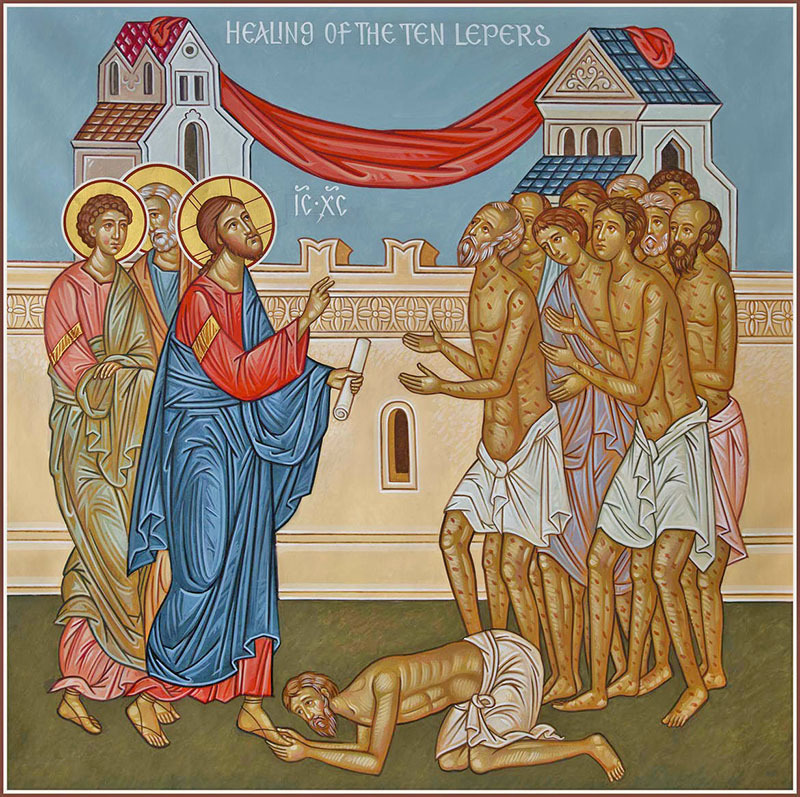
11 On the way to Jerusalem Jesus was going through the region between Samaria and Galilee. 12 As he entered a village, ten men with a skin disease approached him. Keeping their distance, 13 they called out, saying, “Jesus, Master, have mercy on us!” 14 When he saw them, he said to them, “Go and show yourselves to the priests.” And as they went, they were made clean. 15 Then one of them, when he saw that he was healed, turned back, praising God with a loud voice. 16 He prostrated himself at Jesus’s feet and thanked him. And he was a Samaritan. 17 Then Jesus asked, “Were not ten made clean? So where are the other nine? 18 Did none of them return to give glory to God except this foreigner?” 19 Then he said to him, “Get up and go on your way; your faith has made you well.”
You may have noticed that our translation of Luke’s gospel mentioned “ten men with a skin disease” and that may have taken you by surprise because in the versions of this story that we are familiar with, going all the way back to the King James version, the men are described as “lepers” (indeed, the Greek word used in Luke is lepros).
Our translation today reflects recent biblical scholarship, which notes that what the ancient world called leprosy was not quite what we see in the film Ben Hur, and certainly not what medical science today calls Hansen’s Disease (more medical background here). In ancient Judaism, what we used to call leprosy could be a wide variety of skin conditions such as psoriasis, dermatitis, scabies, lesions, or even thinning or balding hair.
All of these conditions fell under a Hebrew word called tzaraat and all these various conditions are decribed in the Book of Leviticus. The diagnosis would be done by a priest, and if a priest declared you as tzaraat, then you were unclean and not fit to be part of society. Hence, when Jesus cures the ten men, he sends them to the priests so they can be declared as healed. Thus, to be tzaraat in Jesus’ time was as much a religious conditon as it was a medical condition.
There is a further religious dimension to this story because of the ten men healed, only one returns to thank Jesus and praise God “with a loud voice”. Jesus tells him that his “faith has made him well”, which is a little odd, because ten men were healed. All ten were healed by Jesus, and only one has his faith recognized. So were the other nine not healed by their faith? It all seems a little confusing. What is the connection between faith and healing?
If we step back a bit, we can make some sense of the story by putting it in its larger context. The story, like most gospel stories, is about the power and authority that Jesus has been given by God the Father. Jesus, as he says elsewhere, does not abolish the law of Torah - sending the men to the priests to be declared clean clearly shows his respect for Torah. But Jesus also uses his authority to go beyond law to grace.
The man who returns to praise God is a Samaritan, an outsider to faithful Jews of Jesus’ day. As we see elswehere in Luke’s gospel and in Acts, outsiders (Samaritans and gentiles) can be as worthy of God’s love and mercy as faithful Jews. Indeed, the Good Samaritan shows more love and mercy than do the faithful Jews in the parable (Luke 10:25-37).
So our gospel story tonight is about healing, to be sure. The ten men are healed by Jesus. But perhaps more importantly, it’s also about Jesus being willing to see and love and heal those who are not seen. It’s about Jesus being merciful with the definitions of unclean and outsider.
In her book Encampment: Resistance, Grace, and an Unhoused Community, Maggie Helwig begins by saying, in effect, that our society effectively treats the unhoused and most marginal as tzaraat, unclean. She writes that ”there is a great gulf fixed, and very few people are willing to cross it. People who have not lived in the world of which encampments are part are afraid, and they are angry. And they cannot imagine that there is a way to cross that line, to speak to a homeless person as a fellow human being, without somehow themselves being harmed, being damaged, being touched by a world they would rather deny.”
I think we as a society can actually imagine what it would take to help the unhoused if we wanted to make real, costly investments in affordable housing, in addiction and mental health treatment, in accessible medical care, and a universal basic income. But before we get there, we have to overcome our secret fear that the unhoused are the new tzaraat, the new lepers. Today’s gospel story suggests to us that God’s healing can begin when we can let go of our fear of the unclean and see people for who they are, as loved children of God.
Helwig, Maggie. Encampment: Resistance, Grace, and an Unhoused Community (pp. 7-8). (Function). Kindle Edition.


No comments:
Post a Comment