
Preached at All Saints, Collingwood, and St Luke’s, Creemore, Anglican Diocese of Toronto, the Eighteenth Sunday after Pentecost [Proper 28C). Readings: Jeremiah 29:1, 4-7; Psalm 66:1-11; 2 Timothy 2:8-15; Luke 17:11-19
Thanksgiving, the time when we take stock of our blessings, traditionally thought of as blessings of the earth, and when, ideally, we think of others as ourselves. Thanksgiving can be thought of as an attitude that is sometimes expressed in prayers and hymns. I want to suggest today that thanksgiving is best thought of as the church’s posture, as a spiritual default position.
The Christian write Anne Lamott has written that the best prayers she knows are ‘help me, help me, help me” and “thank you, thank you, thank you”. It’s a wise observation, because surely our most heartelt personal prayers fall into the two categories of “please” and “thank you”.
In their everyday use, both prayers are born out of urgency. We might pray “please help me” when we are racing to the hospital after receiving terrible news, or when we want the pain to stop. We might pray “thank you” when we receive a clean bill of health, or when we get to the hospital and find that our loved one is ok. I can’t prove it, but I think that we are more likely to pray “please help” than we are to pray “thank you”, because I think that fear is a stronger motivator than is gratitude.
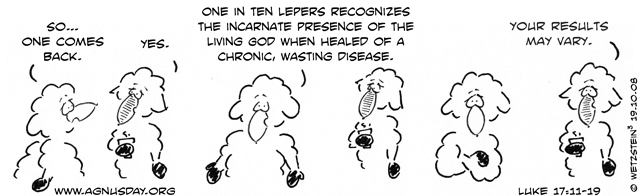
In our gospel lesson, Jesus meets ten people who are pretty good at the “please” part of praying, but not so good at the “thank you” part. By healing them, Jesus does them an enormous favour. Before they met Jesus they were practically in exile, banished from their homes and communities because they were ritually unclean. Now they are healed, they can come home. But the only one who actually comes to Jesus turns out to be a Samaritan, an outsider and, as Jesus calls him, a “foreigner”. And yet the point of the story is surely that this the Samaritan leper, even through a foreigner, understood grace, in the same way that another Samaritan practiced grace when he stopped to help an injured traveller. The Samaritan who has been given new life surely understands what authentic gratitude is.
Why do the other nine never return to thank Jesus? We find their ingratitude shocking, and indeed, it clearly offends Jesus. Perhaps like someone who receives a windfall, they just think “well, this is my lucky day” without taking the trouble to feel grateful. But the Samaritan who returns to thank and praise Jesus connects the blessing with who Jesus is. He realizes somehiow that Jesus is God, with the power to rescue, to heal, to resurrect, for leprosy was a kind of living death. He understands who Jesus truly is and he is grateful - authentically grateful.
I wonder how we can go beyond this gospel story and feel authentic gratitude even when the blessings aren’t flowing our way. It can be especially challenging to feel gratitude to a God who might not give us ironclad guarantees of security, who might not answer every “please help” prayer with the prosperity that we might wish. T
GThere is one place in the old Prayer Book service For the Blessings of a Harvest which I find helpful in this regard. The authors of that service wisely included a prayer to be used if and “when the harvest has been defective”:
Almighty God and everliving Father, who hast in wisdom seen fit to withhold from us at this time thine accustomed bounty: we most humbly praise thee for still bestowing upon us far more than we deserve. Make us truly thankful for our many blessings; increase in us more and more a lively faith and love, and a humble submission to thy blessed will; through Jesus Christ our Lord. Amen. (BCP pp. 619-620)
This prayer is remarkable in that it says “thank you” when it really still wants to say “help”. The harvest has not been good. All is not safely gathered in. Meals may be plain and infrequent this winter. Even so, it says “thank you” for our real gifts: faith, love, life, and even for God’s claims on our freedom to just look after our own interests and not share with others. In times of scarcity, after a bad harvest, it would be all the more important to look after one’s neighbours, and all the more tempting to ignore them and hoard the little one has.
This prayer brings us back to gratitude and the difference between authentic and false gratitude. Maybe the greatest difference between “help me” and “thank you” is that while the former is often simply primal, just pure raw need, “thank you” can sometimes be calculated in favour of our own interests and advantages. Like the Pharisee (Lk 18.9-14), it can be tempting to say “thank you that I am not like” … like this person who has less than I do, like people who live in this war zone in this crappy country, like people who I see as being less important. Idols and golden calves can seduce us into this kind of false gratitude.
Authentic gratitude is challenging because it makes us vulnerable – it exposes us to the needs of others and it does not meet every one of our perceived needs. Authentic gratitude takes us away from ourselves and towards God, which is why in our prayer books we combine our thanks AND our praise. Authentic gratitude means that we are grateful for the things that we hold in common with all humanity – the ability to love and be loved as creatures who all bear the image of God and who thus deserve equal dignity– and thus share what we have.
This Thanksgiving, may our gratitude be properly placed, with thanks and praise, in the living God who rescues us from sin and death, things that no god of our own making can do. May our prayers of “help me” be answered as we need and not as we deserve, and may our prayers of “thank you” be born of authentic gratitude which sees the love of God for all his creation and which compels us to love and share with our neighbours.
MP+


No comments:
Post a Comment