The notes and illustrations on this page are meant to be prompts to me for Anglicanism 101 series in our Regional Ministry. If you find this page, I hope it’s helpful to you and I’ll try and build this page out a bit and flew out the references as time permits. MP+
Why Church History?
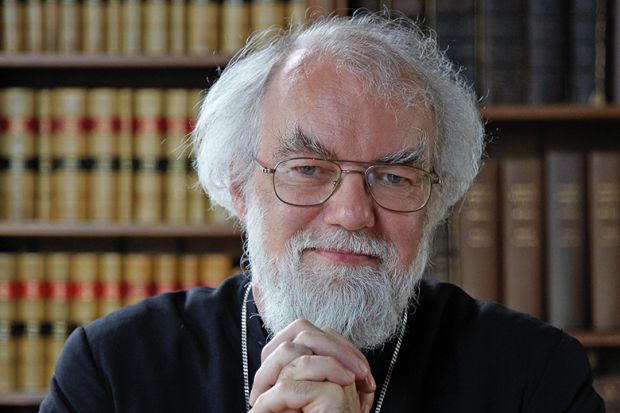
Rowan Williams, Why Study The Past?
“To engage with the Church’s past is to see something of the Church’s future.”
Church and Continuity
How far back should we go in studying the Anglican Church?
“We have always been here” (Stephen Neill, Anglicanism). When you go into an old Anglican church in Britain or Ireland, you realize that our worship and church come out of a long continuity, that we have been gathering in these places worshipping together before we were Anglicans. In other words, our the church didn’t start with the Reformation, as some Protestants believe.

St Mary’s, Limerick, Ireland
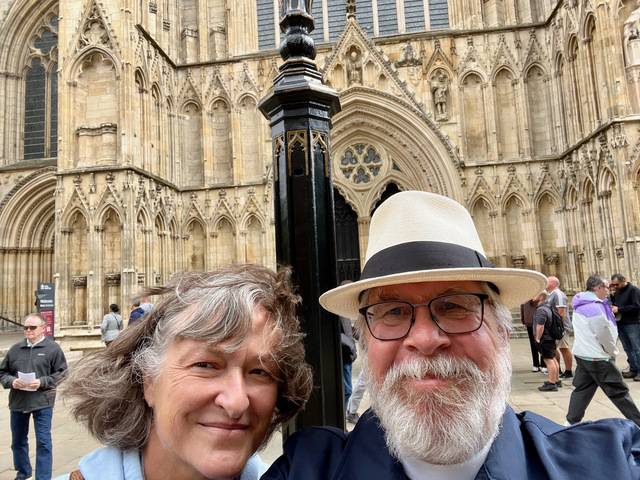
York Cathedral, York, England
But what of Canada? What of the churches built here, like Prince of Peace (50ish years old) or St Margaret’s Barrie (30ish)
Do we see these churches as new, in that they are newer churches in a newer country, or as old churches, in that they come out of a centuries old tradition? And where is tradition anyway in our life as a church and is it important? And are there some unique aspects of our life together as Canadian Anglicans? We’ll come back to that.
So Let’s Talk About The Reformation, Where Some Say it all Started
Was it just about Henry VIII and his wives?

To Be Sure it was about politics - that’s covered in the late Hilary Mantel’s trilogy about Thomas Cromwell, beginning with Wolf Hall
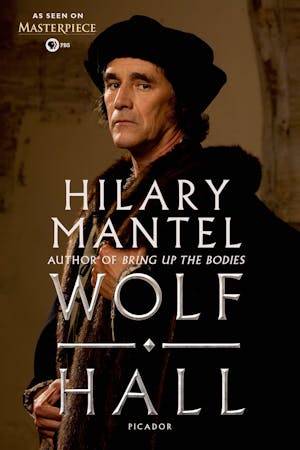
The Reformation was a real fight about superpower politics, about English independence from Europe (specifically the Catholic church - it was the first Brexit) and it was about land and money.

John Houghton, Dominican (d 1535), one of the the First (Catholic Martyrs of the Reformation), the most famous of which was Sir Thomas More, the Man for All Seasons. There were martyrs on both sides.
But the Reformation was also a fight over theology. It was about who could read and translate the Bible (eg, John Tyndale (d 1536), and it was about how Salvation worked (grace vs works) and the perceived monetization of grace by the Roman Catholic church. It was driven by the writings of rebellious theologians from Europe, specifically Martin Luther
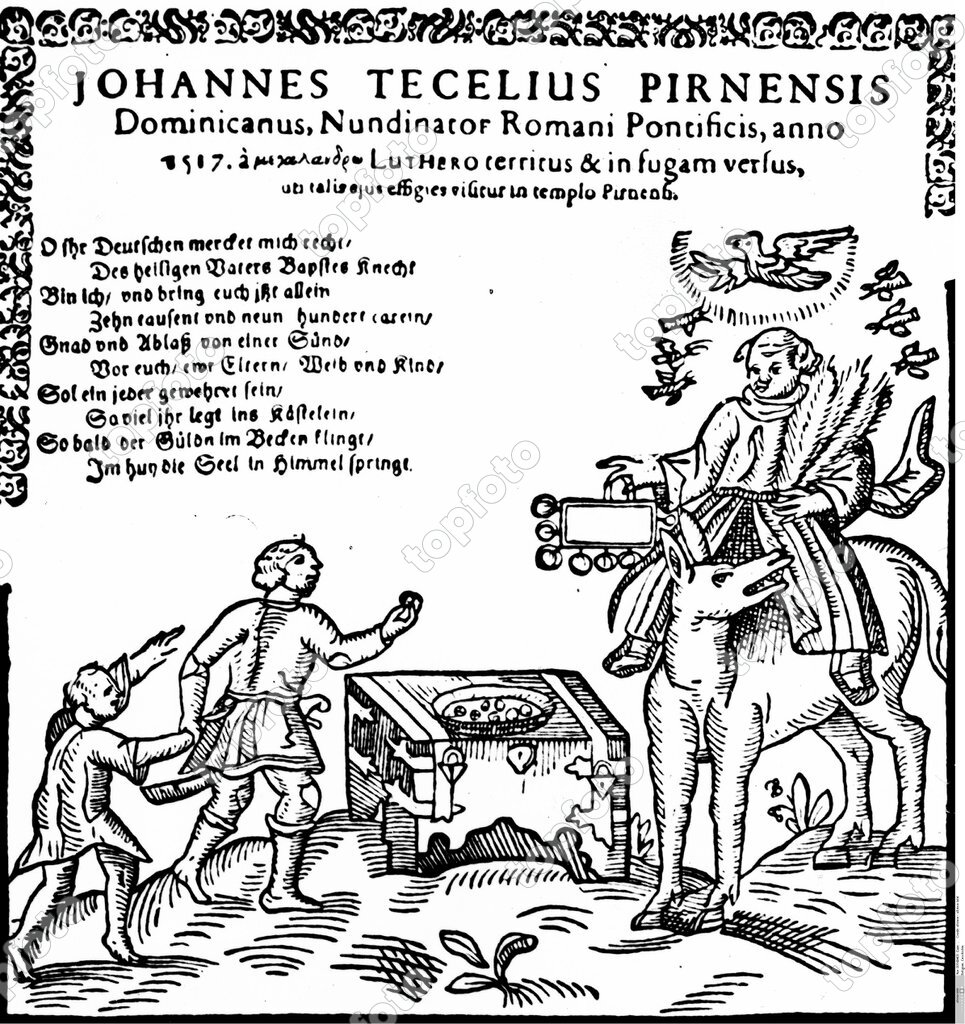

German Dominican Friar Johann Tetzel selling indulgences (pardons from Purgatory).
When Henry VIII asserts the independence of the English church, his key church supporter is Thomas Cranmer, the Archbishop of Canterbury (which explains why Canterbury is the centre of the Church of England and was, until recently, the spiritual centre of the Anglican Communion)
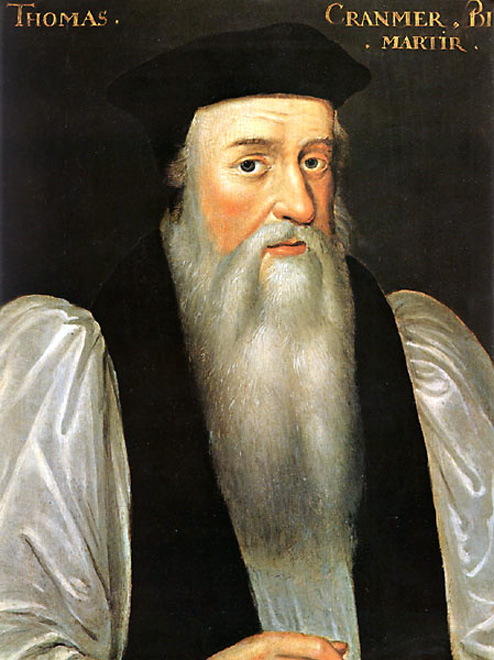
Key Beliefs of the English Reformers
An English language book of common prayer that all the laity could use and pray with (hence the word common), which was rooted in the Roman tradition of worship but adapted both in the times of prayer (morning and evening prayer, Communion, compline)
An emphasis on theology of grace, hence the Prayer of Humble Access from the BCP:
WE do not presume to come to this thy Table, O merciful Lord, Trusting in our own righteousness, But in thy manifold and great mercies. We are not worthy So much as to gather up the crumbs under thy Table. But thou art the same Lord, Whose property is always to have mercy: Grant us therefore, gracious Lord, So to eat the Flesh of thy dear Son Jesus Christ, And to drink his Blood, That our sinful bodies may be made clean by his Body, And our souls washed through his most precious Blood, And that we may evermore dwell in him, And he in us. Amen.
An emphasis on doctrine (the sermons provided for English clergy, the Thirty Nine Articles of Faith)
A suspicion of the Roman doctrine of Transubstantiation and Real Presence, a tendency towards the idea that the Communion was a memorial rather than a sacrament. Leftover bread was to be eaten by the priest for lunch, it wasn’t to be revered and paraded around.
Reformation, Counter Reformation, Compromise
However, after the death of Henry VIII, the reign of Catholic Queen Mary (a bad time for Cranmer and his associates) and the reign of the Protestant(ish) Queen Elizabeth, a sort of compromise evolved.As Elizabeth said, the Crown did not want to “make windows into men’s souls”, a certain amount of belief, eg, about what happened at Communion) was private.
Thus there is a sort of compromise in the Words of Administration in our Prayer Books.
THE Body of our Lord Jesus Christ, which was given for thee, preserve thy body and soul unto everlasting life: Take and eat this in remembrance that Christ died for thee, and feed on him in thy heart by faith with thanksgiving.
And the Minister that delivers the Cup shall likewise say:
THE Blood of our Lord Jesus Christ, which was shed for thee, preserve thy body and soul unto everlasting life: Drink this in remembrance that Christ’s Blood was shed for thee, and be thankful.
The Church in Upper Canada
The Anglican Church came to Canada as it did to the rest of the Empire, through commerce (whaling, fishing, the Hudson’s Bay Company) and through the military (army and navy garrisons). This is true in Upper Canada (Ontario) where the English presence and the Anglican church were centred on Kingston and York. Much of the work of the church on the ground was sponsored by missionary societies such as the Society for the Propagation of the Gospel which paid for clergy, books, and buildings.
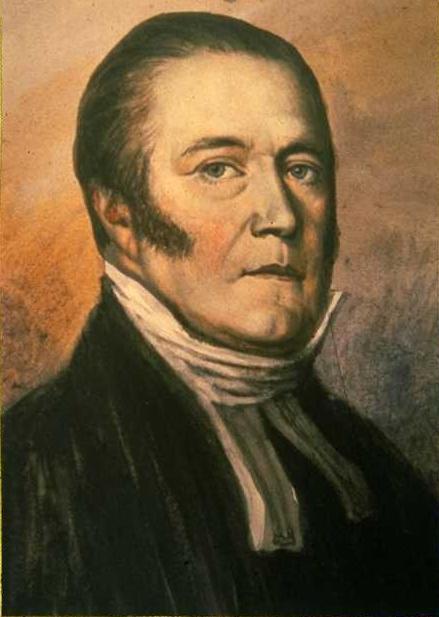
Bishop John Strachan
Bishop John Strachan was a key leader in the early Anglican Church in Upper Canada. He was determined that the Anglican Church receive a monopoly (establishment). He argued that a strong Church would help keep American influence at pay (he was worried about American Methodist clergy travelling back and forth over the border). The government never really said yes for several reasons:
1) Precedent with French Quebec, which had been left free to be Roman Catholic
2) The trend in England was towards religious freedom and toleration
3) Many Canadian settlers and their provincial representatives were non-Anglican (eg Scots Presbyterians)
Nevertheless, the Anglican Church received considerable favours from the government including land and (the clergy reserves) and a near monopoly on its clergy being the only officials who could marry people.
Why So Many Kinds of Anglican Churches?

St Thomas, Huron Street, Toronto
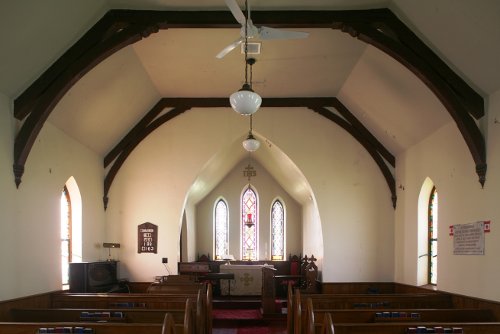
St Paul’s, Middleport (nar Brantford)
To understand the somewhat bewildering variety of styles of Anglican church (both in architecture and liturgy), we need to briefly understand the terms High Church and Low Church. Originally the two terms had to do with politics; High Church thought authority came from the top down (through bishops) and Low Church thought authority came from the bottom up.
Once synods and elections of bishops became the norm, the terms High and Low Church eventually transferred to styles of doing church.
If you went to church in Upper Canada in the 1850s, it would have looked much like Anglican worship anywhere for the last 300 years. The clergyman in a cassock, surplice, preaching scarf and hood, stationing himself at the north end of the altar. In part the justifications for this were scriptural:
we have such a high priest, one who is seated at the right hand of the throne of the Majesty in the heavens - Hebrews 8:1;
he sat down at the right hand of God - Hebrews 10:12;
Thou sittest at the right hand of God - Te Deum.
And also there was a desire that the priest’s actions be seen by the communicants. Also, the priest with his back to the people was seen as too Catholic or Papist.
Typical services on Sunday would have been Mattins, the Litany, Ante Communion, with a long sermon, all lasting 2 plus hours. Communion would have been infrequent. This style was sometimes called “High and Dry”.
Many older dioceses in Canada were first established by clergy from the Church of Ireland, which tended to be much more conservative and “lower” than some.
Eventually the Ritual or Communion Movement changed much church practice. Coloured vestments, frequent communion, incense, and other liturgical practices were introduced in some parishes, which caused much controversy, anxiety, lawsuits, and riots.
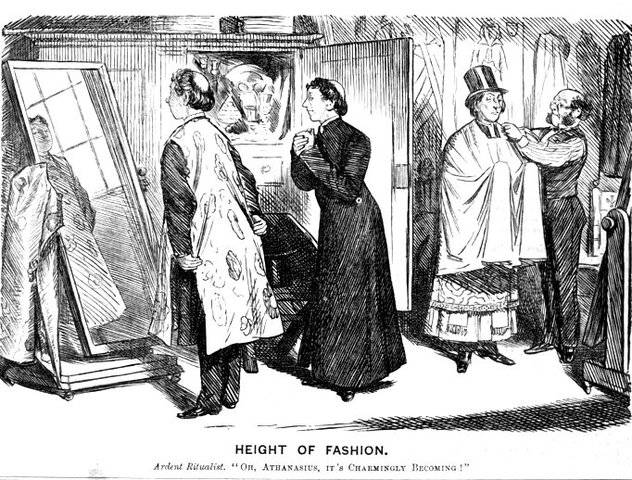
Cartoon from British magazine Punch making fun of ritualist clergy.
“If a clergyman took the ‘north-end’ at the Celebration of the Holy Communion h was a ‘Low Churchman’; if he took the eastward position he was a ‘High Churchman’. If he spoke of the ‘Altar’ he was ‘High’; if he spoke of the ‘Table’, or the ‘Holy Table’, he was ‘Low’. If he wore collard stoles he was very ‘High’; if he wore a black scarf or stole he was ‘Low’. If he had a cross on the Altar, he was decidedly ‘High’; if a cross was on the hangings, the book markers or the stole, he was ‘High’ (Hayes, Anglicans in Canada, 129).
Today these debates are largely lost in time, and most Anglican churches look the same, though there are some exceptions (All Saints Collingwood does things a little more “High” than some in our dealer). It depends what seminary the clergy went to, what their personal practices are, what the local tradition of the parish is. Most Anglican churches are happily Middle of the Road.
Other Canadian Changes
Election of Primates, loss of authority of the Archbishop of Canterbury, reflects an overall trend in the Anglican Communion. As the colonies of the British Empire became independent, their Anglican churches developed their own systems of independent governance and often changed their names, so the Anglican Church in Kenya for example is simply called “The Church of Kenya”, the name “Anglican” being dropped.
Likewise Primates of national Anglican churches had their own authority within their churches, which is why, whereas Rome can tell the Catholic Church what to do and believe, there is no one authority in Anglicanism.
Other Changes:
Ordination of Women

Rev Florence Li Tim Oi, ordained May 1941 Hong Kong
Changes in Liturgy (introduction of the Book of Alternative Services, 1980s)
Ecumenical Talks with United and Lutheran Churches
Debates Over Gender, Same-Sex Marriage (during this debate, the term “experience” is often added to the traditional Anglican triad of “Scripture, Reason, Tradition”
Decline of the Church and Predictions of “Extinction” by 2040s
Indigenous Christians and Reconciliation
Most of us know the story of the Doctrine of Discovery, the Residential Schools, and the church’s complicity in the government practice of assimilation.
Fewer of us know that there are still many indigenous Canadians who identify as Christians and as Anglicans.
In the 2011 National Household Survey of Statistics Canada, of 1,400,685 persons who self-identified as Aboriginal in private households, 889,315 (63%) identified as Christian. Of these, over 500,000 identified as Roman Catholic, and about 130,000 identified as Anglican.
Some of their stores give us hope and remind us of the importance of indigenous voices in our church.
Tobasanakwut Kinew was an Anishnable elder, respected academic, and spiritual leader. He was born on a trapline in northern Canada and was a survivor of a Roman Catholic Residential School. He was involved in the process that led to the Catholic Church’s apology to Canadian indigenous peoples for their treatment in the schools.
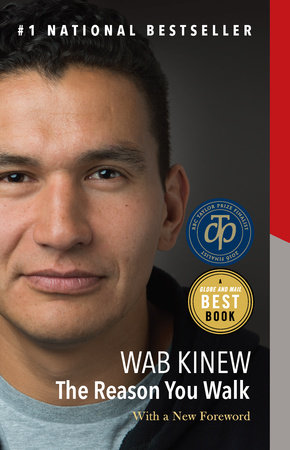
In his book “The Reason You Walk”, his son, Wab Kinew (now the new premier of Manitoba” wrote that “My father lived long enough to see an apology and now he has lived long enough to show forgiveness”.

“My father lived long enough to see an apology and now he had lived long enough to show us forgiveness as well.” p. 246
Other changes in the Anglican Church of Canada that show our church’s indigenous heritage:
Practice of “land acknowledgements"
Decisions reached by consensus (eg, talking circles) rather than by parliamentary style motions and votes
Educational initiatives: (Mapping Our Ground, Blanket Exercise)
Cultural practices such as smudging, sweat lodges becoming more familiar
Use of the term “settler"
Indigenous Archbishops
Indigenous Archbishop the Rt Rev. Chris Harper