No Canadian
scholar knows the history of Canadian military chaplaincy in the Great War
better than my friend, Dr. Duff Crerar.
In these notes which Duff kindly shared with myself and CAF chaplain
colleagues, Duff describes the ministry of Canadian padres in the last months
of the war and on to demobilization. It
is a harrowing story of chaplains pouring themselves into their work and in
some cases working themselves to death.
My thanks to Duff for telling their stories. MP+
The Pursuit
to Mons and the Padres
The Canadians
captured Cambrai on 9 October, having again surprised the Germans by a night
attack. Already attempting to make a general withdrawal, the enemy gave way
before they could blow all the critical bridges. The Second Division’s 20th
and 21st Battalions saw off a surprise counter-attack by German
tanks, but it was clear that the Germans were making another retreat.
The
Canadians had broken through at the critical point of the Siegfried line. Valenciennes was the next fallback for an army
rapidly running out of men. Over twenty German divisions were disintegrating because
they could not be reinforced. Crown Prince Rupprecht doubted that his troops
would hold to December.
The chase
was one. Canadians would bombard a German position, patrols would investigate,
and report the Germans gone or in the process of leaving. Or, there would be a
hurricane of machine gun fire, shrapnel and high explosive. Currie ordered his
troops to proceed with caution, especially as the trail of sabotage and
scorched earth combined with heavy rain to make casualty evacuation almost
impossible. The Allies were outrunning their supply lines. Canadian soldiers, enjoying
the experience of being greeted as liberators, were pausing for impromptu civilian
hospitality. Belgians were handing out much of their precious hoarded food,
which meant the Canadians had to rush some of their own rations forward to feed
the over one hundred thousand liberated civilians.
The Germans
had not all given up. Postwar critics who charged Currie with needless
casualties in the last week of the war were oblivious or unwilling to
acknowledge that German machine guns and artillery continued to oppose the
advance, and that in many sectors local counter-attacks required continued
operations. The Germans gave every intention to fight for Valenciennes,
flooding the defences along the Canal de l’Escaut, with five –understrength – divisions
guarding the gateway, Mount Houy. Rebuffed when he offered his artillery assets
to assist the British, Currie grimly knew (after the British failed to take
Mount Houy for the third time) that his troops would have to take the hill, and
ruffled more than a few British senior officers by refusing to throw his troops
in without full preparations. He and Andrew McNaughton, his gunnery expert,
honoured their vow to purchase victory with shells, not men.
On 1
November, the all-Canadian attack blasted the Germans out of Mount Houy: the
shattered survivors surrendered to a mop-up attack by the 10th Canadian Brigade.
The 12th Brigade entered Valenciennes, and on 3 November the city was declared
free of German defenders.
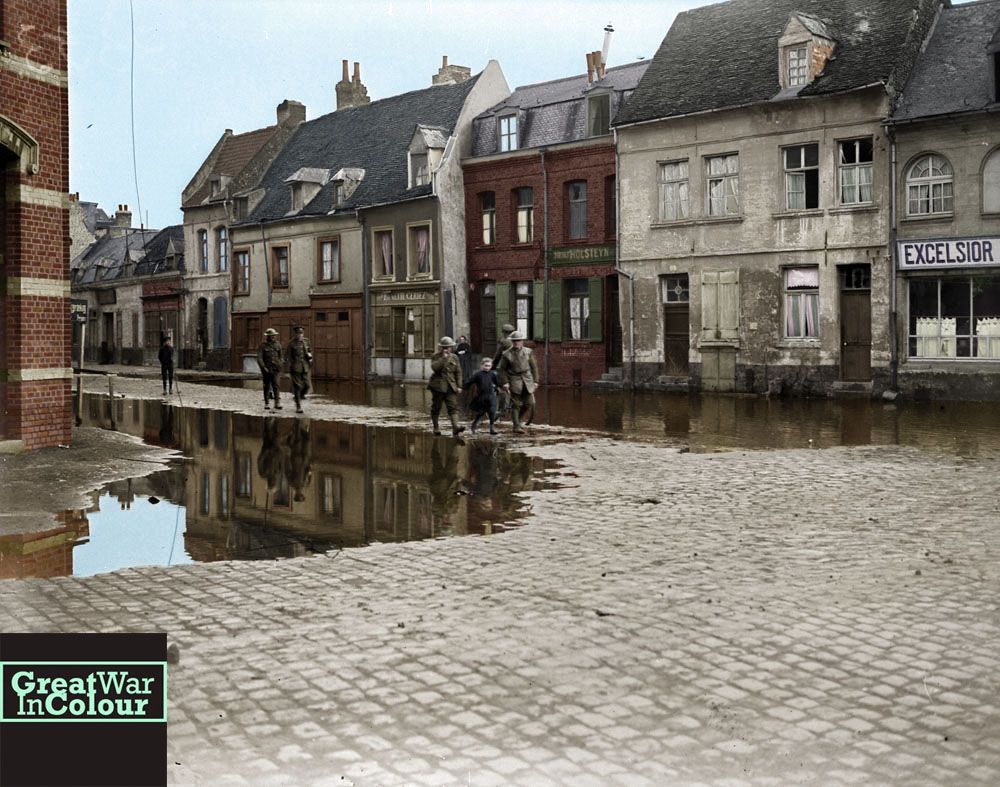
Canadian troops in Valenciennes after its capture on 3 November, 1918.
By then, General
Ludendorff, de facto commander in
chief of the German Army, had been dismissed. Attacks by Australians and
Canadians on 4 November struggled to mop up the snipers and machine gunners
left behind to cover the all-out retreat. The casualty rate plummeted, but
Canadians felt them even more deeply as it was clear that war was almost over.
It is a terrible thing to die at the end of a war. Most important, both to
Currie and his Army Commander, General Horne, was the reality that German
soldiers were not all giving up, but often continuing to cause casualties in
pockets of determined resistance. The Germans gave every indication they would
fight for Mons. Currie’s plan to encircle it and break in simultaneously fell
afoul of such isolated pockets of the enemy. On 10 November, a company of the
RCRs and another of the 42nd Battalion moved in to clear out Mons. After
causing a few last minutes casualties, the Germans melted into the mist. At
eleven, the Armistice took effect. Already a riotous celebration was brewing up
in the city centre. It was St. Martin of Tours day, the patron saint of
chaplains.
Canadian
chaplains had kept pace with the troops, though 3rd Division Senior
Chaplain Louis Moffit reported that holding services and large gatherings fell
by the wayside in the constant shifting and shelling. Reports preserved from
this period in Chaplain Service records are few. Another half-dozen chaplains
were wounded by shells. Father T. McCarthy had been with the 7th
Brigade constantly, and was reported among the first troops entering Mons. Conditions had been brutal, and more than one
padre could not express what they had seen in genteel tones. A.E. Andrew, an Anglican chaplain to the Royal Canadian Regiment, recently awarded the Military Cross for his work
with casualties (including stepping in when most of the officers had been
killed or wounded) in October, let off steam during the celebrations that
followed, making some frank comments about the high command which got into the Canada Gazette. The Assistant Director
of the Service, A.H. McGreer, noted “he used language which is commonly
employed by officers of all ranks, and I am sure he never dreamed of all his
statements being reported… If it comes to a court martial they can’t convict
him, I’m sure of that… Andrew got the MC the other day…” Word of Andrew’s
remarks at Cambrai, when told that he did not belong up front – “if the men can
go, I can” – had percolated through the Division. After they had cooled down,
the authorities let him off with a warning, and a transfer.

W. B. Carleton, a priest from Metcalfe,
Ontario, received a surprise when the French Army conferred the Croix de Guerre
for his intrepid work with the 3rd Division Artillery. Carleton
would return as a Senior Chaplain to the Canadian Army in 1940.
Other
chaplains were showing signs of strain as the pressure of operations turned
into the march to occupation across the Rhine and restlessness to get home.
Sickness, nervousness and other disorders were reported by several padres:
chronic bronchitis, a sign of exhaustion, and hard to treat in the
pre-anti-biotic era. His Brigade reduced to a skeleton by casualties, B.J. Murdoch
was returned to Britain on sick leave, exhausted and insomniac. He was given
early discharge and returned to New Brunswick, though the psychological scars
of being under fire relentlessly in the last 100 days would haunt him for the
rest of his life. Almond learned that one of his former chaplains, Salvation
Army officer Charles Robinson, who had reverted to combatant ranks in 1916 and
been awarded a Military Cross at Vimy Ridge, had been killed in September and
was buried near Arras. Just previously word had reached headquarters that a
Methodist Chaplain, Eric Johnston, who had been in action continuously with the
Canadian Machine Gun Battalion since Amiens, trying to spend a week with each company
across the Corps, had been evacuated sick to #20 General Hospital, where he
died of pneumonia.
Other padres
found the change in moral climate and the breakup of units for repatriation
seemed calculated to undo their work. Roman Catholic chaplains went to the
Belgian hierarchy as well as the British Army authorities to fight a soaring
V.D. rate. F.G. Sherring, a decorated Anglican Chaplain, exploded in rage when
his 2nd Division Artillery units were scattered, ruining his plans
to distribute comforts ranging from cigarettes to underwear -- as well as his
Christmas and New Years’ religious services. Fortunately for him, his
near-seditious remarks about the high command were expressed in reports to his
chaplaincy superiors, who quietly filed them away without action or comment.
Throughout
the rest of the winter and early spring of 1919, the Canadian chaplains
prepared for the peace. Many occupied themselves in teaching in the Khaki
University, and some took advantage of the program to add to their own
education. Nearly two dozen made the journey to Buckingham Palace to receive
decorations from King George V. Often
they ran into chaplains of other denominations which they had served alongside,
and which they might never see, much less work with again. John Holman
reminisced about urgently throwing up sandbags alongside a priest to protect an
advanced dressing station before taking heavy fire, both in their shirtsleeves
in the Amiens heat. Many took part in the conferring of battalion colours, now
being brought over from England or being consecrated for the first time, in
drumhead services in Germany and Flanders. Others found themselves, in moments
of inactivity, thrown back to moments which they had pushed into the back of
their minds during the victory autumn. They saw faces. They recalled brief,
intense, often whispered confidences. They remembered the men they had helped,
many, to die. Percy Coulthurst, Ewen MacDonald, Thomas McCarthy, Canon Scott
just out of hospital in England and W.H. Sparks flashing back to ministering,
stretcher to stretcher, reciting, “The Lord is my Shepherd”.
For many
chaplains with the Corps, the end of combat meant the pressure to get letters
written, some perhaps which they probably had wished to avoid. Murdoch found
himself awash in letters of sympathy to kinfolk in Canada. His Montreal
battalions, Highlanders, and working men left widows and orphans, bereaved
parents who needed some reassurance and comfort. Their men had died well,
suffered little, and had the ministrations of the priest or minister they
needed and deserved in the hour of their death. On their return, more than one
followed the example of George Kilpatrick, by 11 November the Senior Chaplain
of a Division, who personally visited the homes of every soldier from the 42nd
Battalion who had died overseas. As harrowing is that could be, there were some
consolation for padres, as more than one family was grateful for every scrap of
news about their loved one they could provide. They were touched, and often
inspired by another kind of bravery and resolute courage they witnessed among
those who had only waited, and waited.

One of the
most perceptive padres to write his superiors in this period was A. B.
MacDonald, a priest who would return to his Calgary church and devote his life
to veterans after the war. He had spent days among the refugees who streamed
back during the last weeks of the German retreat, hearing pitiful tales of
deprivation and atrocity. He had been only a few miles from Mons when his
gunners ceased firing on the 11th. As he looked around him, at the
devastated land and lives, and contemplated his own men coming back seeking
order out of chaos at home, he knew he needed help.
MacDonald
reached out to J.J. O’Gorman, the doughty priest who lit the fuse which
exploded in Ottawa and led to reform of the Catholic chaplaincy, now returned
to direct the Catholic Army Huts overseas. He asked for copies of popular and
influential tracts by Catholic authorities on social questions, family life and
the pronouncements of Leo XIII on the church’s role in society. He intended to
translate, rewrite and paraphrase their contents to adapt them to Canadian
conditions and Canadian veterans. “The practical application of social science
in Canada will be completely different from England”, he noted. Lt. Col. W.T. Workman,
in London, ensured that he would have Rome leave.
By the
summer of 1916 MacDonald was back at Sarcee Camp in Calgary. He noted to A.L.
Sylvestre, his Senior Chaplain in Canada, that the veterans would open up and
trust the uniformed padre, or one they had known overseas. He recommended that
the Permanent Force be granted permanent chaplaincies. Sylvestre was
sympathetic, but Ottawa was already preparing the demise of the Chaplain Service.
MacDonald was probably the last chaplain standing on the day it was officially demobilized
-- 1 January, 1921. The Great War was really over: now came the Peace to
endure, and overcome.