Monday, July 9, 2012

How The Marine Corps Trains Its Officers

A fascinating piece (with equally compelling photos) in today's NYT about how the US Marine Corps trains its infantry officers. There was a recent conversation on this blog about the wisdom of militaries accepting women as combatants. One aspect of this NYT piece is that the USMC will soon open its Infantry Officer Course to female candidates. MP+

8 July 2012 A Grueling Course for Training Marine Officers Will Open Its Doors to Women By C. J. CHIVERS QUANTICO, Va. — Under the searing sun of one of the worst heat waves in decades, a sweat-drenched Marine second lieutenant stepped from the woods on the base here and reported to an infantry captain standing on a dirt road.

The captain handed the lieutenant a sheet of paper. “Write your name and the time on this card,” the captain said. “You have five minutes to take this portion of the test. Do not use any reference materials. When you are done, return this card to that captain” — he nodded to a huge, tattooed man a few yards away — “and he will tell you what to do next. Begin.”

The lieutenant dropped to the dirt beside other sweaty young officers and removed a pen from his soggy uniform. Another officer, his time up, approached the second captain, who took the card, expressed disgust that the lieutenant had not written his name at its top and pointed him to a laminated sheet of paper displaying a grid coordinate.

That coordinate was where the lieutenant was expected for the test’s next stage. When the lieutenant plotted it on his map, he saw that like many of the preceding stations, it was miles away. He shouldered his pack, slung his rifle and began to jog. The temperature hovered near 100 degrees.

This was one sequence in the Combat Endurance Test, the opening exercise in the Marine Corps’ Infantry Officer Course — one of the most redoubtable male-only domains in the American military. And this session of the course could be the last male-only class. Beginning in September, the corps says, female officer volunteers will participate here, part of a study to gauge the feasibility of allowing female Marines to serve in more extensive combat roles.

Col. Todd S. Desgrosseilliers, the commander of the Basic School, which oversees the course, said he had no special concerns as the course prepares to accept women. “Nothing more so with women than with men,” he said.

“We expect them to be fit enough to go through the course when they get here, just like the men are.”

Read the whole piece here.

Military Picture Of The Week

No, these are not soldiers practising geometry. Well, maybe they are, in a sense.
This picture from the UK MOD news feed shows British Army NCOs at Sandhurst engaged in a competition. Here's the MOD description.
"The 2012 British Army All-Arms Pace Sticking Championships saw 14 teams competing at the Royal Military Academy Sandhurst. The teams of four march just over 300 paces, with each person twisting a 30-inch [762mm] wide pace stick as they go to measure their step. They are judged on their drill, performance and skill whilst pacing at two speeds - 65 paces per minute, and a quick speed rate of 116 steps per minute. The annual event dates back to 1952, but the pace stick itself can trace its origins back to the Roman Empire when the engineers used an almost identical device as a measure of two Roman marching paces. When building roads, the Roman 'sticker' would turn his pace stick 500 times, which equalled one Roman mile. A milestone marker would then be erected, and this would continue along the entire length of the road." [Picture: Shane Wilkinson, Crown Copyright/MOD 2012]
As a matter of interest, the pace stick is still used in the Canadian Army, both for training purposes and, when folded together, as a badge of office for the senior NCO in a unit or formation. Whenever I see a trim figure striding around with a long stick under his arm, I automatically check my bearing and try to look more military.

Wednesday, July 4, 2012

Seen On The Morning Hike

Such is the glacial pace of my blogging that I am only now getting to the next part of report on some travels in SE Alberta that Mrs. Padre and I took last month. After seeing Writing on Stone Provincial Park (see last post), we pointed Appa the Volksbison (see previous post) west, travelling along Alberta's Mormon Trail through quiet rural towns like Magrath and Cardston, with the mountains growing closer on the horizon.

Our destination was Waterton National Park, one of my favourite places on earth. Waterton is sometimes called the place where the prairies and the mountains meet, and unlike the region further north around Banff and Canmore, there is hardly any interstitial area of foothills. You just kind of arrive at the base of this part of the Rockies. The weekend in question, June 22-24, was the Waterton Wildflower Festival, and Mrs. Padre was booked into several workshops on nature photography, something she is getting very good at. That left me free to hike on Saturday.

The trail I chose was the Rowe Lakes Trail, a moderate 12km route that takes you to two mountain lakes. The weather was threatening rain, but I got an early start and it was dry and misty, only starting to rain late in the morning as I was on my way back down. All the pictures that follow were taken with my iphone 1 using the HDR app.

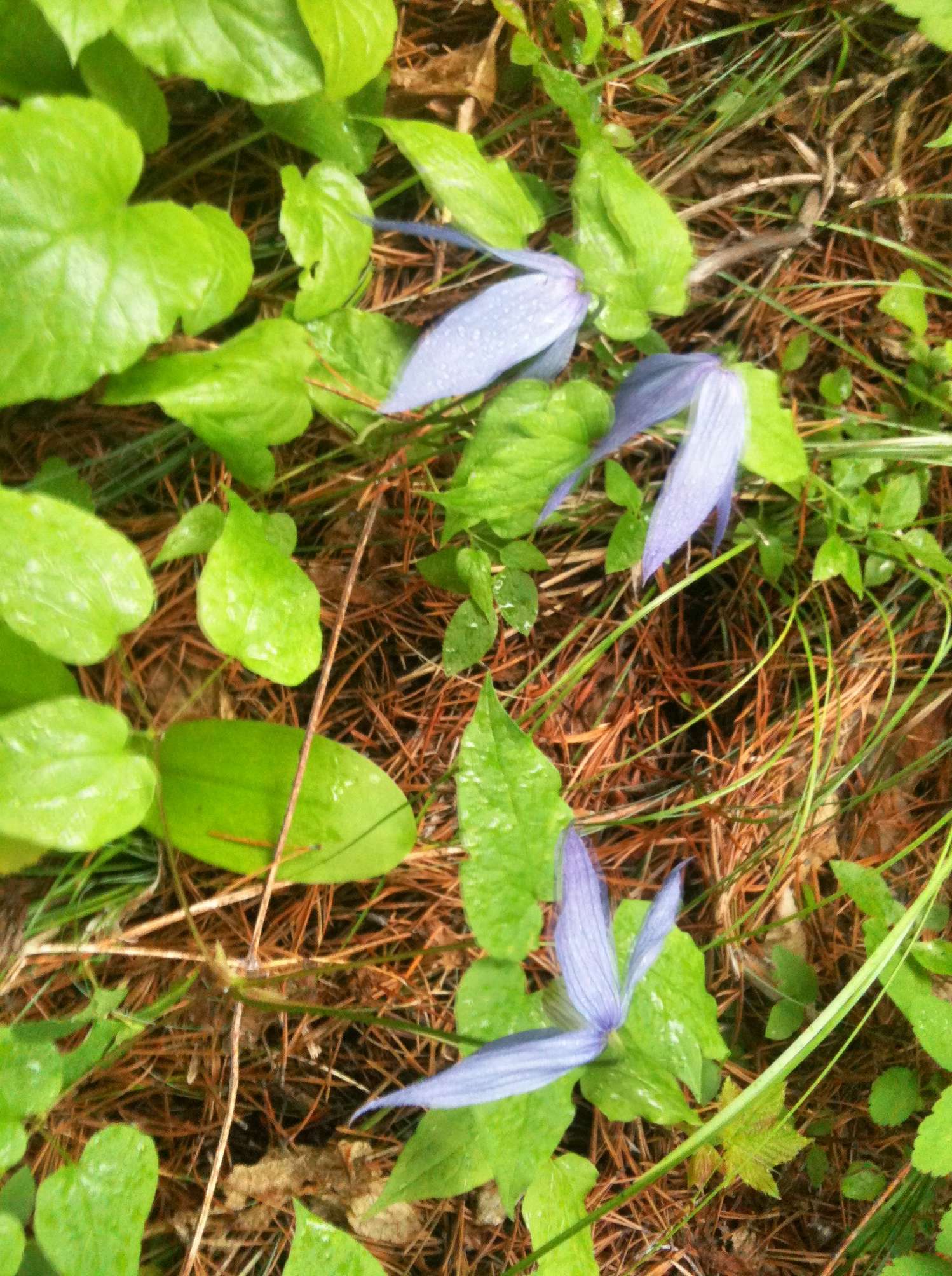
There wildflowers aplenty in the meadows off the lower parts of the trail, and while I'm not an expert, I got this photo of some wild clematis (as I later learned it was) to show Kay.

Some lovely little waterfalls are visible off the lower part of the trail.

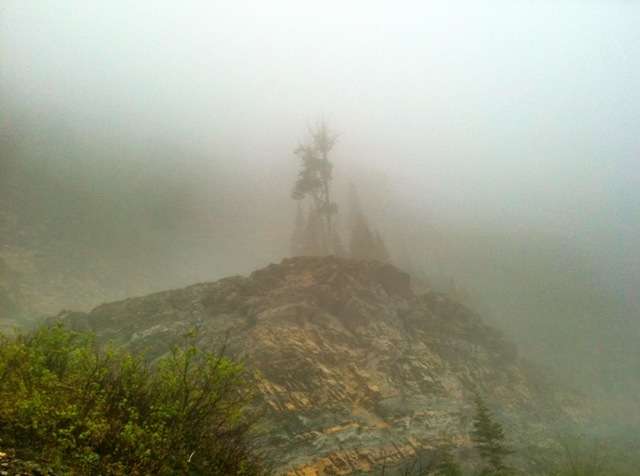
My favourite shot of the day, looking up the slopes of Mount Rowe at these trees in the mist.

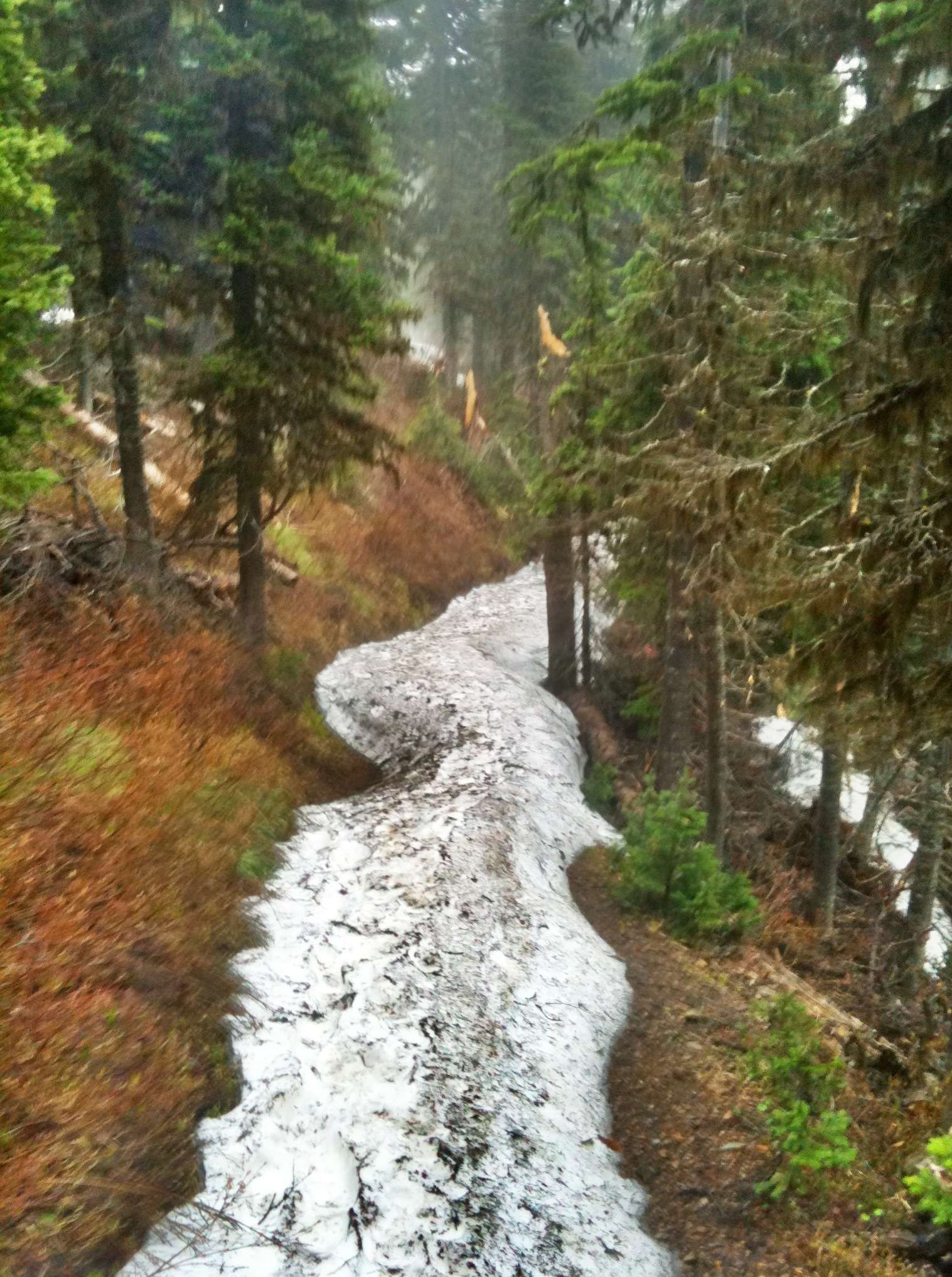
AS I got about half way up the trail I noticed a small patch of snow, and since it was the second day of summer, that seemed rather cute to me. "Awwwww, snow!" I said, and bent down and touched it. Another few hundred metres of elevation, and the trail began to look like this, with snow covering long sections. I stayed warm enough in my shorts, but occasionally I broke through to the knee and that was both cold and scratchy.

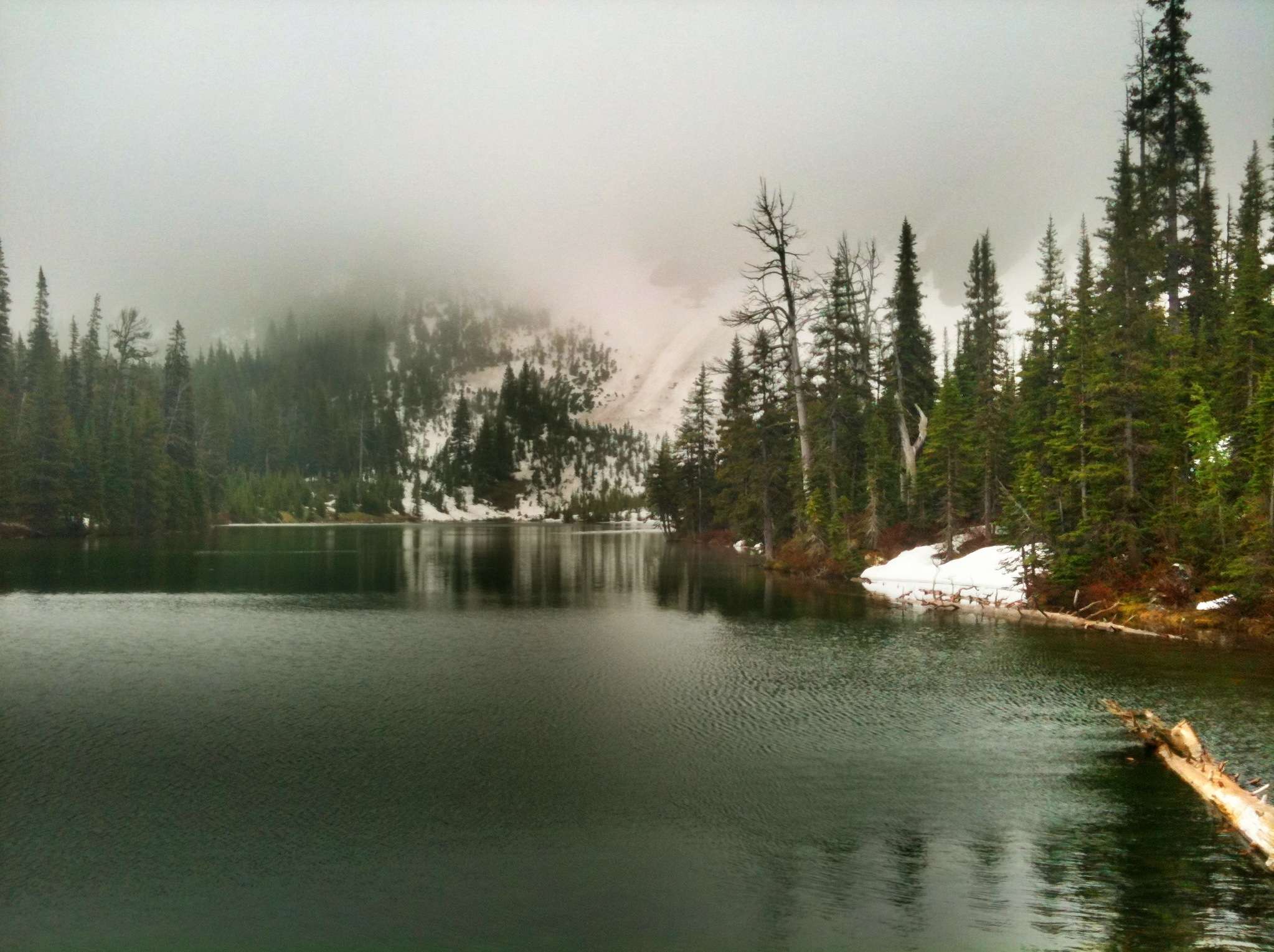
I was able to make it to Lower Rowe and was rewarded with this incredible sight.

By Lower Rowe Lake, looking up the mountain side at a waterfall. Lots of snow!

After resting at Lower Rowe Lake I headed off to follow the trail to the upper Lake, and made it about a kilometre before giving up. At higher elevations the snow was everywhere, totally covering the ground, and the footprints marking the established trail grew fainter and fainter, until I became increasingly nervous about losing it altogether and blundering around in thick woods. With a magnetic compass and a topo map I would probably have been ok, but I felt discretion was the better part of valour, and turned around. An hour and a half later, as I got back off the trail to my car, a light drizzle had turned into a steady rain, and I felt sorry (slightly) for the pack of teenagers I had passed in tshirts, shorts and sandals. Not sure what they were thinking.

Waterton is one of the hidden gems of Canada's parks, and is worth visiting if you are in this part of Canada. I hope to make it back before the summer is over and discover Upper Rowe Lake and parts beyond.

Mad Padre

Mad Padre
Opinions expressed within are in no way the responsibility of anyone's employers or facilitating agencies and should by rights be taken as nothing more than one person's notional musings, attempted witticisms, and prayerful posturings.

Followers

Blog Archive

Labels